
Most educators already assign flashcards after a lesson. That makes sense. Students review what they’ve learned, encode it, and prepare for assessments.
But there’s a surprisingly powerful move that’s still underused:
Assigning flashcards before the lesson.
Not instead of post-lesson study, but in addition to it.
When students create flashcards ahead of time, they don’t just prepare for class. They prime their brains for learning, transforming the next lesson from passive exposure into active meaning-making.
In this article, we’ll explore exactly why assigning flashcards before a lesson is so beneficial to learning and what that could look like in your classroom.
What Happens When Students Create Flashcards Before Class?
When students create flashcards before class, something amazing happens. They arrive for their lessons warmed up. Even a handful of pre-class cards nudges them to:
- Notice key terms and ideas before you explain them
- Make guesses about what’s essential
- Flag questions early
- Build the first blocks of a mental scaffold that they can fill in during class
That pre-class set can come from several places. It might be teacher-made, pulled from an existing marketplace collection, or built collaboratively by peers in a shared class set where students are assigned flashcard creation duties for specific chapters or lessons.
Either way, even just five flashcards require students to engage with the upcoming material. They have to identify what seems central and retrieve or articulate it in their own words. This process activates multiple learning mechanisms before your instruction even begins.
Why Does Forecasting What’s Important Improve Learning?
Learning speeds up when students can predict before they’re told.
If students guess what is likely to be important—and then compare that guess to what you actually emphasize in class—they’re doing several useful things at once:
- Generative processing, because they are constructing meaning from what’s being taught instead of just copying it down into their workbooks.
- Metacognition, because they have to judge what they understand and what they do not.
- Error-based learning, because they update their thinking when their prediction is off.
Cognitive science research shows that prediction, even when it’s wrong, improves learning when followed by feedback (Soderstrom & Bjork, 2015).
(Check out the 16 cognitive science principles of learning.)
The pre-class cards are not supposed to be perfect. They are supposed to give students something to test and edit.
In fact, students learn more when they’re wrong first!
How Does This Change the In-Class Learning Experience?
Prepping with flashcards changes the pace and the quality of attention you can expect from your students. When students have already seen the terms and ideas once, it reduces the cognitive load of the lesson, so your content delivery feels familiar, your explanations land faster, the examples make more sense, and their questions become more specific and insightful.
A simple way to make this visible is to build a quick check-in into your lesson plan, depending on how students are using flashcards.
If students are making their own flashcards:
- Start class with two minutes: “Open your pre-class cards. Which one felt hardest to write?”
- Mid-lesson: “Update one card you now realize was vague or incomplete.”
- End of class: “Add one clarifier card for a common mix-up we covered today.”
If students are studying premade flashcards (for example, in an adaptive flashcard platform such as Anki or Brainscape):
- Beginning of class: “Which cards did you rate with the lowest confidence on a 1–5 scale? Did you bookmark any for more help understanding?”
- End of class: “Go through the cards again and update your confidence ratings based on your updated understanding.”
Now the flashcards are doing double duty: they prepare students to learn, and they become the study tool they will actually use later.
(Read: Should Students Use Existing Flashcards or Make Their Own?)
What Happens to Flashcards After the Lesson?
This is where the approach pays off. If students are using their own printed flashcards or have Edit access to their digital flashcards, students revisit the cards they made in advance and clean them up. They fix any errors, tighten wording, and fill in missing information along with examples and specific details.
Over time, their flashcards become living study notes. Students are not scrambling to create everything after class or right before a major test or exam. They already did the first pass. Now they’re just studying with better understanding.
Most importantly, those refined cards become the material students keep reviewing with spaced repetition throughout the rest of the semester. A few minutes at a time, they cycle back through old cards, retrieve the answers, and strengthen long-term memory instead of relearning everything from scratch later.
This also helps you as the teacher. You can spot misconceptions early by scanning a small sample of flashcards, or by asking students to submit one “before and after” card each week.
When Should Students Study These Flashcards?
Ideally, a little every day. The key habit is daily studying with spaced repetition, rather than saving flashcards for a cram session right before the test.
That said, the workflow around creating and refining cards can follow the pace of your course. A simple weekly structure looks like this:
- Start of the week: students create a small set of cards for the upcoming topic
- During the week: students study and expand their flashcards based on instruction
- End of the week: students study the refined flashcards and check for gaps
This tends to work especially well in higher education and in any course where topics stretch across multiple sessions.
And you don’t necessarily need to constantly grade the quality of their work either. Setting students up in groups, where they review each others’ flashcards and even create them collaboratively, will keep them accountable, ensure the work is of a high quality, and relieve you of the job of doing it yourself.
Why Digital Flashcards Make This Much Easier
Paper flashcards can work, but they add friction. Students have to carry them, rewrite them, and reorganize them. That is extra effort with no learning benefit.
Digital flashcard apps such as Brainscape make the workflow much smoother. Students can create, edit (collaboratively), and study in the same place, and they can keep everything organized across weeks.
Most importantly, digital flashcards provide the perfect vehicle for retrieval practice, which turns these cards into a tool for long-term study habits, rather than static notes.
How Brainscape Supports Pre-Lesson Flashcard Creation
Brainscape supports this approach by making it easy to create high-quality, effective flashcards and keep review efficient over time. Students can write a few cards before class, edit them after, then study them regularly using confidence-based repetition.
If you choose to use Brainscape for this routine, a simple implementation looks like:
- Assign 5 pre-class cards, focused on key terms and core concepts
- Ask students to edit two of those cards after class for clarity and accuracy
- Have students study the set for short bursts across the week, rather than cramming
For educators, the benefit is practical. Students come in with more familiarity, class time goes to sense-making faster, and review becomes steady instead of last-minute.
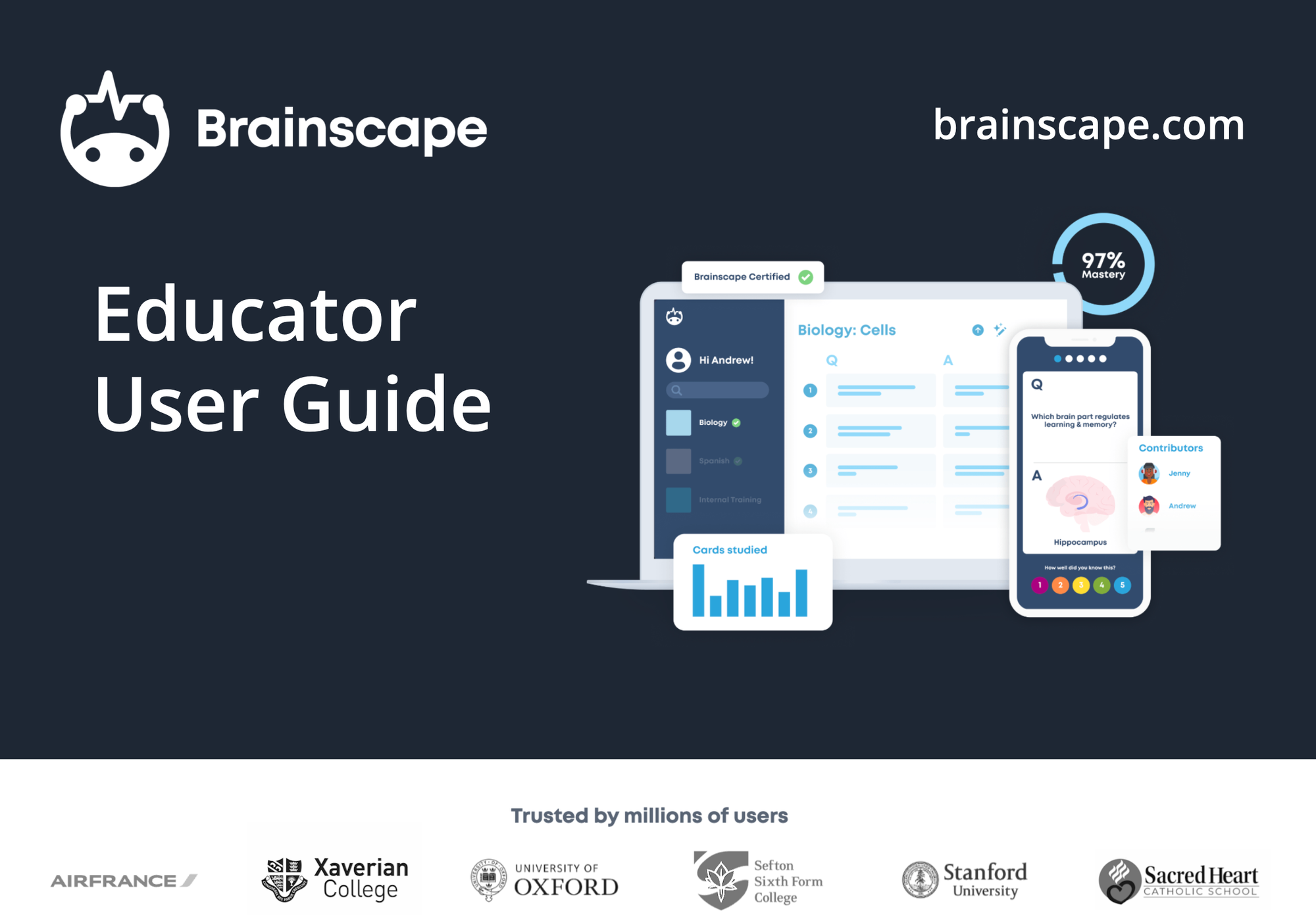
Get Brainscape's Educator User Guide
Curious to learn more about how to introduce Brainscape into your physical or virtual classroom? Our Educator User Guide provides a detailed walkthrough of how to get set up. It'll also give you all the material you need to motivate adoption among your students, their parents, or the faculty of your school or college:
The Bottom Line for Educators
Assigning flashcards before class is a small shift in timing that changes how students start the lesson. It primes attention, gives students a first pass at the ideas, and turns class into a chance to confirm, edit, and connect. Then the same cards become the tool students study from later, which reduces the usual gap between “I took notes” and “I can actually recall this.”
Flashcards are not only for review. When used before a lesson, they’re one of the best tools for preparing students to learn.
Free Educator Resources For You:
- Brainscape Teacher’s Academy: Practical guides for implementing the cognitive science of learning and memory into your classroom, at scale
- “Tips for Teachers” YouTube Channel: Short, research-backed advice and classroom strategies
- The Cognitive Science of Studying: 16 Principles for Faster Learning (and how flashcards leverage each one)
References
Fiorella, L., & Mayer, R. E. (2021). Learning as a generative activity (2nd ed.). Cambridge University Press.
Soderstrom, N. C., & Bjork, R. A. (2015). Learning versus performance: An integrative review. Perspectives on Psychological Science, 10(2), 176–199. https://doi.org/10.1177/1745691615569000
Cepeda, N. J., Pashler, H., Vul, E., Wixted, J. T., & Rohrer, D. (2009). Distributed practice in verbal recall tasks: A review and quantitative synthesis. Psychological Bulletin, 135(3), 354–380. https://doi.org/10.1037/a0015166
Dunlosky, J., & Rawson, K. A. (2020). Practice tests, spaced practice, and successive relearning. Educational Psychology Review, 32, 207–228. https://doi.org/10.1007/s10648-019-09510-6