Welcome to the first of the minefield of exams you have to step through in order to become a WSET Ⓡ Master of Wine! The WSET Diploma (Level 4) D1 exam on Wine Production essentially tests your knowledge of everything that happened to the wine in your glass to make it the way it is, from shoot to shelf (Read: vineyard site, rootstock, climate, soil conditions, vine diseases, fermentation, barrel aging, bottling, and distribution.)
In other words, you’ve got your work cut out for you! But that’s why you’re here, reading this guide, which is not just about how to pass the WSET 4 D1 exam (with distinction) but also how to set yourself up for enormous success in all of your subsequent WSET Level 4 Diploma exams!
This brings us to our first important point, after which we’ll walk you through some powerful tips for efficient and effective studying of that mountain of content. And it’s this …
The WSET 4 D1 module establishes an important foundation for all subsequent modules
D1 Wine Production lays a fundamental foundation of knowledge on viticulture and wine-making, which teaches you “the WHAT” so that when it comes to the higher levels, you can answer “the WHY”.
If you treat this module as the foundation for all future learning—and are good about regular review so that your knowledge is always fresh and accessible—you’ll set yourself up to do extremely well later on. I’ll give you an excellent tool for that kind of review in just a little bit. But first, let’s get started on our best tips for learning WSET Level 4 Diploma content…
Key Study Tips for the WSET 4 D1 Module on Wine Production
The WSET Diploma D1 concludes with a memory-heavy exam, so much of the advice we have for you is how to efficiently approach, sort, study, and remember the most crucial information. Then, in the next session, we’ll talk about hacks you can use on the actual day of the WSET level 4 exam to make your life a little easier.
Tip # 1: Create a Detailed Study Schedule
No successful military leader in history rushed into combat without a battle strategy, so this too should be your starting point: drawing up a detailed plan of attack on the enormous amount of content you need to learn to pass WSET 4 D1.
Gather together all your resources and portion them out into daily, weekly, and monthly study goals. Write them down or draw them up into a visual plan that you can refer to every day.
A detailed daily study schedule like this will ensure that you:
- Stay on track throughout your studies
- Allocate more time to your weaknesses
- Efficiently learn new content while constantly reviewing older material (so that you don’t just forget it by the time the exam rolls around).
Make sure you stick to this schedule and also work in a few “rest days” of lighter content review.
Pro Tip: Everything you need to know about what’s tested in the WSET Diploma exam on Wine Production is thoroughly explained in the Official Specification Sheet, so make sure you align your study plan closely with that.
Tip # 2: Use Adaptive Flashcards to Understand and Memorize the Facts
In our previous tip, we hammered home the importance of daily content review. The reason for this is simple: without it, you’ll simply forget the older material you cover as you relentlessly learn the new stuff. And since the WSET level 4 Diploma teaches an enormous amount of information, the last thing you can afford to do is forget anything.
This is where digital flashcard apps like Brainscape or Neuronation can help you (1) prioritize the most important information, (2) learn and understand the facts, (3) efficiently memorize them, and (4) conveniently review anytime, anywhere, and on any device; even offline.

What happens next? You rate yourself on a scale of 1 to 5 on how well you knew that particular piece of information, and this determines how frequently you’ll see that card again. It’s called spaced repetition, and it’s literally how your brain is hardwired to learn information. Apps like Brainscape and Anki use an individually personalized spaced repetition algorithm to optimize your learning efficiency.
By leveraging cognitive science, adaptive flashcards are able to help you learn TWICE as efficiently, while drilling you on your knowledge weaknesses until they become strengths.
So, get flashcards from an app like Quizlet or Brainscape, and you'll have the world's most efficient tool to study for the WSET 4 D1 exam.
Tip #3: Lean on a Study Group for Support
Many WSET Level 4 Diploma students find studying in groups to be pivotal to their success, which is unsurprising. A study group can:
- Provide a ton of support, if you struggle with any of the content,
- Motivate you to study and hold you accountable when you’d otherwise procrastinate,
- Help you consolidate your knowledge through teaching,
- Be a great source of feedback on practice essays and essay outlines, and
- Make tasting sessions way more fun and affordable, since you can split the cost of the bottles you need to buy.
Plus, at the WSET Diploma level, most students take their studies seriously. so you shouldn’t have to worry about any slackers. So get yourself into a study group and try to meet every week.
Tip # 4: Teach What You Learn
One of the best ways to really embed a new topic in your brain is by teaching it. It’s called the Feynman Technique and here’s how it works …
Find a willing victim (or just use your comatose cat or potted plant) and explain the topic or concept as though you are talking to a sixth grader. In other words, explain it in simple terms from the ground up so that even a young person could understand it. Then, scaffold the details onto the foundations you’ve established to explain the topic in its entirety from beginning to end.
If you can effectively do this, then you indeed know the topic really well.
Of course, it’s not always smooth sailing: at first, you may haltingly proceed your way through “your lecture”, stopping and starting as you refer to your notes and flashcards. But with repetition, you should be able to smoothly explain your way through the whole topic without any prompting. This isn’t pure memorization; it’s a deeply ingrained understanding.
So, when you’ve had enough of studying, reading the textbook, making notes, and running through flashcards, use the Feynman Technique to consolidate your knowledge and tie everything together.
How Should You Approach the WSET Level 4 Diploma 1 Exam?
Now that we’ve equipped you with the best tools and advice for studying all of that wine content more efficiently, let’s turn our attention to the actual WSET 4 Diploma exam and what you can do to optimize your performance. For starters, this exam consists only of essay questions, which brings us to our first tip…
Tip # 5: Practice Your Essay-Writing Skills
Unlike any other WSET exam you may have taken before, the WSET 4 D1 is essay-only, which means there is nothing else to fall back on if you suck at writing. No multiple-choice questions and no tasting exam. Only essays. So you'd better get good at writing!
How? PRACTICE. Source some past WSET diploma exam questions and practice writing out full essays for them. Equally as important, however, is to get detailed feedback from your study group or certified WSET tutor, not only on your essay’s content, but also on your writing style, formatting, and structure. If there is a single thing wrong with the way you write your essays, you’re going to want to know about it early on, so that you can work on improving.
Tip # 6: Understand How the Exam Is Graded So You Can Manage Your Time
In the WSET Level 3 exam, essays (or short-answer questions) were pretty simple to navigate, because the mark allocation told you how many facts you needed to supply. If a question was marked out of five, there were five pieces of information required of you.
The WSET 4 D1 is different, and understanding HOW it’s difficult is important in helping you negotiate its questions. For the Diploma, questions are given as a percentage of the total exam score. So, instead of having a mark allocation of five points, a question may account for 5% of your total test score. Or there might be four worth 25% or two worth 50%, or a combination. (In other words, “1 mark = 1 fact” is out.)
What this percentage tells you is how much of your time you should allocate to each question. A question worth 10% accounts for, surprise, 10% of your exam’s points, while one worth 50% accounts for HALF. Spend the appropriate amount of time answering each (10% and 50% respectively) and not a minute more, unless you have time to spare.
Tip #7: Know the Command Words and What They Require of You
The next logical question is if the WSET 4 D1 exam doesn’t have mark allocations for every question, how do you know how much information to provide in your written responses?” You won’t know exactly, but the command words, like “define”, “describe”, “explain”, or “compare”, will give you a good idea of how much detail is expected.
If the question says “describe”, it’s obviously expecting more than just a one-liner. If it says “compare”, you’ll probably have to define two different or similar things and then relate them to each other. The percentage score and command words will tell you just how in-depth your response should be, and then just be thorough, without squandering more time than is necessary.
The best way to understand this balancing act is, once again, through practice so make sure you get plenty of that in before your exam!
Tip # 8: Answer the "Easy" Questions First
Begin your exam by answering the questions you feel the most confident in first. Don’t pass up on easy points by leaving the “easy questions” for last so get them done and then tackle the harder questions. Remember, all you need is 55% to pass so if you begin by smashing out a 10% question here, a 5% question there, and perhaps another 10%, you’ll be well on your way!
Tip # 9: Memorize a Topic Grid to Help You Remember Points When Constructing Answers
In response to an essay question, it’s not a matter of IF but WHEN you’re going to forget to mention an element or two (or more) involved in wine production. This is because there’s a crushing avalanche of information you need to remember, not only about wine-making itself but about what happens to the wine after it’s bottled. And when you’re sitting there in the exam venue, sweating bullets with anxiety, your chances of forgetting something (and leaving marks on the table) are only going to compound.
So, in preparation, memorize a simple grid that lays out all those crucial factors. It could look a little something like this:
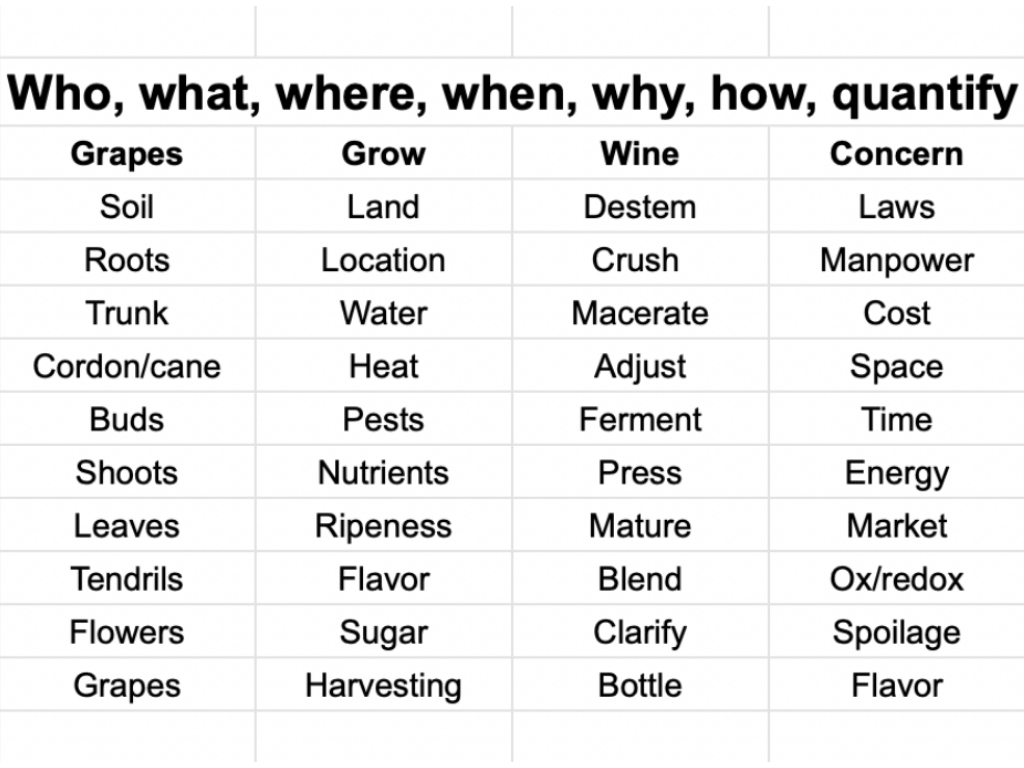
Then, when the exam starts, quickly jot this grid onto a piece of paper and use it as a totally legal reference tool when you compose your responses to each question (particularly the more complex ones). This will prevent you from forgetting any important factors and, in doing so, leaving marks on the table.
For example, let’s say you get a question about site selection for a new vineyard. A quick look over your grid would immediately help you isolate keywords like location, heat, soil, water, nutrients, laws, and pests. Right off the bat, that’s seven coherent concerns you can discuss in your answer, which is WAY better than getting flustered and forgetting something.
Pro Tip: You can even use Brainscape to help memorize such a grid by making a flashcard that reads “What are the important factors to consider when writing about viticulture?” To which the answer would be “Land, location, water, heat, pests, soil, nutrients, ripeness, flavor, sugar, harvesting.” And then repeat that for the other three columns.
Final Thoughts on the WSET 4 D1 Module on Wine Production
So, there you have 9 super useful tips for passing the WSET 4 D1 exam on Wine Production:
Tip # 1: Create a detailed study schedule
Tip # 2: Use (adaptive) flashcards to understand & memorize the facts
Tip # 3: Lean on a study group for support
Tip # 4: Teach what you learn (to a cat or basil plant)
Tip # 5: Practice your essay-writing skills
Tip # 6: Understand how the exam is graded so that you can manage your time
Tip # 7: Know the “command words” and what they require of you
Tip # 8: Answer the “easy” questions first
Tip # 9: Memorize a “topic grid” to help you remember points to raise when constructing answers
Now all that’s left to say is that we wish you the very best ahead of this important exam. Know that with dedicated daily studying, question practice, and flashcard review (we've made some expert-certified WSET Level 4 D1 flashcards), you will confidently pass the WSET Diploma!
Additional Reading
- How to pass the WSET Diploma D2 exam on the Business of Wine
- How to pass the WSET Diploma D3 exam on the Wines of the World
- How to ace the WSET Diploma D4 exam on Sparkling Wine
- How to pass the WSET Diploma D5 exam on Fortified Wines
*Disclaimer: Brainscape has worked with top wine experts to supplement the official publications and preparation offered by WSET. We are not officially endorsed by or connected to WSET itself.
References
Kang, S. H. (2016). Spaced repetition promotes efficient and effective learning. Policy Insights from the Behavioral and Brain Sciences, 3(1), 12–19. https://doi.org/10.1177/2372732215624708
Karpicke, J. D. (2012). Retrieval-based learning: Active retrieval promotes meaningful learning. Current Directions in Psychological Science, 21(3), 157-163.
Lally, P., & Gardner, B. (2013). Promoting habit formation. Health Psychology Review, 7(sup1), S137-S158.
Wine & spirit education trust (WSET). WSET. (n.d.-b). https://www.wsetglobal.com/