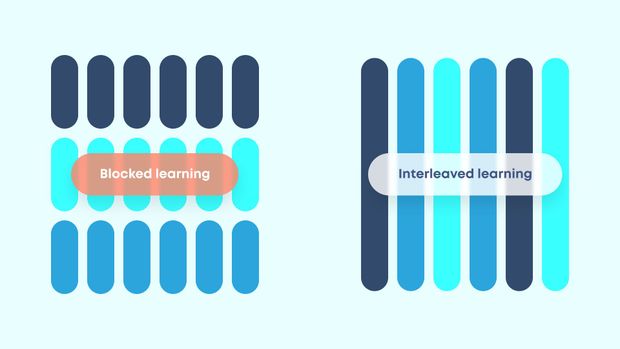
This article is part of Brainscape's Science of Studying series.
Two students are learning to play three songs on the piano: "Twinkle, Twinkle, Little Star," "Mary Had a Little Lamb," and "Chopsticks."
Student A decides to learn each song on its own, perfectly, before moving on to the next.
Student B decides to mix it up by practicing all three songs every day.
Who do you think learns faster?
According to decades of cognitive science research, the answer is almost definitely Student B (assuming Student A isn’t Elton John). Why? Because Student B made use of a powerful learning strategy called interleaving—or mixed practice—which helps the brain encode, retrieve, and apply knowledge far more efficiently than traditional “blocked” studying.
And this has been widely shown to improve learning and retention.
Yet despite its power, interleaving remains woefully underused in classrooms and even in many digital learning tools. Most platforms stop at spaced repetition without realizing that combining spacing with interleaving produces exponential gains.
Flashcard apps like Brainscape are among very few that integrate interleaving into their adaptive study algorithms, but before I explain how, let’s unpack what interleaving actually is, why it works, and how you can harness it to learn (or teach) anything faster.
What is an Interleaving Study Strategy?
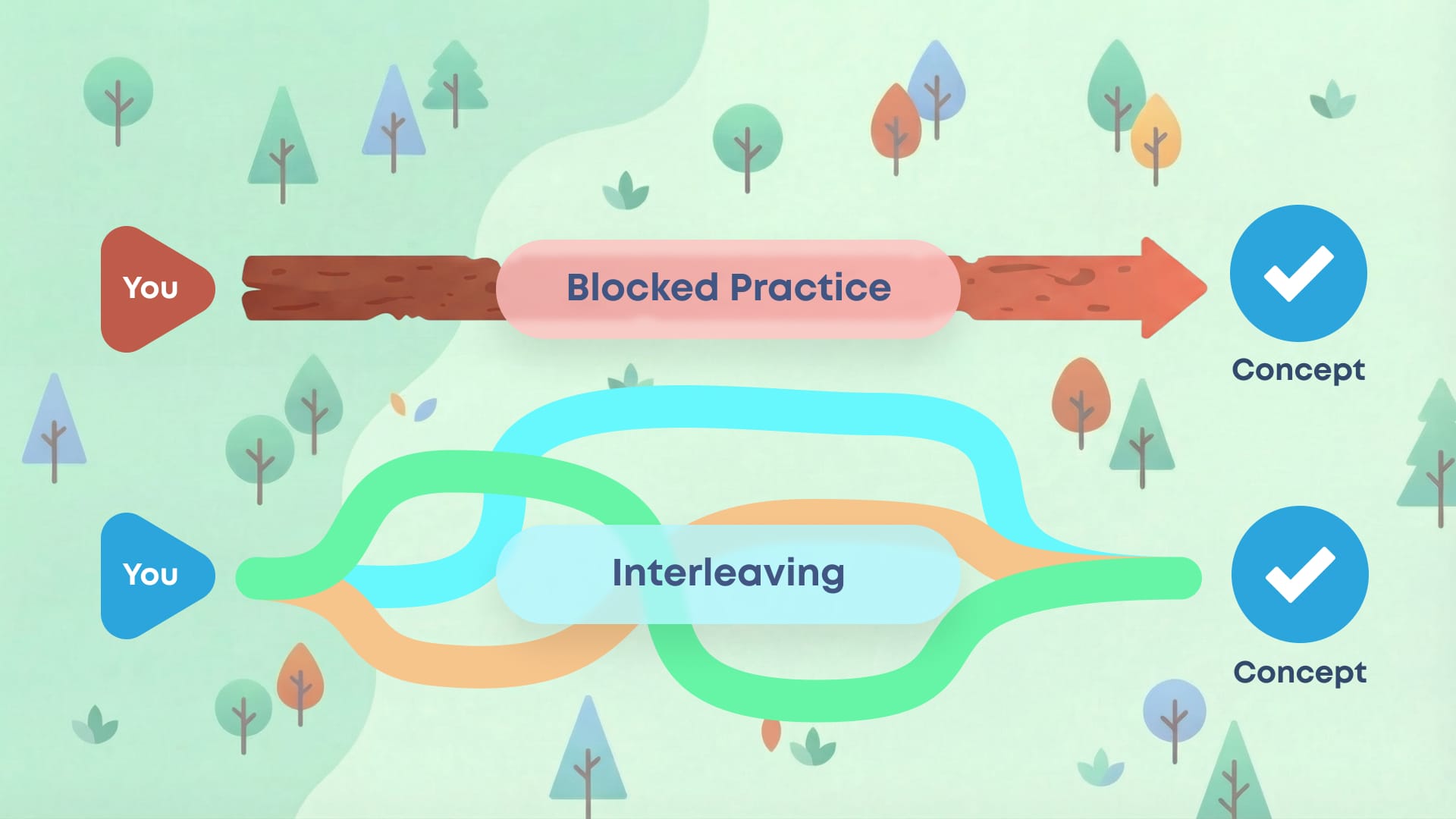
Interleaving practice means intentionally alternating between different topics, skills, or problem types, instead of focusing on one at a time.
Where traditional learning relies on “blocking” (e.g., spending one full session on biology, then one on chemistry), interleaving alternates between these subjects, forcing your brain to repeatedly shift context and re-engage different cognitive processes.
Everyday Examples of Interleaving
- Studying problems from multiple chapters rather than one in sequence.
- Mixing subjects, e.g., reviewing biology, then history, then back to biology.
- Alternating between learning modalities (watching a lecture, then doing practice questions, then flashcards).
- Breaking up study with low-effort, non-distracting tasks like stretching or walking. (Importantly, this does NOT include dopamine-spiking activities like watching TV or playing video games, which will only derail your focus.)
Far from random chaos, interleaving strategically disrupts pattern dependence. It forces your mind to retrieve information in new contexts, strengthening neural connections and improving long-term recall (Kornell & Bjork, 2008; Yan et al., 2016).
If you think about it, this is kind of how ALL of life’s lessons and skills outside the classroom are learned: randomly, haphazardly, and unpredictably. Fragments of information bombard us constantly, like meteor shards pounding into the Earth’s atmosphere. And with the advent of modern technologies like the internet and social media, the bombardment is more relentless than ever.
One second you could be watching an IG reel on how to make garlic focaccia, or reading a Medium.com article on the tell-tale signs your friend is a narcissist; and the next, it could be a blog on keeping New Year’s resolutions, a new TikTok dance tutorial, or the latest news headlines.
These random themes you encounter tend to stick in your brain WAY more effectively than, for example, the stuff you read about in your economics textbook. And this SUCKS because it’s the latter that you need to remember so that you can pass your exams and graduate!
But this is where an interleaving study strategy comes in.

Where Did the Concept of Interleaving Come From?
Interleaving emerged from the late 20th-century desirable difficulties research pioneered by Robert Bjork and colleagues. Their experiments revealed that making learning harder in the short term can improve memory in the long term (Bjork, 1994).
(If you struggle to make short-term sacrifices for long-term gain like, I don’t know, virtually all of humankind, read this article on hyperbolic discounting, which isn’t nearly as complicated as it sounds.)
Early studies showed that students who practiced mixed problem sets—e.g., geometry formulas drawn from several chapters—performed significantly better on later tests than those who practiced in isolated blocks (Rohrer & Taylor, 2007).
Over time, interleaving has been validated across many different disciplines, from language learning to sports, and from music to medicine, showing consistently improving retention, transfer, and metacognitive accuracy (Brunmair & Richter, 2019; Yan et al., 2021).
In other words, it works.
But how?
How Does Interleaving Work in the Brain?
Close your eyes and think of your brain as a vast network of trails through a forest. (Okay, open them again to keep reading.) When you study one topic repeatedly (blocked practice), you stomp the same path over and over. You get good at that trail… but only that one.
Interleaving forces you to switch trails constantly, weaving new paths between them. Each switch strengthens your mental map, creating multiple retrieval routes for the same concept (Carpenter, 2014).
This process introduces what psychologists call “cognitive conflict.” By switching between topics, your brain must decide which strategy or concept applies, which takes effort. And that extra mental effort is what cements memory and promotes flexible understanding (Birnbaum et al., 2013).
At this point you may realize what I’m saying. Blocked practice feels easier. It allows you to focus on one thing. Interleaving practice is harder. But here’s the kicker: learning should never feel too easy. When it does, it means you’re walking the well-trodden pathway.
That ‘easy vs hard’ feeling is usually your best clue about whether you’re doing blocked repetition or the kind of active work that actually builds memory. The infographic below makes that distinction concrete, so you can spot passive habits quickly and swap in strategies like interleaving that force real retrieval.
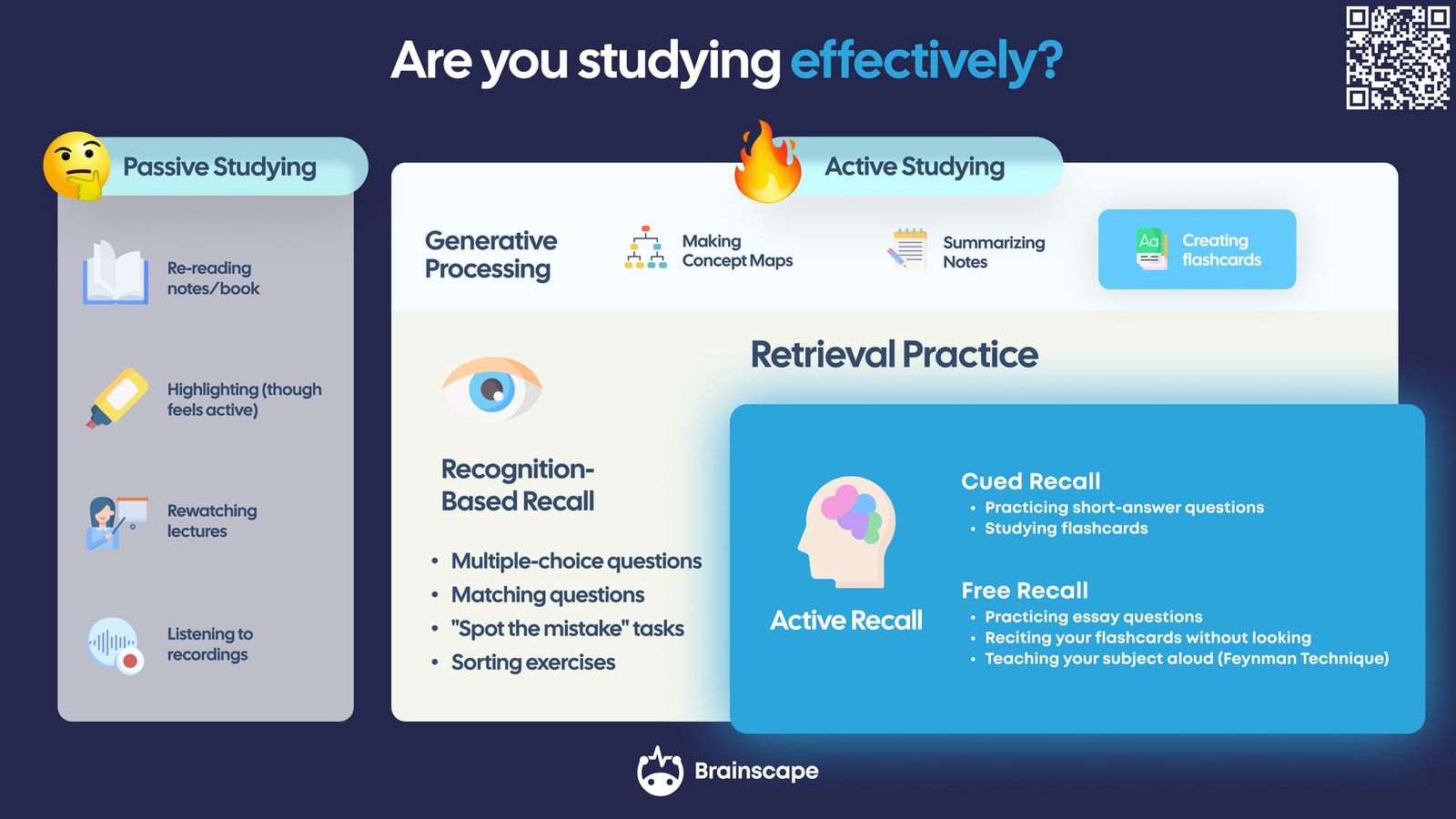
When it feels harder—when you experience that resistance; that cognitive burn—it means your brain is blazing fresh trails.
And that is what’ll help you learn much faster.
Why Does Interleaving Matter for Learning and Memory?
Blocked practice can feel easier, but it’s deceptive. You recognize patterns quickly within one topic, so it feels like you’re mastering the material. Then you forget it a week later.
Interleaving, though harder in the moment, produces deeper encoding because it:
- Forces discrimination between similar ideas (e.g., identifying when to apply one formula vs. another).
- Strengthens retrieval pathways, since each switch reactivates memory traces from a different angle.
- Enhances transfer, the ability to apply knowledge in new contexts.
- Builds resilience against forgetting by spacing exposure naturally.
This effect is so reliable that Rohrer and Taylor (2007) found students practicing interleaved problem sets scored 43% higher on later tests than those using blocked practice! That’s a staggering improvement! Can you imagine what that would look like on your report card?
Yes please!
How Can You Apply Interleaving Practice to Your Own Studying?
You don’t need an elaborate system to put interleaving into practice. In fact, one of the best-suited tools for the job are digital flashcards because they break knowledge into discrete, atomic facts that can be shuffled and mixed. We’ll talk more about that in the next section. Here are some other ways you can mix things up intentionally:
- Alternate topics: Shuffle flashcards or problem sets from different chapters or even different subjects.
- Change modalities: After reading and making notes, test yourself with recall questions or flashcards. Change it up!
- Rotate subjects: Spend 20 minutes each on math, history, and biology rather than an hour on one.
- Review older material regularly: Sprinkle previously learned concepts into each new study session.
- Avoid distractions: Don’t confuse interleaving with multitasking. Instead, think of it as structured variety.
Invest a little time into designing a study schedule that constantly compels your brain to change tracks, whether it's by answering questions on different topics, switching study modalities, or allocating study time to multiple subjects every day. It may feel harder, but you’ll learn faster!
How do Digital Flashcards Leverage Interleaving?
Flashcards make interleaving practice easy because they are by their very nature discrete, atomic nuggets of knowledge. This allows you to chop, change, and switch them. Even paper flashcards allow you to randomize topics and questions… but not nearly to the level of sophistication of apps like Brainscape.
Brainscape has a feature called Smart Study, which allows you to interleave your learning by toggling what percentage of your flashcards should come from each subject.
So, for example, if you’re trying to stay on top of your schoolwork, you could set it to 20% biology, 20% Spanish, 20% history, 20% geography, and 20% economics. Alternatively, if you have a biology test coming up, you might crank that up to 60% biology. That means that six flashcards out of every 10-flashcard-round will drill you on biology, while the rest will be distributed equally among your other subjects.

This randomness keeps your brain guessing, enhances engagement, and maximizes recall.
So, What’s the Takeaway?
In real life, we naturally learn in an interleaved way: by juggling problems, stimuli, and contexts all day long. Classrooms and textbooks, however, still default to neat, linear “blocks”, with our days consisting of one 45-minute class or lecture after the next.
Interleaving restores your brain’s natural rhythm of learning: mixing challenges, building flexible understanding, and strengthening memory.
By deliberately alternating topics and revisiting material over time, you’ll:
- Retain more information for longer.
- Transfer knowledge more easily across contexts.
- Stay engaged and motivated through variety.
Tools like Brainscape’s Smart Study make interleaving effortless, helping you study less, remember more, and learn faster than you thought possible.
So now that you have a more sophisticated understanding of interleaving practice and the tools to incorporate it into your learning journey, go forth, practice, and make perfect!
Additional Reading
Don’t stop here! Keep nerding out over how your brain actually works with these awesome reads:
- What is Metacognition (& How Can It Help You Remember Anything Better)?
- What is Spaced Repetition (& Why Is It Key To All Learning)?
- What Is Confidence-Based Repetition (& How Can I Massively Boost Grades)?
For even more articles on how to harness cognitive science to improve learning, focus, and memory, check out our ‘Science of Studying’ hub.
References
Birnbaum, M. S., Kornell, N., Bjork, E. L., & Bjork, R. A. (2013). Why interleaving enhances inductive learning: The roles of discrimination and retrieval. Memory & Cognition, 41(3), 392–402. https://doi.org/10.3758/s13421-012-0272-7
Bjork, R. A. (1994). Memory and metamemory considerations in the training of human beings. In J. Metcalfe & A. Shimamura (Eds.), Metacognition: Knowing about knowing (pp. 185–205). MIT Press.
Brunmair, M., & Richter, T. (2019). Similarity matters: A meta-analysis of interleaving benefits for learning. Educational Psychology Review, 31(2), 401–439. https://doi.org/10.1007/s10648-018-9450-9
Carpenter, S. K. (2014). Spacing and interleaving of study and practice. In J. Dunlosky & K. A. Rawson (Eds.), The Cambridge Handbook of Applied Memory (pp. 465–486). Cambridge University Press.
Kang, S. H. K. (2016). Spaced repetition promotes efficient and effective learning: Policy implications for instruction. Policy Insights from the Behavioral and Brain Sciences, 3(1), 12–19. https://doi.org/10.1177/2372732215624708
Kornell, N., & Bjork, R. A. (2008). Learning concepts and categories: Is spacing the “enemy of induction”? Psychological Science, 19(6), 585–592. https://doi.org/10.1111/j.1467-9280.2008.02127.x
Rohrer, D., & Taylor, K. (2007). The shuffling of mathematics problems improves learning. Instructional Science, 35(6), 481–498. https://doi.org/10.1007/s11251-007-9015-8
Yan, V. X., Soderstrom, N. C., Seneviratna, R. S., Bjork, E. L., & Bjork, R. A. (2016). Successive relearning: Combining retrieval practice and spacing to maximize retention. Journal of Applied Research in Memory and Cognition, 5(4), 518–524. https://doi.org/10.1016/j.jarmac.2016.05.002
Yan, V. X., & Pan, S. C. (2021). The interleaving effect: Mixing it up boosts learning. Trends in Cognitive Sciences, 25(8), 677–690. https://doi.org/10.1016/j.tics.2021.05.002