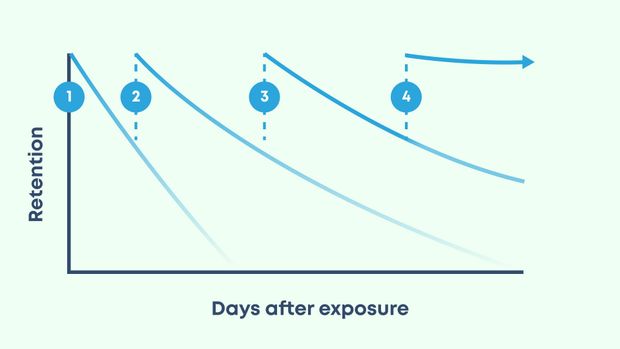
This article is part of Brainscape's Science of Studying series.
If you’ve ever crammed the night before an exam, only to forget everything a week later, then you already know the hard truth: the brain has a schedule for forgetting. But it also has a hack: if you revisit information at carefully timed intervals, right before you’re about to forget it, you can actually supercharge your learning so that you remember it almost indefinitely.
That secret is spaced repetition, one of the most powerful and well-documented learning strategies ever discovered in cognitive science. It’s the invisible backbone behind how you mastered your first language, remembered the alphabet, or learned to play the guitar, and it’s the core principle behind how adaptive flashcard systems like Brainscape are engineered to help learners remember more with less effort.
In this article, we’ll explore how spaced repetition works, why it’s such a marvel of cognitive efficiency, and how you can use it to make what you learn stick… for good.
What is Spaced Repetition?
Spaced repetition is the process of reviewing information at increasing intervals over time, rather than trying to cram it all at once. (You know what I’m talking about, buster.)
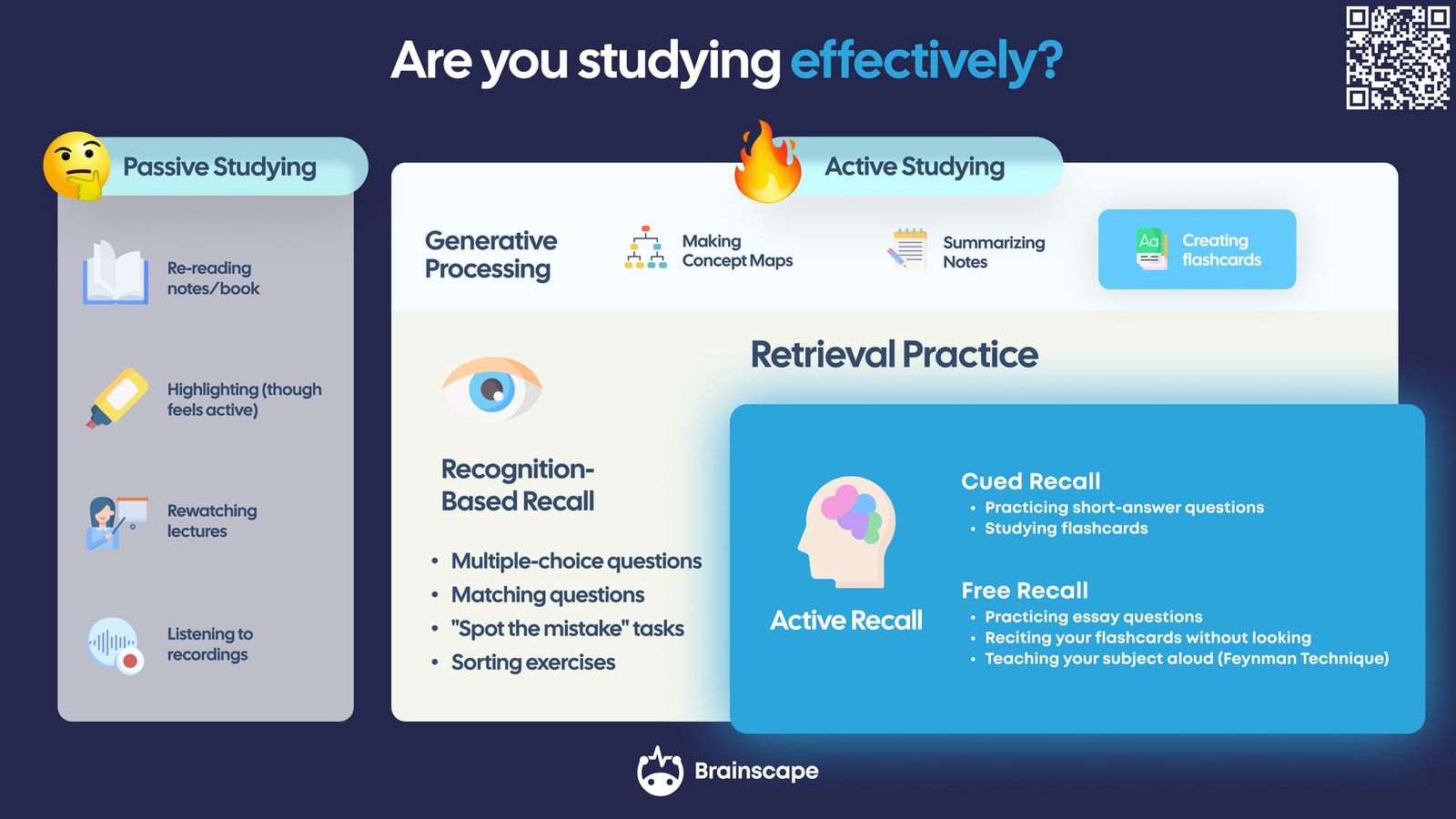
Cramming also tends to go hand-in-hand with passive habits like rereading and highlighting. The infographic below puts passive vs. active study strategies into perspective.
For example:If you learn a new word or fact today—like the Spanish word for pillow (almohada)—you might review it again:
- Tomorrow,
- Then three days later,
- Then a week later,
- Then a month later…
…each time reinforcing your memory of that fact just before it starts to fade.
The idea is simple: your brain is a pattern-detecting machine. When you encounter something repeatedly, it flags that information as important and stores it more securely. This is especially the case when you’re required to retrieve that information in order to solve a problem or answer a question.
But when you flood your brain with the same information all at once, it gets tricked into thinking: “This must not matter long-term, I’ll dump it later.” That’s why cramming for a test almost never works. You’ll just find yourself repeatedly struggling to remember anything about that subject.
Spaced repetition combats forgetting by sending precisely timed reminders that say, “Nope, this matters: keep it!”
The result?
Better long-term memory with less total study time.
What I would have done for that when I was in college!
Where Did the Idea Behind Spaced Repetition Come From?
The roots of spaced repetition stretch back to the 19th century, when German psychologist Hermann Ebbinghaus (1885) became the first person to systematically study human memory.
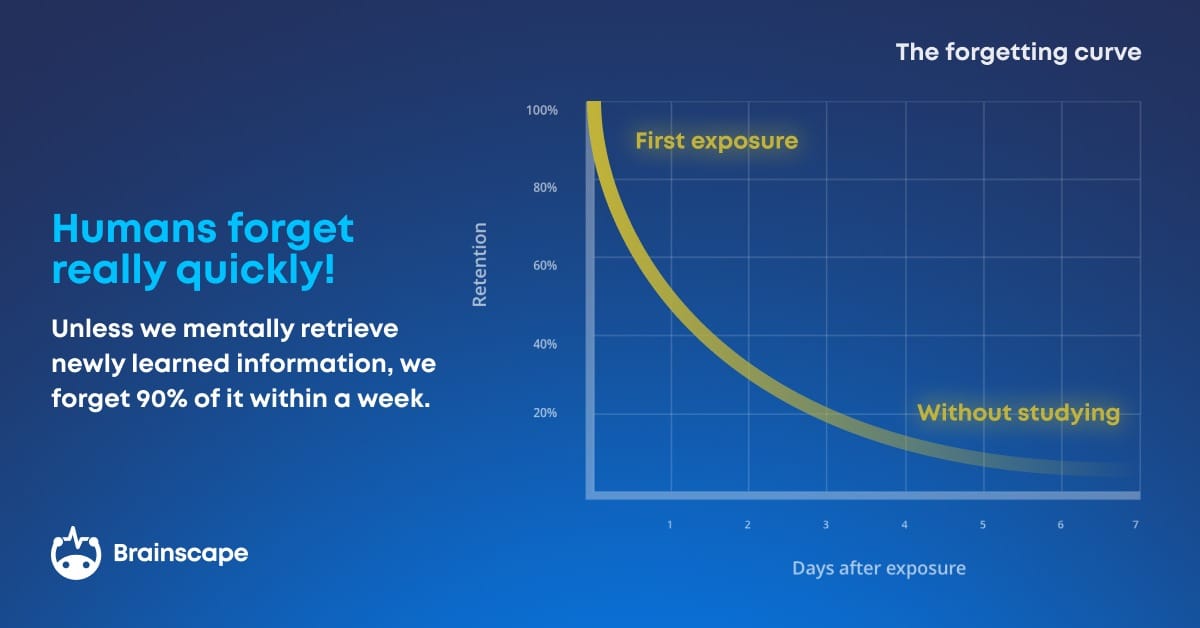
Using nonsense syllables like “DAX” and “QEH,” he discovered the now-famous forgetting curve, a graph showing how memory retention plummets over time without review. Within days, most new information is gone.
But with each strategic review, the curve flattens, and the memory sticks.
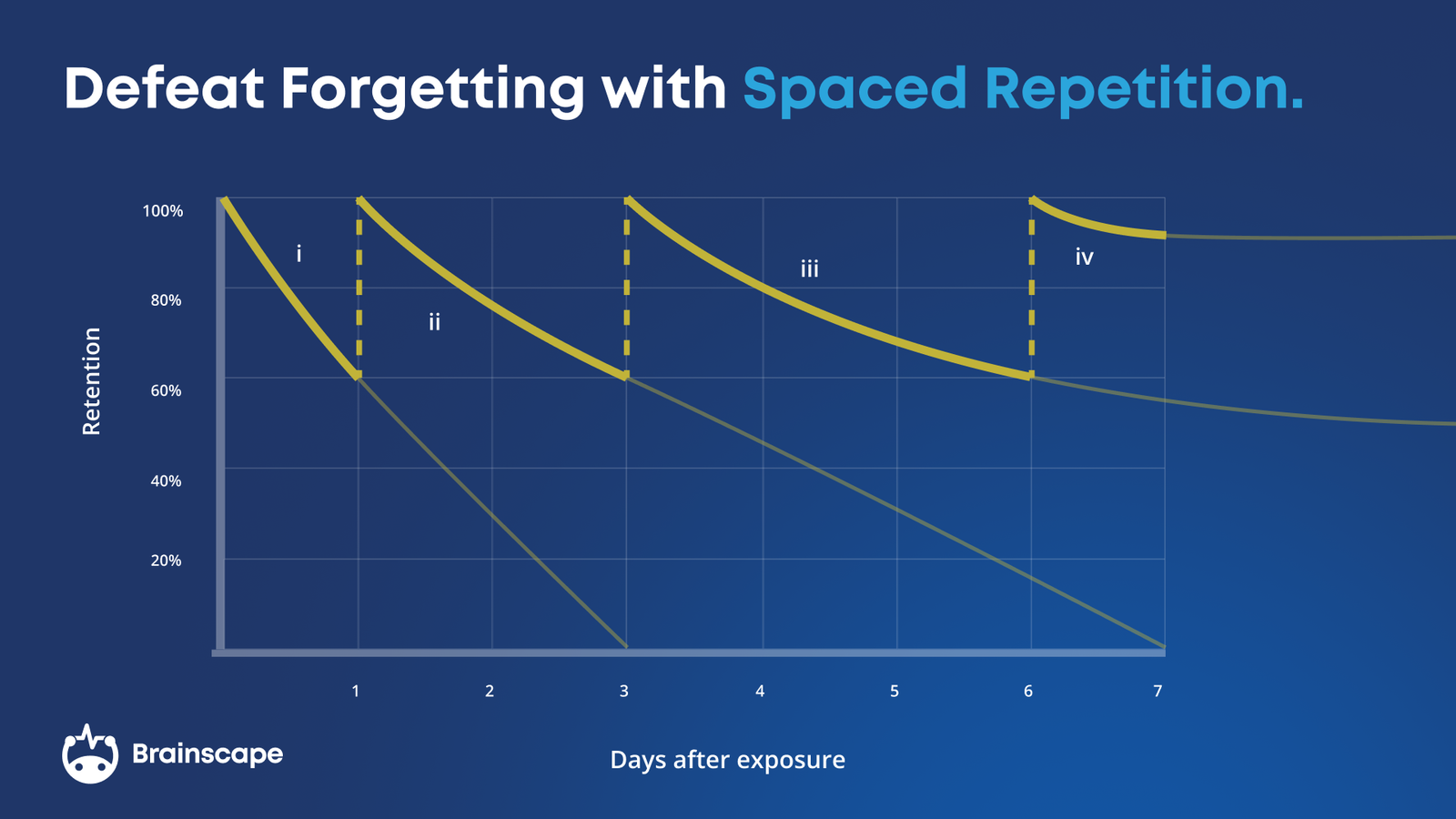
Ebbinghaus also discovered the spacing effect, the finding that spreading study sessions out over time drastically improves retention compared to massed (“crammed”) practice.
A century later, researchers like Bahrick (1979), Cepeda et al. (2006), and Kang (2016) expanded this work with large-scale studies confirming that spaced learning outperforms cramming across every age group and domain, from language and medical school to professional training.
And today, digital learning platforms and adaptive flashcard apps like Brainscape and Anki bring this 140-year-old discovery to life at a massive scale!
How Does Spaced Repetition Work, Cognitively?
Think of your brain like a bouncer at an exclusive nightclub.
Every new piece of information tries to get in, but only the ideas that show up repeatedly, becoming familiar with the bouncer, make it past the velvet rope.
When you first learn something, the brain encodes it in the hippocampus, where short-term memories are stored. Unless those memories are reactivated through recall, they fade quickly.
Case in point: what was the Spanish word for pillow again?
I told you not too long ago but chances are you’ve forgotten it already (unless you’re fluent enough in Spanish to know the word for pillow).
So, it makes sense that, unless you see a piece of information more frequently, you won’t retain it for the long term, right?
Each retrieval strengthens the neural connections associated with that memory, which is a process known as consolidation, and this gradually transfers it into long-term storage in the neocortex (Karpicke & Roediger, 2008).
Spaced repetition optimizes the timing of those retrievals. Reviewing information too soon is inefficient because you haven’t had time to forget it yet. Reviewing it too late means you’re essentially relearning it from scratch. The sweet spot is that uncomfortable moment when you’re on the verge of forgetting.
That tension—the mental struggle to recall—is precisely what strengthens memory. Over time, the intervals between reviews can grow exponentially longer because your brain learns to hold onto what matters.
Why Does Spaced Repetition Matter for Learning, Teaching, and Memory?
Imagine your brain as a leaky bucket. Every time you study, you pour new information in, but unless you patch the holes, it drains away. Spaced repetition is how you seal those leaks.
Without spacing, knowledge is shallow and short-lived. You might ace the test but forget it weeks later, a phenomenon researchers call transient performance gains. Spacing converts temporary understanding into lasting mastery.
In education, this principle has profound implications:
- Students can retain more with shorter study sessions spread over days.
- Teachers can design curricula that revisit key ideas at spaced intervals.
- Professionals can maintain expertise through periodic refreshers rather than re-training.
In short, spaced repetition transforms learning from an act of input into one of maintenance. And this is why spaced repetition matters enormously for education. But it is the most efficient way for learners to achieve the long-term retention of knowledge.
That brings us neatly to the following question…
How Can Learners and Educators Apply Spaced Repetition?
It can be a bit of a logistical nightmare for educators to figure out how to repeat material at precisely the right frequency for learners to retain it. Everyone is different for one. One student might need four or five exposures while another might retain it after only two or three.
Ideally, the spaced repetition of new concepts is best delivered through tools like digital flashcard apps, which quickly adapt to the individual learner’s unique strengths and weaknesses.
Moreover, flashcard apps like Brainscape take this science a step further with something called confidence-based repetition: a form of spaced repetition that adjusts how often you review a concept based on your self-rated confidence in remembering it.
Let’s look at the following flashcard, which comes from Brainscape:
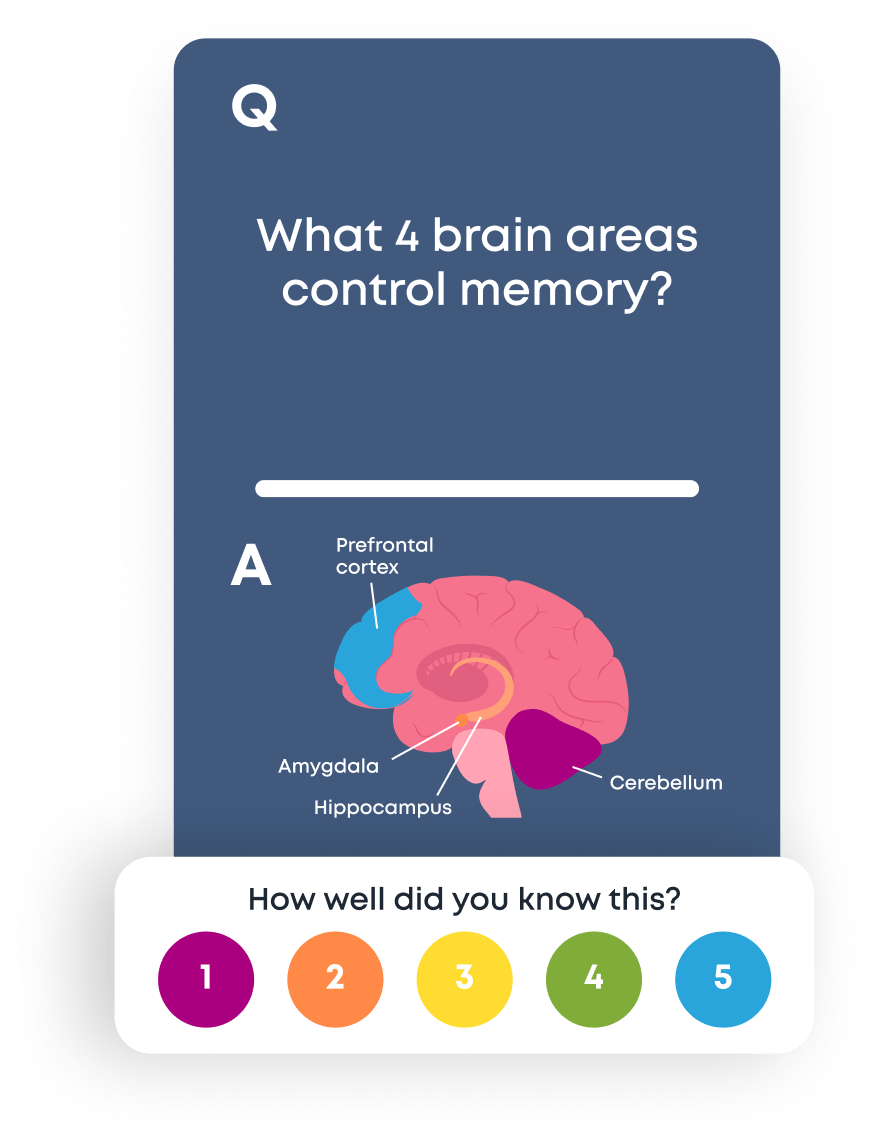
The card asks a question. Once you’ve answered the question (in your head or out loud: it doesn’t matter), you’d flip it over to reveal the answer. This is the part where you’re prompted to rate how well you knew the answer on that sexy lil’ 1-5 scale you see at the bottom of the flashcard.
If you knew the answer confidently, you’d rate yourself a 4 or 5. If you didn’t know it at all, you’d rate it a 1 or 2. This informs the spaced repetition algorithm how frequently to show you that concept again. And that, my friend, is confidence-based repetition.

The best digital flashcard apps use it because it tailors your learning to your unique strengths and weaknesses, empowering you to study much more efficiently!
What other study techniques can you employ to tap into the learning power of spaced repetition?
1. Spread Out Your Study Sessions
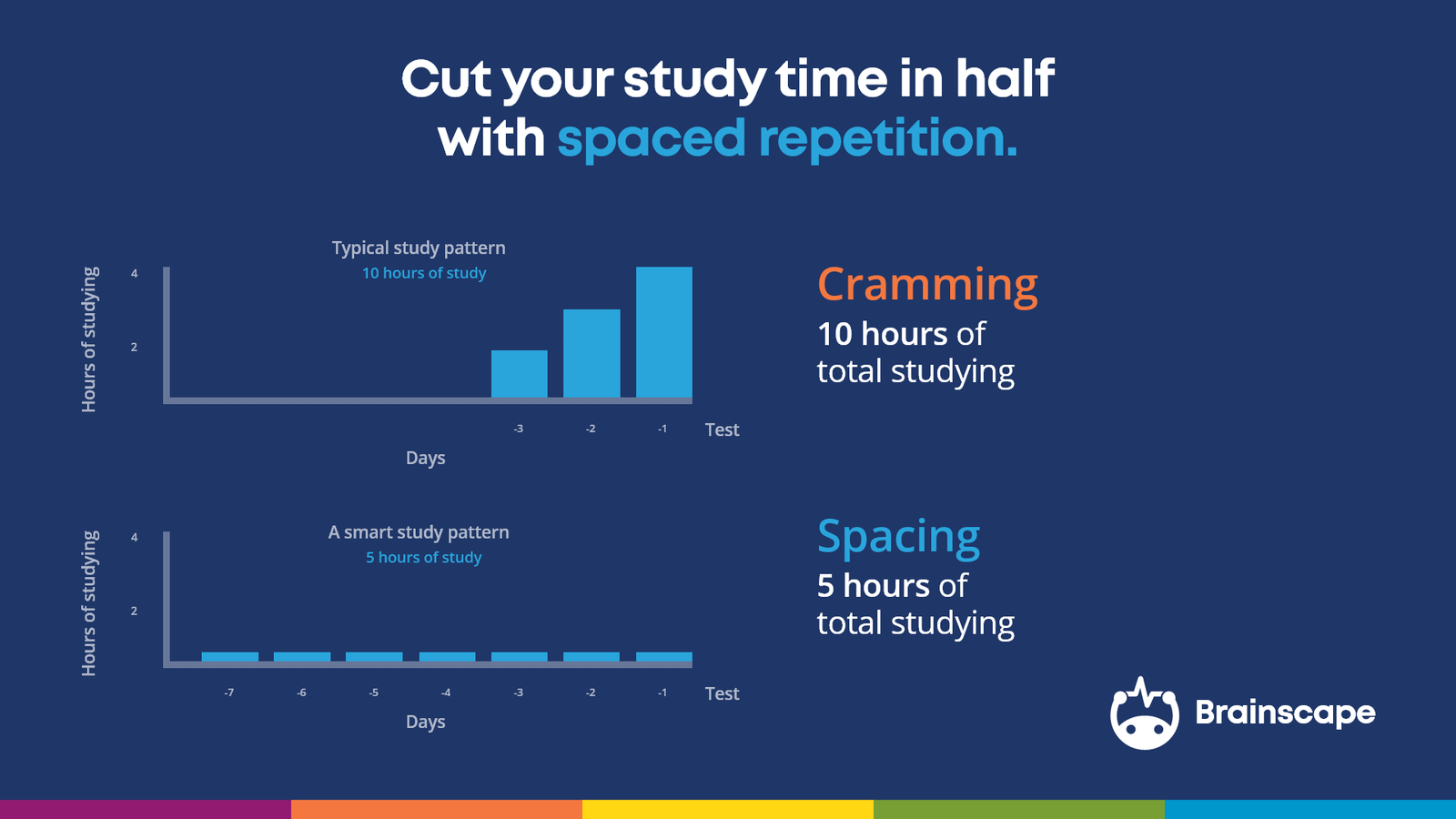
Instead of cramming for five hours, study one hour over five days. Your total time may be the same, but your retention will be exponentially higher. In fact, spreading your learning out is so powerful for retention that you’d probably spend twice the amount of time cramming just to get to the same level of confidence!
2. Mix Old and New Material
Don’t just focus on what you learned today. Interleave older material into each study session. (This is something that flashcard apps like Brainscape automatically do, saving you the logistical headache of figuring out what to review, when, and how often.) Regularly reviewing both old and new material reinforces long-term retention and prevents knowledge decay.
4. Track Your Confidence
Rate your confidence in what you recall by asking yourself: “How well did I know this?” This is a little trick called metacognition and it helps you to calibrate your study focus by spending more time on your weaknesses and less time on your strengths. (Oh, and that’s a principle called judgment of learning resolution (Dunlosky & Metcalfe, 2009) in case you were curious.)
5. Incorporate Spaced Review Into Teaching
Educators can design lesson plans or quizzes that spiral back to previously taught material, a structure known as spiral curriculum, which keeps foundational knowledge alive even as students advance. The result: less time reviewing, less stress before exams, and far more durable mastery across every domain.
(I wish my high school math teacher had done more of this.)
So What’s the Takeaway?
Spaced repetition is fundamentally how the human brain learns: through cycles of forgetting and remembering that gradually engrain information for the long haul.
It’s also the scientific foundation of adaptive flashcard platforms like Brainscape, which use this principle to help learners study more efficiently. By automatically managing review intervals based on your unique strengths and weaknesses, tools like Brainscape make the science of memory something you can apply without even thinking about it.
Whether you’re a student, a teacher, or a lifelong learner, understanding spaced repetition gives you the ultimate edge: the ability to turn knowledge into something that truly lasts.
Additional Reading
Want to go deeper? Explore the rest of our Cognitive Science of Learning series to understand more mental hacks behind how you learn, remember, and master knowledge!
- What is Cognitive Load Theory? (& Why Does Too Much Info Hurt Learning)
- What Is Confidence-Based Repetition (& How Can I Massively Boost Grades)?
- What Is Interleaving Practice (& How Can It Help You Learn Faster)?
References
Bahrick, H. P. (1979). Maintenance of knowledge: Questions about memory we forgot to ask. Journal of Experimental Psychology: General, 108(3), 296–308.
Bjork, E. L., & Bjork, R. A. (2020). Desirable difficulties in theory and practice. Journal of Applied Research in Memory and Cognition, 9(4), 475–479. https://doi.org/10.1016/j.jarmac.2020.09.003
Cepeda, N. J., Pashler, H., Vul, E., Wixted, J. T., & Rohrer, D. (2006). Distributed practice in verbal recall tasks: A review and quantitative synthesis. Psychological Bulletin, 132(3), 354–380. https://doi.org/10.1037/0033-2909.132.3.354
Cepeda, N. J., Vul, E., Rohrer, D., Wixted, J. T., & Pashler, H. (2008). Spacing effects in learning: A temporal ridgeline of optimal retention. Psychological Science, 19(11), 1095–1102. https://doi.org/10.1111/j.1467-9280.2008.02209.x
Dunlosky, J., & Metcalfe, J. (2009). Metacognition. Sage Publications.
Ebbinghaus, H. (1885). Über das Gedächtnis: Untersuchungen zur experimentellen Psychologie [Memory: A Contribution to Experimental Psychology]. Duncker & Humblot.
Kang, S. H. K. (2016). Spaced repetition promotes efficient and effective learning: Policy implications for instruction. Policy Insights from the Behavioral and Brain Sciences, 3(1), 12–19. https://doi.org/10.1177/2372732215624708
Karpicke, J. D., & Blunt, J. R. (2011). Retrieval practice produces more learning than elaborative studying with concept mapping. Science, 331(6018), 772–775. https://doi.org/10.1126/science.1199327
Karpicke, J. D., & Roediger, H. L. (2008). The critical importance of retrieval for learning. Science, 319(5865), 966–968. https://doi.org/10.1126/science.1152408