
As someone who’s taken on the Herculean task of passing the WSET’s Diploma of wine program, you’re now facing the summit of your undertaking. Affectionately dubbed the “Mother-of-all exams” by some wine nerds, the WSET Diploma’s third module (D3) on the principal still wines of the world is the Olympus Mons of the WSET solar system, making the other modules look like pimples in comparison.
To hike this beast, you’re going to need a full rucksack of study tips and resources so that your approach can be as efficient and effective as possible, but also fun because you chose this direction for a reason: for the love of wine. This WSET D3 study guide delivers on those needs with all the insider study tips you need to skip the unnecessary learning curves and have every minute of studying pay triple dividends!
Tip #1: Refresh Your WSET D1 Module Content
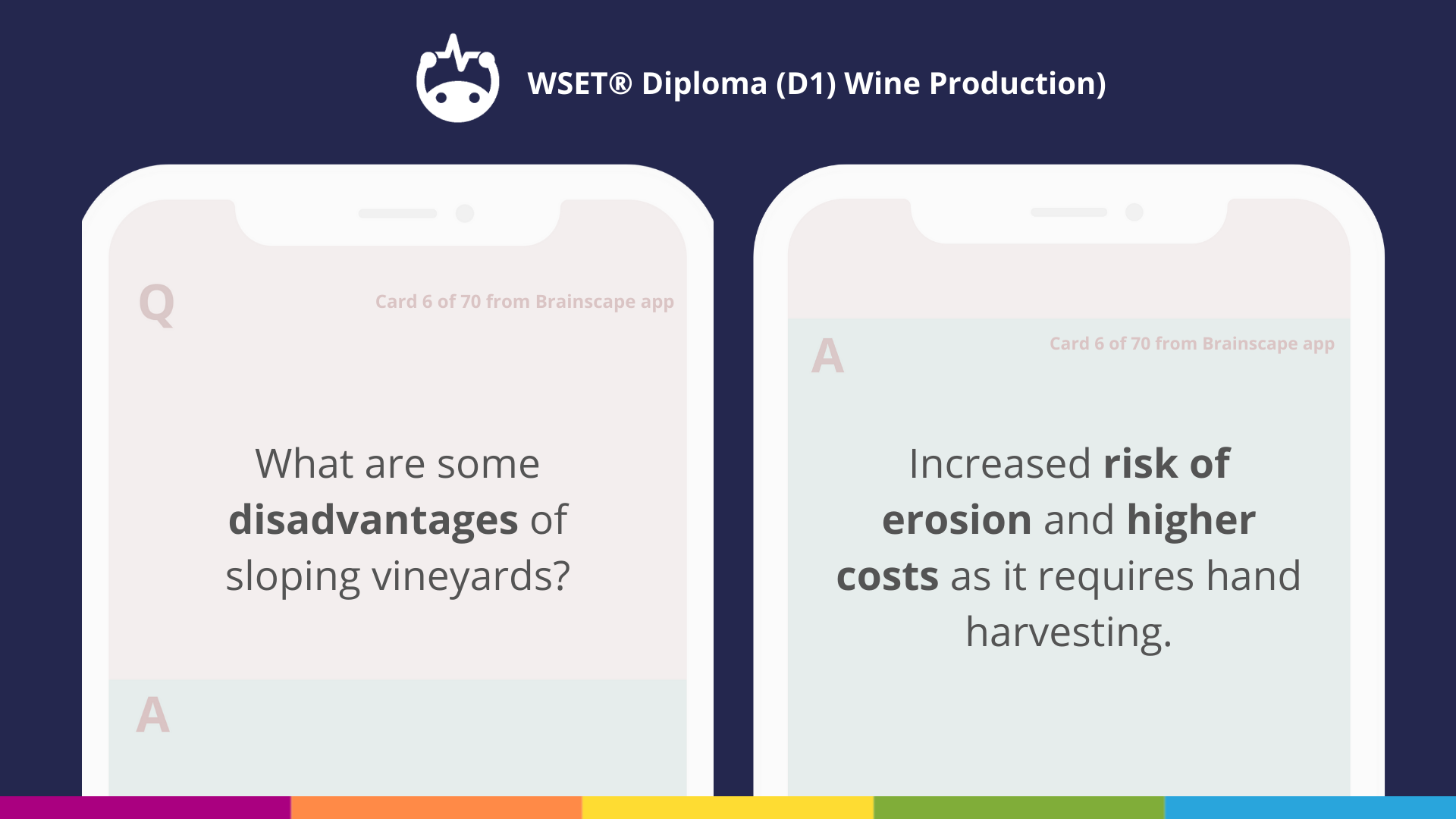
The first of the WSET Diploma’s modules establishes the essential foundation for everything you’ll be learning about the still wines of the world (as well as sparkling and fortified wines in those latter modules), which is why you should begin with a refresher of the WSET D1 Wine Production content.
Understanding how wine is made, from seed to cellar and grape to grocery store, at the level of detail demanded by the WSET Diploma is crucial for establishing a powerful foundation for you to then build your knowledge of the still wines of the world.
Pro Tip: The easiest, most seamless way to complete this review is to spend a little time every day working through digital flashcards from an app like Mochi or Brainscape (we teamed up with experts to make our WSET D1 flashcards), so that any gaps of understanding that may have been created since you last studied that information are bridged.
Tip #2: Create a Detailed Study Schedule to Stay on Track
Of all the WSET Diploma’s modules, D3 is the most knowledge-intensive and demanding in terms of memorization. To make sure you cover everything in time and avoid the awful possibility of arriving at your exam date not fully prepared and confident, it’s essential that you map out a detailed study schedule.
Decide upon your study milestones so that you stay focused and on track in the months, weeks, and days leading up to the exam. This’ll also quickly alert you to when you’re falling behind, giving you a chance to adapt your schedule to compensate for time lost, whether it’s because a topic took you longer than anticipated or you had to take a half-day off because, oops, there wasn’t a spittoon at the wine tasting.
Pro Tip: Cushion your study schedule with plenty of extra days here and there to account for the above-mentioned circumstances.
Tip #3: Strictly Stick to the Content Covered by the WSET
While you may be seduced into reading external resources out of interest or, perhaps, the ambition to substantiate your knowledge, don’t invest a lot of time actually ingraining/memorizing that content. You will only ever be tested on the content that comes up in the WSET textbook. (Brainscape's WSET D3 flashcards focus explicitly on drilling you on this content, too.)
Time is a precious resource, and considering the amount you need to learn to pass the WSET D3 Diploma exam, you can’t afford to be anything less than razor-focused.
Tip #4: Understand How the Exam Is Structured
Going into the WSET Diploma D3 exam without knowing how it’s structured and what’s expected of you wouldn’t be your smartest move yet. You need to know where the goal posts are in order to kick for them, right?
Here are the basics…
The WSET Diploma D3 exam consists of a theory and a tasting exam held on consecutive days. (Awesome news: if you pass one and fail the other, you only have to retake the one you failed.)
The theory paper is then split into two papers:
- Paper 1 (2 hours): four open-response questions, of which you can cherry-pick three to answer for a total of 300 points (100 points per question)
- Paper 2 (1 hour, 20 minutes): three open-response questions, of which you can cherry-pick two to answer for a total of 200 points.
Please note that there are NO compulsory questions, short-form questions, or compulsory essay-format questions, although you are encouraged to write in essay format where appropriate (more advice on this later).
The tasting portion is split into two examinations and a total of 12 wines:
- Paper 1 (1 hour 30 minutes):
- Question 1: three wines of one common grape variety
- Question 2: three wines from one country of origin
- Paper 2 (1 hour 30 minutes):
- Question 3: three wines from one region of origin
- Question 4: three unspecified wines
… all for a total of 50% of your total Diploma assessment. I know, right? No pressure.
What Are the Best Study Tips for WSET Diploma D3?
Now let’s talk about the inescapable task of memorizing the truly staggering amount of information you’ll need to learn and understand about the principal still wines of the world…
Tip #5: Use Flashcards to Efficiently Understand and Memorize the Facts
Digital flashcards are built around well-established principles from cognitive science, including active recall, which pushes you to retrieve answers from memory, and spaced repetition, which schedules reviews at the most effective moments for long-term retention. For content-heavy subjects like wine, this approach has been shown to dramatically improve both learning speed and recall.
Together, we broke down the most current WSET 4 D3 curriculum into individual adaptive flashcards, which leverage the learning power of spaced repetition, metacognition, and active recall to help you absorb and permanently ingrain the facts in your brain as fast as humanly possible.
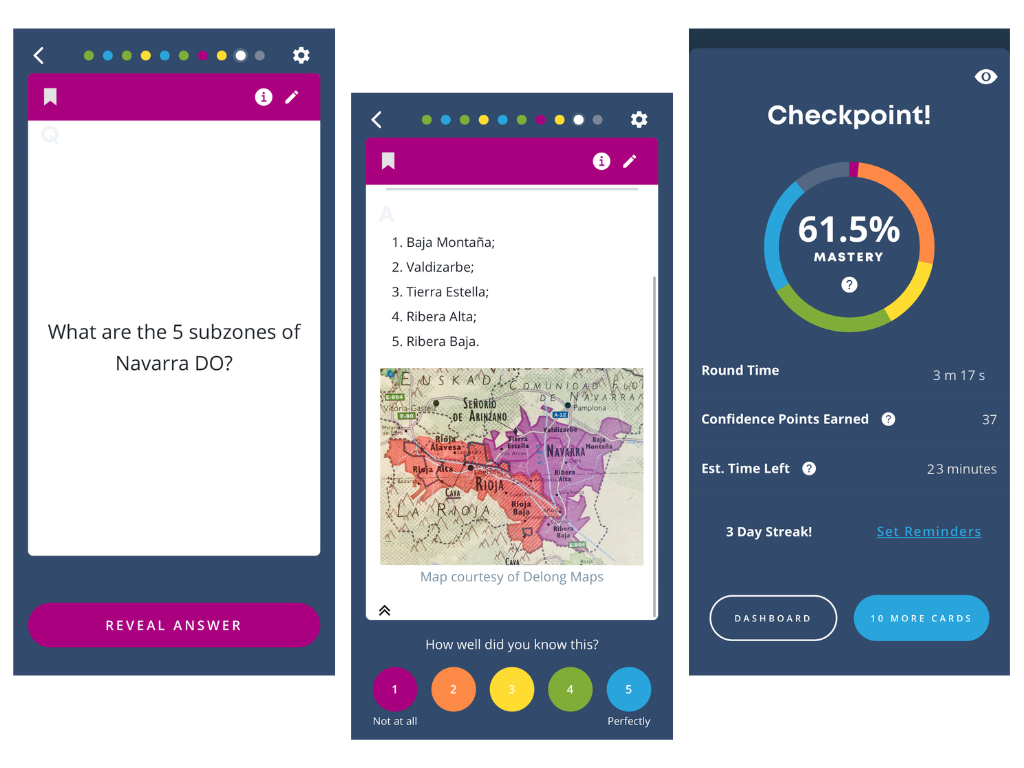
Thanks to the adaptive algorithms used by digital flashcard apps such as Anki or Brainscape, this study method helps you:
- Lock in vast amounts of information efficiently. Modern spaced repetition systems focus your time on weaker areas while resurfacing familiar material just before you’re likely to forget it, making your study sessions far more efficient than traditional rereading or note review.
- Study flexibly, wherever you are. Short bursts of review during spare moments, like commuting, waiting in line, or between commitments, quickly add up. Over time, these micro-sessions can translate into hours of high-quality study each week.
- Stay aware of your progress. Built-in feedback and progress tracking make it easier to see what you’ve mastered and where you still need work, which is especially valuable when preparing for an exam as broad as the D3 Wines of the World module.
When it comes to memorizing regions, grape varieties, production details, and styles across the global wine landscape, digital flashcards are one of the most effective tools you can use. Paired with deeper reading and tasting practice, they form a powerful foundation for success on the WSET Diploma D3 exam.

To maximize your learning efficiency, incorporate regular review with a flashcard app like Brainscape or Quizlet. Here at Brainscape, we built our WSET Diploma D3 Wines of the World flashcards with our experienced team of wine experts led by Master of Wine candidate Sarah Looper, who has run the gauntlet of the Diploma exams herself!
Tip #6: Do Not Learn the Facts in Isolation
Dry facts are not enough to do well on the WSET Diploma exams. (This is precisely why we’ve gone to great lengths to ensure that the facts our flashcards deliver also contain further explanations in the footnotes.) You need to understand how each fact relates to the greater picture.
Remember, the WSET Diploma requires skills of analysis and logical thinking. So when writing about a wine, you must be able to explain not just how this wine tastes but why, relating flavors, aromas, acidity, and alcohol to factors such as climate, soil, production methods, and so on.
Tip #7: Use Maps and Other Visualization Techniques to Ingrain the Facts
Context is everything. When talking about France or Germany or Australia or South Africa, or any wine region, you should be able to mentally picture a map of that region and the various mountains, rivers, lakes, and coastlines that shape its landscapes.
The human brain learns faster when picturing or conceptualizing things in HD. That’s why reading a textbook is probably the least effective way to actually remember information. Sure, you might learn something and remember a little bit of it b,t a few days later, 90% of that information would have leaked out of your ears.
Of all the visualization tools you can use, studying fine-grained regional maps to commit the various wine regions to memory (down to individual notable vineyards) is probably chief of all. In fact, many WSET Diploma students actually draw (and redraw) these maps themselves, coloring them in, and sticking them up all over their house so that the constant exposure literally carves those maps’ contours into their brains.
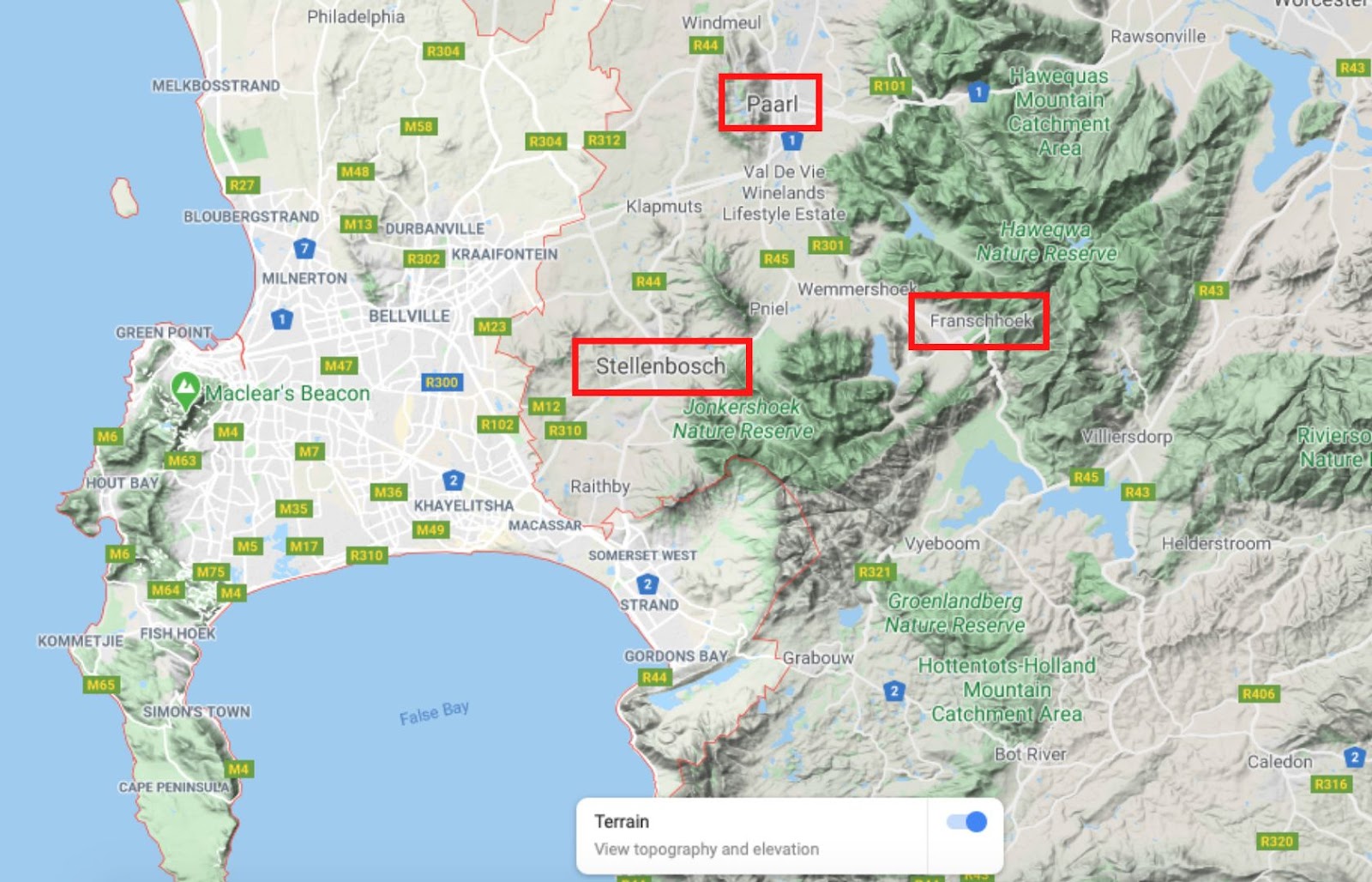
Pro Tip: Search for your chosen winemaking region in Google Maps and activate the “terrain” filter (top left-hand drop-down menu). Then, zoom in and explore the region’s topography, identifying how its features influence viticulture (see example below).
Tip #8: Practice WSET Diploma D3 Questions as Early as Possible
By now, you should have some experience with how the WSET Diploma lays out its exams, which is helpful… but there’s much more work to be done. The more WSET Diploma D3 questions and past exams you can get your hands on, the better. Answering these is a skill in itself (and we’ll tackle some of the tips you can take into the exam with you in the next section).
The great news is that the WSET does offer previous exam questions for students to practice. They also provide feedback as to what makes a great essay. To access these resources, log into WSET Global > Diploma Student Resources Area 2023/24 > Modules > Scroll to Exam Guidance > Select any Examiners' Report > Scroll down within the report to ‘Theory Paper’.
This is a start, but since every student will be making use of these same WSET Diploma D3 questions, you might even consider them the bare minimum of practice. At this level, it is up to you, dear reader, to be resourceful. Google is your friend.
Speaking of which, a simple search coughs up all kinds of resources, like this PDF of WSET Diploma practice questions by Kelly Liang of ‘A Thousand Glasses’.
Our advice is to cherry-pick a few and read them in your free time. In other words, do not consider them a part of your prep, or else you might sink too much time into reading blog after blog after blog.
Also, remember to treat these resources as subjective! These are posts written by other WSET Diploma candidates from the perspective of their own personal experience. What they have to say is incredibly helpful, but what works for them may not work for you. Just bear that in mind.
Tip #9: Join a Study Group With Other WSET Diploma Candidates
When it comes to the memory-intensive work of ingraining the WSET Diploma content into your brain, solo study is without peer. It’s nearly impossible to work on deeply internalizing the facts when there are people around you. However, there is most certainly a time and place for group study, particularly during WSET Diploma D3 exam prep, and it can really break the monotony of solo study.
So, gather together a few other students and set up weekly meetings during which you can:
- Perform a high-level review of the material covered
- Address any areas of difficulty
- Practice your wine-tasting methodology and notes
Tip #10: Memorize a Wine Elements Grid
Make it a priority to memorize a simple grid that lays out all of the elements involved in wine production. It could look a little something like this:
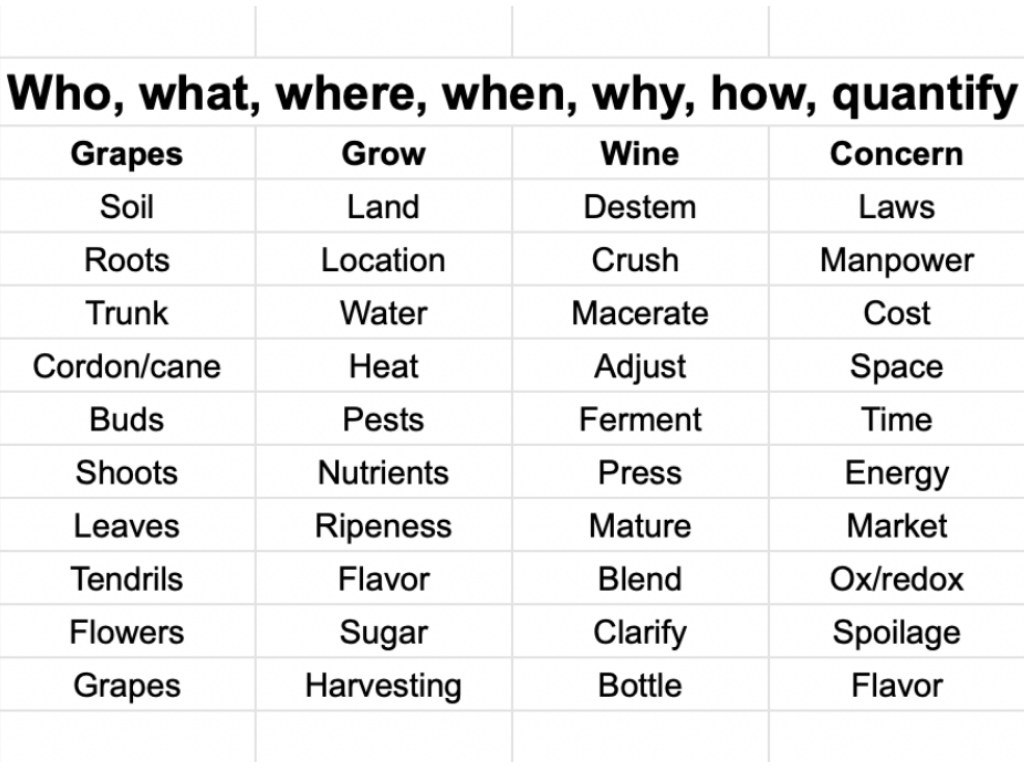
Then, when the exam starts, quickly jot this grid onto a piece of paper and use it as a totally legal reference tool when you compose your responses to each question. This grid will (1) inform the structure of your responses, (2) ensure you cover every conceivable element, and (3) prevent you from leaving marks on the table.
For example, let’s say you get a question about site selection for a new vineyard. A quick look over your grid would immediately help you isolate keywords like location, heat, soil, water, nutrients, laws, and pests. Right off the bat, that’s seven coherent concerns you can discuss in your answer, which is WAY better than getting flustered and forgetting something.
Tip #11: Devise and Lean on Useful Acronyms
Additionally, or alternatively to the aforementioned tip, you could memorize a suite of acronyms designed to jog your memory every time you’re faced with a particular WSET Diploma D3 exam question. Brainscape’s fearless wine educator Sarah Looper weighed in with the acronyms she engineered and memorized in order to pass her exam:
For questions about the vineyard: WESTCLIDS
Water availability
Elevation
Sunlight interception
Topography/geography
Climate
Latitude (length of growing season)
Influences (proximity to water, temperature, air flow)
Diurnal shift (yes/no?)
Soils
For questions about grape-growing options: TMHMP
Trellising / planting
Management: water, canopy, pest & disease
Harvest dates
Mechanization vs hand-pick
Pruning
For questions about the winery: AAY FFM PMBP
Arrival -- sorting, chilling, destemming, crushing, pre-fermentation skin contact
Adjustments -- acid, tannin, sugar, deacidification
Yeast -- cultured or native
Fermentation temperature -- cool (54-61F), mid-range (63-77F), warm (70-90F)
Fermentation vessel -- inox (reductive), cement, wood (oxidative), pump overs or punchdowns
Malo -- lowers acidity, adds body and aromas and flavors
Post-fermentation soak -- extracts more tannins
Maturation -- lees, oxygen, wood
Blending -- is it typical for the region?
Packaging -- can indicate price and quality
Feel free to grab these or make up your own!
Tip #12: Look After Yourself to Optimize Your Performance
At this point in your adulthood, you’ve probably learned the importance of good sleep, nutrition, hydration, and exercise. In spite of that, all it really takes to knock someone off course is a dose of good old-fashioned exam stress, and since the WSET Diploma D3 exam is a real doozy, you’d be forgiven for a few all-nighters and subsisting off ramen noodles and caffeine for three weeks straight.
Here’s the thing, though…
Your brain is your ultimate weapon against the WSET Diploma D3 exam. And if you want to pass or do really well, you need your brain to be in its best possible condition. So in the weeks leading up to your exam (and DEFINITELY in the three nights prior), prioritize:
- Getting good sleep
- Eating nutritious, protein-rich foods (the more colorful your plate, the better)
- Drinking enough water
- Movement every day, even if it’s just a light walk
- Limiting alcohol consumption
If you’ve been a bit of a hopeless case in the weeks before the WSET Diploma D3, at least try your hardest to get these right on the three nights prior to the exam. Trust me. You will perform so much better if your brain is well-rested, fed, and hydrated.
Tip #13: Manage Your Time Carefully
We already mentioned in tip # 4 that the WSET Diploma D3 theory exam consists of two papers, one with three open-ended questions (2 hours) and one with two (1 hour 20 min). With a little math magic, it’s clear that the examiners allocate 40 minutes per question, so right there is your goal post. Keep an eye on the clock, and if you don’t finish in 40 minutes, move on to the next question and try to make up a little time so you can come back to the previous one when you’re done.
Likewise, for the tasting portion, there are two papers, each 1 hour and 30 minutes long, covering six wines apiece. That gives you 15 minutes per wine to fully capture your tasting notes. Stay dialed in to your time allocation, and you won’t have to contend with the howling disappointment of not getting through everything in time.
Two bits of advice that can help with this are to (tip # 14) know the command words so that you explicitly answer the questions without getting off track and (tip # 15) answer the easy questions first…
Tip #14: Know the Command Words and What They Require of You
In other words: answer the damn questions!
What exactly is the WSET Diploma D3 examiner asking you? Look for the command words in the questions, like “define”, “describe”, “explain”, or “compare”. These will tell you exactly how you should answer the question and the level of detail you should provide.
If the question says “describe”, it’s obviously expecting you to explain a single concept in as much detail as possible (and you can use the grid and acronyms above to guide how you lay those answers out). But if the question asks you to “compare”, then you’ll have to define TWO different or similar things and relate them to each other in as much detail as you can.
The take-home here is to make sure you understand exactly what the examiners are asking you to do by explicitly identifying the command words and then delivering on that using your extensive knowledge base.
Tip #15: Answer the Question You’re Most Confident in First
As soon as the starter gun for the WSET Diploma D3 theory exam goes off, scan the four exam questions and spend no more than a couple of minutes deciding which you are the most confident in. Then, answer it first.
Why? Because the question you find easy—easy because you know your sh*t—is likely to contribute the most points in the least amount of time to your results! Also, you’ll work out your exam jitters much quicker on a question you know you can ace. Then, by the time you tackle the harder questions, you’ll have one solid answer done, perhaps a little extra time on the clock, and your nerves thoroughly in the rearview mirror!
Don’t pass up on easy points by leaving the “easy questions” for last!
A Final Word: How Can You Conquer the WSET Diploma D3 Exam?

So there you have it! 15 Tips for preparing to take on the WSET Diploma D3 exam: the “Mother-of-all-exams”, your personal Mount Everest, and the Olympus Mons of the WSET solar system. Just remember that there’s no shortcut around learning, understanding, and memorizing all the WSET Diploma D3 information, so the earlier you start and the more efficiently you study, the better.
With smart adaptive flashcards such as Anki or Brainscape (check out our WSET Diploma D3 flashcards), you'll be fully prepared for the theory section. So now there’s nothing left to say except that the team here at Brainscape wishes you all the best with your studies!
Additional Reading
- How to pass the WSET Diploma D1 exam on Wine Production
- How to pass the WSET Diploma D2 exam on the Business of Wine
- How to ace the WSET Diploma D4 exam on Sparkling Wine
- How to pass the WSET Diploma D5 exam on Fortified Wines
*Disclaimer: Brainscape has worked with top wine experts to supplement the official publications and preparation offered by WSET.
References
Kang, S. H. (2016). Spaced repetition promotes efficient and effective learning. Policy Insights from the Behavioral and Brain Sciences, 3(1), 12–19. https://doi.org/10.1177/2372732215624708
Karpicke, J. D. (2012). Retrieval-based learning: Active retrieval promotes meaningful learning. Current Directions in Psychological Science, 21(3), 157-163.
Lally, P., & Gardner, B. (2013). Promoting habit formation. Health Psychology Review, 7(sup1), S137-S158.
Wine & spirit education trust (WSET). WSET. (n.d.-b). https://www.wsetglobal.com/