What is cytogenetics?
The study of inheritance in relation to the structure and function of chromosomes.
Must catch cell during active division (metaphase) in order to view chromosomes.
What are the technical advances taht have made it easier to study cytogenetics?
- Mitogens, particularly phytohaemagglutinin (PHA), push cells into active division
- Spindle poisons (colchicine) produce metaphase arrest
- Hypotonic solutions rupture nucleus, spreading out the chromosomes
- Differential staining
How are chromosomes identified?
Based on their size, banding pattern and the position of the centromere.
Banding resolution: how many visible bands; “stretch” the chromosome to see more
Name the parts of a chromosome and the types.
p: short arm
q: long arm
telomere: end of chromosome
centromere: center of chromosome
satellite: secondary, pinched of constriction
stalk: secondary constriction containing genes which code for ribosomal RNA
heterochromatin: tightly packed form of DNA
metacentric: p & q equal size
sub-metacentric: distinctly shorter p
acrocentric: almost no p
Which chromosomes have large heterochromatic regions?
1, 9, 16 & Y
(constitutive heterochromatin)
Which chromosomes are acrocentric?
13, 14, 15, 21, 22 & Y
What are the types of banding methods used?
G-Banding: G bands produced with Trypsin using Giemsa (GTG); routine method in USA.
Q-Banding: Fluorochromes bind DNA and produce distinct banding patterns of bright/dull fluorescence; first banding method developed for human chromosomes.
C-Banding: C bands produced with Barium hydroxide using Giemsa (CBG); stains constitutive heterochromatin (1, 9, 16, Y).
R-Banding: Pattern is opposite of G-Banding
How does chromosome nomenclature work?
Each chromosome arm is divided into regions, or cytogenetic bands, that can be seen using a microscope and special stains.
The cytogenetic bands are labeled p1, p2, p3, q1, q2, q3, etc., counting from the centromere out toward the telomeres.
At higher resolutions, sub-bands can be seen within the bands. The sub-bands are also numbered from the centromere out toward the telomere.
For example, the cytogenetic map location of the CFTR gene is 7q31.2, which indicates it is on chromosome 7, q arm, band 3, sub-band 1, and sub-sub-band 2.
What is the process for preparing chromosomes for cytogenetics?
- Add tissue sample
- Culture in growth medium
- Add PHA to stimulate mitosis
- Incubate 2-3 days
- Add colchicine to stop mitosis in metaphase
- Transfer cells to tube and centrifuge to concentrate in layers
- Transfer to tube containing hypotonic fixative
- Put cells on microscope slide
- Add Giemsa stain to enhance chromosomes
- Identify and photograph chromosomes
- Cut out chromosome pictures and arrange into a karyotype
What is the human genome and what are its basic characteristics?
The complete set of genetic information for humans; this information is located as DNA sequences within the 23 chromosome pairs in cell nuclei and in a small DNA molecule found within individual mitochondria.
6 million base pairs of DNA (~3 meters)
15-20K genes encoding 80-100K proteins
Genes spread out over 24 different chromosomes
One chromosome from each parent for a total of 23 pairs (24 different b/c X & Y), or 46 chromosomes per somatic cell.
What is a chromosomal imbalance?
Either the gain/loss of a whole chromosome (full/complete aneuploidy) or part of a chromosome (partial aneuploidy).
May occur in the mosaic or non-mosaic state (mosaicism: presence of two or more populations of cells with different genotypes in one individual who has developed from a single fertilized egg).
Monosomy (one missing chromosome) is generally more devastating than trisomy (one extra chromosome).
What is a ploidy?
A category of chromosome changes which involve the addition or loss of complete sets of chromosomes.
Triploidy is the posession of one complete extra set of chromosomes (caused by polyspermy, the fertilization of an egg by more than one sperm); embryos usually spontaneously abort. Written as 69, XXX.
Tetraploidy usually results from the failure of the first zygotic divison; also lethal to the embryo. Written as 92, XXXX.
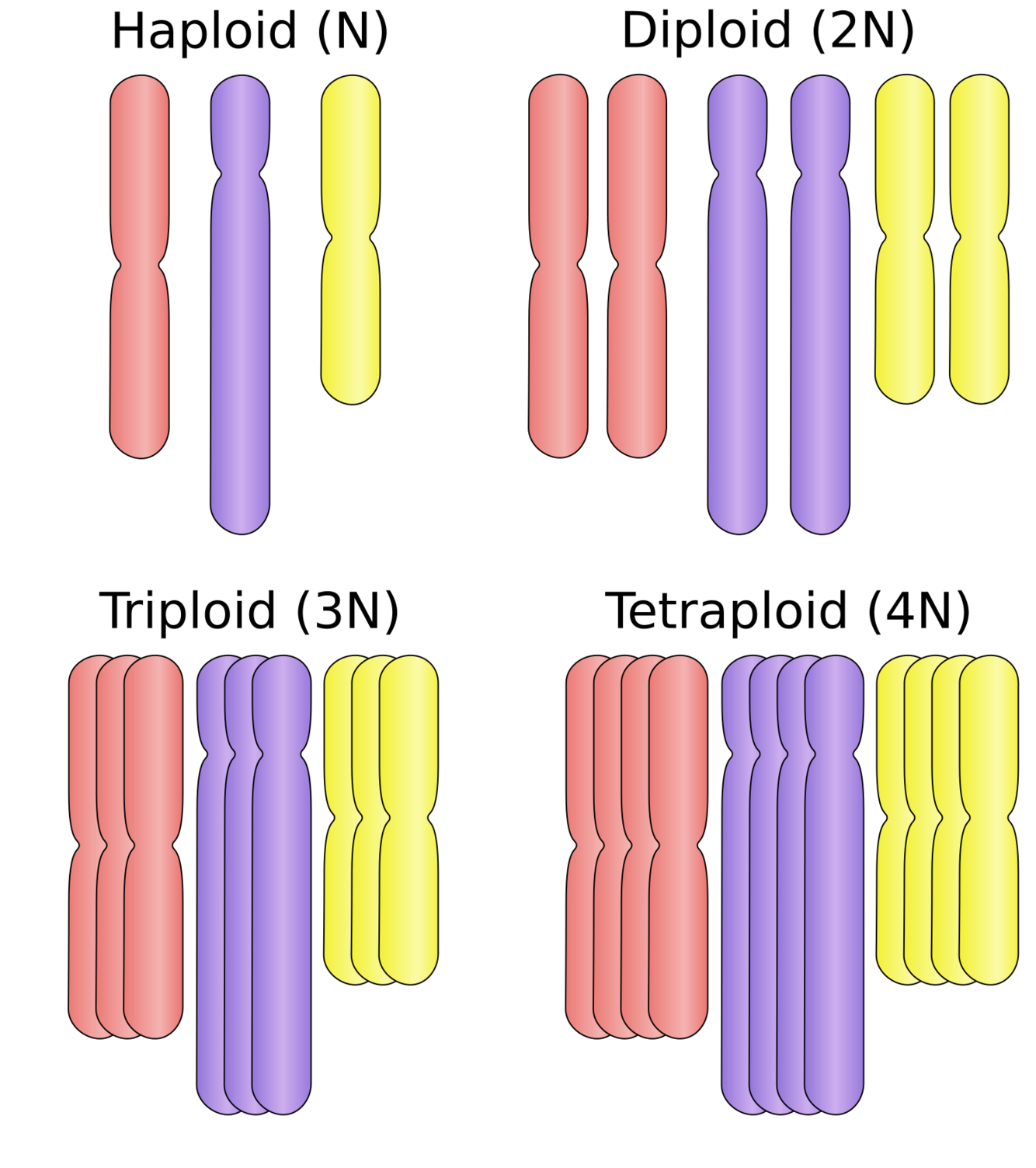
What complete non-mosaic aneuploidies can be observed in liveborns (and are thus surviveable)?
- Down syndrome (Trisomy 21)
- Edward syndrome (Trisomy 18)
- Patau syndrome (Trisomy 13)
- Turner syndrome (Monosomy X)
Other chromosomal imbalances will contain much smaller chromosomal regions (partial aneuploidy) that would allow for the organism to survive.
What are the common clinical phenotypes of chromosomal abnormalities?
- Developmental delay/intellectual disability (ID)
- Alteration of facial morphogenesis
- Growth delay
- Malformations of the internal organs (especiall cardiac)
MCA (multiple congenital abnormalities) and ID are indications for chromosome analysis
For Down Syndrome, describe:
- Cytogenetics
- Phenotype
- Medical complications
Cytogenetics:
- Trisomy 21 (47,XY,+21)
- 95% caused by nondisjunction
- 95% of trisomies from maternal nondisjunction
- 75% of errors occur during meiosis I
Phenotype:
- Hypotonia (low muscle tone)
- Redundant neck fold/flat occiput
- Low-set ears w/ characteristic pinnae
- Protruding/large tongue
- Abnormal dermatoglyphics (simian line, clinodactyly, wide space between 1st and 2nd toes)
- Brushfield spots (eyes)
Medical complications:
- Leukemia (15-20x)
- Moderate to severe ID (100%)
- Congenital heart defect (40%)
- GI obstruction (3%)
- Respiratory infections common
For Edward Syndrome, describe:
- Cytogenetics
- Incidence
- Prognosis
- Phenotype
- Medical complications
- Trisomy 18 (47, XY, +18)
- 1:3333 live births (most common abnormality in stillbirths)
- 10% alive by 1 year
- Rocker-Bottom feet, marked ID
- Prenatal growth deficiency results in small for gestational age infant (SGA), 90% congenital heart defect (ventricular septal defect)
For Patau Syndrome, describe:
- Cytogenetics
- Incidence
- Prognosis
- Phenotype
- Trisomy 13 (47, XY, +13); 75% due to meiotic nondisjunction; 20% from translocations (25% of which are familial); 5% due to mosaicism (mitotic nondisjunction)
- 1:5000 live births (95% spontaneously aborted)
- 10% alive by 1 year
- Microcephaly with sloping forehead, holoprosencephaly, ophthalmologic abnormalities, cleft lip +/- palate, low set ears with abnormal helices, polydactyly
For Turner Syndrome, describe:
- Cytogenetics
- Incidence
- Phenotype
- Medical complications
- Treatment
- 45, X0 (50%; ~10% spontaneously abort), 45, X0/46XX or 45,X0/46,XY (mosaics; 30-40%); structural X abnormalities (10-20%); 80% are due to loss of paternal X chromosome
- 1:5000 live female births (99% spontaneously aborted)
- Very short, infertile, broad chest, widely-spaced nipples, webbed neck, spatial perception decreased
- Structural kidney defects (50%), coarctation of the aorta (20%)
- Growth hormone and estrogen
For Klinefelter Syndrome, describe:
- Cytogenetics
- Incidence
- Phenotype
- 47, XXY (48,XXXY or 49,XXXXY rare; severe IDs)
- 1:1000 live male births
- Testes small, fail to produce normal levels of testosterone, leading to breast growth (gynaecomastia) in 40% of cases; poorly developed secondary sexual characteristics; no spermatogenesis (sterility); taller and thinner; slight reduction in IQ (10-15 points below siblings)
For Triple X, describe:
- Cytogenetics
- Incidence
- Phenotype
- 47, XXX (48,XXXX and 49,XXXXX rare; mild to moderate ID, variable dysmorphic features)
- 1:1000 female live births
- No phenotypic abnormalities; may have sterility or learning disabilities (speech/language); IQ reduction (10-15 points below siblings)
For XYY Syndrome, describe:
- Incidence
- Phenotype
- 1:1000 live male births
- May be phenotypically normal; tall but normally proportioned; 10-15 point IQ reduction (?); problems with impulse control (?)
Maternal age is well-recognized in all aneuploidies except which two?
45,X (Turner) and XYY Syndrome
What is partial aneuploidy?
Deletions resulting in smaller chromosomal regions which allow for the conceptus to survive, albeit with clinical abnormalities in most cases.
Result from unbalanced rearrangements (translocations and inversions), deletions, duplications, isochromosomes, rings and supernumerary marker chromosomes.
What are the types of translocations and inversions?
Translocations:
- Balanced (no material lossed)
- Reciprocal (equal exchange of material)
- Unbalanced (leads to partial mono/trisomy)
Inversions:
- Pericentric (include centromere)
- Paracentric (arm only)

-
01: Introduction to Genetics21
-
02: Cytogenetics41
-
Treatment & Prevention of Genetic Disease23
-
Ethics and Genetics12
-
Gene Therapy8
-
03: Anatomy of the Gene22
-
04: Genetic Variations & Their Origins16
-
05: Patterns of Inheritance16
-
06: Laboratory Methods for Genetic Mutation Analysis10
-
07: Population Genetics and Screening11
-
08: Personalized Genomics9
-
09: Epigenetics13
-
10: Complex Genetic Traits9
-
11: Molecular & Biochemical Basis of Disease14



