Explain the core concept of the ADM
The ADM provides a tested and repeatable process for developing architectures.
The ADM includes:
- establishing an architecture framework,
- developing architecture content,
- transitioning, and
- governing the realization of architectures.
These activities are carried out within an iterative cycle of continuous architecture definition and realization that allows organizations to transform their enterprises in a controlled manner in response to business goals and opportunities.
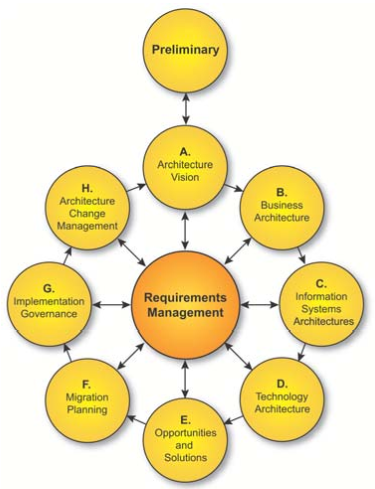
List the ADM Phases - in order
- The Preliminary Phase
- Phase A: Architecture Vision
- Phase B: Business Architecture
- Phase C: Information Systems Architectures
- Phase D: Technology Architecture
- Phase E: Opportunities and Solutions
- Phase F: Migration Planning
- Phase G: Implementation Governance
- Phase H: Architecture Change Management
- Requirements Management
Describe the Preliminary Phase of the ADM
The Preliminary Phase describes
- the preparation and
- initiation activities
required to create an Architecture Capability, including
- the customization of TOGAF, and
- the definition of Architecture Principles.
Describe Phase A of the ADM:
Architecture Vision
The Architecture Vision describes the initial phase of an Architecture Development Cycle.
It includes :
- information about defining the scope,
- identifying the stakeholders,
- creating the Architecture Vision, and
- obtaining approvals.
Describe Phase B of the ADM:
Business Architecture
Describes the development of a Business Architecture to support an agreed Architecture Vision.
Describe Phase C of the ADM:
Information Systems Architectures
Describes the development of Information Systems Architectures for an architecture project, including the development of Data and Application Architectures
Describe Phase D of the ADM:
Technology Architecture
Describes the development of the Technology Architecture for an architecture project.
Describe Phase E of the ADM:
Opportunities and Solutions
Describes the development of the Technology Architecture for an architecture project.
Describe Phase F of the ADM:
Migration Planning
The process of identifying major implementation projects and grouping them into work packages that deliver the Target Architecture defined in the previous phases.
Describe Phase G of the ADM:
Implementation Governance
Provides an architectural oversight of the implementation
Describe Phase H of the ADM:
Architecture Change Management
Provides an architectural oversight of the implementation
Describe Requirements Management during the ADM cycle
Examines the process of managing architecture requirements throughout the ADM

-
01a Introduction7
-
01b Introduction - Test Yourself5
-
02a Basic Concepts17
-
02b Basic Concepts 215
-
02c Basic Concepts - Test Yourself5
-
03a Core Concepts12
-
03d Core Concepts - Test Yourself7
-
04a Key Terminology A10
-
04b Key Terminology B-E11
-
04c Key Terminology F-M12
-
04d Key Terminology O-S11
-
04e Key Terminology T-V6
-
04f Key Questions - Test Yourself6



