How is a cryptographic protocol defined?
A cryptographic protocol is defined as a series of steps and message exchanges between multiple entities in order to achieve a specific security objective.
What are some general properties of a protocol?
- Everyone involved in the protocol must know the protocol and all the steps to follow in advance
- Everyone involved in the protocol must agree to follow it
- The protocol must be unambiguous, every step is well defined and there is no chance of misunderstanding
- The protocol must be complete (a specified action for every possible situation)
* Additional property of a cryptographic protocol:
- It should not be possible to do or learn more than what is specified in the protocol
What are some applications of Cryptographic Protocols?
- Key exchange
- Authentication
- Data origin authentication
- Entity authentication
- Combined authentication and key exchange
- Secret splitting (all parts needed for reconstruction)
- Secret sharing (m out of n parts needed for reconstruction)
- Time-stamping
- Key escrow (ensuring that only an authorized entity can recover keys)
- Zero-Knowledge proofs (proof of knowledge of an information without revealing the information)
- Bling signatures (privacy-preserving time-stamping services)
- Secure elections
- Electronic money (like Bitcoins)
Explain some concerns about the Diffie-Hellman (cryptographic protocol) for key exchange:
- The protocol does not realize any authentication
- Both parties (Alice, Bob)
How does PFS (Perfect Forward Secrecy) takes place?
- PFS (Perfect Forward Secrecy) takes place when a separation of key exchange and authentication of the exchange happens.
- If a key exchange ensures PFS, then a compromise of one key in the future will not allow to compromise any data that has been protected with other keys exchanged before that compromise.
- Example: Alice and Bob sign the data exchanged to compute sk with their private keys. Even the compromise of a private key in the future will not allow to decrypt recorded data that has been protected with sk.
What is Data Origin Authentication?
Data origin authentication is the security service that enables entities to verify that a message has been originated by a particular entity and that it has not been altered afterwards.
Also called: data integrity.
What is the relation of data integrity to cryptographic protocols?
- There are cryptographic protocols to ensure data integrity. They comprise just one protocol step and are not very “exciting”:
- Example 1: everybody knows Alice’s public RSA key and its sure to know really Alice’s key, Alice then can insure data integrity of her messages by encrypting them with her private key.
- Example 2: Alice can also compute MDC over her messages and append the MDC encrypted with her private key to the message.
- Data integrity of messages exchanged is often an important property in cryptographic protocols, so data integrity is a building block to cryptographic protocols.
What is Entity Authentication?
- Entity Authentication is a security service that enables communication partners to verify the identity of their peer entities.
- Entity authentication is the most fundamental security service, as all other security services build upon it.
How can Entity Authentication be accomplished?
- Knowledge: passwords.
- Possession: physical keys or cards.
- Immutable characteristics: biometric properties.
- Location: evidence to verify that an entity is at a specific place.
- Delegation of authenticity: the verifying entity accepts, that somebody who is trusted has already established authentication.
- ^ In communication networks, direct verification of the above means is difficult or insecure which motivates the need for cryptographic protocols.
Why entity authentication is more than an exchange of (data-origin) authentic messages?
- Timeliness:
- A party B receiving authentic messages from A, can not be sure if the other member is actually participating in the communication at THAT specific moment or if a third party C is replaying old messages from A.
- This is of specific significance, when authentication is only performed at
connection-setup time (tranmission of a PIN).
What 2 means can be used to ensure timeliness in cryptographic protocols?
- Timestamps (requiring synchronized clocks)
- Random numbers (challenge-response exchanges)
Most authentication protocols do also establish a secret session key for securing the current session following the authentication exchange.
What are the two main categories of protocols for entity authentication?
- Arbitrated authentication:
- Arbiter as a TTP (Truted Third Party) directly involved in every authentication exchange.
- Direct authentication:
- A and B directly authenticate to each other.
Describe the advantages and drawbacks of Arbitrated authentication:
- Advantages:
- Allows two parties A and B to authenticate to each other without knowing any pre-established secret.
- Even if A and B don’t know each other, symmetric crypto can be used.
- Drawbacks:
- The TTP (Trusted Third Party) can become a bottleneck
- The availability of the TTP is critical
- The TTP can monitor ALL authentication activity
Describe the advantages and drawbacks of Direct authentication:
- Advantages:
- No online participation of a third party is required and no possible performance bottleneck is introduced.
- Requires asymmetric cryptography or pre-established secret keys.
Describe the meaning of some notation of Cryptographic Protocols (1):
Describe the meaning of some notation of Cryptographic Protocols (2):
Describe and elaborate on the Needham-Schroeder Protocol:
- Invented in 1978 by Roger Needham and Michael Schroeder.
- This protocol relies on symmetric encryption and makes use of a TTP (Thrusted Third Party).
- Procedure: the TTP shares secret keys KA,TTP and KB,TTP with A and B:
- A generates random number rA and sends:
- A–> TTP: (A, B, rA)
- TTP generates a session key KA,B for secure comm betwen A and B, then replies to A:
- TTP–> A: {rA, B, KA,B, {KA,B, A}KB, TTP}KA, TTP
- A decrypts the message and extracts KA,B. A confirms that rA is identical to what was previously generated, so she knows the reply is a fresh reply from the TTP. Then A sends to B:
- A–> B: {KA,B, A}KB,TTP
- B decrypts the message and obtains KA,B. He then generates a random number rB to answers A:
- B–> A: {rB}K A,B
- A decrypts the message, computes rB-1 and answers with:
- A–> B:{rB-1)K A,B
- B decrypts the message and verifies that it indeed contains rB-1
Elaborate on the security discussion of the Needham-Schroeder Protocol:
- The exchange of the random numbers rB and rA are supposed to ensure that an attacker, trying to impersonate A cannot perform a full protocol run with replayed messages.
- As old session keys KA,B remain valid, an attacker can manage to get to know a session key to impersonate A.
- E–> B: {KA,B, A}KB,TTP (E doing a replay)
- B–> A: {rB}KA,B (E has to intercept this)
- E–> B: {rB-1}KA,B
- This is how, E, without knowing KA,TTP or KB,TTP can impersonate A.
- Kerberos further fixes this vulnerability using timestamps.
Explain how the Otway-Rees Protocol works:
- Otway-Rees protocol fixes the problem of the Needham-Schroeder protocol using index numbers and additional random numbers:
- A sends a message to B containing an index iA, her name A, B name, an and additional random number rA encrypted with key KA,TTP
- A–> B: (iA, A, B, {rA, iA, A, B}KA,TTP
- B generates a random number rB and encrypts this together with the previous message using a key KB,TTP. All this new longer message is send to TTP
- B–> TTP: (iA, A, B, {rA, iA, A, B}KA,TTP, {rB, iA, A, B}KB,TTP)
- TTP then generates a new session key KA,B and creates two encrypted messages, one for A and one for B and sends them through B
- TTP–> B: (iA, {rA, KAB}KA,TTP, {rB, KAB}KB, TTP)
- B decrypts his part of the message, verifies rB and sends A her part of the message:
- B–> A: (iA, {rA, KAB}KA,TTP)
- Finally A decrypts the message and checks if iA and rA have not changed during the exchange. If not, she can be sure that TTP has send her a fresh session key KA,B for communications. However, this does not authenticates B to A.
Elaborate on the security discussion of the Otway-Rees protocol:
- The index number iA prevents against replay attacks. However, this actually requires that TTP checks that the current iA is bigger than the last iA.
- As TTP will only generate the two messages if both parts of the message he received contain the same index number iA and names A, B. Therefore, A and B are sure that both of them have authenticated to TTP during the protocol run.
What is Kerberos and what are its key characteristics?
- Kerberos is an authentication and access control service for workstation clusters.
- Works on the basis of tickets to allow nodes communicating over a non-secure network to prove their identity to one another in a secure manner.
- It is aimed primarily at a client-server model and it provides mutual authentication (both user and server verify each other’s identity).
- Kerberos protoco messages are protected against eavesdropping and reply attacks.
- It is build on symmetric key cryptography and requires a TTP.
- Key characteristics as its design goals:
- Security (protection against eavesdropping, active attacking, impersonation)
- Reliability (using a services requires authentication, Kerberos should be highly reliable and available)
- Transparency (transparent authentication process beyond password input)
- Scalability (supporting a large number of clients and servers)
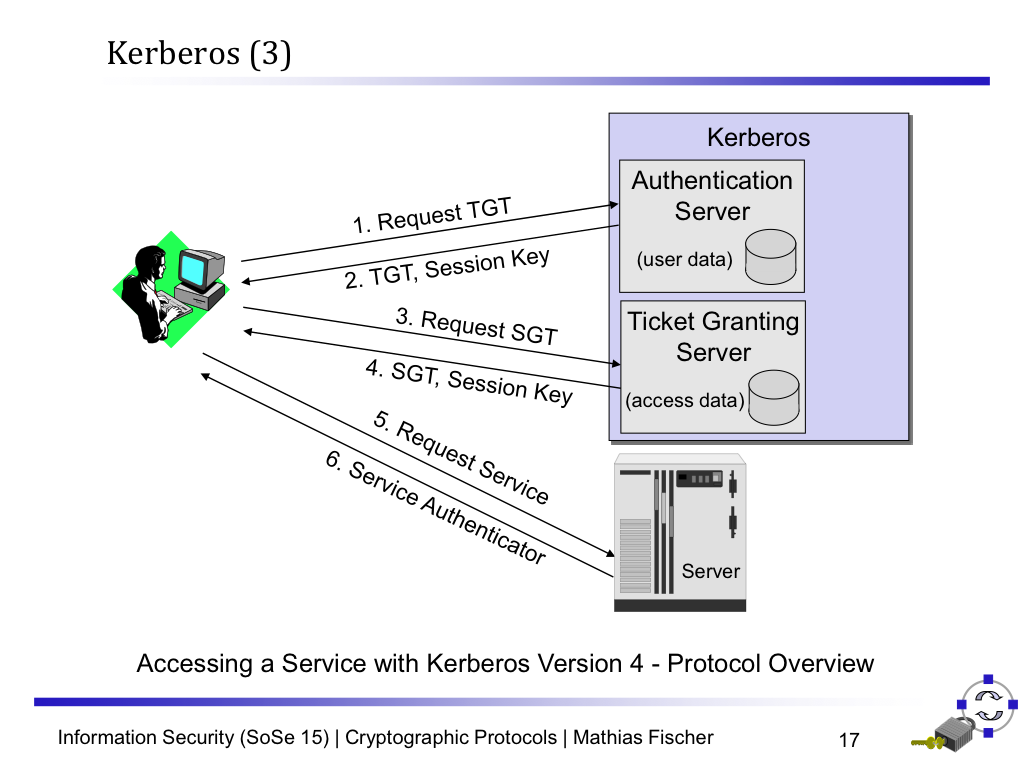
How does Kerberos (v4) works? Describe its steps:
- User A, who wants to access one ore more services, provided by servers S1, S2… connected over an insecure network.
- Authentication: A will authenticate to an AS (Authentication Server) who provides a temporal permit that allows to demand access for services. This permit is a Ticket-Granting Ticket (TicketTGS).
- Access control: A then using this TGT can demand a Ticket Granting Server (TGS) to obtain access for a service provided by another specific server S1. The TGS decides if the access is permited and answers with a Service Granting Ticket (SGT) TicketS1 for Server S1.
- Key exchange: the AS (Authentication Server) provides a session key for communication between A and Ticket Granting Server (TGS), later the TGS provides a session key for communication between A and Server1 (S1). The use of these session keys also serves for authentication purposes.
Graphically explain and elaborate on how Kerberos work:
How does Multiple Domain Kerberos works?
- It work on the basis of having different realms where the AS, TGS and S1…Sn could be located.
- For example: an AS (Authentication Server) and a TGS (Ticket Granting Server) can be in Realm 1 but a needed Service S1 can be in another Realm 2.
- A request to the AS the TGT inside Realm 1.
- AS replies with a TGT and Session Key.
- A uses the TGT to get anoter cross-realm TGTrem from a TGS in Realm 1.
- TGS R1 replies with a TGTrem and Session Key.
- A uses the obtained TGTrem to request a SGT from a TGS in Realm 2.
- TGS R2 replies with a SGT and Session Key.
- A has obtained a SGT and Session Key that can be used to request a service from S1 in Realm 2.
- S1 replies with a Service Authenticator.






