- Give a brief definition of diffusion.
(solid.state) diffusion is a means (“ein Mittel”) of mass transport within solid materials by stepwise atomic motion
- Explain the terms interdiffusion and self-diffusion.
interdiffusion refers to the migration of impurity atoms (2 material conentraions involved); for host atoms, the term is self diffusion i.e. diffusion within a material where all atoms are the same
- (a) List and briefly describe the two atomic mechanisms of diffusion.
vacancy and interstitial diffusion:
vacancy d. occurs via the exchange of an atom residing on a normal lattice site with an adjacent vacancy.
interstitial d.: an atom migrates from one interstitial position to an empty adjacent one
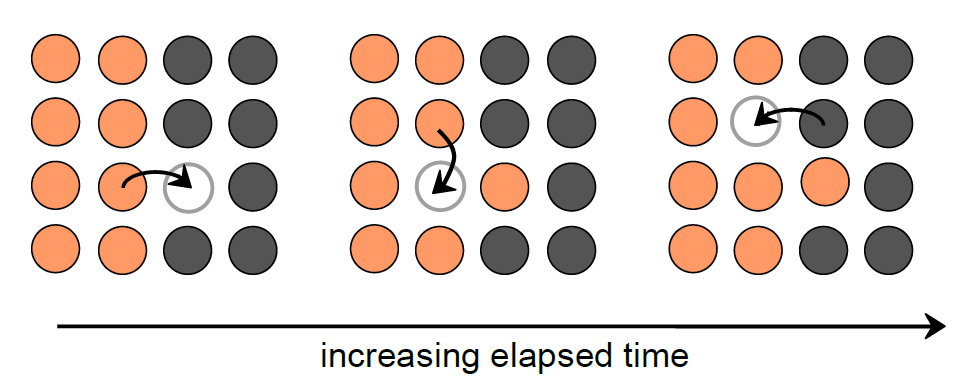
(b) Indicate for which type diffusion occurs more rapidly, and then explain why this is so.
interstitial atomic species generally diffuse more rapidly
vacancy d. depends on the number of vacancies and activation energy to exchange which is rather large
Although, the main reason is that interstitial atoms (e.g. H, C, N, O) are much smaller and thus more mobile.
- Given the mass of material diffusing through a cross-sectional area over a specified time period, compute the diffusion flux.
the rate of mass transport = diffusion flux J is defined as:
J = M/(A*t)
A…cross-sectional area
M…Mass (or number of atoms)
t…elapsed diffusion time
J = [kg/m²s] or [#atoms/m²s]
- Define the terms concentration profile and concentration gradient.
concentration profile is represented as a plot of concentration versus distance into the solid material
concentration gradient dC/dx is the slope of the concentration profile curve at some specific point
- Distinguish between steady-state and nonsteady-state diffusion.
for steady-state d. the diffusion flux J is independent of time
For non-steady state d., there is a net accumulation or depletion of diffusing species, and the flux is dependent on time.
- For steady-state diffusion through a metal sheet, determine the diffusion flux given values for the diffusion coefficient, the sheet thickness, and the concentrations of diffusing species at both surfaces.
Fick´s First Law:
J = -D * dC/dx
D…diffusion coefficient (constant of proportionality) [m²/s]
concentration gradient is calculated by:
dC/dx = (CA-CB)/(xA-xB)
xA-xB = t = sheet thickness
- Cite the driving force for steady-state diffusion.
the driving force for steady-state diffusion is the concentration gradient dC/dx
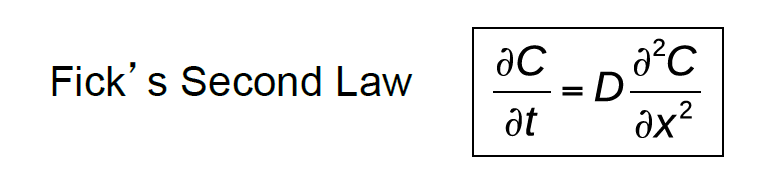
- Write Fick’s second law in equation form and define all parameters.
concentration C is dependent on time and position x -> PDE
diffusion coefficient is assumed to be constant
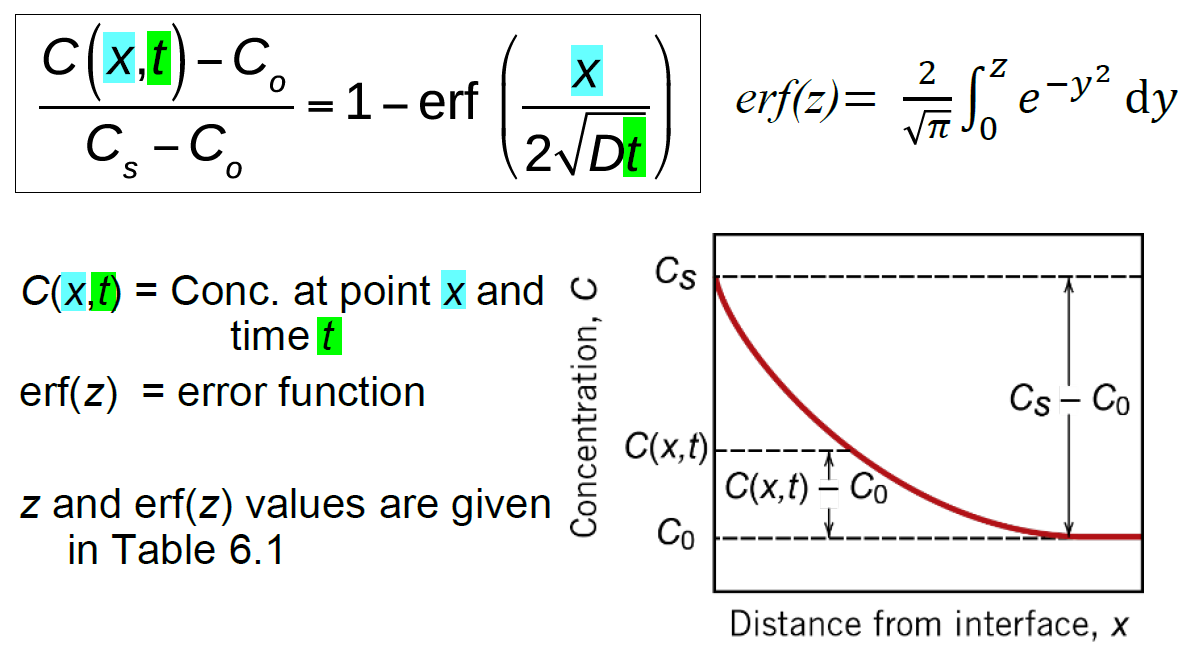
- For diffusion into a semi-infinite solid and when the concentration of diffusing species at the surface is held constant, compute the concentration at some position after a specified time given the following:
(a) the pre-diffusion concentration in the solid,
(b) the surface composition, and
(c) the value of the diffusion coefficient of the diffusing species.
assumptions made in the solution:
- before diffusion, any of the diffusing solute atoms in the solid are uniformly distributed with concentration C0
- value of x at the surface is zero and increases with distance into the solid
- t=0 the instant before diffusion begins
Initial condition: for t = 0, C = C0 at <= x <= inf
Boundary conditions: for t > 0, C = Cs (the const. surface concentration) at x = 0
for t > 0, C = C0 at x = inf
this yields the equation as depicted below, whereby C(x,t) represents the concentration at depth x after time t.
Also note the relation x^2/(D*t) = const. (7.6b in the book)
- Cite two factors that influence diffusion rate (i.e., the magnitude of the diffusion coefficient).
the magnitude of the diffusion coefficient is an indicator of the rate of atomic motion and depends on both host and diffusing species as well as on temperature
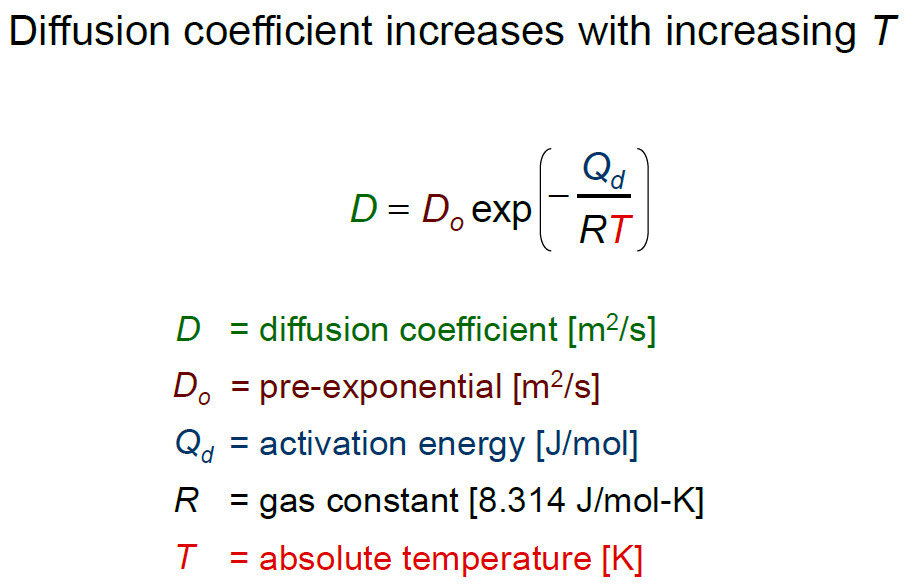
- Given the pre-exponential, D0, the activation energy, the absolute temperature, and the gas constant, be able to compute the value of the diffusion coefficient.
D0 is a temperature dependent pre-exponential
Qd = activation energy for diffusion [J/mol or eV/atom]
Side remark:
For diffusion situations wherein time and temperature are variables and in which composition i.e. C(x) remains constant at some value x 7.6b takes the form:
D*t = const.
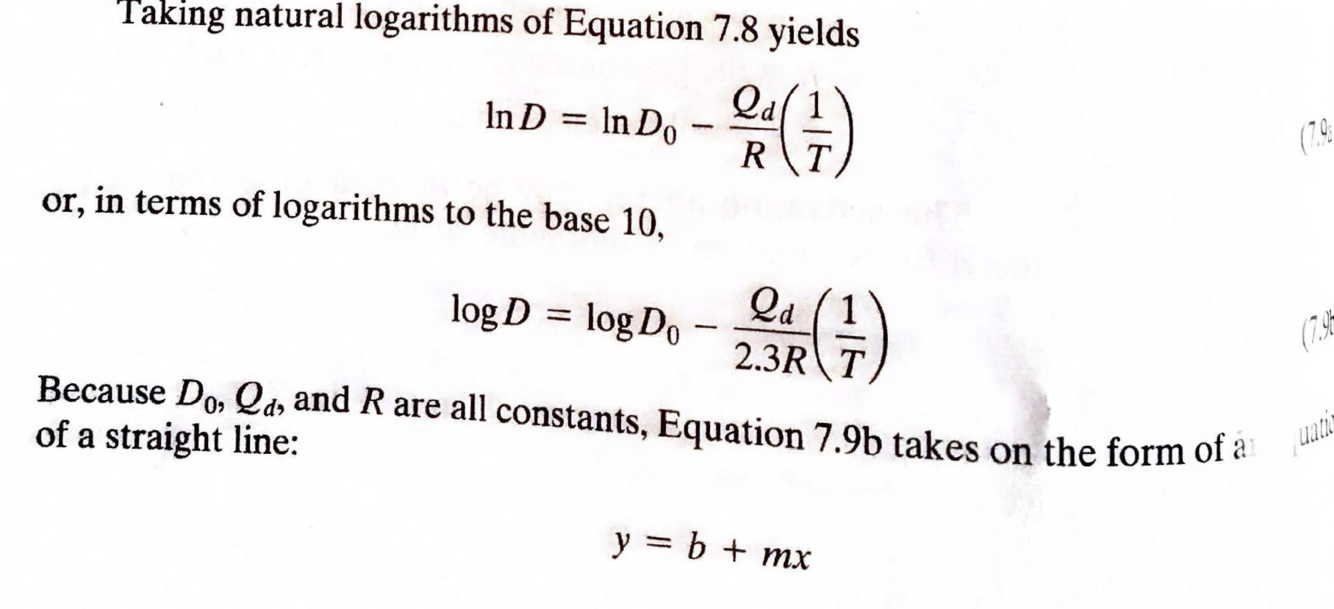
- Given a plot of the logarithm of the diffusion coefficient (to the base 10) versus the reciprocal of absolute temperature, determine values for the diffusion coefficient’s pre-exponential and activation energy.
- Name and describe the two heat treatments that are used to diffuse impurities into silicon during integrated circuit fabrication.
- predepostion and 2. drive-in:
- impurity atoms are diffused into the silicon, often from a gas phase, the partial pressure of which is maintained constant.
- impurity atoms are transported deeper into the silicon so as to provide a more suitable concentration distribution without increasing the overall impurity content
- From the standpoint of diffusion, explain why integrated circuit interconnects are made of aluminum.
Although aluminium has a lower electrical conductivity than Ag, Cu, and Au, its extremely low diffusion coefficient D makes it the material of choice. Often the IC chips, need a further heat treatment (up to 500°C) after the interconnects have been deposited. Significant diffusion of the interconnect metal into the Si can occur, which can destroy the electrical functionality of the IC. -> use Aluminium




