What is the internal resistance to an external force?
Stress. (Tension, Compression, Shear, Torsion, Bending, Combined Stresses)
Stress f = total force P / total area A
What are the three basic types of stress?
Tension, compression, and shear
What is tension?
Tension is stress in which the particles of the member tend to pull a part under load.
What is compression?
Compression is stress in which the particles of the member are pushed together and the member tends to shorten.
What is the deformation of a material caused by external forces?
Strain (e)
strain (e) = total strain e / original length L
What is shear?
Shear is stress in which the particles of a member slide past one another.
What is Hooke’s law?
As a force is applied to a material, the deformation (strain) is directly proportional to the stress, up to a certain point.
Ultimate Strength
The failing point of a given material.
Yield Point
On a stress-strain graph, the point at which the material begins to deform with minimal increase in load (stress).
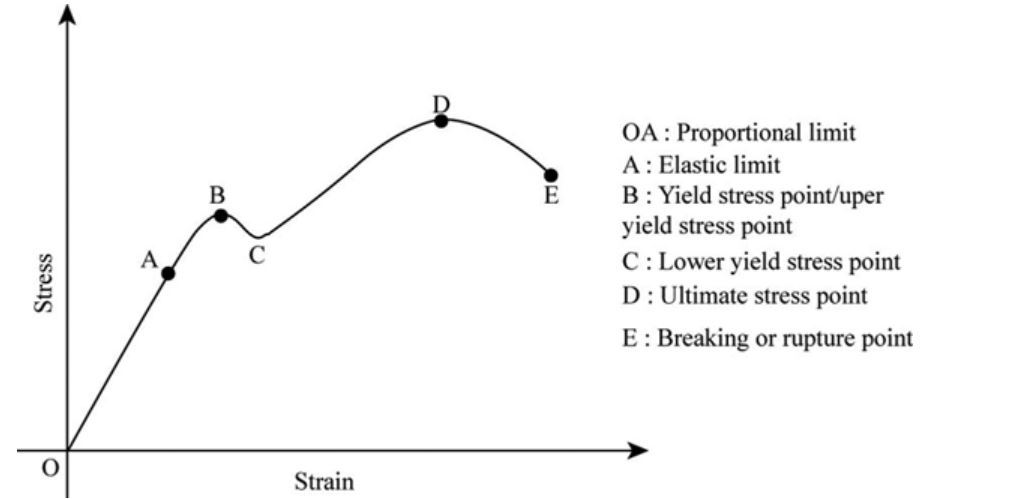
Elastic Limit
On a stress-strain graph, the point at which the material will experience deformation faster. (Prior to to this point stress and strain are directly proportional.)
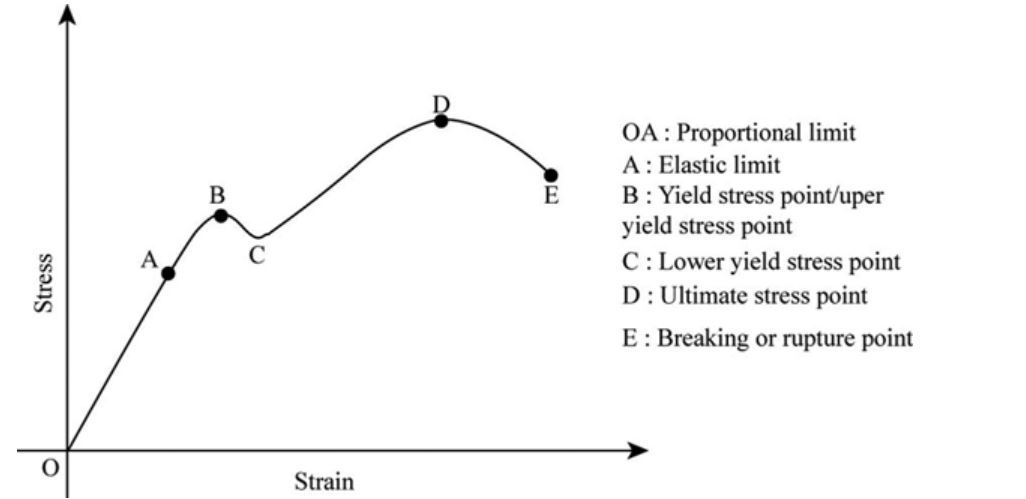
Coefficient of Expansion
Thermal Stress
plastic, acrylic = 0.0000450
aluminum = 0.0000128 in/in-F
bronze = 0.0000101
structural steel = 0.0000065
concrete = 0.0000055
glass = 0.0000051
marble = 0.0000045
brick = 0.0000034
Question: What is the applied force called in the following diagram?
→ ▯ ←
A) Shear
B) Compression
C) Torsion
D) Traction
B) Compression
Newton’s 3rd law
For every force acting on a body (building) there is an equal force of opposite magnitude.
List & define the 3 types of forces which may impact a structural body.
1 - COLLINEAR = along the same line of action *sum of vectors = magnitude along same line of action
2 - CONCURRENT = vectors that intersect at one point *sum of vectors with parallelogram polygon method
3 - NON-CONCURRENT = moment or rotation forces *sum of vectors = moment arm = F X d
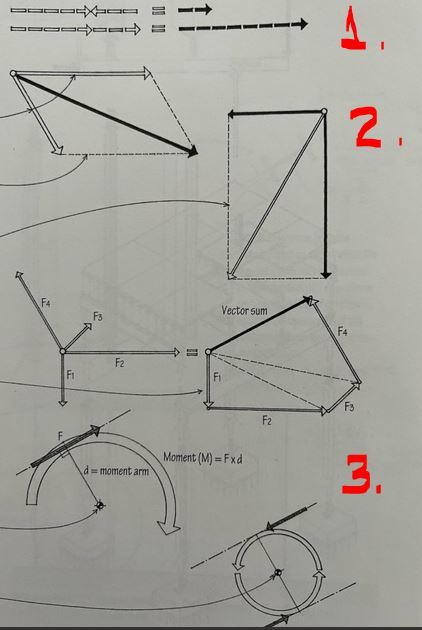
Shear & moment forces are best resisted with which construction types?
- RIGID CONNECTIONS (Least efficient, only good for small buildings)
- SHEAR PLANES
- BRACING
2 types of loads
Static & dynamic
2 types of static loads
Dead & Live
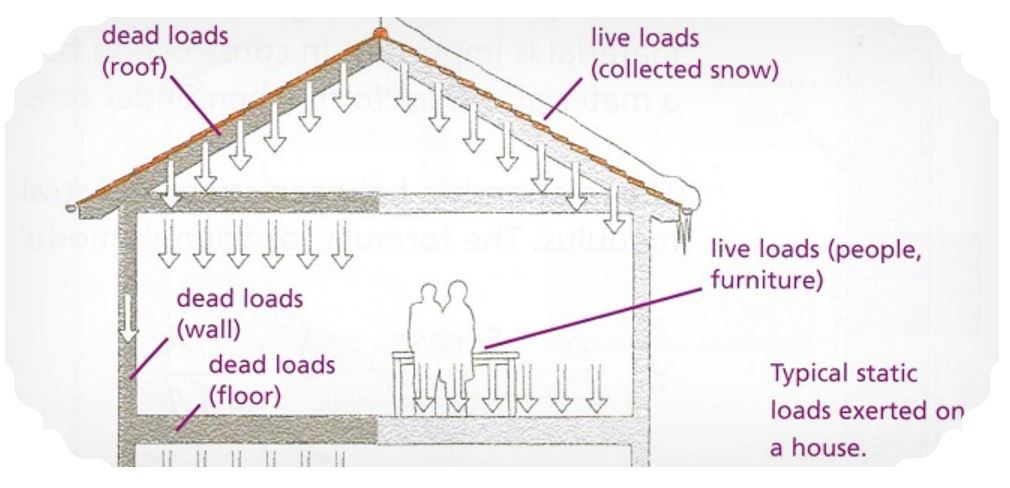
4 types of live loads
1 - Occupant & moveable furniture / equipment
2 - Snow
3 - Rain
4 - Impact (kinetic loads of short duration - cosidered static by Code *amplify load to compensate for its dynamic nature)
2 Common types of dynamic loads
Wind & seismic
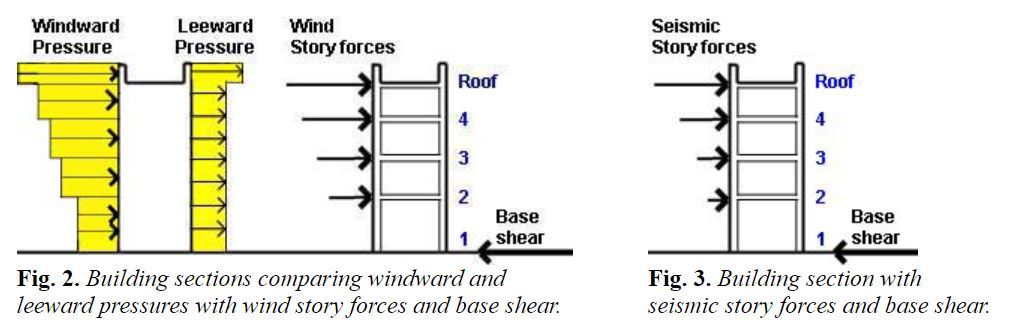
- Name 3 criteria governing the choice and use of a construction material.
- How should these criteria be for a material to be the most advantageous?
- Resistance
- Elasticity
- Rigidity
- The most beneficial materials of construction provide optimal elasticity and rigidity.
Elasticity
- Ability of a material to deform under stress - bending, elongation or compression - and to return to its original shape when the stress is removed.
- Any material has a yield point beyond which it breaks or permanently deforms.
Explain: ductile material vs brittle material
Ductile Material: Undergoes plastic deformation before breaking.
Brittle or fragile material: weak elastic limit and, without noticeable visible deformation, breaks under a load.
- Less resistant than ductile materials, brittle materials are not very suitable for the construction of buildings.
Rigidity
Why is it important?
Measurement of the compressive or tensile force that must be exerted on a material for it to reach its elastic limit.
The stiffness / rigidity of a material and the stiffness of its cross-section are very important when it comes to the relationship between span and deflection under load.
The dimensional stability of a material determines what?
The degree of dimensional stability of a material subjected to variations in temperature and humidity determines how it will be shaped and joined to other materials.


-
1. Final Project - Structural38
-
1. Final Project - Mechanical25
-
1. Final Project - Soil & Foundations39
-
1. Final Project - Building Envelope35
-
1. Final Project - Acoustics35
-
1. Final Project - Materials - Concrete130
-
1. Final Project - Materials - Wood116
-
1. Final Project - Materials - Metals116
-
1. Final Project - Materials - Masonry100
-
1. Final Project - Materials - Moisture Protection and Thermal Insulation95
-
1. Final Project - Materials - Doors, Windows, and Glazing64
-
1. Final Project - Materials - Finishes71
-
1. Final Project - Vertical Transportation28
-
1. Final Project - Specifications94



