State the 5 animal sampling techniques.
- Pooter
- Sweep Nets
- Pitfall Trap
- Tullgren Funnel
- Kick Sampling
Describe how kick sampling and a Tullgren funnel works.
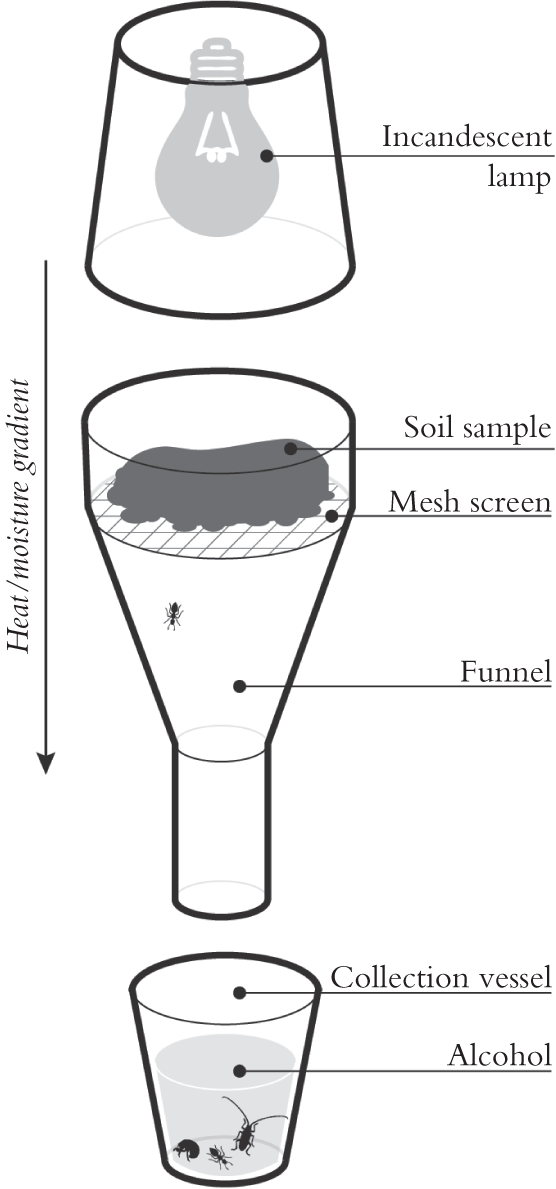
Tullgren Funnel:
- Used to extract invertebrates from soil or leaf littter
- Place the sample in a funnel above the perforated disk
- Shine a bright light over the funnel
- Rise in temp. and drying effect will force the organisms to move and fall through the disc into a collecting funnel (takes 2-3 days)
- Insects land into a preservative liquid such as alcohol
Kick Sampling: Studies organisms in rivers. River bed/bank is kicked to disturb substrate, a net is held downstream to capture flowing dislodged organisms
Describe how a pooter,** **sweep net** & **pitfall trap works.
Pitfall Traps: Catch small crawling insects. Dig hole in ground, deep enough so insects cannot crawl out. Have a roof-prop above the hole. Leave trap overnight (for nocturnal). Sample
Sweep Nets: They catch insects in areas such as long grass.
Pooter: 2 tubes present inside a chamber. One connceted to the insect habitat, one in your mouth. Both feed into a tube, suck on it to draw insects in
State and describe the 2 plant sampling methods.
Point Quadrat: Uses a frame with a horizontal bar. Long pins along the bar can be pushed into the ground. Each species of plant touching the pin is recorded
Frame Quadrat: Square frame, divided into a grid. Type and number of species in each section is recorded
How is species richness measured?
- Use a combination of techniques to identify all species in a habitat
- Produce a list of the species and calculate the total number of species.
- Identification keys are used – help scientists identify organisms – may contain images, or a series of questions based on the presence of characteristics to identify the species.
How is species evenness measured?
Identify the number of each species to decide the evenness of species spread in a habitat.
Describe the 3 ways to sample using a frame quadrat.
Density – count number of plants in 1m by 1m square quadrat – gives density per m2 - an absolute measure, not an estimate.
Frequency – used where individual members of species are hard to count (e.g. grass). Use frame quadrat, in each grid count the number of plant species present. If there are, for e.g. 65 clovers present in 100 squares, there is an estimate 65% coverage.
Percentage cover – used for speed, useful when a species is abundant or hard to count. Eye estimate of the area within a quadrat a plant covers
Describe the method used to estimate animal population size.
- Animals are constantly moving through their habitat, so counting them is difficult
- Capture-mark-release-recapture is used – capture as many individuals of a species as you can, mark them in a way that doesn’t harm the animals, or inhibit their survival chances, then release them. This gives them time to redistribute. Capture as many as you can again.
- The greater the number of marked organisms recaptured, the smaller the population
Define abiotic factor and give some examples.
Non-living conditions of a habitat. {light intensity; water; pH; temperature etc.}
What are the sensors and units used for each abiotic factor?
Wind speed
Anemometer
ms-1
Light intensity
Light meter
lx
Relative humidity
Humidity sensor
mg dm3
pH
pH probe
pH
Temperature
Thermometer/Temp. probe
⁰C
O2 content in H2O
Dissolved O2 probe
mg dm3
What are the advantages of using accurate sensors?
- Rapid changes can be detected
- Reduced human error
- High precision degree
- Data can be stored and tracked for analysis




