Identify the various compartments and the fascia that surrounds each compartment.
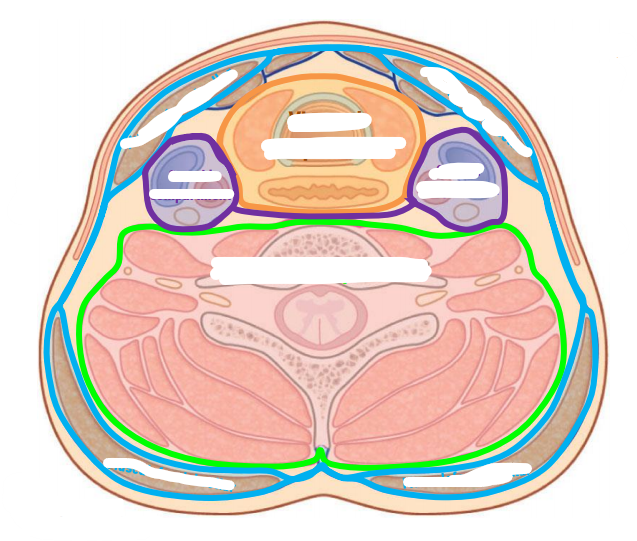
- blue: musculofascial collar surrounded by INVESTING LAYER (completely surrounds neck)
- green: verterbral compartment surrounded by PREVERTEBRAL LAYER (surrounds deep anterior and posterior neck muscle)
- purple: carotid compartment surrounded by CAROTHID SHEAT (encircles common cartodi a, internal jugular v and vagus n)
- orange: visceral compartment surrounded by PRETRACHEAL LAYER
Identifty the triangles of the neck and their borders.
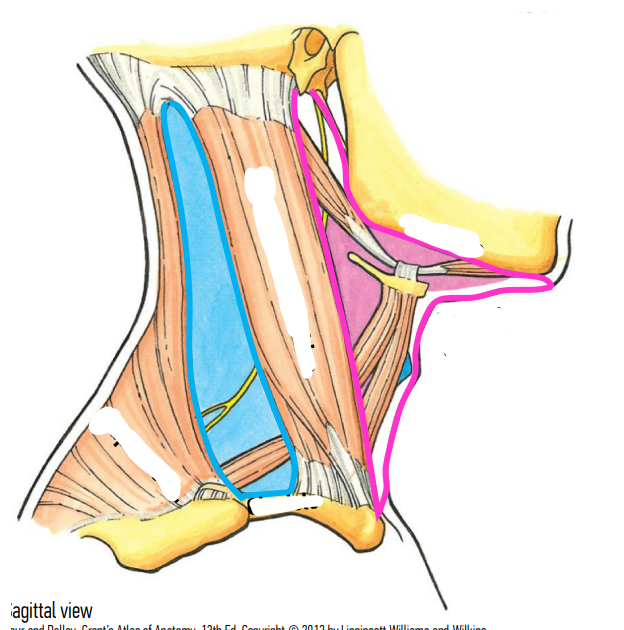
- (blue) POSTERIOR TRIANGLE:
- posterior border: trapezius m
- inferior border: clavicle
- anterior: sternocladomastoid m - (pink) ANTERIOR TRIANGLE:
- posterior border: sternoclado mastoid
- superior: mandible
- anterior: midline of neck
What fascia surrounds the triangles of the neck
prevertebral fascia
Identify the contents of the posterior triangle of the neck.
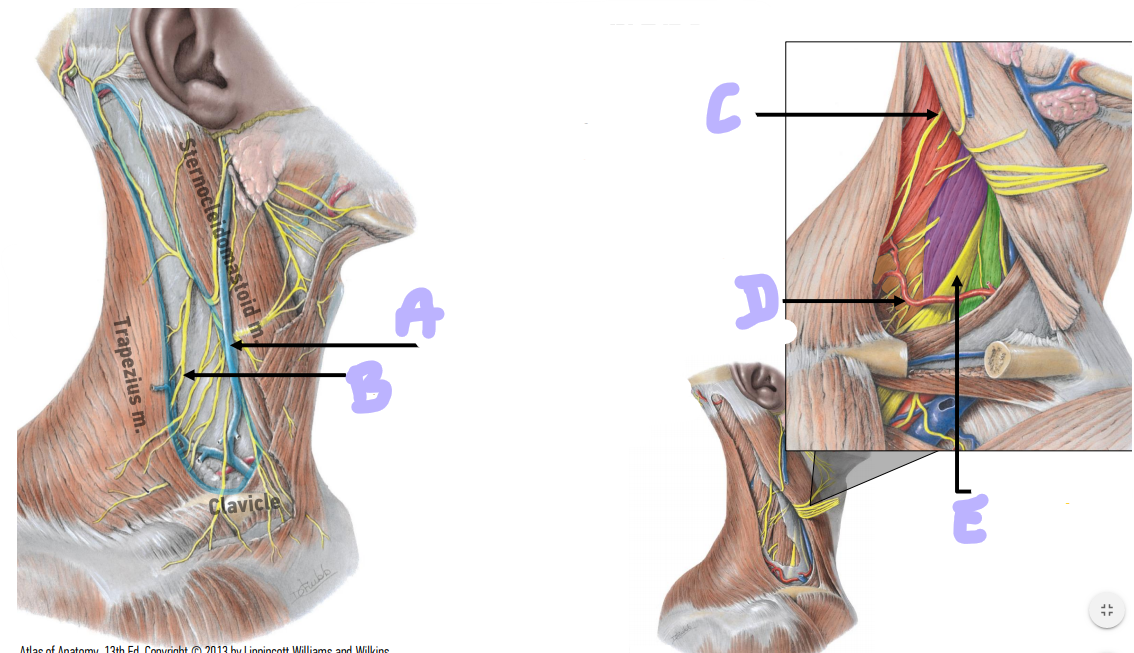
A. external jugular v (runs on sternocladomastoid m)
B.Spinal accessory nerve (on top of levator scapulae m)
(under the spinal accessory n, we have the sensory nerves of the cervical plexus C2-C4)
C. spinal accessory n
D. transverse cervical a
E.brachial plexus (between anterior and middle scalene m)
- red: levator scapulae m
- orange: posterior scalene m
- purple: middle scalene m
- green: anterior scalene m
What triangle is shown here. Explain the venous drainage
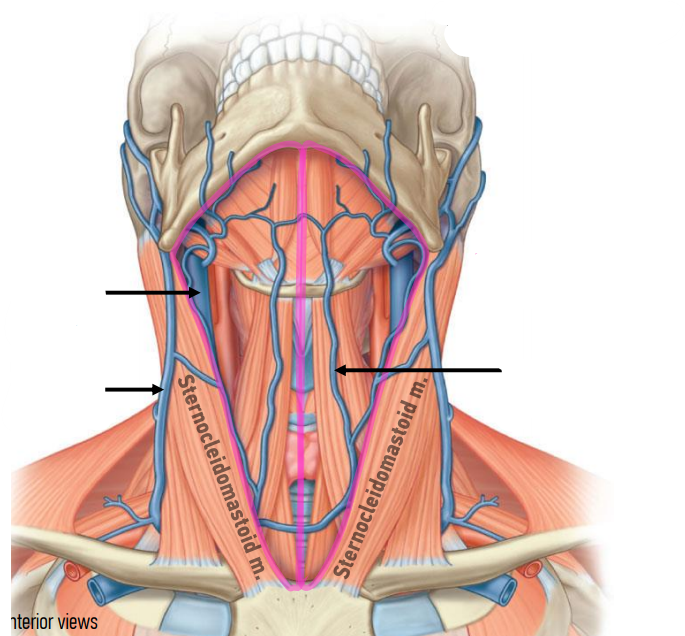
2 anterior triangles of the neck.
- top arrow: internal jugular v (deep to sternocladomastoid m)
- bottom arrow: external jugular v (on sternocladomastoid m)
- middle arrow: anterior jugular v
What is a cricothyrotomy, why is the incision done here
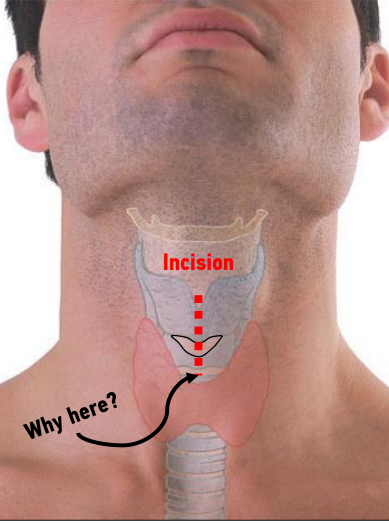
when choking or due to windpipe issue, poke a hole between the thyroid and cricoid cartilage through cricothyroid membrane to intubate because its right between the 2 anterior jugular veins
Identify the 2 groups of muscles and their functions.
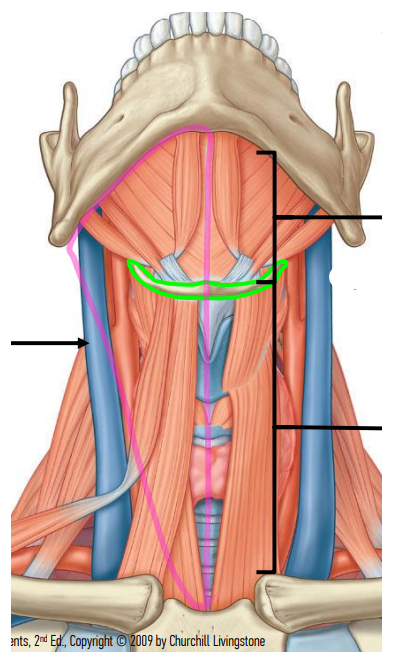
top: suprahyoid muscles: elevation of hyoid bone and laryngeal apparatus + depression of mandible + used in iniation of swallowing + used in increasing pitch
bottom: infrahyoid muscles: depression of hyoid bone and laryngeal apparatus + used at end of swallowing + used for decreasing pitch
During depression of the mandible, which group of the hyoid muscles are activated
both the suprahyoid and infrahyoid muscles are activtated
Identify the infrahyoid muscles and their functions.
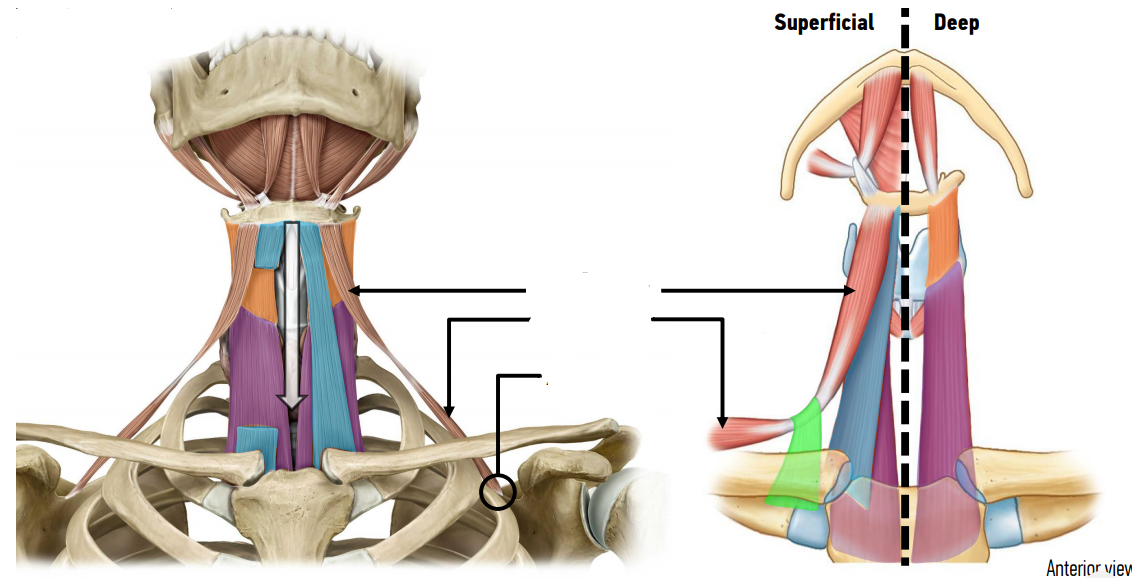
- arrow: OMOHYOID MUSCLE
- top arrow: superior belly
- middle arrow: inferior belly
- low arrow: attachment at shoulder
- has a facial sling (in green) between 2 bellies - blue: STERNOHYOID M (sternum to hyoid bone)
- purple: STERNOTHYROID M(sternum to thyroid cartilage)
- orange: THYROHYOID M (thyroid cartiolage to hyoid bone)
COMMON FUNCTION: depression of the hyoid bone
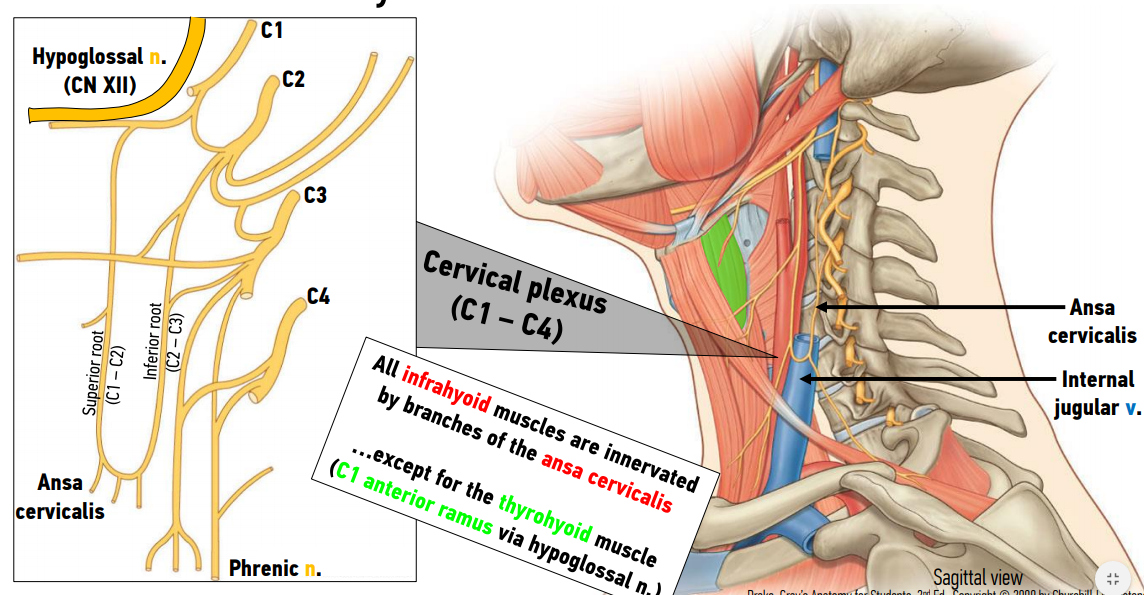
Explain the innervation of the infrahyoid muscles.
All infrahyoid muscles are innervated by branches of the ansa cervicalis (from cervical plexus C1-C4) EXCEPT
thyrohyoid muscle innervated by C1 anterior ramus via hypoglossal n
- ansa cervicalis is found on top of the internal jugular v in carotid sheath
- ansa cervicalis has a superior root (c1-c2) and an infeiror root (c2-c3)
Identify all the syprahyoid muscles and their functions.
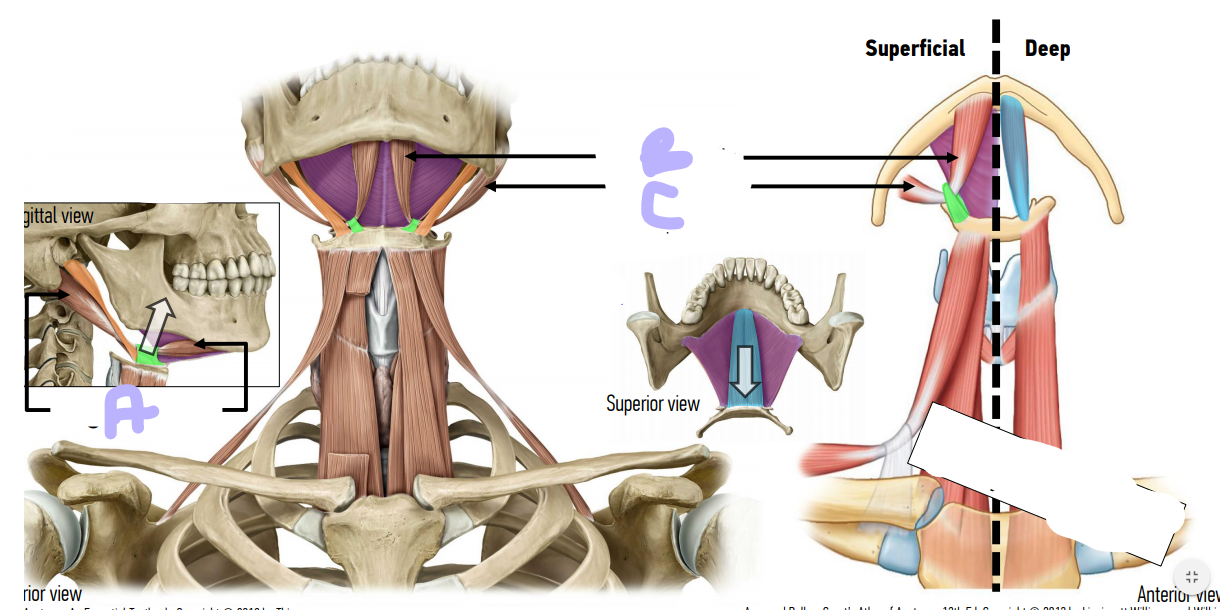
- purple: mylohyoid m
- blueÈ geniohyoid muscle (deep)
- orange: stylohyoid m (styloid process to hyoid bone)
A. Digastic m
- has an anterior belly (B) and a posterior belly (C) and a facial sling (in green)
- anterior belly near chin and posterior belly near mastoid process
COMMON FUNCTION: elevation of hyoid bone
Explain the innervation of the suprahyoid muscles.
- c1 anterior ramus via hypoglossal n inn geniogyoid m
- Facial n inn posterior belly of digastric m and stylohyoid m
- mandibular n inn anterior belly of digastric
- n to mylohyoid (from mandibular n) inn mylohyoid m
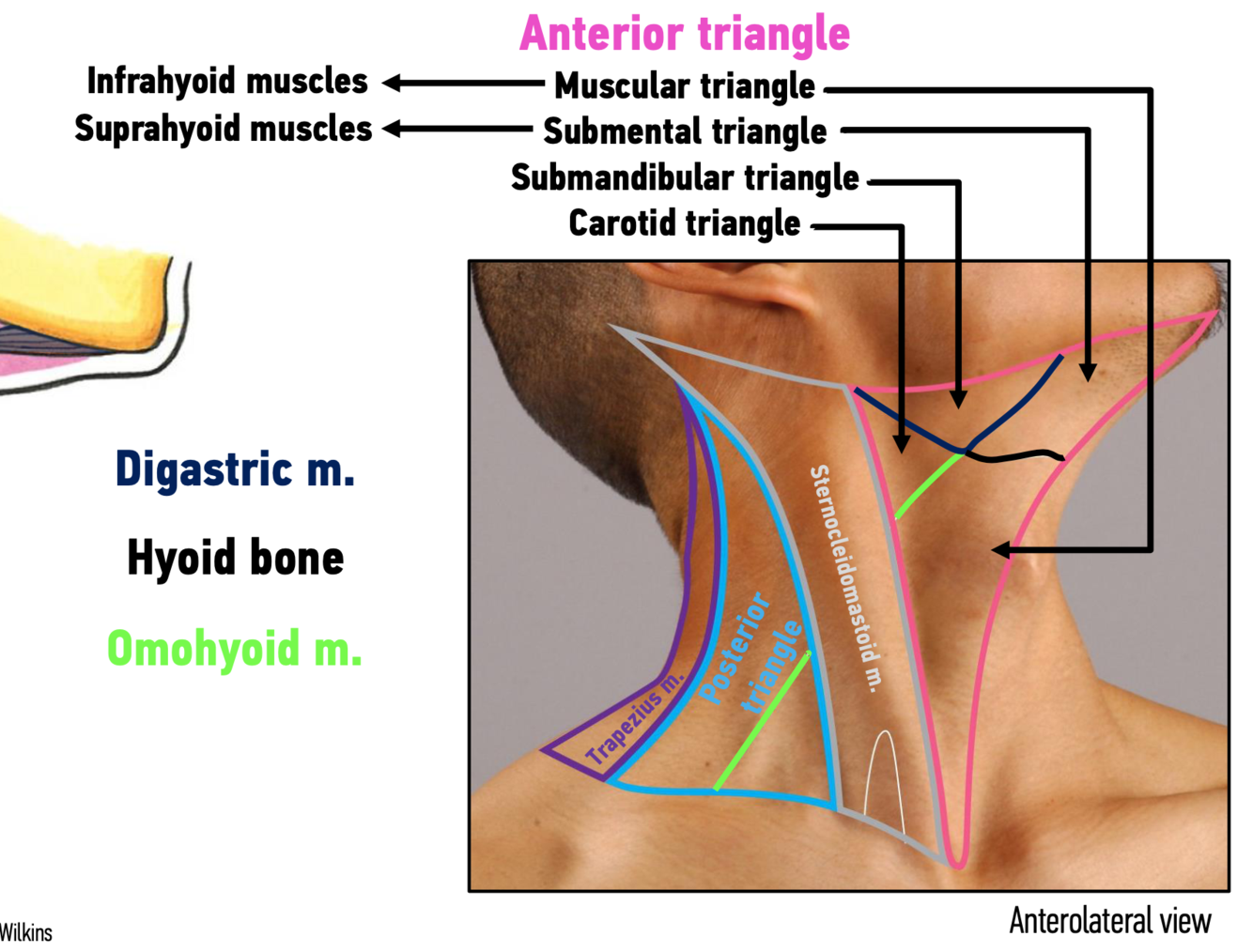
Identify the various triangles found in the anterior triangle of the neck and what muscles can be found in each.
green line: omohyoid m
navy blue line: digastric m
black: hyoid bone
A. muscular triangle: infrahyoid muscles
B. submental triangle: has suprahyoid muscles
C. submandibular triangle =digastric triangle
D.carotid triangle: has vagus n
Identify the contents of the carotid triangle
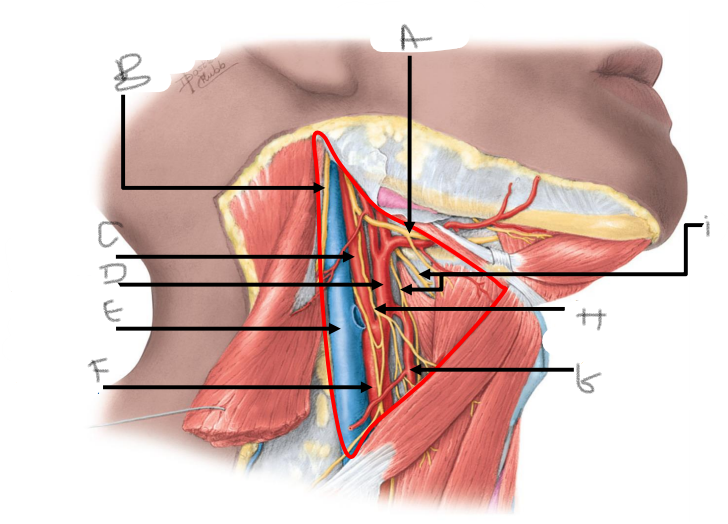
A. hypolossal n
B. spinal accessory n
C. internal carotid a
D. external carotid a
E. internal jgular v (and what drains into it)
F. common carotid a
G. superior thyroid a
H. ansa cervicalis
I. internal and external branches of superior laryngeal n (from vagus n)
vagus n is in the carotid triange: can be found deep to the common carotid a
Identify the contents of the submandibular triangle.
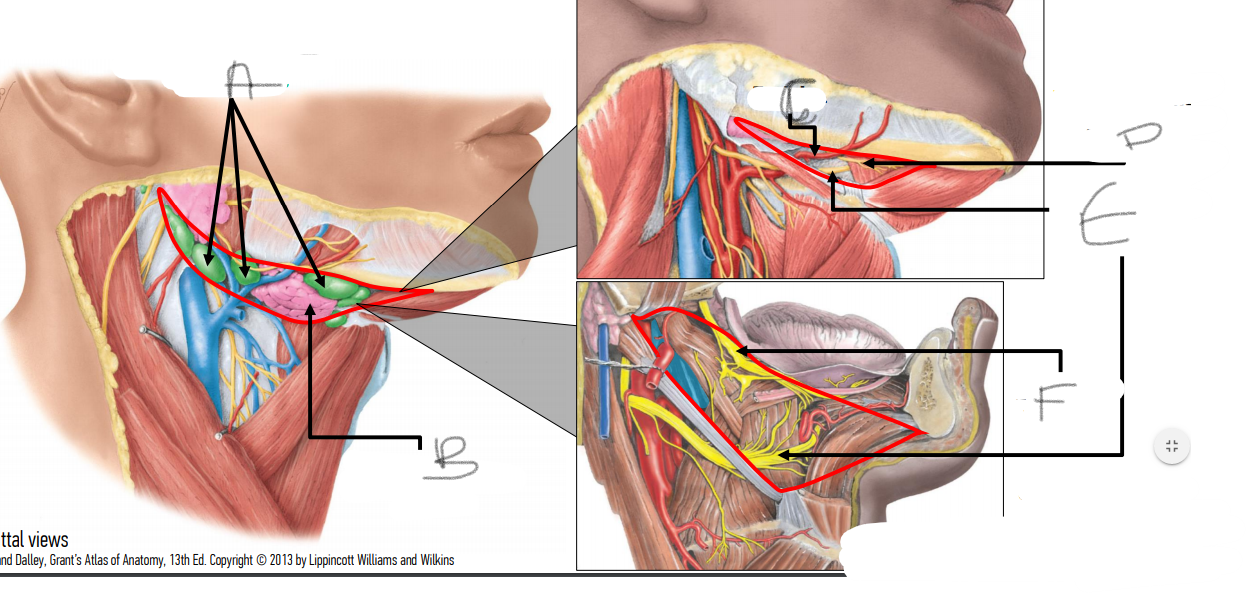
A. submandibular lymph nodes
B. submandibular gland
C.facial a
D. n to mylohyoid (from cv3)
E. hypoglossal n
F. lingual n (from cv3)
glosopharyngeal n is also in the submandibular triangle but its very deep
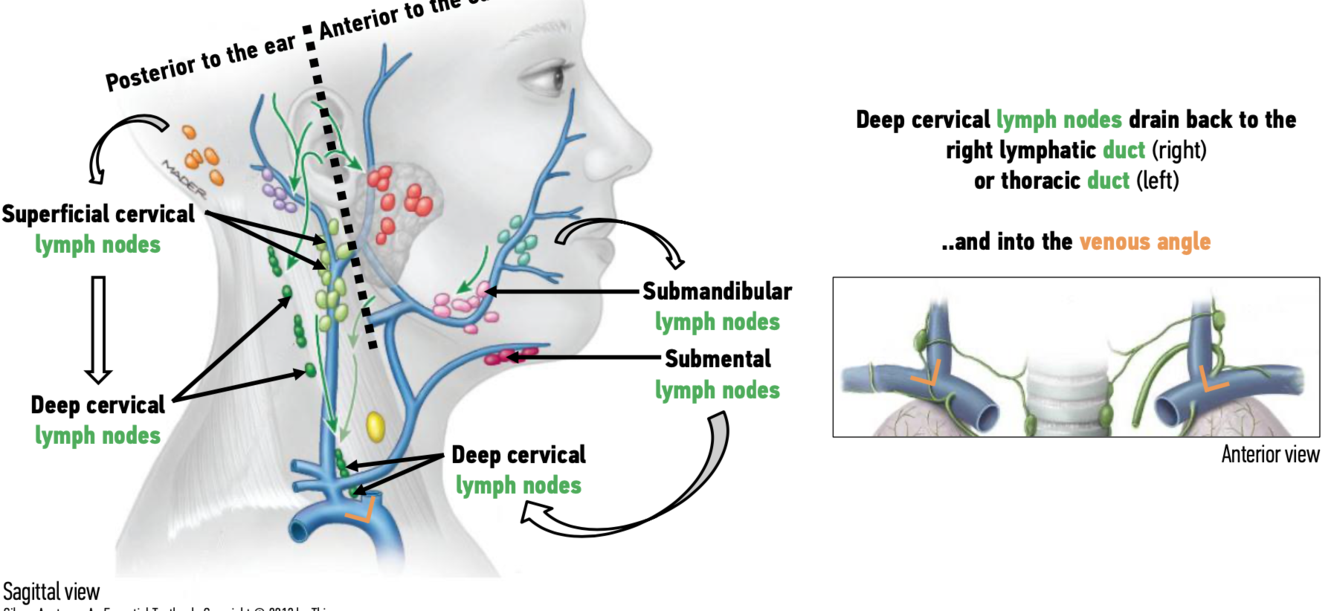
Explain the lymphatic drainage of the neck from the cervical region in order.
- POSTERIOR TO EAR: superficial cervical lymph nodes (back of head) drain into the deep cervical lymph nodes (along neck)
- ANTERIOR TO EAR: submandibular lymph nodes and submental lymph nodes drain into deep cervical lymph nodes
- deep cervical lymph nodes drain into lymphatic duct (right) OR thoracic duct (left)
which then drains into venous angle

-
1. Introduction17
-
2. Lungs and Pleurae32
-
3. Heart and Pericardium25
-
4. Neurovasculature of Heart27
-
5. The Thoracic Mediastina19
-
6. The Skull43
-
7. Brain & Cranial Nerves Pt. 149
-
8. Brain & Cranial Nerves Pt. 228
-
9. The Face28
-
10. Nasal Cavity39
-
11. Oral Cavity49
-
12. Pharynx & Larynx39
-
13. Neck16
-
16. Introduction to Abdomen47
-
17. The Foregut33
-
18. The Midgut & The Hindgut16
-
19. Posterior Abdomen36
-
20. The Pelvis40
-
21. Perineum26



