What are the drivers for a process redesign?
and
What types of improvements may Orgs seek?
Drivers?
A change in the environment forces a business to realign their goals, which would affect the process to meet these goals. e.g
- - New regulations imposed,
- - Developments by competitors or
- - Opportunities offered by new technology.
- - Operational staff may have identified a better process.
Organisations may seek to improve their processes to:
- Reduce costs, particularly during tough times
- Build a scalable platform for fast growth, or entering new markets
- Offer better products or services to be more competitive
- Exploit opportunities offered by technology
- Execute a new strategic direction
Why and How do Managers evaluate the level of change needed?
Why :-
- Understand what resources, (money, time, manpower) they need for the project or design process
- How will the redesign affect the business?
- Is the redesign worth it?
How they do it:-
- Gap analysis
- Holistic View
- Business Case
Gap analysis.
Management needs to understand the current position of the processes. Management has an idea of what they want processes to be.
In the middle you have the” GAPs” identified, this will help to determine the scope of process redesign required. e.g -
- If the gap is small – quick fix minimal effort
- If the gap is large – needs a more formal project management
Holistic view
Manwani (2008) highlights the importance of taking a holistic view on process redesign, as Most process redesign programmes will affect more than one area of the organisation.
Understanding how these elements interrelate helps to raise questions that the project team will need to consider. These could include: (External and internal impacts)
- · Are those affected by the change likely to need the training to use the website effectively?
- · Will customers want to use it? Will it affect what our customers purchase from us?
- · Will the introduction of a new website require improvements to the existing site or a complete upgrade of the existing IT infrastructure?
- · Will the change be supported by the use of in-house technical support or be provided by a third party?
Business case and benefits – Management should consider the cost and benefit analysis, is it worth the business to carry out the change, the analysis should be considered from a financial gain and a qualitative gains point of view.
Define the need and Briefly explain Harmons Process-strategy Matrix?
Harmons Process - Strategy Matrix - Helps management decide on how to best to achieve the change.
it’s based on 2 key criteria
Strategic Importance - to the core business and how this part of the business plays on the competitive advantage and impact on the customer.
Process Complexity and Dynamics - is the process rule-driven, how often are the rules changed, is there a regular need for a high-level specialist.
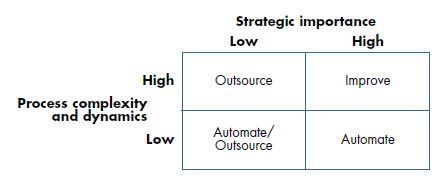
What are the 4 types of options do managers have to IMPROVE redesign?
Definition: A process redesign pattern: Is a general approach to redesigning processes for their improvement.
Harmon identified 4 Key Basic Redesign patterns>
- Re-Engineering - involves fundamental and radical changes to processes and functions. Seeking Dramatic Improvements, (High Risk, High Gain)
- Simplification: Eliminates redundant process elements. Seeks to make simple changes, remove any redundant or duplicated processes.
- Value-added analysis eliminates all activities which are not necessary and do not add value to customers.
- Gaps and Disconnects, in the flow of information between departments, mainly reporting, monitoring and management activities.
Define Re-engineering process design?
Re-engineering: Starts with a clean sheet of paper.
1st, think about what is the needs to be achieved or endpoint.
2nd think about how best to achieve it, with complete disregard with how things are currently done.
Fundamental and Radical redesign, seeking dramatic improvements, it is highly disruptive, likely to be High risk, but High Gain.
Briefly, explain simplification?
Simplification is a far less radical pattern of the redesign. It starts on the
the assumption that most established organisational processes are likely to have developed elements of duplication or redundancy.
Starts by identification and modelling of all established systems, Each element is then subject to challenge, such as:-
- It may not actually be necessary
- It may provide information that is available elsewhere
- It may be a bottleneck
- It may repeat something done in another place
it is important to consider subtle differences that are important in one
departmental contextbutnot in another.
Briefly, Explain Value-added analysis?
Value-added analysis: Eliminates activities that do not add value to the customer. This has parallels with the concept of ‘lean’ production.
Highlights that value-adding activities to satisfy three conditions:
- The customer is willing to pay for the output
- The process changes the output in some way
- The process is performed correctly at the first attempt (Total Quality Management)
Non-value-adding:
- Preparation and set-up activities
- Control and inspection activities
- Movement of a product
- Activities that result from delay or failure of any kind
Value-Enabling activities - are essential preliminaries. processes necessary for value-adding activities.
What are Gaps and disconnects?
Gaps and disconnects: Target problems at departmental boundaries. When information fails to pass on from one department to another.
Three key levels:-
- The organisation as a whole
- The process
- The job or performance level
Mainly Concerned with level 2/3 and the design of processes and the monitoring and control of process outcomes. These are clearly management activities.
Name the 4 areas considered for the feasibility of a proposed redesign?
The feasibility study is used to filter out proposals that would cost too much, cause too much disruption, make excessive demands on human and other resources or the cost of resources outweighs the benefits.
F.E.S.T
- Financial feasibility
- Cost-Benefit analysis can be difficult as benefits may be intangible
- Environmental feasibility
- is it acceptable to all the stakeholder groups, is it legal, level of reputational damage.
- Social feasibility
- How does it impact people and is it feasible to all those affected?
- Technical feasibility
- does the tech exist or does it need innovation
- has the tech matured enough
- how specialised is the tech? and do we have the expertise to exploit it?
What is a process redesign methodology? and the advantages of following one?
Process redesign methodology - a structured method of approaching a process redesign.
Advantages
- Provides discipline and focus when conducted the redesigning activities, to ensure the original end goals are met.
- Aids in the Communication of plans, so that staff accept and support the plan(buy in to), for which the process is dependent on to be successful.
Briefly describe Harmons Proces redesign Methodology.
- Planning - Goals, Project Scope, the team roles and responsibilities, time schedule
- Analysis- of Current workflows documented, Identify problems and the general approach to redesign.
- Redesign - Possible solutions considered, choose the best, and what are the objectives for the next phase.
- Development - Review implementation plans in-depth, manage the implications develop, improve aspects.
- Transition - Implement the plan, make modifications if they are required.

-
1. Strategy, Leadership & Culture25
-
2. Stakeholders and Social Responsibility32
-
3. Impact of Corporate Governance on Strategy31
-
4. The External Environment8
-
5. Strategic capability12
-
6. Competitive Advantage and Strategic Choice27
-
7. Assessing and managing risk12
-
8. Internal control systems19
-
8. 2 KP14 Audit & Compliance16
-
9. Applying Ethical Principals11
-
10. Financial analysis24
-
11. Applications of IT20
-
12. E-Business18
-
13. Enabling Success and Strategic Change32
-
14. Process Redesign11
-
15. Project Managment32
-
Explain the exam requirement for the action word or key skill17
-
Key Skills24
-
Technical Articles8
-
Models3
-
1. Strategy, Leadership & Culture COPY25



