Friday, 9 PM: Jenna B. is a 17-year-old girl. She has a history of seizures since childhood, for which she takes phenytoin, an antiepileptic drug. This afternoon, she took a home pregnancy test, which was positive. She is terrified of telling her parents the news. She recently won a scholarship to a prestigious art school, and her parents are very excited about her future college plans. Desperate, Ms. B. ingests a bottle of acetaminophen in an overdose. She writes a suicide note to her parents and goes to bed. Saturday, 10 AM she awakes feeling terrible. She is very nauseated and vomits multiple times in her bathroom. Her mother finds her vomiting bilious liquid into the toilet, and Ms. B. breaks down in tears and tells her about the pregnancy and her drug ingestion of the night before. Her mother calls the pediatrician and rushes her to the emergency department at Children’s Hospital.
How does acetaminophen cause toxicity in overdose?
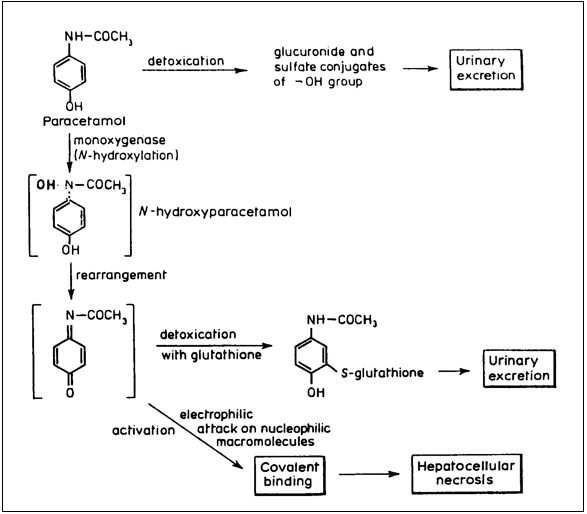
Acetaminophen is hepatically metabolized to a toxic metabolite. The metabolic pathway through the P450 enzymes (N-hydroxylation) is a minor component of acetaminophen metabolism and the reactive intermediate it produces is immediately conjugated to glutathione. In overdose, more acetaminophen is available to be metabolized by the P450 enzymes to this reactive metabolite. When glutathione stores are depleted, the toxic metabolite is free to react with hepatocytes, causing a toxic hepatitis and hepatocellular death.
Friday, 9 PM: Jenna B. is a 17-year-old girl. She has a history of seizures since childhood, for which she takes phenytoin, an antiepileptic drug. This afternoon, she took a home pregnancy test, which was positive. She is terrified of telling her parents the news. She recently won a scholarship to a prestigious art school, and her parents are very excited about her future college plans. Desperate, Ms. B. ingests a bottle of acetaminophen in an overdose. She writes a suicide note to her parents and goes to bed. Saturday, 10 AM she awakes feeling terrible. She is very nauseated and vomits multiple times in her bathroom. Her mother finds her vomiting bilious liquid into the toilet, and Ms. B. breaks down in tears and tells her about the pregnancy and her drug ingestion of the night before. Her mother calls the pediatrician and rushes her to the emergency department at Children’s Hospital.
What might be the impact of chronic phenytoin use on acetaminophen overdose?
Phenytoin induces the activity of the P450 enzymes. As a result, any acetaminophen that is available for oxidative metabolism by the P450 enzymes will be more efficiently metabolized to the reactive toxic intermediate. The risk of liver toxicity will be increased.
Friday, 9 PM: Jenna B. is a 17-year-old girl. She has a history of seizures since childhood, for which she takes phenytoin, an antiepileptic drug. This afternoon, she took a home pregnancy test, which was positive. She is terrified of telling her parents the news. She recently won a scholarship to a prestigious art school, and her parents are very excited about her future college plans. Desperate, Ms. B. ingests a bottle of acetaminophen in an overdose. She writes a suicide note to her parents and goes to bed. Saturday, 10 AM she awakes feeling terrible. She is very nauseated and vomits multiple times in her bathroom. Her mother finds her vomiting bilious liquid into the toilet, and Ms. B. breaks down in tears and tells her about the pregnancy and her drug ingestion of the night before. Her mother calls the pediatrician and rushes her to the emergency department at Children’s Hospital.
How might she be treated to ameliorate the toxic effect?
An intravenous infusion of a cysteine derivative (N-acetylcysteine) is initiated as a loading dose and maintenance infusion to increase the levels of glutathione available for conjugation.
Are biotransformation reactions necessary?
- many compounds are hydrophobic and not elim without modification
- Hydrophillic to pass through kidneys or intestines
- Hydrophobic properties facilitate reabsorption following glomerular filtration
- Prolonged duration of action if not metabolized
- Alterations in activity of biotransformation enzymes affects t1/2
- Polar molecs are not fully ionized at physiological pH
- Many compounds bind plasma proteins and require modification to release them
- Or else not readily filtered at glomerulus
biotransformation and elimination
Major purpose of drug metab is converting highly lipophilic molecs (long t1/2) to more water-soluble metabs that can be excreted in the urine.
- Liver and kidney work in concert
- Drugs elim as unchanged or metabolites
- If elim in feces = poor absorption or metabolites excreted in bile
Renal excretion of drugs:
- Glomerular filtration: efficient for small polar drugs w/low affinity for binding plasma proteins
- Active tubular secretion: organic acids (penicillin) and metabs (glucuronides) secreted into tubule by endogenous transport system (OAT) that is involved in transport of uric acid. Organic bases (tetrahylammonium) are secreted by a different transport system (OCT) that translocates bases like choline, histamine, etc. BOTH systems are bidirectional. Can be influenced by changes in urine pH.
- Passive tubular reabsorption: nonpolar compounds at urine pH can dissolved in lipid membranes and diffuse down electrochem gradients as candidates for reabsorption
Biotransformation - bioactivation vs inactivation
- Inactivation (detoxification)
- Most common
- Major function of biotransformation is to metabolized drugs to products with less or no biological activity
- Metabolites are usually more polar and thus more readily excreted in the urine
- Bioactivation
- End products more biologically active than parent drug
- Desired effect (activation of L-dopa to dopamine in regions of the brain, prontosil ot sulfanilamide)
- Undesirable effects (toxic or oncogenic)
phase 1 vs phase 2
Phase I reactions
- Convert parent drug to more polar metabolite by introducing or unmasking a functional group like a hydroxyl, amino, or sylfhydryl residue
- Usu produce inactive metabolites
- If sufficiently polar, can be readily excreted by kidneys
- Usu go to phase II reactions
Phase II reactions
- Add endogenous substrate like glucuronic acid, sulfate, acetate, or glutathione to functional group exposed in phase I reaction
- Enables metabolites to be more polar
- Presence of glucuronic acid, sulfate, acetate, etc makes more readily excreted by kidneys thanks to naturally occuring transport processes (like those to secrete uric acid for acids or those for choline and histamines for bases)
cytochrome p450s - common names, function, location, substrates, isoforms, and overall reaction
Common Names
- Mixed function oxidases
- Relatively nonspecific system
- Monooxygenases
- CYP, cyp450s, P450s
- Principal phase I enzymes
- Microsomal drug metabolizing enzymes
- Polysubstrate monooxygenase
Function
- Introduce or unmask a functional group
- Metabs inactive (usu)
Location
- Endoplasmic reticulum - microsomes
- A heterogenous group of heme proteins
- Liver = predominant organ
Substrates
- Wide spectrum:
- xenobiotics
- Rx, env’t pollutants, direct-acting carcinogens
- endogenous substances
- Fatty acids, prostaglandins, leukotrienes, steroid hormones
- xenobiotics
Isoforms
- Many different P450 enzymes
- Large multigene family
- Multiple isoforms
- Each enzyme has broad substrate specificity
overall reaction:
NADPH + H+ + O2 + RH -> (Cyto P450) -> NADP+ + H2O + ROH
requirements:
NADPH, O2, NADPH-Cytochrome p450 reductase, FAD/FMN, cytochrome b5
cytochrome P450s overall reaction
overall reaction:
NADPH + H+ + O2 + RH -> (Cyto P450) -> NADP+ + H2O + ROH
requirements:
NADPH, O2, NADPH-Cytochrome p450 reductase, FAD/FMN, cytochrome b5
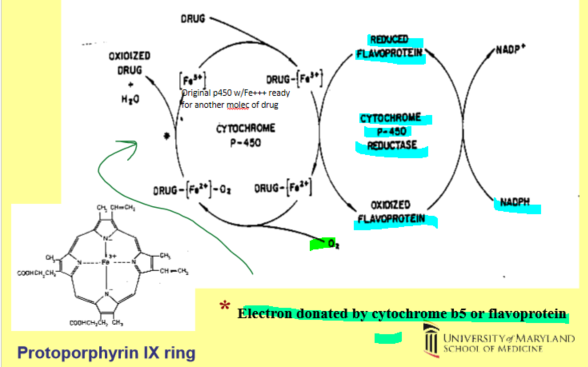
cytochrome p450 cycle
- Flavoproteins = FAD and FMN
- Hydroxylation reactions involving the particip of molecular oxidation (O2) and reducing equivalents derived from NADPH
- NADPH releases 2 e- when oxidized that are used in cytochrome P-450 complex at different points in the cycle
- Flavoproteins (FAD and FMN) and cytochrome P-450 reductase (cytochrome c reductase) required to shuttle e-‘s at the appropriate times
- Cytochrome P450 is a porphyrin-containing enzyme that containes coordinately bound Fe that can be in a reduced (+2) or oxidized (+3) state
phase II enzymes: overarching characteristics
Final step in “detoxification” pathway to make inactive products to be excreted renally
- Conjugates are polar
- Invovles high energy intermediates
- Endogenous substrates for conjugations originate in diet
- Nutrition plays a critical role in regulation of drug conjugations
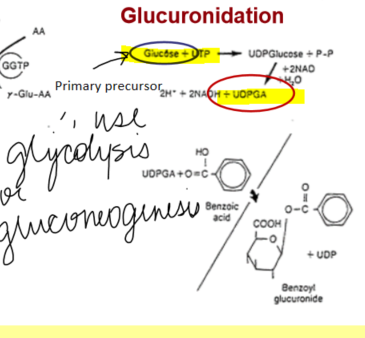
Glucuronidation (glucuronic acid conjugation)
- Major phase II reaction because of the general availability of glucose
- Most metabolites are excreted as glucuronide conjugates
- Involves condensation of drug or its biotransformation product with D-glucuronic acid
- Requires formation of a high energy intermediate: uridine diphosphate glucuronic acid (UDPGA)
- Formation of UDPGA from UDP-glucose is mediated by a dehydrogenase present in cytoplasmic fraction of liver
- Rxn of UDPGA w/ acceptro drug is catalyzed by glucuronyltransferase (UGT)
- Localized in ER microsomes
- Liver***, kidney, GI tract, skin
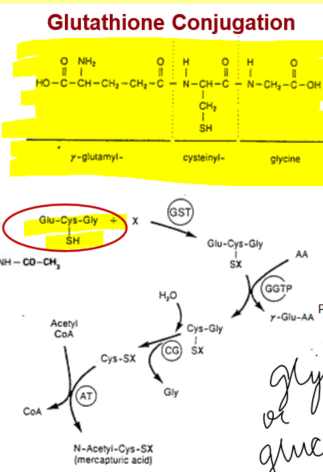
Glutathione Conjugation
- Means for removing toxic elecrtophilic compounds
- Electron free-radical scavenger
- Drugs and xenobiotics metab to strong electrophiles via phase I reactions and then converted to non-toxic conjugates by glutathione-S-transferase
- Cytosol of liver, kidney, gut and other
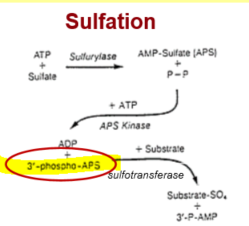
sulfate conjugation
- Major pathway for phenols (eg isoprenaline) and alcohols (dimetranizadole), amides (acetaminophen) and steroids (estrone)
- Cytosolic sulfotransferase (SULT) requires ATP activated 3’-phosphoadenosine-5’-phosphosulfate (PAPS) as a high energy intermediate cofactor
Acetylation
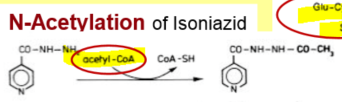
- Acetylation by N-acetyltransferase take place mainly in the liver Kuppffer cells (not in hepatocytes) and requires acetyl-CoA as a cofactor
- Kuppffer cell = fixed macrophage on liver sinusoids that is stellate
- Sulfanilamide and isoniazid
Other types of conjugation reactions: methylation and AA conjugation
- Methylation
- Desmethylimiprimine
- Noradrenaline
- Requires S-adenosylmethionine as cofactor with the methyltransferase
- Amino Acid Conjugation
- Benzoic acid
- Special form of N-acetylation, conjugating erogenous carboxylic acids with amino acid (usu Gly, Glu, Ornithine, Arg, or taurine)
summary of phase II enzymes: type of conjugation, endogenous cofactors, transferase (location)
Type of Conjugation
Endogenous Cofactors
Transferase (location)
Glucuronidation
UDP-glucuronic acid
UDP-glucuronyl Transferase (microsomes)
Acetylation
Acetyl-CoA
N-acetyl transferase (cytosol, kuppffer cell)
Glutatione
Glutathione
GSH-S-transferase (cytosol)
Sulfation
Phosphoadenosyl phosphosulfate
Sulfotransferase (cytosol)
Glycine
Glycine
Acetyl-CoA transferase (mitochondria)
Methylation
S-Adenosyl methionine
Transmethylases (cytosol)
bioactivation
- Prodrugs can be selectively activated in a spec region of the body or to extend drug’s t1/2
- Prontosil -> Sulfanilamide (Abx; phase I azo-reduction)
L-DOPA -> Dopamine (Parkinson’s treatment; permeable to BBB & conv to dopamine in substantia nigra)
adverse reactions (general toxicity)
- Pattern of CYP450 genes varies b/w indivs
- Some indivs are more susceptible to developing adverse reactions to rx than others
- Eg lack functional gene for drug X, so doesn’t biotransform it –> too high plasma [] and toxicity
acetaminophen toxicity
- hepatic necrosis re: acetaminophen (paracetamol; TYLENOL)
- Metabolic pathway w/ P450 enzymes
- Metabolites usu detox by reacting preferentially with glutathione
- In overdose, more acetaminophen is avail to be metabolized by P450 enzymes to reactive metabolite
- When glutathione stores are depleted, it is free to react w/hepatocytes causing hepatitis and hepatocellular death
- Treatments that alter the availability of glutathione also alter hepatic necrosis and covalent binding of acetaminophen
- N-acetylcysteine = a stable precursor of glutathione -> decreases hepatotoxicity and covalent binidng assoc w/acetaminophen by increasing avail. Of glutathione
isoniazid and hepatitis
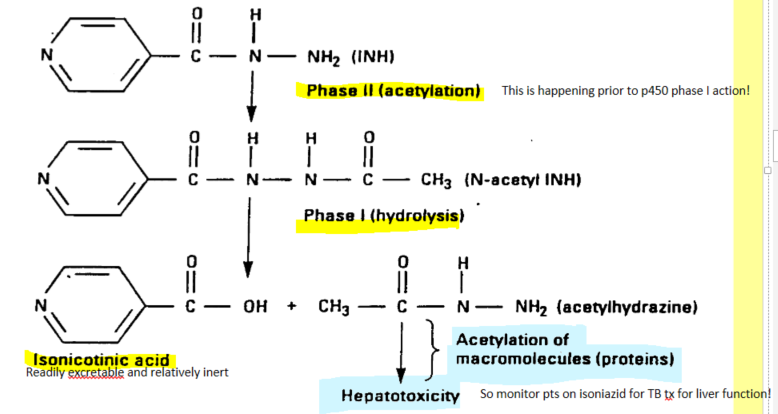
- serious hepatitis re: isoniazid (NYDRAZID) for TB prophylaxis
- Eg of a drug first acetylated directly by Phase II reaction
- Conjugated product = substrate for phase I type hydrolysis to form a reactive product (acetylhydrazine) -> hepatocellular necrosis
carcinogenesis re: bioactivation
- Cyp-450 isoforms and some phase II enzymes implicated in the activation of chemicals to carcinogens
- Epoxidation of benzo[a]pyrene = metabolites active in generating cancers
- Metabolites may form DNA adducts (intercalate into double strand of DNA)
- Some are free radicals causing DNA breaks
- Eg carbonium/nitrosamine
enterohepatic recirculation
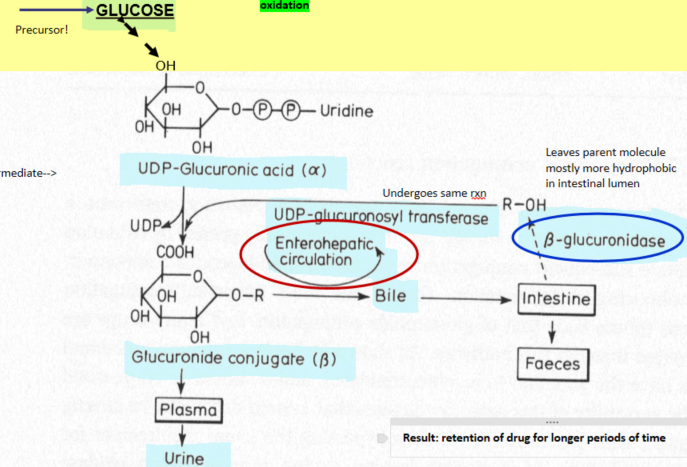
- some drugs excreted through intestinal tract are conjugated by glucuronidation following binding to bile
- Conjugates enter intestine but can be hydrolyzed by bacterial enzyme B-glucuronidase (product = original drug that can be reabsorbed through the enterocyte back to hepatic circulation)
- Extends lifetime of drug
enzyme induction
Environmental agents induce (enhance) the biosynthesis or inhibit degradation of various components of the mixed-function oxidase system (Phase I)
- eg Bishydroxycoumarin is metab more rapidly w/ presence of phenobarbital thanks to p450 enzymes being used up to induct phenobarbitol

-
5. Neoplasia II (Principles of Carcinogenesis)22
-
6. Intro to Anemia and Hemolytic Anemias27
-
7. Thaslessemias and Hemoglobinopathies30
-
8. Nutritional Deficiency Anemias29
-
9. Hemostasis (Physiology and Lab Tests)17
-
10. Hemostasis (Disorders)13
-
12. Pathology of BVs Overview (Burke) 8/2612
-
11. Pathology of Thrombosis and Hemostasis, hemodynamic disorders and shock16
-
13/14 Quantification of Drug-Receptor Interactions22
-
15/16 Pharmacokinetics13
-
16. Biotransformation28
-
17. Pharmacogenetics/genomics0
-
18. Case/Control Studies9
-
19. Cohort Studies7
-
20. Clinical Trials30
-
21. Confounding14
-
22. Diagnosis, Screening, and complications of Overuse27
-
23. Quasi-Experimental Study10
-
24. Statistical Inference35
-
25. Correlation, Regression, and Survival Analysis23
-
1. Cell Adaptations, Injury, and Death24
-
2. Injury and Repair19
-
3. Intro to Immunology14
-
4. Neoplasia I22



