- Why Electroencephalography (EEG)?
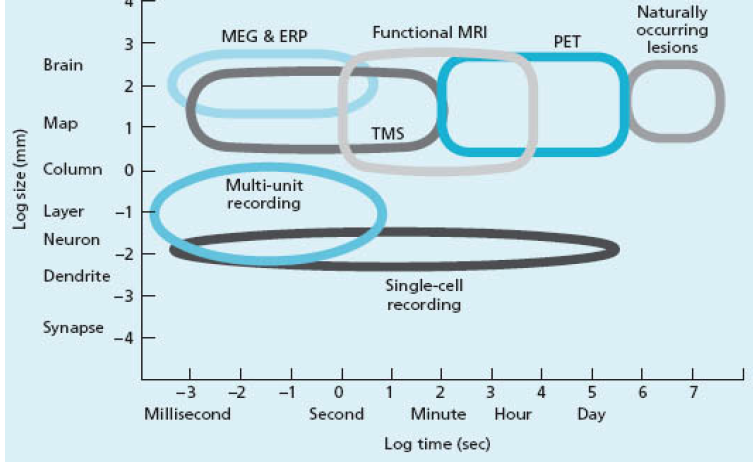
Excellent time resolution
- Cognitive, perceptual, linguistic, emotional and motor processes are fast and dynamic
- For example, consider theta band (4-8 Hz), a ‘slow’ rhythm but quite ‘fast’ for our conscious experience
- Or consider gamma (30-80 Hz)
2.
List 4 positive aspects of EEG.
- Direct indicator of neuronal activity
- Multidimensional (time, space, frequency, power, phase, connectivity etc)
- Portability (observing brain in action)
- Relatively inexpensive (20k - vs 2million fMRI)
3.
Name some negative qualaties of EEG
- It is not well-suited for precise functional localization
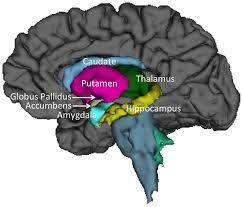
- It is not well-suited for measuring deep brain structures (e.g., putamen, thalamus, nucleus accumbens)
- Sub-optimal method: where in the brain does process X occur or is information Y stored
- It is also not very well-suited to study very slowly fluctuating process with uncertain and variable time course (fMRI is better)
4.
EEG reflects the differences of ………………………… over
time, created by the ……….. flows originating from
……………………….
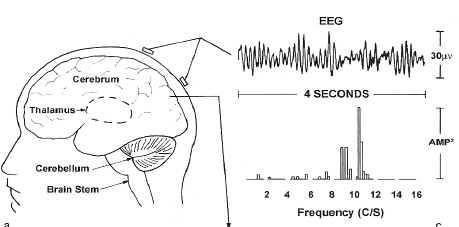
EEG reflects the differences of electrical potential over
time, created by the current flows originating from
neuronal populations.
5.
Name the two types of neuronal electrical activity.
(i) Action potential (AP) (an action potential is a short-lasting event in which the electrical membrane potential of a cell rapidly rises and falls, following a consistent trajectory)
(ii) Postsynaptic potentials (PSPs) are changes in the membrane potential of the postsynaptic terminal of a chemical synapse. PSPs are graded potentials, and should not be confused with action potentials although their function is to initiate or inhibit action potentials
EEG reads signals from PSPs in groups of millions of neurons.
6.
What are sodium channels (Na+)?
Sodium channels are integral membrane proteins that form ion channels, conducting sodium ions (Na+) through a cell’s plasma membrane
7.
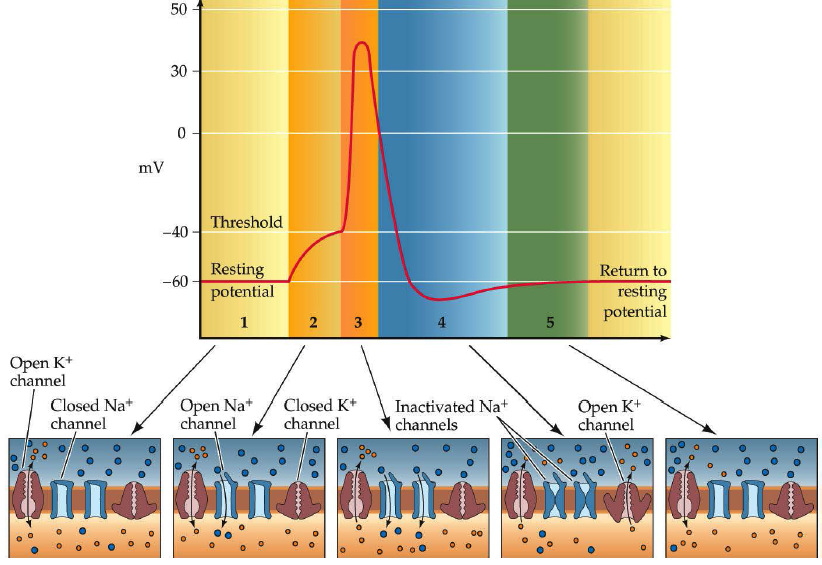
Mediation of the Action Potential by Voltage-Gated Sodium Channels:
List the 6 stages
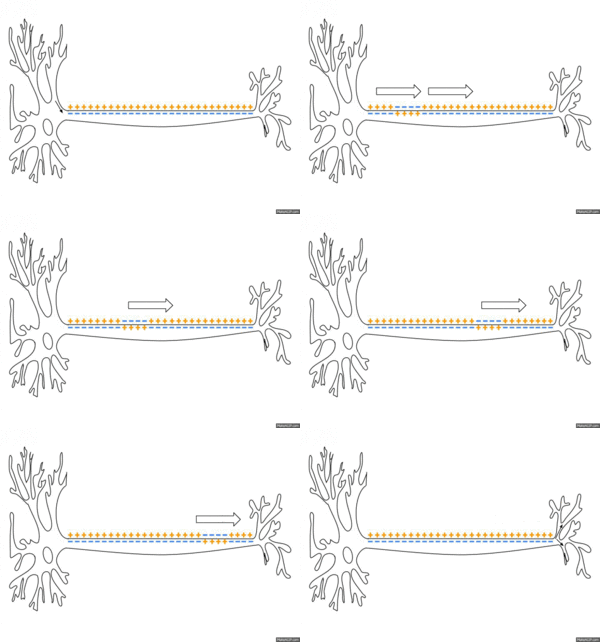
- Resting State – Both sodium and potassium channels are closed and membrane is in the resting state.
- Threshold - A stimulus opens some sodium Na+ channels. If the influx of sodium Na+ achieves threshold, then more channels are opened, triggering an action potential.
- Depolarization Phase- Activation gates of sodium channels are open, but the potassium K+ channels remain closed. Sodium ions rush into the cell, the interior of the cell becomes more positive
- Repolarization phase- Inactivation gates close channels, and potassium channels open. Potassium ions leave the cell, and the loss of positive charge causes the inside of the cell to become more negative.
- Undershoot - Both gates of the sodium channels are closed, but potassium channels remain open because their relatively slow gates have not had time to respond to repolarization of the membrane. Within another millisecond or two, the resting state is restored and the system is ready to respond again.
- Back to Resting State ready to fire again
8.
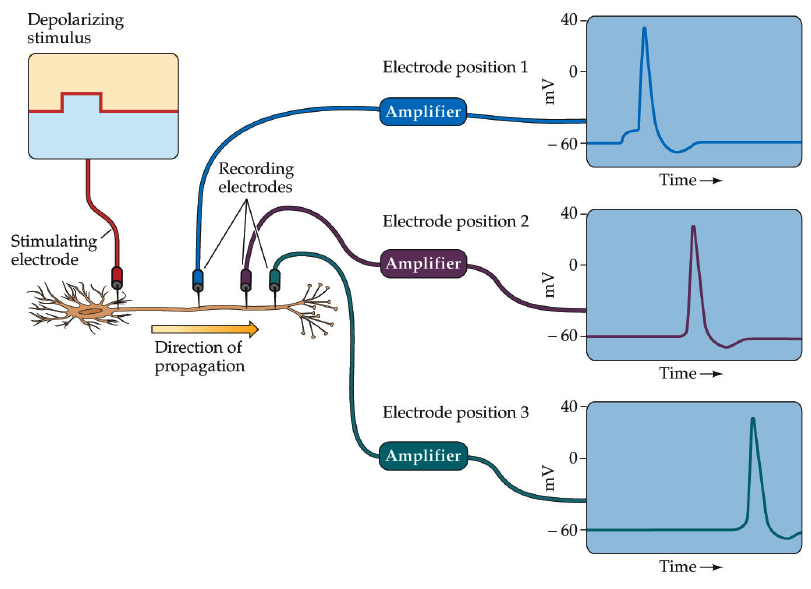
Propogation of action potential - how are electrodes placed?
Electrodes may be placed along an axon and will collect data at different times depending on the direction of the action potential.
9.
…………………. cause local changes in postsynaptic membrane potentials, through ……………………….. Information transmits with some delay on the order of a millisecond.
Besides ……………….. there are ……………………. or gap junctions. Ions flow directly through large channels into adjacent cells, with no time delay.
Chemical synapses cause local changes in postsynaptic membrane potentials, through neurotransmitters. Information transmits with some delay on the order of a millisecond.
Besides chemical synapses there are electrical synapses, or gap junctions. Ions flow directly through large channels into adjacent cells, with no time delay.
10.
Generation of Post-Synaptic Potential (PSP)
Generation of PSP:
- When the AP reaches the presynaptic axon end, a neurotransmitter is released into the synaptic cleft
- The neurotransmitter binds to the receptor of the postsynaptic neuron by opening or closing ion channels
- This leads to a graded change in membrane potential
11.
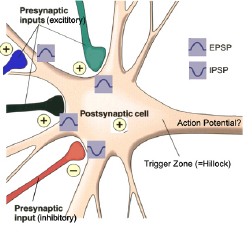
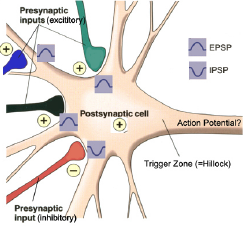
What are the two types of post-synaptic potential (PSP)?
- Excitatory PSP (for excitatory synapse - positive potential)
- Inhibitory PSP (for inhibitor synapse - negative potential)
A PSP is an electrical potential initiated at a postsynpatic site that can vary in amplitude and spreads passively across the cell membrane, decreasing in strength with time and distance
12.
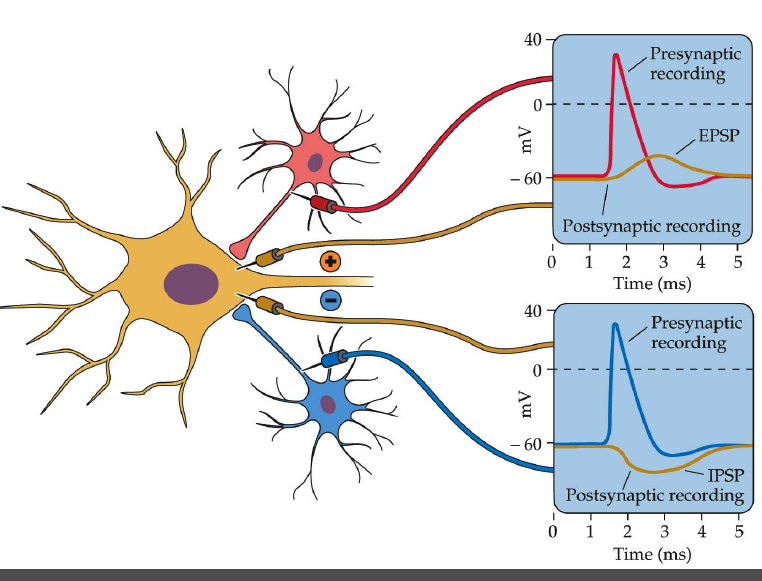
Recording Postsynaptic Potentials:
Draw an image of both excitatory and inhibitory neurons being read by EEG electrodes.
Red is excitatory (+)
Blue is inhibitory (-)
Depending on the neurotransmitter that is released the post synaptic potential can be either negative or positive.
- Electrical Signals are the Vocabulary of the Nervous System
…………. perform information processing to integrate ………………………..
A …………………. will fire an ……………………….. if a …………………. that exceeds threshold reaches its …………………….
Generally the combined effect of many …………………………….. is required for a …………………… neuron to fire.
Neurons perform information processing to integrate synaptic inputs.
A postsynaptic neuron will fire an action potential if a depolarization that exceeds threshold reaches its axon hillock.
Generally the combined effect of many excitatory synapses is required for a post-synaptic neuron to fire.
14.
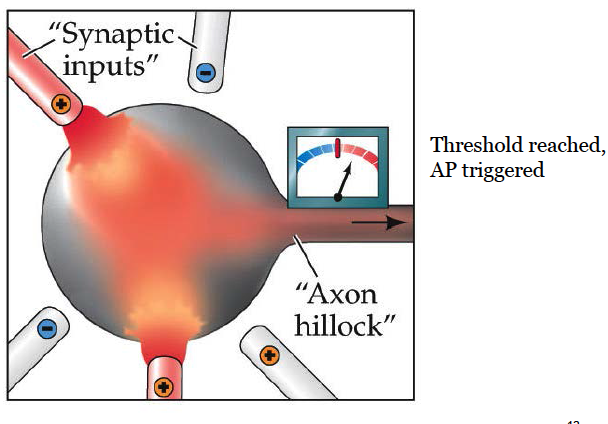
Spatial Summation in a Postsynaptic Cell (Part 1)
…………………………… cause a cell to fire.
Excitatory inputs cause a cell to fire.
15.
Spatial Summation in a Postsynaptic Cell (Part 2)
……………….. also plays a role.
Inhibition also plays a role.
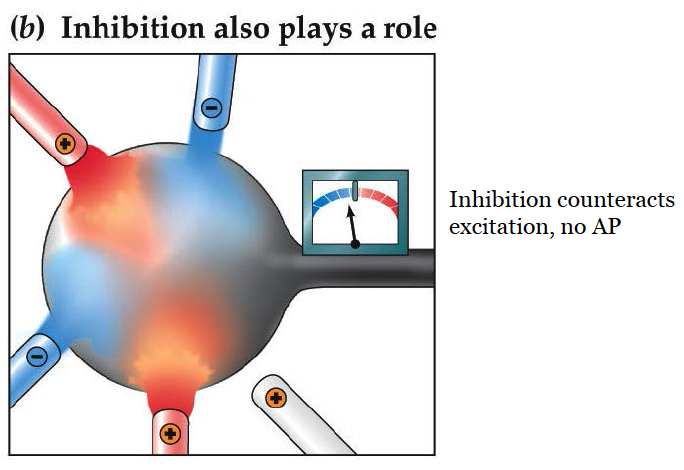
Inhibition counteracts excitation, no AP
16.
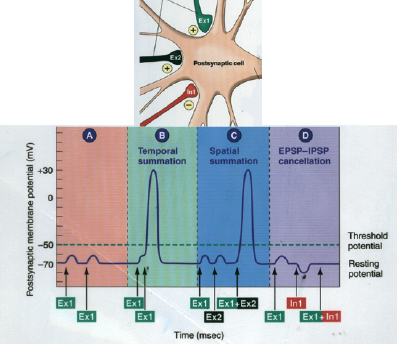
There are two types of summations:
What is spatial summation?
Spatial summation is the summing of potentials that come from different parts of the cell. If the overall sum – of EPSPs and IPSPs – can depolarize the cell at the axon hillock, an action potential will occur.
17.
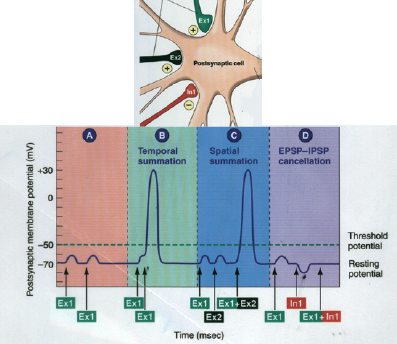
There are two types of summations:
What is temporal summation?
Temporal summation is the summing of potentials that arrive at the axon hillock at different times.
The closer together in time that they arrive, the greater the summation and possibility of an action potential.
18.
…………….. are primarily produced by summation of ……………………… of millions of …………….
EEG signals are primarily produced by summation of postsynaptic potentials of millions of neurons
19.
List 5 things EEG is not:
Include statements on:
meaurement, sensitivity, brain regions and speed.
- It cannot measure all neural events
- It cannot measure individual molecular or synaptic events nor it can isolate events that are produced by a specific neurotransmitter or neuromodulator
- It is less sensitive to deep brain structures Field strength decreases exponentially with distance
- Neuronal populations in deeper structures are not arranged in a geometrically parallel fashion
- It is not very suitable to measure to very slow (< 0.1 Hz) or very high (> 100 Hz) fluctuations
20.
Sample MC Question EEG
Signals represent summation of:
A.action potentials
B.post-synaptic potentials
C.a mixture of A and B
D.neither A nor B
B. post-synaptic potentials
21.
Sample Brief Question
(a) Describe briefly how post-synaptic potentials are generated.
(b) Also describe briefly the procedure by which the post-synaptic potentials are integrated
a) When the AP reaches the presynaptic axon end, a neurotransmitter is released into the synaptic cleft
The neurotransmitter binds to the receptor of the postsynaptic neuron by opening or closing ion channels
This leads to a graded change in membrane potential
b) Neurons perform information processing to integrate synaptic inputs. Generally the combined effect of many excitatory synapses is required for a post-synaptic neuron to fire. IPSPs and EPSPs are summed together.
22.
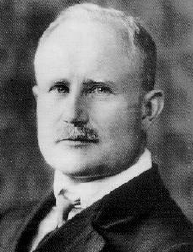
Who undertook the first EEG recording in Humans?
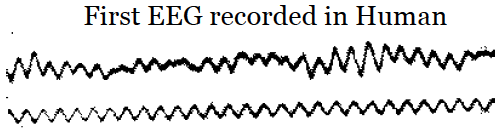
Hans Berger (1873-1941)
23.
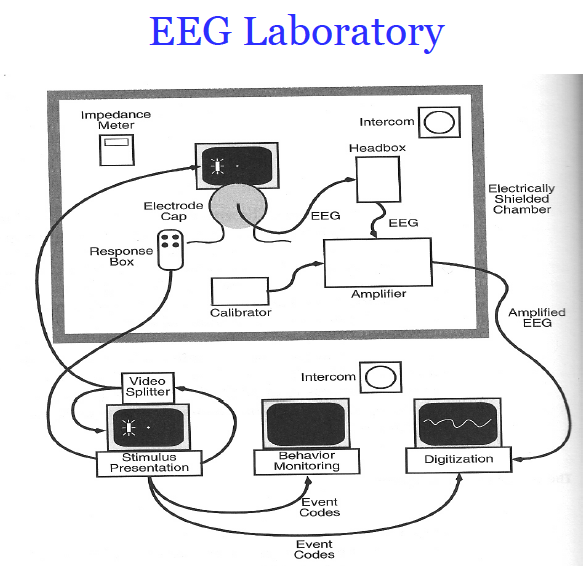
Draw a diagram of the EEG setup:
24.
Detail the electrondes used in EEG:
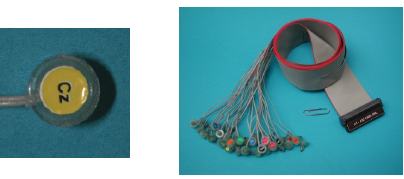
• Metal (conductive) –Ag/AgCl Electrodes (Silver electrodes with a thin coating of silver-chloride
- –Tin Electrodes
- –Goldcap Electrodes
•The conductivity should be good between the electrode and the scalp –Electrode gel to reduce the impedance/resistance
- –Impedance below 5 Kilo Ohms
- –Scalp preparation (removal of dead skin cells with alchohol cleaner wipes)
•Active Electrodes (relatively new last decade or so)
- –Integrated pre-amplifier
- –Faster preparation time






