What are the steps in the Nuffield intervention ladder, from least to most intrusive?
Vaccine hesticacy or low vaccine uptake
- No nothing/monitor the situation
- Inform and educate (e.g. social media messaging about vaccine safety and effectiveness)
- Enable choice that allows people to change behaviour (e.g. provide vaccine to people whenever and wherever they want it through mobile phone app and online platform in a model similar to uber)
- Guide choice through changing the default (HCPs will automatically offer vaccine unless the patient explicitly refuses during each healthcare visit)
- Guide choice through incentives (e.g. Receving money for completing vaccinations)
- Guide choice through disincentives (e.g. vaccination mandatory to get publicly-funded programs and services including public schools, colleges/universities, daycare as well as to be employed by government agencies)
- Restrict choice (e.g. Mask or vaccinate)
- Eliminate choice (e.g. Mandatory to get vaccinated or else face jail time)
List the five principles of the Canada Health Act.
CUPPA!
- Comprehensiveness
- Universality
- Portability
- Public administration
- Accessibility
As an AMOH, you have been asked to recommend a policy to your Board of Health that will guide decision making about opening local vaping establishments. List the steps you would take to develop this policy.
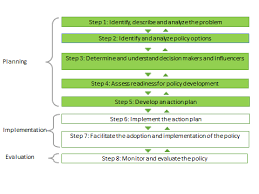
PHO 8 steps to making Healthy Public Policies
- Identify, describe, analyze the problem (e.g Opioid overdose)
- Identify, describe, analyze different policy options (e.g. needle exchange program, supervised consumption site, advocacy for decriminalization of all drugs)
- Identify, understand important stakeholders including decision makers (e.g. your boss and upper mgmt) and influencers (Community groups on opioid harms) to gain buy-in early
- Assess readiness for this type of policy (e.g. organization facing reorganization, so not a good time to develop new programs)
- Develop an action plan including goals and objectives, resources required.
- Implement the policy
- Faciliate the adoption and implementation of the policy
- Monitor and evaluate the policy
A new virus has been discovered recently that you believe is responsible for increased morbidity and mortality in your region. You are considering the application of quarantine measures to reduce the impact of this virus. List three criteria you would use to apply the precautionary principle to this situation.
- Is there sufficient evidence to support a reasonable suspision that there is a causal relationship between the virus and increased morbidity/mortality observed?
- Is there an observed increased morbidity/mortality when exposure to virus is increased?
- Is the exposure widespread?
- Are the harms from the virus serious?
- Are the harms from the virus difficult to treat or irreversible?
- What are the costs and benefits of action or no actions?
- Are the proposed measures proportionate to the risk?
- Similar situations with a new virus treated similarly based on best practice?
- Acceptability of the proposed quarantine measures to the public.
List 4 ypes of cost outcomes in health care and give an example of each
- Direct health costs - actual costs of delivering intevention e.g. drugs, nursing staff, lab tests
- Direct non-health costs - transport, support services, pension payouts, disability benefits, unemployment benefits (EI)
- Indirect costs - e.g. days lost from work, reduced productivity
- Intangible costs - e.g. pain, psychological harm, stigma
What are 3 measures of health status that takes into account time, mortality and morbidity?
HALYs (Health-Adjusted Life Years) are a group of summary measures of population health used in estimating burden of disease. HALYs combine the effects of morbidity and mortality simultaneously and are used to compare across diseases, interventions and populations. HALYs include QALY, DALY and HALE. QALY (Quality Adjusted Life Year) - estimate the number of years lived and the quality of life during these years that can be attributed to an intervention/treatment. QALY often used to analyze clinical interventions with the goal of maximizing the “good” quality of life. QALY can give an idea of how many extra months or years of life of reasonable quality of health a person might gain with each intervention. DALY (Disability Adjusted Life Yea) - quantify the burden of disease and disability in populations. It measures the gap between the current health of a population and an ideal situation (i.e. where everyone reaches the standard life expectancy). Daly estimates the number of years of life lost due to premature mortality and years lived in disability/disease. DALYs are an absolute measure used to compare disease burden in populations with the goal of minimizing the “bad” of gaps in health. HALE (Health Adjusted Life expectancy or Healthy Life Expectancy) - estimates the number of years that a person at a given age can expect to live in good health. It summarizes mortality and morbidity in a single measure of average population health, and has been used to compare health between countries and to measure changes over time. Healthy Life Expectancy is related to HALYs but not disease-specific and calculated using the life table method, incorporating estimates of average health over each age interval. https://nccid.ca/publications/understanding-the-measurement-of-global-burden-of-disease/
What is QALY? and how do you calculate QALY?
Quality-Adjusted Life Year is a summary measure of population health used in estimating burden of disease. QALY estimate the number of years lived and the quality of life during these years that can be attributed to an intervention/treatment. QALY = number of additional year of life lived x utility values related to Health Related Quality of Life
What is DALY? and how do you calculate DALY?
DALY (Disability Adjusted Life Yea) - quantify the burden of disease and disability in populations. It measures the gap between the current health of a population and an ideal situation (i.e. where everyone reaches the standard life expectancy). Daly estimates the number of years of life lost due to premature mortality and years lived in disability/disease. DALYs are an absolute measure used to compare disease burden in populations with the goal of minimizing the “bad” of gaps in health. DALY = DALY= Years of life lost due to premature mortality (YLL) + Years lived with disability (YLD) YLL = the number of deaths multiplied by a standard life expectancy. YLD=multiplying the number of disability cases (incidence cases) by the average duration of the disease/disability and weighted representations of disability called the disability weight.
Name the 5 Stages in policy cycle?
Agenda Setting
Policy formulation
Decision-making
Policy implementation
Policy evaluation
According to the ACF, how does polic change occur?
- Policy-oriented learning: “enduring alterations in thought or behavioural intentions that result from experience and which are concerned with the attainment or revision of the precepts of the belief system of individuals or of collectives”; generally takes place in public fora
- Policy brokers: Similar to the MSF’s policy entrepreneur
- External shock: “events outside the control of subsystem participants”; might include economic or regime changes, disasters, or changes in other subsystems (often necessary, but not sufficient, for policy change)
- Internal shock:Events directly related to the policy subsystem that “confirm the policy core beliefs of minority coalitions, increase doubts abou the core beliefs of the dominant coalition, and bring into question the effectiveness of their policies”
- Negotiated agreement:Agreement between two or more parties that disagreed over a policy choice; requires a hurting stalemate, in which the status quo hurts all parties
List 5 mechanisms for implementing policy instruments
- Legislation and regulation
- Constitution
- Court ruling
- Institutional rules
- Arbitration
- Inaction: Non-decision becomes policy “when it is pursued over time in a fairly consistent way against pressures to the contrary”
How do governments decide which policy instrument to use?
- Effectiveness: “Degree of goal-realization”
- Efficiency: “Input-output/outcome ratio”
- Legality: “degree of correspondence…with the relevant formal rules as well as with principles of proper (administrative) process)
- Democracy: “accepted norms as to government-citizen relationships in a democratic political order”
- Legitimacy: Degree to which policy instrument choice is viewed as just
Name 5 types of policy analysis
- Descriptive: What happened? (e.g., description of the development and implementation of the IHR 2005)
- Explanatory: Why did it happen? (e.g., why was the IHR 2005 developed and implemented?)
- Evaluative: Did it work? (e.g., did the implementation of the IHR 2005 reduce the risk of the international spread of disease?)
- Predictive: What will happen? (e.g., will the IHR 2005 continue to be effective in an increasingly globalized world?)
- Prescriptive: What should happen? (e.g., how can the IHR 2005 be amended to better address inequities in surveillance?)
You are tasked with developing policy instruments to reduce childhood obesity. List the 4 types of policy instruments and give an example of each as applicable to reducing childhood obesity.
- Incentive - government subsidies to reduce price of fresh produce and fruits to affordable level
- Disincentive - taxing sugar heavily e.g. 100% per kg of sugar
- Governmental delivering service - running a bike-sharing programs nation-wide for free
- Legislation/Regulation - Ban markerting of junk food towards children and teenagers
You have been asked to plan for a process, short-term, and long-term outcome evaluation of an intensive 12-week group intervention program designed to increase physical activity among men aged 40-64 in your region who are at high risk of progression to T2DM and developing IHD.
A) Apart from reduced risk of T2DM and IHD, list 4 health benefits of physical activity
B) List 4 potential process indicators
C) List 4 potential short-term outcome indicators
D) List 4 potential medium-to-long-term outcome indicators
A) Health benefits
- Decreased risk of certain cancers
- Decresed blood pressure/risk of hypertension
- Decreased risk of adverse blood lipid profile
- Decreased risk of dementia
B) Process indicators
- Number of participants who took part in group sessions
- Number of group sessions delivered
- Proportion of target population in region that participated
- Number of individuals referred to the program
C) Short-term outcome indicators
- Proportion of participants meeting 150 minutes of moderate-vigorous physical activity upon completion of program
- Mean % change in weekly minutes of physical activity reported by participants before and after program
- Mean % change in weight of participants before and after program
- Mean % change in HDL, LDL and triglycerides before and after program
D) Medium-Long-term outcome indicators
- Proportion of participants meeting 150 minutes of moderate-vigorous physical activity 1 year after completion of program
- Proportion of participants who develop T2DM in 1-5 years
- Proportion of participants who are diagnosed with an MI in 1-5 years
- Mean % change in weight 1 year after program
You are performing an HIA related to the proposed construction of a new sports complex in your area. You have identified that there is likely to be a significant impact related to noise on residents in neighbouring areas during the construction phase.
A) List 4 adverse health impacts associated with noise
B) List 4 potential mitigating measures you could recommend to reduce the adverse health impacts of noise on the residents.
C) List 4 potential indicators you could use to assess the impact of noise on residents once construction has commenced
A)
- Noise induced hearing loss
- Impaired speech comprehension
- Increased sleep disturbance
- Increased stress & annoyance
B)
- Erect a sound barrier around construction site
- Alter routes of construction vehicles into area to reduce need for reversing alarms
- Use machinery with improved technological effiiciency to reduce noise production
- Alter orientation and design of construction site to maximize physical distance between construction and residents
- Reduce the maximum blast noise produced in exchange for increased number of blasts (evidence-based)
C)
- Noise complaints made by residents to local council about construction noise
- % of residents reporting sleep disturbance pre and post construction commencement
- % of residents reporting extreme annoyance pre and post construction commencement
- % change in background noise levels in decibals before and after construction commencement
You are an MOH in a regional health authority and have been advised there is a large (~500) arrival of Somali refugees expected to be relocated to your region in the coming months. Your CMOH has asked you to perform a health needs assessment for the incoming refugees.
A) List 4 health conditions that are likely to be more prevalent in the incoming refugees than your existing typical regional Canadian population
B) List 4 potential recommendations you would make to prepare various health services to provide care for the incoming refugees
A)
- TB
- Psychological distress (e.g. PTSD if coming from refugee camps)
- Malaria
- HIV
- Schistosomiasis
- Strongyloides
B) Recommendations
- Appropriate interpreter services are available in the necessary languages and dialects of the incoming refugees
- Healthcare providers to undergo andy specific cultural competency training related to this specific population
- Health information materials and resources are translated into the appropriate languages
- Providing training to healthcare workers related to diagnosis and treatment of specific conditions they may encounter in the refugee population that they are unfamiliar with e.g. schistosomiasis
- Making a contact network among relevant healthcare and social service providers to enable better continuity of care
You are a senior medical advisor to the Ministry of Health in your province that has recently seen a large increase in opioid-related deaths. The Minister would like to implement a comprehensive set of harm reduction strategies to address the issue but first you have been tasked with conducting a stakeholder analysis related to this issue.
A) List 4 potential harm reduction policies that can be used to to address the issue of opioid-related deaths.
B) List 5 stakeholder groups or sectors you would include in your stakeholder analysis
C) List 6 factors to consider and assess for each stakeholder as part of your analysis
A)
- Drug testing
- Supervised consumption sites
- Peer-delivered naloxone therapy
- Opioid substitution therapy
B)
- Provincial police chief/commisioner
- Canadian Mental Health Association
- Drug user advocacy group
- Provincial Emergency Health Services
- Ministry of Justice
C)
- Nature of involvement in the issue
- Level of interest in issue
- Level of influence, power, and authority related to the issue
- Resources available to address the issue
- Position/level of support for issue/intervention to address the issue
- Impact of the issue on the stakeholder
List 8 steps in developing a policy
PROSS-DIE
- Problem - describe
- Readiness
- Objectives/Goals/Options
- Stakeholders - decision makers and influencers
- Support - develop support, share, consultation
- Revise - draft/revise based on feedback received
- Implement
- Evaluate
List 6 steps in the policy cycle
- Stakeholder engagement
- Agenda setting
- Policy formulation
- Policy adoption/support
- Policy implementation
- Policy evaluation
List 6 criteria to consider in a stakeholder analysis
I4RS (or RINS or RAISIN)
- Resources available to support the issue/intervention
- Influence - level of authority and power related to the issue
- Interest level in the issue
- Impact level of the issue on the stakeholder
- Nature of involvement in the issue (funder, decision maker)
- Support - support and position related to the issue
A) List 6 steps in program evaluation
B) List 4 groups of standards to inform each step of a program evaluation
A) SDD-ECD
Some Don’t Do Evaluation ‘Cause Dumb
- Stakeholders - Engage stakeholders throughout the process
- Describe - describe the program being evaluated
- Design - focus the design of the evaluation
- Evidence - gather credible evidence (quant and qual)
- Conclusions
- Disseminate - share findings and lessons learned
B) FUPA (Fees utilitze proper accuracy)
- Feasibility
* Are the planned evaluation activities realistic given the time, resources, and expertise at hand? - Utility
- Who needs the evaluation results?
- Will the evaluation provide relevant information in a timely manner for them?
- Propriety
- Does the evaluation protect the rights of individuals and protect the welfare of those involved?
- Does it engage those most directly affected by the program and changes in the program, such as participants or the surrounding community?
- Accuracy
* Will the evaluation produce findings that are valid and reliable, given the needs of those who will use the results?
List 7 steps in strategic planning in healthcare
MS-OOP-BE
- Mission and vision - develop or review existing
- SWOT - Business and Operational Analysis
- Options - Develop and Select Strategic Options
- Objectives - Establish strategic objectives
- Plan - develop strategic execution plan
- Budget - establish appropriate budget and resource allocation
- Evaluate - evaluate execution of plan
List 5 general policy levers/instruments
- Incentives
- Disincentives
- Information campaigns
- Regulations
- Funding programs


-
2021 Environmental Health63
-
2021 Communicable Disease59
-
2021 Health Promotion26
-
2021 NCD22
-
2021 Epi/Biostats45
-
2021 Policy and Planning42
-
2021 Emergency Management8
-
2021 Public Health Ethics & Law4
-
2021 Management & Leadership101
-
2021 Others3
-
2021 Risk Factors16
-
2021 Special Populations42
-
2021 Oral openers10
-
2021 CTFPHC + NACI18
-
Miscellaneous from 2021 Deck185
-
2022 Environmental Health31
-
2022 Mock Orals0
-
Summary Deck13
-
2022 Hot Topics4
-
2022 Health Promotion0
-
2021 Epi/Biostats COPY45
-
2021 Policy and Planning COPY42
-
2021 Emergency Management COPY8
-
2021 Public Health Ethics & Law COPY4



