Name 3 examples of condensation polymers
- polyamides
- polyesters
- polypeptides
What are polyamides made out of?
Dicarboxylic acids + diamines
Polyamides
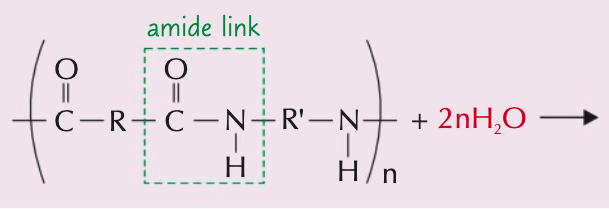
State the name of the bond that forms between the carboxyl
groups and amino groups
Amide link

Name 2 examples of polyamides
- Nylon 6,6
- Kevlar
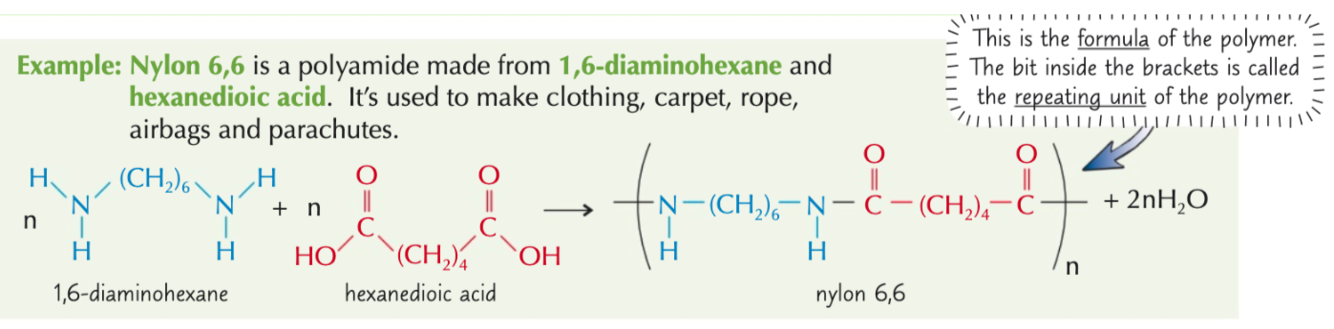
State what nylon 6,6 is made from
1,6-diaminohexane + hexanedioic acid
Name some uses of nylon 6,6
Used to make clothing, carpet, rope, airbags and parachutes
Draw an equation showing how nylon 6,6 is formed
State what kevlar is made from
1,4-diaminobenzene and benzene-1,4-dicarboxylic acid
Name some uses of kevlar
Used in bulletproof vests, boat construction, car tyres and lightweight spots equipment
Draw an equation showing how kevlar is formed

What are polyesters made out of?
Dicarboxylic acids + diols
Polyesters
State the name of the bond that forms between the carboxyl
groups and hydroxyl groups
Ester link

Name an example of polyester
Terylene (PET)
State what terylene (PET) is made from
Benzene-1,4-dicarboxylic acid and ethane-1,2diol
Name some uses of terylene (PET)
Used in plastic bottles, clothing, sheets and sails
Draw an equation showing how terylene (PET) is formed

Hydrolysis
Draw the original monomers

Condensation polymers are ______ than addition polymers
stronger & more rigid
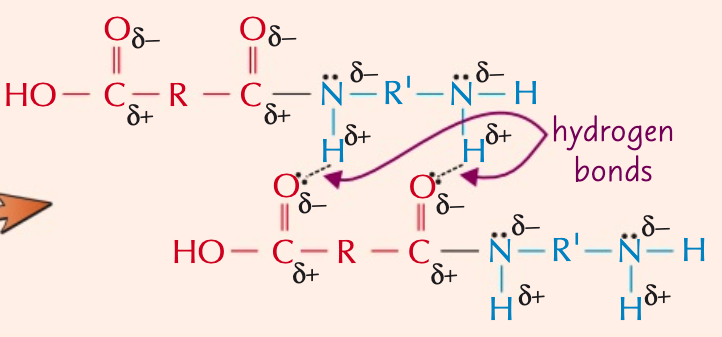
Why are condensation polymers stronger & more rigid than addition polymers?
- ∵ made up of chains contains polar bonds e.g. C-N and C-O
- ∴ have Van der Waals forces, permanent dipole-dipole forces and hydrogen bonds between polymer chains
Why are polyalkenes (addition polymers) non-biodegradable and won’t react when being used?
Have non-polar C-C bonds = unreactive and chemically inert
Why are condensation polymers biodegradable?
- polar bonds (e.g. C=O) in chains = open to attack by nucleophiles
- ∴ can be broken down by hydrolysis
- ∴ are biodegradable but process is very slow
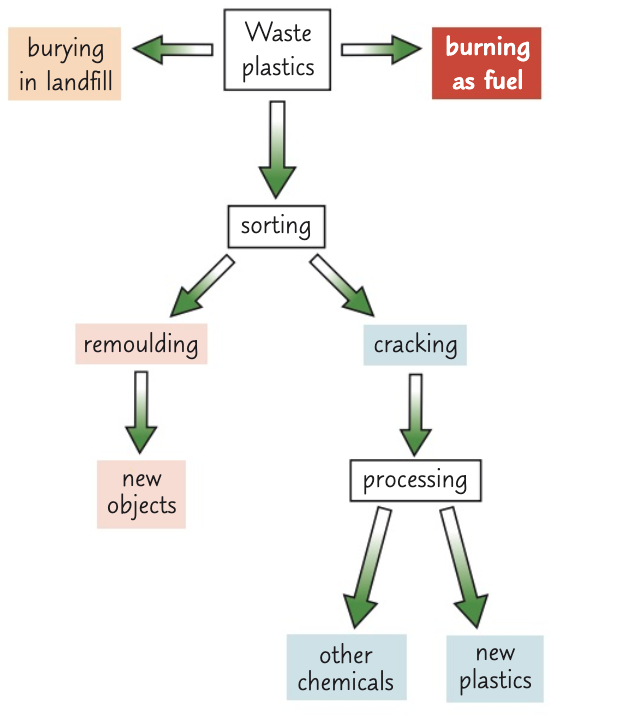
Name 3 ways of disposing waste plastics
- Burying in landfill
- Burning as fuel
- Recycling
When are plastics placed in landfills?
When plastic is:
- Difficult to separate from other waste
- Not in sufficient quantities to make separation financially worthwhile
- Too difficult technically to recycle
Name an advantage of using landfills to dispose plastics
Landfill is cheap and easy method of waste disposal


-
1.1 Atomic Structure88
-
1.2 Amount of Substance44
-
1.3 Bonding136
-
1.4 Energetics43
-
1.5 Kinetics26
-
1.6 Chemical Equilibria, Le Chatelier's Principle and Kc31
-
1.7 Oxidation, Reduction and Redox Equations34
-
1.8 Thermodynamics72
-
1.10 Acids and Bases101
-
1.11 Rate Equations60
-
1.12 Kp19
-
1.9 Electrode Potentials and Electrochemical Cells94
-
2.1 Periodicity17
-
2.2 Group 2, The Alkaline Earth Metals47
-
2.3 Group 7, The Halogens69
-
Test for Ions33
-
2.4 Properties of Period 3 Elements and their Oxides and Chlorides88
-
2.5 Transition Metals176
-
2.6 Reactions of Ions in Aqueous Solution62
-
3.1 Introduction to Organic Chemistry65
-
3.2 Alkanes73
-
3.3 Halogenoalkanes52
-
3.4 Alkenes51
-
3.5 Alcohols43
-
3.6 Organic Analysis29
-
3.7 Optical Isomerism20
-
3.8 Aldehydes and Ketones27
-
3.9 Carboxylic Acids and Derivatives99
-
3.10 Aromatic Chemistry46
-
3.11 Amines43
-
3.12 Polymers33
-
3.13 Amino Acids and Proteins39
-
3.14 Organic Synthesis31
-
3.15 Nuclear Magnetic Resonance Spectroscopy42
-
3.16 Chromatography39
-
test0



