what is in a CBC?
- WBC
- hemoglobin
- hematocrit
- platelets
what are normal lab values for CBC?
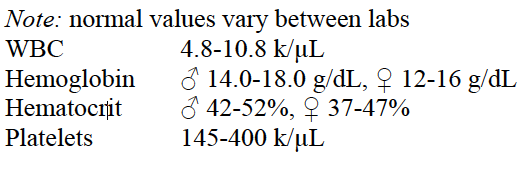
with an infection, what is expected to happen to the WBC count after surgery?
- Eventually it should go down,
- but in post-op days 1-2, the WBC may actually increase a bit.
- this is may occur because surgery activates the body’s reaction to the infection.
what should be done if the patient’s WBC is over 10?
First, decide if the patient has an infection:
- If there is an infection, then antibiotics and possible incision and drainage (I&D) should decrease the WBC count
- If there is not an infection, then the cause must be determined. Is the increase acute or chronic? Is there another source of infection (other than the foot)? Is the patient on corticosteroids? Is there a combination of medical conditions causing this?
what to do if platelets are low
(under 150-350 k/mL)?
can transfuse platelets,
but this is not commonly done
what are the minimum levels for hemoglobin and hematocrit for elective surgery?
- Hemoglobin 10 gm/dL
- Hct 30%
what should be done if the Hemoglobin/Hematocrit (H/H) is below 10/30?
if necessary, transfuse 1-2 units of packed red blood cells (PRBC)
what is the condition called if the Hemoglobin/Hematocrit (H/H) is below 10/30?
anemia
what are causes of microcytic, hypochromic anemia?
- Iron deficiency
- thalassemias
- lead poisoning
what are causes of macrocytic, megaloblastic anemia?
Vitamin B12/folate deficiency
following a transfusion of PRBC,
when will changes in the H/H be seen?
(PRBC = packed red blood cells)
approximately 3 hours
Therefore, order new labs to be drawn 4 hours after last unit given.
what is in a BMP?
(BMP = basic metabolic panel)
- sodium
- potassium
- chloride
- carbon dioxide
- BUN
- creatinine
- glucose
what is in a CMP?
(CMP = comprehensive metabolic panel)
- BMP
- ALP (alkaline phosphatase)
- ALT (alanine amino transferase, also called SGPT)
- AST (aspartate amino transferase, also called SGOT)
- bilirubin
- albumin
- total protein
- calcium
what are normal values for BMP?
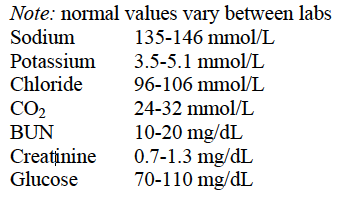
what do Na+, K+, Cl and CO2 tell you?
these electrolytes indicate nutritional status
what should be done if Na+ is low?
give NSS or regular salt
(NSS = Normal saline solution)
normal saline solution
route, other names, indications
- can be administered only via intravenous (IV) access.
- 0.9% Normal Saline (NS, 0.9NaCl, or NSS) is one of the most common IV fluids
- Indications (most hydration needs): hemorrhage, vomiting, diarrhea, hemorrhage, drainage from GI suction, metabolic acidosis, or shock)
what should be done if K+ is too low?
- Manage hypokalemia
- Give K-Dur (potassium chloride supplement)
- Give potassium-rich foods (i.e. banana)
hypokalemia: sequelae
Hypokalemia may cause:
- cardiac arrhythmias
- muscle weakness
- paresthesias
- cramps
what should be done if the K+ is too high?
- Order EKG
- Manage hyperkalemia
- Calcium gluconate
- Sodium bicarbonate
- Dextrose with insulin
- Kayexalate
hyperkalemia: sequelae
Hyperkalemia may cause:
- cardiac arrhythmias
- lethargy
- respiratory depression
- coma
what do BUN and creatinine indicate?
renal function
what should be done if the creatinine is too high?
- Consult renal if creat is over 1.5 for a couple of results
- Note: creat may be increased after muscle breakdown or loss
which is a more important indicator –
BUN or creatinine?
Creat is more important, because BUN is influenced by hydration state
- If the BUN is high but creat is normal, then the patient is most likely dehydrated and rehydration should correct the BUN
- However, if both BUN and creat are high, then the patient most likely has renal damage.


-
1. Anatomy74
-
2. Antibiotics129
-
3. Bugs and Drugs61
-
4. Labs33
-
5. Medicine229
-
6. Clinical Podiatry57
-
7. Biomechanics79
-
8. Surgery160
-
9. Trauma65
-
9B. Trauma Classifications31
-
10-Bone tumors38
-
10A. Radiographs - Bone Tumors32
-
10B. Bone Tumors - Details0
-
11-Wound Care32
-
13. Special Studies34
-
14. Procedures - Forefoot0
-
14. Procedures - Rearfoot0



