What are geometric optics? Explain the relationship of refractive index and speed in a formula.
Geometric optics:
If light propagates through a slit much larger than its wavelength, then the spreading of the wavefront (phase) may be simplified into a line (= light ray).
Therefore: mathematical abstractions → geometric
Refractive index - speed relationship:
Light travels with lower speed in denser materials
n1 = c / c1
Explain the phenomenon of light reflection. What is the relationship between angle of incidence and angle of refraction?
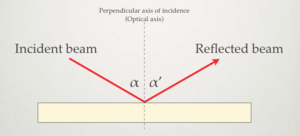
Reflection:
when light arrives at the boundary of 2 optically different media and the light stays in the first medium
Features:
- angle of incidence (α) = angle of reflection (α’)
- perpendicular and in the same plane
Define refraction, explain the related Snell’s law and illustrate the Fermat’s principle with an example from the animal kingdom
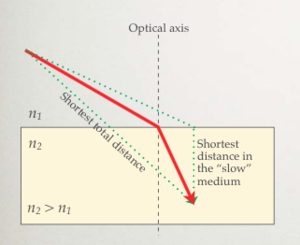
Refraction:
light is refracted as it changes its medium of propagation (n1 ≠ n2)
Snell’s law:
indicates the relationship between angle of incidence θ1, angle of refraction θ2, the velocities (v1 / v2) in the two media, and the indices of refraction (n2 / n1)
sin θ1/sin θ2 = v1/v2 = n2/n1
Fermat’s principle:
states that light takes the path of shortest time instead of the shortest distance
→ ex: “path selection” of ants
What is total internal reflection? How can the critical angle be calculated?
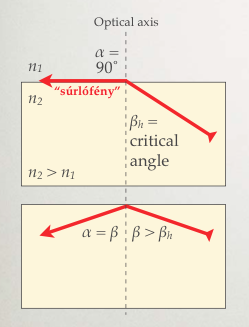
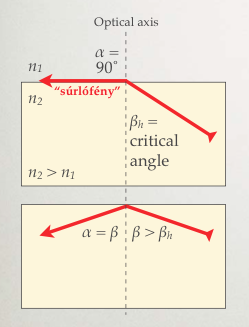
Total internal reflection:
- light travels from medium of higher refractive index to a medium of lower refractive index
- angle of incidence exceeds the critical angle
- entire incident light is reflected back
Formula for critical angle: n1 = n2 * sin βh
What is endoscopy?
Endoscopy:
- visual method to examine internal organs
- used in diagnostics (biopsy) and therapy (cauterization)
- light conducted by optical fibers into **organ **
- total internal reflection: light is reflected inside the fiber (ncore > nwall)
What is a refractometer? Give the formula how to calculate the concentration
Refractometer:
- Optical instrument for measurements of the index of refraction n1 (< nprism) of a small amount of transparent liquid
- used for the indirect concentration measurement of a solution component
- Based on the principle of total internal reflection
n1 = n0 + k⋅c
Explain the different types of images and relate them to magnification
Types of images:
- real image: projected onto a surface
- virtual image: mapped using an accessory lens
⇒ **magnification: **M= i/o
- o ≤ f: upright, virtual, magnified
- f < o < 2f: reverse, real, magnified
- o = 2f: reverse, real, same size
- o > 2f: reverse, real, diminished
Explain image formation and give the meaning of the 3 principle rays
Give the formula for the lens equation and optical power of refractile surface
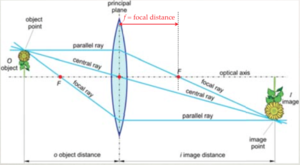
Image formation may be achieved by using a curved refractile surface (= converging lens).
Principle rays:
- parallel ray: ray parallel to optical axis
- focal ray: ray through focal point
- central ray: ray through center of the lens
Lens equation: D= 1/f = 1/i + 1/o
Optical power of refractile surface: D = (n-n’) / r

-
2. Dual nature of light. EM spectrum.9
-
3. Photoelectric effect.4
-
4. Wave phenomena.13
-
5. Geometric optics. Image formation.8
-
6. Wave optics. Microscopy.4
-
7. Image formation. Optics of the eye.5
-
8. Eletrons as matter waves.6
-
9. Atomic and molecular interactions.4
-
12. Boltzmann distribution.6
-
13. Liquid crystalline systems.2
-
14. E-level system of solids. Conductance.6
-
16. Black body radiation.7
-
17. Law of radiation attenuation.8
-
19. Light absorption in solutions.7
-
20. Luminescence.5
-
23. Atomic nucleus. Isotopes.3
-
24. α-, and β-decay. γ-radiation.8
-
25. Radioactive decay law.6
-
26. Ionizing radiations.6
-
27. Radiation and bodies. Applications.10
-
28. Dosimetry. Dose concepts.3
-
29. Nuclear measurement technique.6
-
30. Isotope diagnostics.8
-
31. Diagnostic applications of isotopes.9



