STANDARD DEVIATION (SD)
If the Mean (average) Score on STEP 3 was recently 222 and Your Score is 238, the “Deviation/Difference” from the mean for your score is 16 points (238 - 222 = 16).
- If the Standard Deviation (SD) for STEP 3 is also (coincidentally) 16 points, what does that mean for your score of 238?
You know the following information:
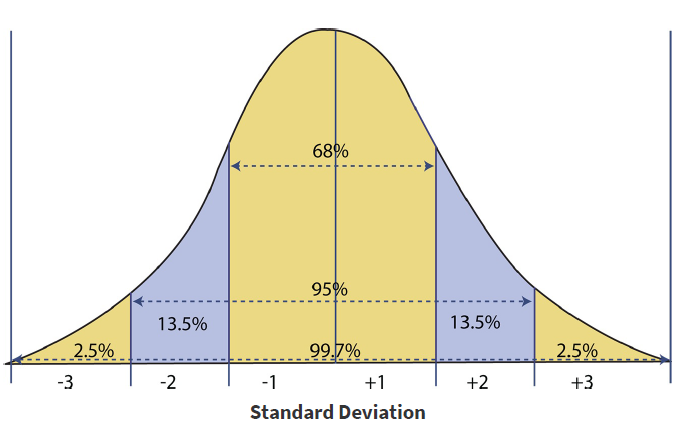
- 1 SD = 68 percent of scores
- 2 SD = 95 percent of scores
- 3 SD = 99.7 percent of scores
Your score of 238 is 16 points above the mean. Here, one SD above the mean indicates that your score is better than 84% (50% + 34% = 84%) of test takers.
STANDARD DEVIATION (SD)
EXAMPLE: Say the Mean Score for STEP 2 is 240 and the Standard Deviation (SD) for STEP 2 is 18 points:
- What Score would you need to receive on STEP 2 in order to do Better Than 84% of other test takers?
You know the following information:
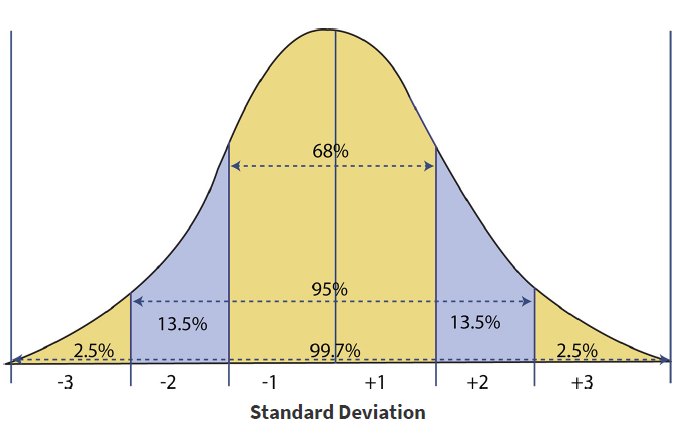
- 1 SD = 68 percent of scores (34% above, 34% below)
- 2 SD = 95 percent of scores (47.5% above, 47.5% below)
- 3 SD = 99.7 percent of scores (49.85% above, 49.85% below)
We know one SD above the average means doing Better Than 86% of other test takers (Mean + 1SD), and on SD below the average means doing Better Than 16% of other test takers (Mean - 1SD):
- One SD above the mean of 240 is 258 (240 + 18).
- So, you need to receive a 258 on STEP 2 to do Better Than 84% of other test takers.
STANDARD DEVIATION (SD)
Sample Problem:40,000 students take USMLE Step 3 each year. The mean score is 222 with an SD of 16. How many students scored above 254?
(A) 10,000
(B) 6,400
(C) 1,000
(D) 600
(E) Cannot be calculated from the data given.
You know the following information:
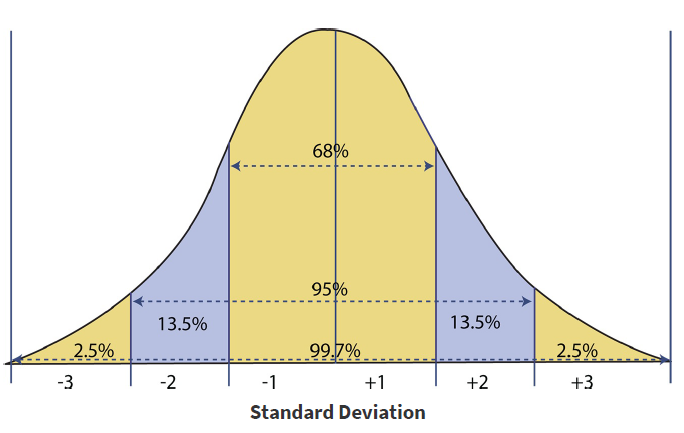
- 1 SD = 68 percent of scores (34% above, 34% below)
- 2 SD = 95 percent of scores (47.5% above, 47.5% below)
- 3 SD = 99.7 percent of scores (49.85% above, 49.85% below)
Doing the math:
a score of 254 on USMLE Step 3 is Two SDs above the Mean Score of 222 (222 + 16 + 16 = 254). This is equal to the Top 2.5% (0.025).
If 40,000 students = 100% of students then X students = 2.5% (top 2.5% of students)
Doing the math:
X = (40,000)(2.5%)
X = 1,000 students
STANDARD DEVIATION (SD)
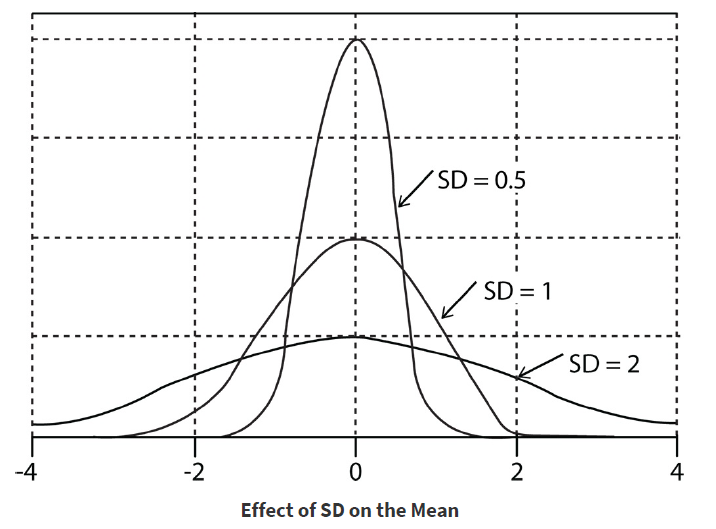
Explain the attached graphic using the Central Limit Theorem
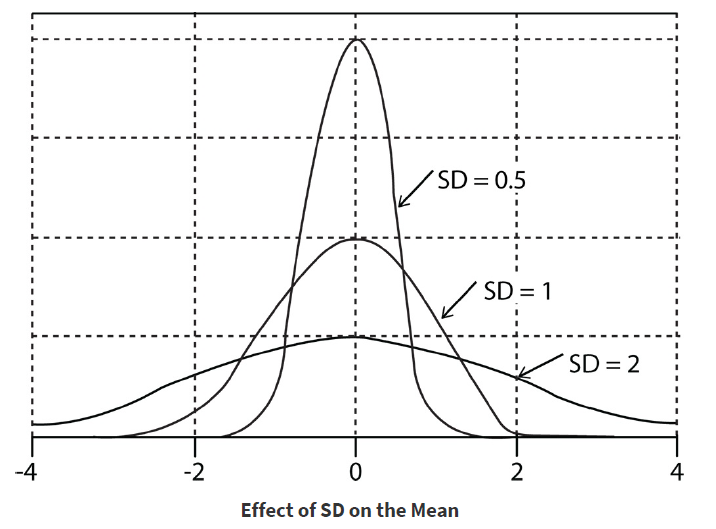
Graphical representation of the effect of SD on how data is grouped around the mean:
- According to the central limit theory, when you collect more data it tends to cluster around the center of the graph.
- The tallest line on the graph shows the smallest SD. This is because t**he data clusters around the center point.
- The flattest line on the graph shows the largest SD.

-
UWorld10
-
1. MTB Step 3 - Descriptive Statistics6
-
2. MTB Step 3 - Types of Data4
-
3. MTB Step 3 - Incidence & Prevalence5
-
4. MTB Step 3 - Precision, Accuracy, & Reliability3
-
5. MTB Step 3 - Standard Deviation4
-
6. MTB Step 3 - Standard Error of the Mean9
-
7. MTB Step 3 - Z-score, CIs, Correlation Coefficient, T-score, ANOVA, Chi-square8
-
8. MTB Step 3 - Study Design, Analysis of Results, Bias12
-
9. MTB Step 3 - Sensitivity & Specificity, NPV & PPV, ARR & RRR)20
-
10. MTB Step 3 - Null Hypothesis, the Meaning of P-Value, Error, Power, Extra Definitions)18



