Identify the six processes in the Project Scope Management knowledge area.
5.1 Understand the six project management processes in the project scope management knowledge area.
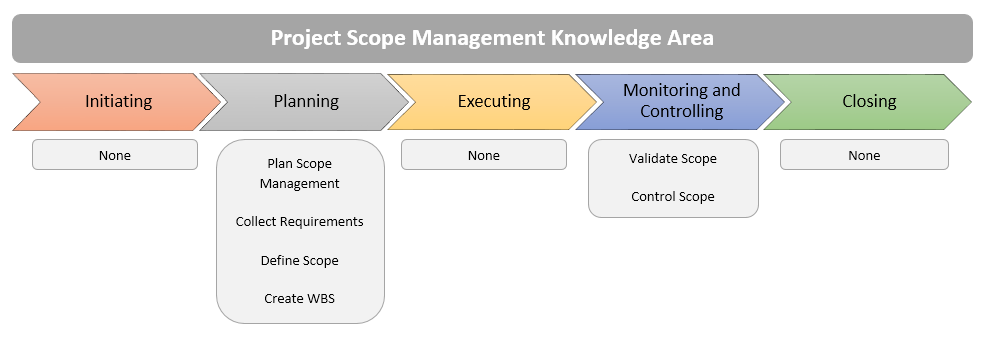
Includes the processes required to ensure that the project includes all the work required, and only the work required, to complete the project successfully.
- 1 Plan Scope Management
- 2 Collect Requirements
- 3 Define Scope
- 4 Create WBS
- 5 Validate Scope
- 6 Control Scope
* PMBOK Guide, Sixth Edition, 5 - Project Scope Management, p. 129*
Desscribe the following process: Plan Scope Management.
5.1 Understand the six project management processes in the project scope management knowledge area.
The process of creating a scope management plan that documents how the project and product scope will be defined, validated, and controlled.
PMBOK Guide, Sixth Edition, 5.1 - Plan Scope Management, p. 134
Desscribe the following process: Collect Requirements.
5.1 Understand the six project management processes in the project scope management knowledge area.
The process of determining, documenting, and managing stakeholder needs and requirements to meet objectives.
PMBOK Guide, Sixth Edition, 5.2 - Collect Requirements, p. 138
Desscribe the following process: Define Scope.
5.1 Understand the six project management processes in the project scope management knowledge area.
The process of developing a detailed description of the project and product.
PMBOK Guide, Sixth Edition, 5.3 - Define Scope, p. 150
Desscribe the following process: Create WBS.
5.1 Understand the six project management processes in the project scope management knowledge area.
The process of subdividing project deliverables and project work into smaller, more manageable components.
PMBOK Guide, Sixth Edition, 5.4 - Create WBS, p. 156
Desscribe the following process: Validate Scope.
5.1 Understand the six project management processes in the project scope management knowledge area.
The process of formalizing acceptance of the completed project deliverables.
PMBOK Guide, Sixth Edition, 5.5 - Validate Scope, p. 163
Desscribe the following process: Control Scope.
5.1 Understand the six project management processes in the project scope management knowledge area.
The process of monitoring the status of the project and product scope and managing changes to the scope baseline.
PMBOK Guide, Sixth Edition, 5.6 - Control Scope, p. 167
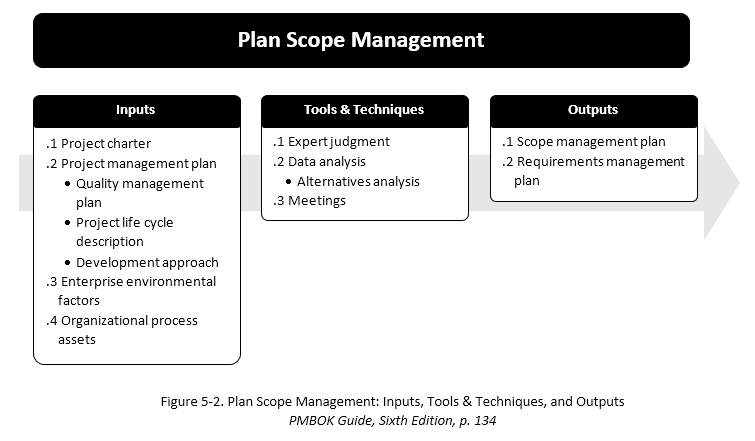
Identify the inputs, tools, techniques, and outputs for the following process: Plan Scope Management.
5.2 Identify the inputs, tools, techniques, and outputs defined in the six processes in project scope management.
PMBOK Guide, Sixth Edition, Figure 5-2. Plan Scope Management: Inputs, Tools & Techniques, and Outputs, p. 134
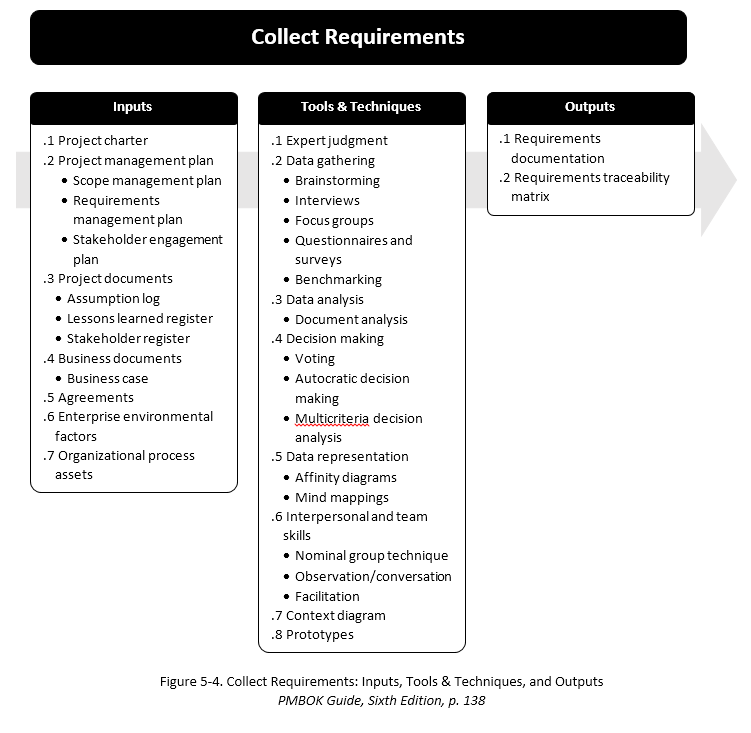
Identify the inputs, tools, techniques, and outputs for the following process: Collect Requirements.
5.2 Identify the inputs, tools, techniques, and outputs defined in the six processes in project scope management.
PMBOK Guide, Sixth Edition, Figure 5-4. Collect Requirements: Inputs, Tools & Techniques, and Outputs, p. 138
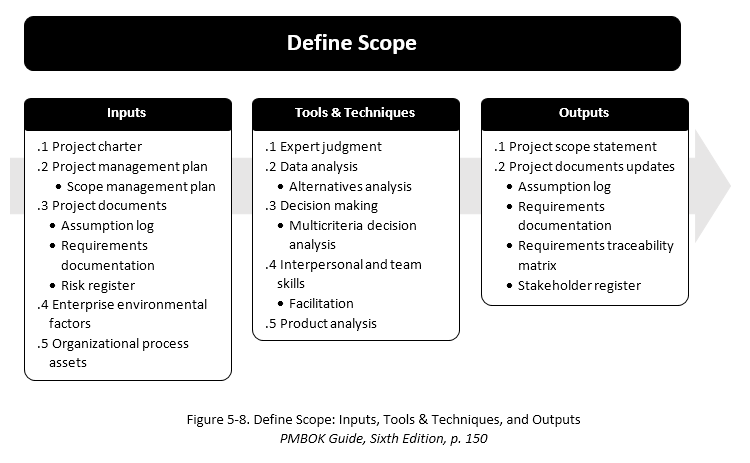
Identify the inputs, tools, techniques, and outputs for the following process: Define Scope.
5.2 Identify the inputs, tools, techniques, and outputs defined in the six processes in project scope management.
PMBOK Guide, Sixth Edition, Figure 5-8. Define Scope: Inputs, Tools & Techniques, and Outputs, p. 150
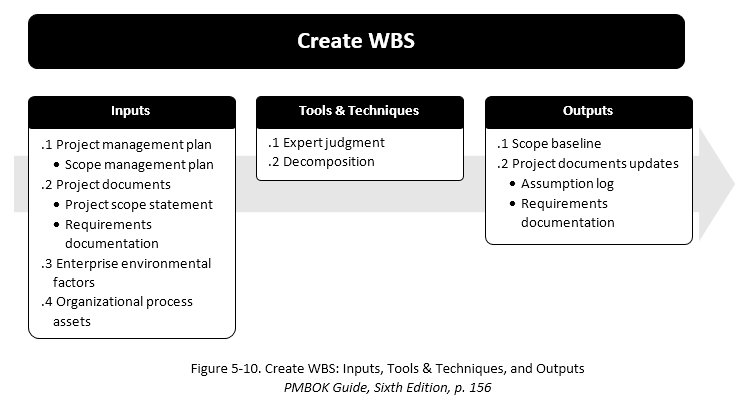
Identify the inputs, tools, techniques, and outputs for the following process: Create WBS.
5.2 Identify the inputs, tools, techniques, and outputs defined in the six processes in project scope management.
PMBOK Guide, Sixth Edition, Figure 5-10. Create WBS: Inputs, Tools & Techniques, and Outputs, p. 156
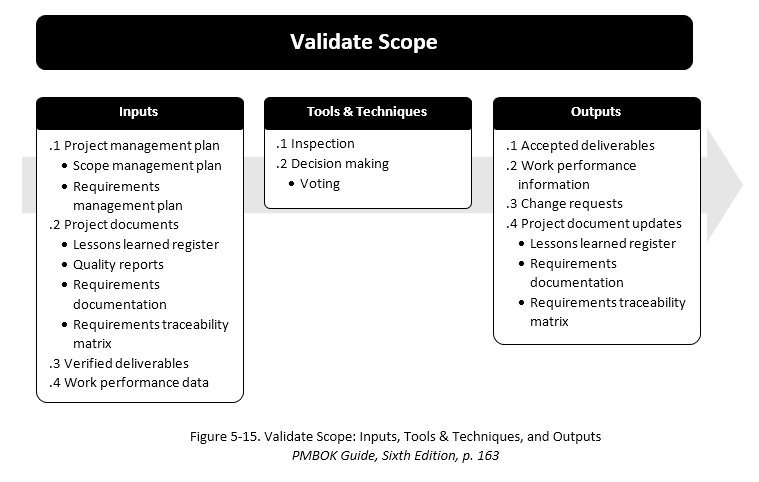
Identify the inputs, tools, techniques, and outputs for the following process: Validate Scope.
5.2 Identify the inputs, tools, techniques, and outputs defined in the six processes in project scope management.
PMBOK Guide, Sixth Edition, Figure 5-15. Validate Scope: Inputs, Tools & Techniques, and Outputs, p. 163
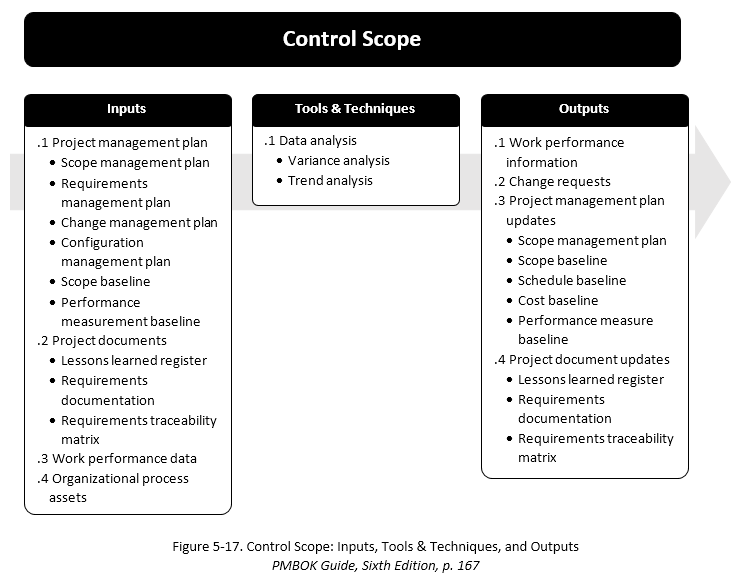
Identify the inputs, tools, techniques, and outputs for the following process: Control Scope.
5.2 Identify the inputs, tools, techniques, and outputs defined in the six processes in project scope management.
PMBOK Guide, Sixth Edition, Figure 5-17. Control Scope: Inputs, Tools & Techniques, and Outputs, p. 167
What are the key concepts for Project Scope Management?
5.3 Identify key concepts and tailoring considerations for project scope management, and key roles in scope management.
tl;dr
- product v. project
- upfront v. iteratively
- completion comparison
quotes
- [product v. project] Scope can refer to product scope (the features and functions that characterize a product, service, or result), or to project scope (the work performed to deliver a product, service, or result with the specified features and functions).
- [upfront v. iteratively] Project life cycles range along a continuum from predictive to adaptive or agile. In a life cycle that uses a predictive approach, the project deliverables are defined at the beginning of the project and any changes to the scope are progressively managed. In an adaptive or agile approach, the deliverables are developed over multiple iterations where a detailed cope is defined and approved for each iteration when it begins.
- [completion comparison] Completion of the project scope is measured against the project management plan. Completion of the product scope is measured against the product requirements.
PMBOK Guide, Sixth Edition, Appendix X4: X4.2 - Key Concepts for Project Scope Management, p. 674
What tailoring considerations should a project manager have for project scope management?
5.3 Identify key concepts and tailoring considerations for project scope management, and key roles in scope management.
- Knowledge and requirements management. Does the organization have formal or informal knowledge and requirements management systems? What guidelines should the project manager establish for requirements to be reused in the future?
- Validation and control. Does the organization have existing formal or informal validation and control-related policies, procedures, and guidelines?
- Development approach. Does the organization use agile approaches in managing projects? Is the development approach iterative or incremental? Is a predictive approach used? Will a hybrid approach be productive?
- Stability of requirements. Are there areas of the project with unstable requirements? Do unstable requirements necessitate the use of lean, agile, or other adaptive techniques until they are stable and well defined?
- Governance. Does the organization have formal or informal audit and governance policies, procedures, and guidelines?
PMBOK Guide, Sixth Edition, 5.0 - Project Scope Management, p. 133
Define “work breakdown structure.”
5.4 Identify the purpose and elements of a Work Breakdown Structure (WBS) for both product and project scope
A hierarchical decomposition of the total scope of work to be carried out by the project team to acommplish the project objective and create the required deliverables.
PMBOK Guide, Sixth Edition, 5.4 - Create WBS, p. 157
What is the purpose of a WBS?
5.4 Identify the purpose and elements of a Work Breakdown Structure (WBS) for both product and project scope
The WBS organizes and defines the total scope of the project and represents the work specified in the current approved project scope statement.
PMBOK Guide, Sixth Edition, 5.4 - Create WBS, p. 157
How do adaptive/agile project environments manage scope?
5.5 Understand project scope management for agile/adaptive projects, including the use of prototypes
In projects with evolving requirements, high risk, or significant uncertainty, …agile methods deliberately spend less time trying to define and agree on scope in the early stage of the project and spend more time establishing the process for its ongoing discovery and refinement.
PMBOK Guide, Sixth Edition, 5.0 - Project Scope Management, p. 133
How do adaptive/agile projects utilize prototypes?
5.5 Understand project scope management for agile/adaptive projects, including the use of prototypes
Many environments with emerging requirements find that there is often a gap between the real business requirements and the business requirements that were originally stated. Therefore, agile methods purposefully build and review prototypes and release versions in order to refine the requirements. As a result, scope is defined and redefined throughout the project. In agile approaches, the requirements constitute the backlog.
PMBOK Guide, Sixth Edition, 5.0 - Project Scope Management, p. 133

-
General Questions42
-
4. Project Integration Management23
-
Glossary465
-
Acronyms45
-
Process Group and Knowledge Area Matrix66
-
5. Project Scope Management19
-
6. Project Schedule Management41
-
7. Project Cost Management29
-
8. Project Quality Management11
-
9. Project Resource Management22
-
10. Project Communications Management13
-
11. Project Risk Management19
-
12. Project Procurement Management15
-
13. Project Stakeholder Management11
-
Key Concepts10
-
Tailoring Considerations10
-
Trends and Emerging Practices10
-
Agile and Adaptive Environments10



