Is the reaction between cadmium and magnesium nitrate feasible given the following:
Cd2+(aq) + 2e- ⇔ Cd(s) EØ= -0.40V
Mg2+(aq) + 2e- ⇔ Mg(s) EØ= -2.37V
- For there to be a reaction between Cd(s) and Mg(NO3)2, the reactants must be Cd(s) + Mg2+ based on the ionic equation
- The half equation for cadmium, is less negative than for magnesium, therefore the cadmium half equation favours the forward reaction and the magnesium favours the reverse
- In other words, Cadmium favours reduction, Magnesium favours oxidation
Cd2+(aq) + 2e- → Cd(s)
Mg(s) → Mg2+(aq) + 2e-
Overall redox equation: Mg(s) + Cd2+(aq) → Mg2+(aq) + Cd(s)
Therefore the reaction is not feasible
What can be used to reduce iron(II) to iron but not aluminium ions to aluminium?
Fe2+ + 2e- ⇔ Fe EØ= -0.44V
Al3+ + 3e- ⇔ Al EØ= -1.66V
Zn2+ + 2e- ⇔ Zn EØ= -0.76V
- To reduce Fe2+, the iron half equation must go forwards and to ensure aluminium is not reduced, the aluminium half equation must be in reverse
- So the iron half equation needs an oxidising agent with a lower electrode potential, but not too low where it will reduce aluminium
-1.66 > -0.76 > -0.44
Al > Zn > Fe
The zinc half equation, has a more negative electrode potential than the iron one, so the iron half equation will go forwards, but the aluminium half equation has a more negative electrode than the zinc half equation, so it will favour the reverse direction and be oxidised, not reduced
What are the limitations of predictions from electrode potentials?
- EØ values are with standard conditions, actual conditions may differ, changing the electrode potential
- Ea may be so high, a reaction that is feasible based on e values, may not take place
- The electrode potential values may indicate thermodynamic stability but there is no indication of reaction rate or kinetics
What are the properties of primary storage cells?
- Non rechargable, to be used once
- Electrochemical reactions produce electricity (from oxidation and reduction at electrodes)
- Reactions cannot be reversed, chemicals will be used up
Whereas in secondary storage cells, they are rechargable as the overall cell reaction is reversible so the chemicals can be regenerated
What are the differences between fuel and storage cells?
Pros and cons of storage cells
- Storage cells don’t need a constantly supply of oxygen and fuel as they have the species
Pros and Cons of Storage Cells
- Storage cells have a high power density and are cheap
- Cons: They have disposal issues due to toxic compounds
- They can be flammable, especially lithium ion batteries
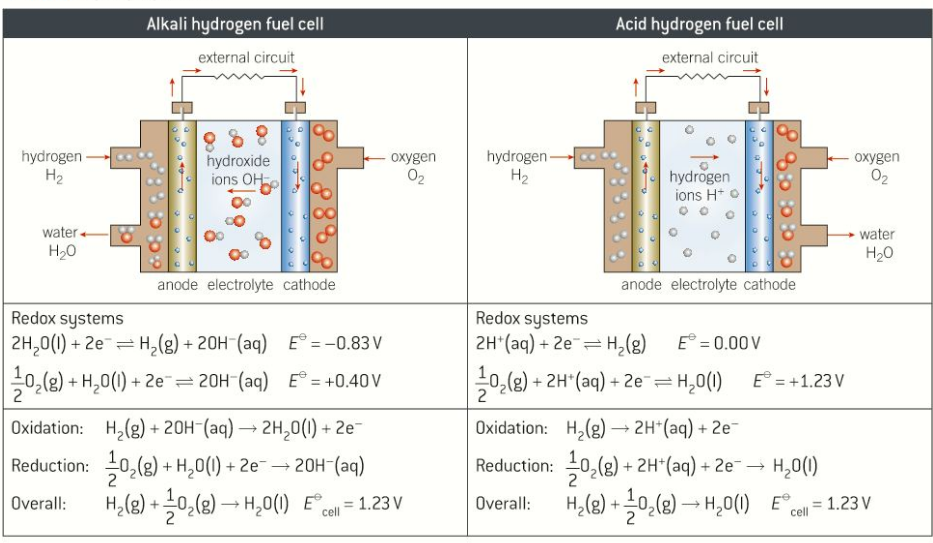
What are the properties of fuel cells?
- Uses energy from reaction between fuel w/ O2 creating a voltage
- Fuel is externally supplied and oxygen comes from the air
- Fuel cells don’t need to be recharged
- H2(g) is the most common fuel
Give the:
Diagram and redox equations for
Acid and alkali hydrogen/oxygen fuel cells
See notes and diagram below