Define:
Oxidation
Reduction
Oxidising agent
Reducing agent
Oxidation = Loss of electrons or increase in oxidation number
Reduction = Gain of electrons or decrease in oxidation number
Oxidising agent = Reagent that accepts electrons from another speies (it itself is reduced)
Reducing agent = Reagent that donates electrons to species being reduced (it itself is oxidised)
Define
Redox reaction
Disproportionation reaction
Redox reaction = Reaction involving oxidation and reduction
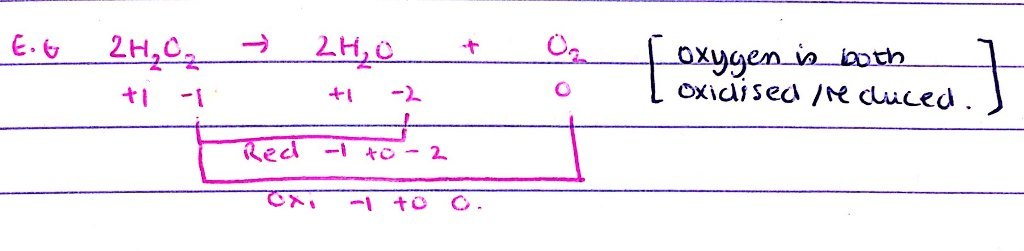
Disproportionation reaction = Redox reaction in whcih the same element is both oxidised and reduced
Give an example of a disproportionation of oxygen
Steps to writing a redox equation
- Balance atoms
- Balance charges
For half equations what side do the electrons go on if the atom is being:
- Oxidised
- Reduced
Reduction: Add electrons on LEFT
Oxidation: Add electrons on RIGHT
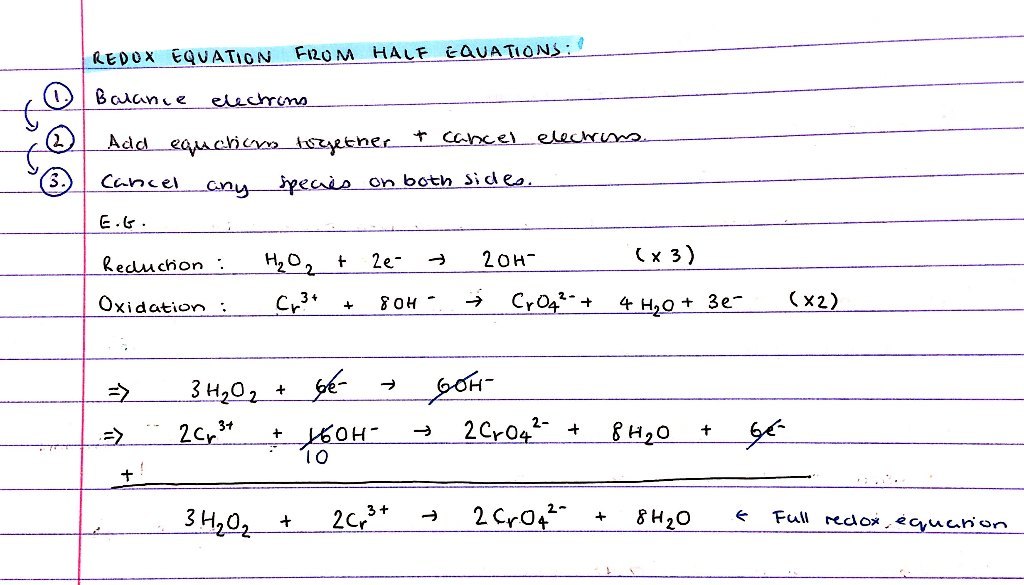
Steps to writing a redox equation from half equations
- Balance electrons
- Add equations together + cancel electrons
- Cancel any species on both sides
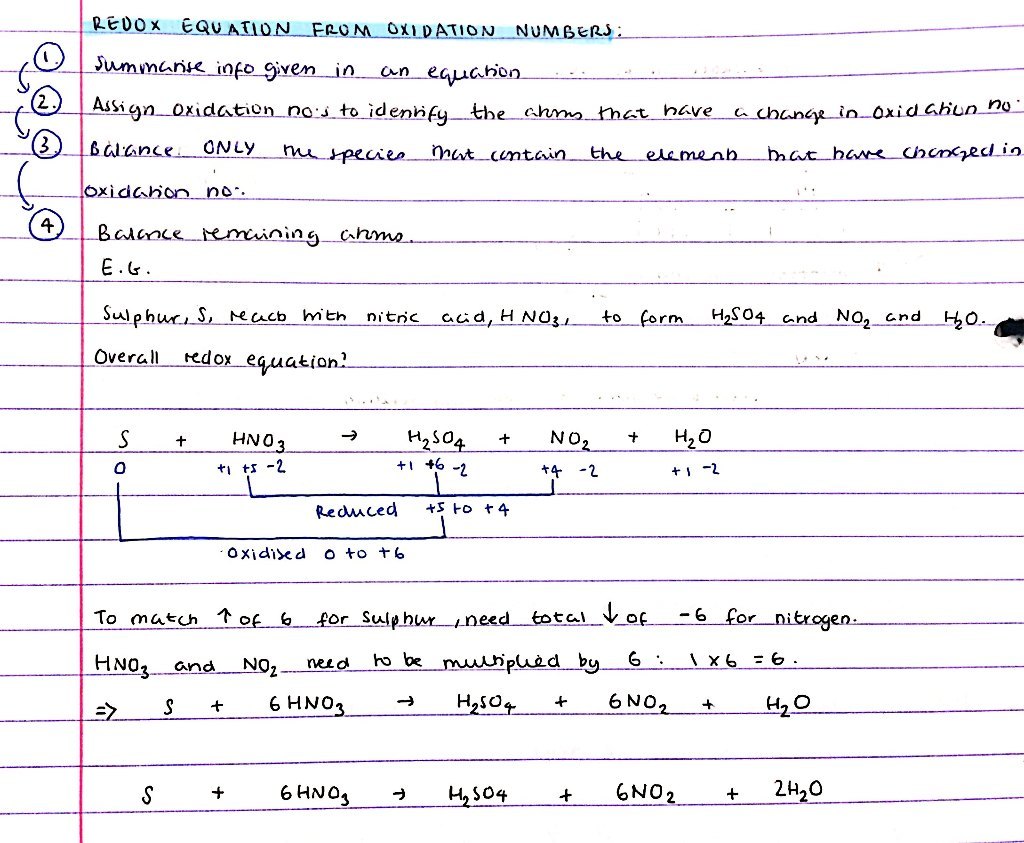
Steps to writing a redox equation from oxidation numbers
- Summarise information given in an equation
- Assign oxidation no’s to identify what has been oxidised and reduced
- Balance ONLY the species that contain the elements that have changed in oxidation no’
- Balance remaining atoms
- Add H2O to balance oxygen
- Add H+ to balance hydrogen
- Check charges are balanced
Define Half cell
Half cell = Contains an element in 2 different oxidation states together with a means of electrical contact (e.g. a piece of metal)
Name the types of half cells you can get and name an example of each
METAL / METAL ION HALF CELLS
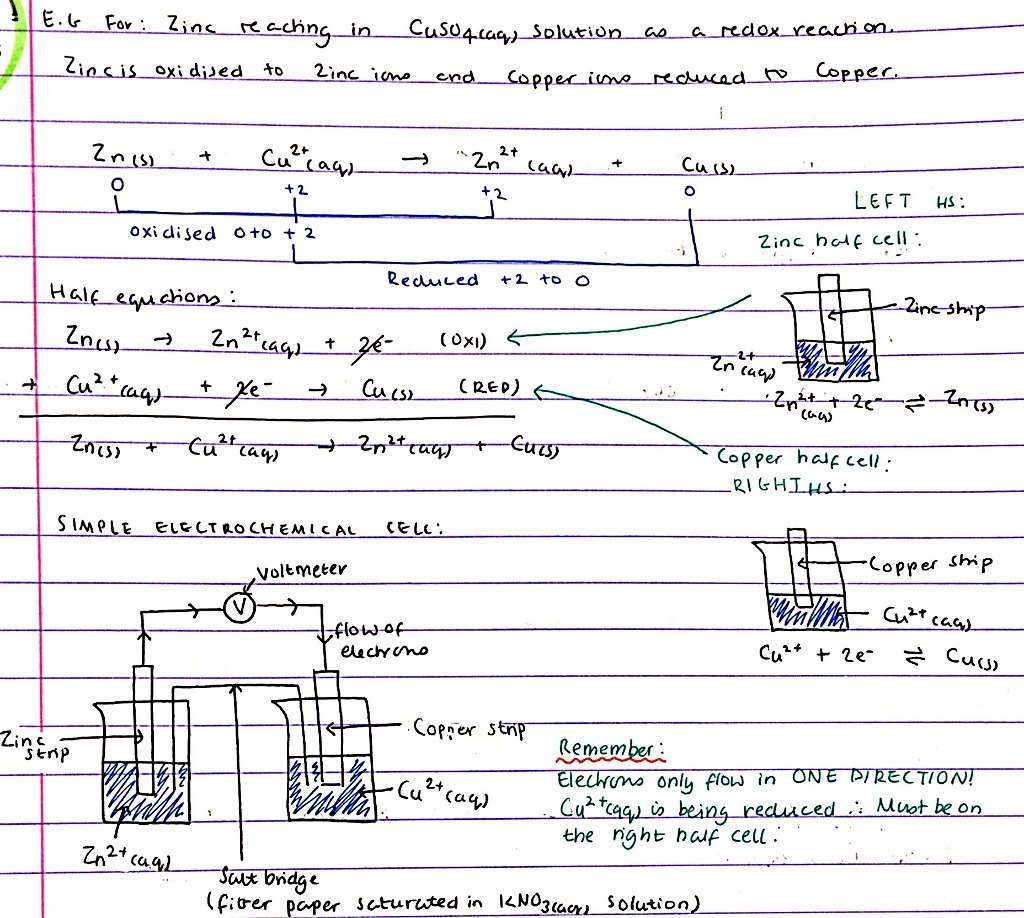
- Zinc reacting in CuSO4(aq) as a redox reaction
- Zinc is oxidised to Zinc ions and Copper ions reduced to Copper
METAL ION / METAL ION (ION / ION) HALF CELLS
- Contains the same element in different oxidation states
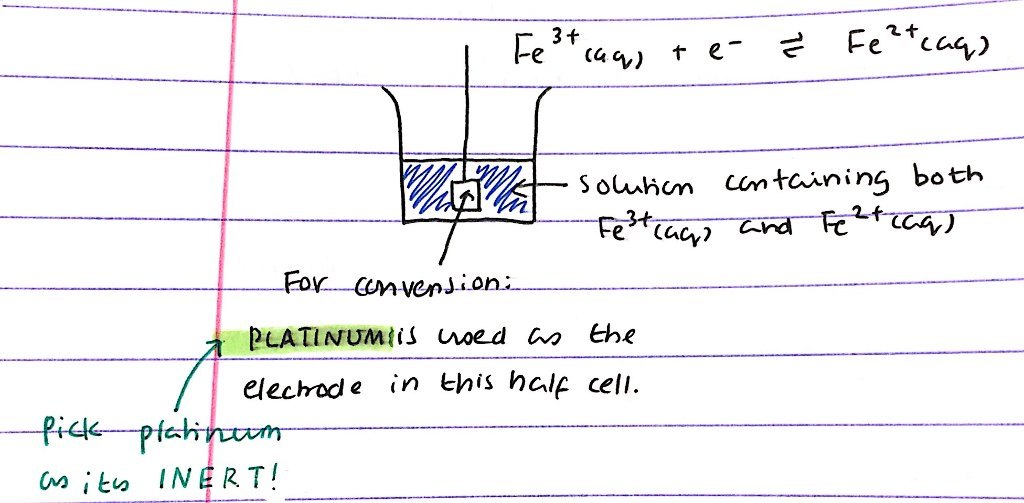
- Redox equilibrium of Fe3+ + e- ⇌ Fe2+
Draw the half cells and simple electrochemical cell for this reaction:
Zinc reacting in CuSO4(aq) as a redox reaction. Zinc is oxidised to zinc ions and copper ions reduced to copper
Define Salt bridge + example of how to make one
Salt bridge = A concentrated solution of an electrolyte that doesn’t react with the materials in either half cells to complete the circuit by allowing ions to flow between the half cells
e.g. piece of filter paper saturated in KNO3(aq)
Draw the half cell of a metal ion / metal ion for the redox reaction of Fe3+ + e- ⇌ Fe2+
What is the electrode made of and why is it made of such a material?
Electrode = Platinum because it’s inhert
Define Standard electrode potential (E⦵)
Standard electrode potential (E⦵) = The emf of a half cell compared with a standard hydrogen half cell, measured at:
- Temperature of 298 K
- Solution concentrations of 1 moldm-3
- Gas pressure of 100 kPa
What does emf stand for?
emf = electromotive force
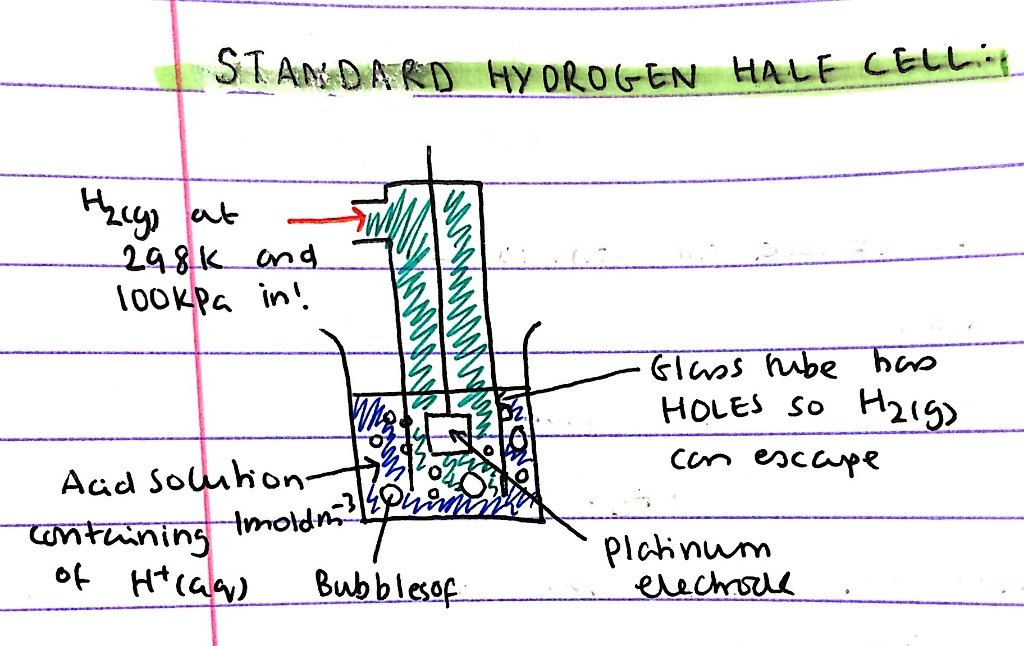
Draw a standard hydrogen half cell
State the standard conditions and the electrode used in this half cell
Standard conditions:
- 298 K
- Solutions 1 moldm-3 concentration
- 100 kPa
Electrode used= Platinum
Draw a standard electrode potential diagram for a Zn2+ / Zn half cell to be measured
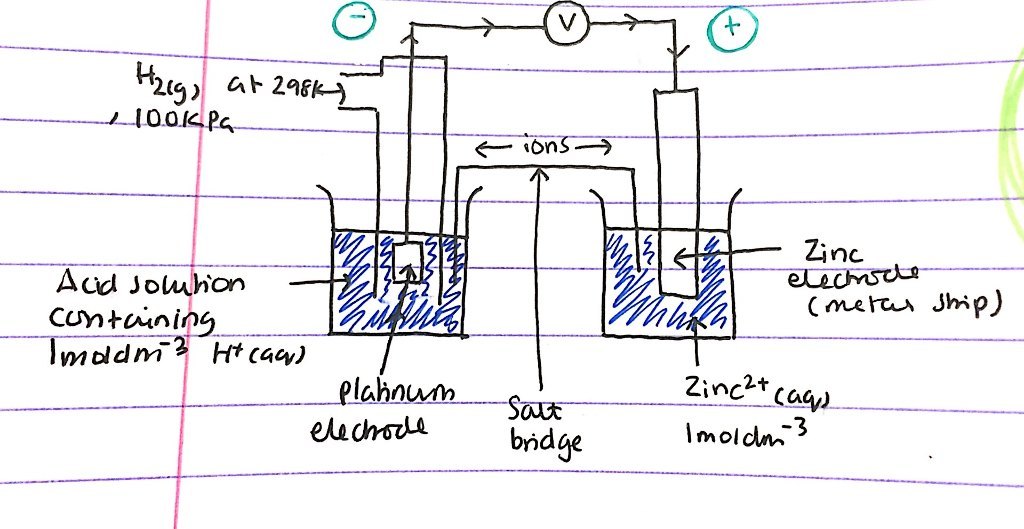
What special care needs to be taken when measuring standard electrode potentials and why do they need to be taken?
when measuring standard electrode potentials NO current is allowed is flow as this changes the conditions so the system is no longer standard
What do standard electrode potentials tell us?
How likely a half cell is to release or accept electrons:
Electrode potential has a negative sign:
- Half cell is more likely to give up electrons than the hydrogen half cell
Electrode potential has a positive sign:
- Half cell is less likely to give up electrons than the hydrogen half cell
Equation for E⦵(cell) = ?
E⦵(cell) = E⦵(more positive electrode) - E⦵(more negative electrode)
E⦵ value > 0 (feasible reaction)
E⦵ value < 0 (not feasible reaction)
Suggest 2 reasons why, even when such combinations of half cells are correctly connected together, the predicted reaction may not, in fact, take place
- Reaction has a very high Ea so reaction rate is too slow to be obsrved
- Actual conditions may not be standard, so the predictions are no longer accurate
Are oxidation / reduction reactions endothermic / exothermic?
Oxidation = endothermic
Reduction = exothermic
When doing non standard electrode condition calculations what is different about the final answer?
It’s called emf and not E⦵
Using this reaction explain the effects of increasing [Fe2+] and decreasing [Cu2+] on the E value of half cell (emf).
What if you change temperature?
Fe2+(aq) + 2e- ⇌ Fe(s) E⦵ = -0.44 V
Cu2+(aq) + 2e- ⇌ Cu(s) E⦵ = +0.34 V
Fe2+(aq) + 2e- ⇌ Fe(s) E⦵ = -0.44 V
Cu2+(aq) + 2e- ⇌ Cu(s) E⦵ = +0.34 V
[Fe2+] increased above 1 moldm-3
- Equil shifts to favor Fe(s) side
- No’ of electrons produced by this half cell decreases ∴ it’s more likely to accept electrons to form Fe(s)
- emf will be more positive
[Cu2+] decreased below 1 moldm-3
- Equil shifts to favour left side
- Half cell more likely to give up electrons and more likely to accept them
- emf will be less positive
Temperature is explained by le chatelier’s principle.
- Decrease temp → Favours exothermic reaction
- Increase temp → Favours endothermic reaction
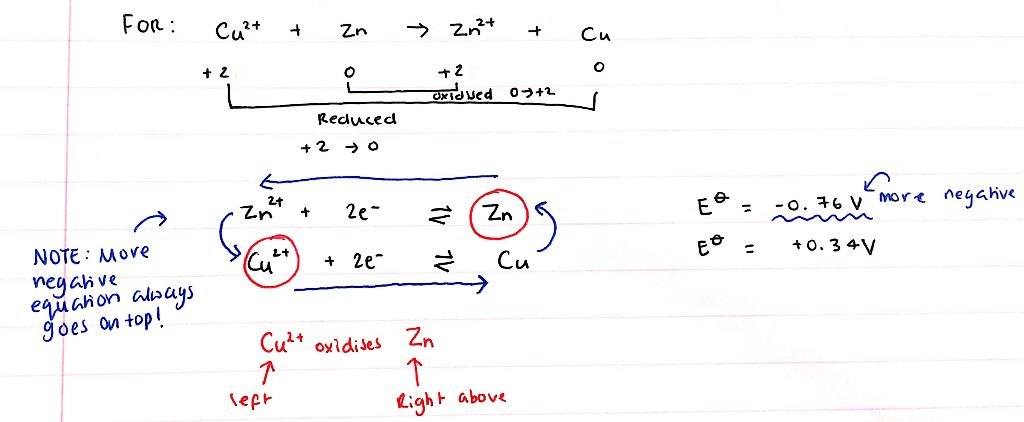
Explain the LORA rule
L = Left
O = Oxidises
R = Right
A = Above



-
5A - Rates definitions10
-
5A - Rates23
-
5B - Equilibria definitions10
-
5B - Equilibria19
-
5C - Acids & pH definitions18
-
5C - Acids & pH32
-
5D - Lattice enthalpy & Free energy definitions19
-
5D - Lattice enthalpy & Free energy26
-
5E - Redox definitions13
-
5E - Redox35
-
5F - Transition elements definitions13
-
5F - Transition elements56
-
5F - Transition elements - oxidation state & colours18
-
6A - Aromatic compounds29
-
6B - Carbonyls20
-
6C - Acids & Esters41
-
6D - Amines, amides & polyamides39



