OKC
Epidemiology
Etiology
Presentation
Epidemiology
- Can occur any time in life
- Peak in the 2nd and 3rd decade of life
- M>F (Slightly more)
Etiology
- Originates from the cell rests of the dental lamina with the basal layer of epithelium playing a role
Presentation
- 25 -40% associated with unerupted tooth (Neville & Damm)
- Resorption of roots is uncommon
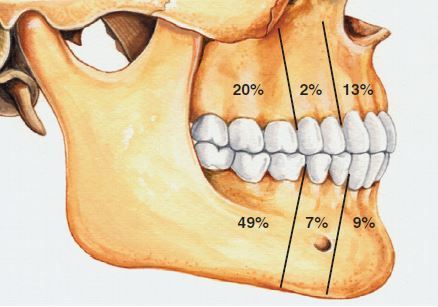
OKC
Proponents for reclassification as a tumor
Greater expression for:
- Ki 67
- PCNA (Proliferating cell nuclear antigen)
Loss of tumor supressor genes
- p16
- p53
- MCC
- LATS2
- FHIT
85% of OKC associated with NBCCS
OKC
FNA
Histopathology
FNA
- Immunochemical staing for cytokeratin 10
- Presence of keratin flakes
- Protein levels of <4g/100mL
Histopathology
- 6 - 8 cells thick
- Stratified squamous epithelium
- Luminal surface show parakeratotic epithelial cells
- Basal layer
- Hyperchromatic
- Palisading cuboidal or columnar cells
- Lumin contents
- Macroscopic “cheesy” debri
- Microscopic - Keratinaceous debri
***If the cyst is inflammed, parakeratinisation and pallisading of the basal layer are lost. Rete ridges develop. It becomed difficult to diagnose an OKC***
Histology - Ortho and Para keratinization
- Orthokeratinization
- As the tissue matures, it forms keratin within its superficial cells
- Parakeratinization
- The most superficial layer contain not only keratin but cell nuclei as well
OKC Recurrence Rates
Reasons for recurrence
- Incomplete removal of original cyst lining
- Growth of new OKC from satellite cyst or epithelial lining
- Unrelated OKC
Johnson and Batstone 2013
- Enucleation - 25%
- Enucleation with adjunctive measures (Not Carnoy’s) - 20%
- Enucleation with Carnoy’s - 8% (5% in conclusion)
- Marsupialisation with adjunctive measures - 15%
- Resection - 6% (1.8% in conclusion)
Al-Moraissi 2017
- Marsupialisation - 30%
- Enucleation - 25%
- Marsupialisation with enucleation - 15%
- Enucleation with peripheral ostectomy/cryotherapy - 15%
- Enucleation with Carnoy’s - 10%
- Resection - 2.5%
Carnoys solution
Ingredients
Mechanism of action
Application technique
Bone penetration
Efficacy without chloroform
Ingredients - FACE (0.1, 1, 3, 6)
- Ferric chloride 0.1g/mL
- Hemostatic & Coagulant agent
- Acetic acid (Glacial) - 1mL (10%)
- Breaks cross-links between proteins
- Coagulation of nucleic acid
- Chloroform - 3mL (30%)
- Carcinogenic - 1992
- Enhances ethanol’s penetration into tissues
- Ethanol - 6mL (60%)
- Denatures proteins
- Coagulative fixative
Voorsmit 1981
- Penetrates 1.54mm into bone when applied for 5 min
Frerich 1994
- Rabbit study - Carnoys applied to IAN for various duration
- 3mins - Did not result in somatosensory evoked potentials in one, slight reduction in another and partial sensory impairment in another
- At 5 and 10 min - Absent evoked potentials
Dashow 2015
- Carnoy’s - 10% Recurrence rate
- Modified Carnoy’s - 35% Recurrence rate
Giant Cell Granuloma
Definition Epidemiology Pathophysiology
- Central giant cell granuloma represents a benign proliferation of fibroblasts and multinucleate giant cells
- F > M
- 10 -20 yr olds (75% occur before the age of 30 yrs old)
- 70% mandible
- Usually anterior mandible
- Aetiology - not known
- Inflammatory
- Reactive lesion
- Neoplasm
- Endocrine lesion
- The proliferating cell in this lesion is the fibroblast which is believed to produce cytokines leading to recruitment of monocytes which subsequently transform into multinucleate giant cells (osteoclast origin)
Giant Cell Granuloma
Classification
Chuong Kaban (2002)
- Classifies the lesion into Aggressive vs Non-aggressive
Aggressive : 1 Major and 3 Minor criteria - Major Criteria
- Size >5 cm
- Recurrence
- Minor (DR CC GP)
- Root resorption
- Tooth displacement
- Cortical bone perforation
- Cortical thinning
- Rapid growth
- Pain/paresthesia
Giant Cell Granuloma
Workup & Differentials
Workup
- History
- Cherubism, Noonan, Ramon
- Exam
- Aggressive vs Non-aggressive
- Bloods
- PTH, Ca, PO4, Alk Phos
- Img
- OPG, CT
- PET - Baseline activity and to monitor for resolution of lesion
- Bx
- Multinucleate giant cells within a stroma of blood vessels and fibroblasts
- Perivascular cuffing of giant cells
- Extravasated RBC
- Foci of bone and osteoid formation
Differentials (Giant cell lesions)
- Infective
- Mycobacteria - Tb, Leprosy
- Syphilis
- Trauma
- Foreign body reaction - Sutures, Alveogyl, Bone wax
- Chronic trauma
- TUGSE
- Autoimmune ulcers
- Oro facial granulomatosis
- Crohn’s Disease
- Sarcoidosis
- Amyloidosis
- Wegners Granulomatosis
- Metabolic
- Brown Tumour
- Paget’s Disease
- Fibrous dysplasia
- Pathology
- Cherubism
- Ramon syndrome
- Neurofibromatosis I
- Aneurysmal bone cyst
Giant Cell Lesions Management
Giant Cell Granuloma
- Medical
- Calcitonin (Shreuder 2017)
Non recommended by FDA due to increased cancer risk- 100-200U/day for 18 months (primary treatment)
100-200U/day for 3 months (adjuvant therapy) - 9.1% Recurrence in treatment group
54% Recurrence in placebo group
- 100-200U/day for 18 months (primary treatment)
- Steroids (Terry and Jacoway 1998)
- Triamcinolone 10mg/mL
- 1mL for every cm of lesion
- 1x/week for 6 weeks
- Resolution in 50% of cases
- Triamcinolone 10mg/mL
- Interferon alpha (Kaban 1999)
- Based on hypothesis GCT is the bone equivalent of infantile haemangioma
- S/cut injections until osseous cavity filled with bone
- Denosumab
- 120mg S/cut weekly for 2 weeks then monthly for 6 months
Not approved for use in growing skeleton
- 120mg S/cut weekly for 2 weeks then monthly for 6 months
- Bisphosphonates
- Calcitonin (Shreuder 2017)
- Surgical
- Enucleation and currettage
- Non aggressive
- Segmental/Marginal resection
- Aggressive
- Aggressive
- Enucleation and currettage
Brown Tumor
- Medical
- Restriction of dietary phosphate
- Phosphate binding agents
- Vit D
- Cinacalcet - Calci-mimetic agent that sensitises calcium receptors of PTH cells and therefore reduces PTH level
- Surgical
- Parathyroidectomy
- Renal transplant to restore normal processing of Vit D
- Soft tissue lesions can be treated with local excision
Cherubism
- Conservative monitoring
- Self limiting
- Surgical
- Guide eruption of teeth
- Cosmetic recontouring at cessation of growth and after disease has ceased
Aneurysmal bone cyst
- Surgical
- Curettage but very vascular
- Pre-op embolisation can be considered
- Defect heals within 6-12 mths without grafting
- Recurrence 10-20% Usually due to complete removal
Syndromes associated with Pathology
- OKC/BCC
- Gorlin-Goltz
- Fibrous dysplasia
- McCune Albright
- Jaffe Lichtenstein
- Mazabraud
- CGCG Multiple
- Noonan
- Browns/HyperPTH
- Ramon/Cherubism
- NF1
- Fragile X
- Jaffe Campanacci
- Osteoma/Epidermoid cysts
- Gardner
- Ulcers
- Behcets
- Oral fibroma (Multiple)
- Cowden’s syndrome
- Neurofibroma
Schwannoma- Neurofibromatosis
- Neuroma
- MEN 2B
- Erythema multiforme
- Steven-Johnson Syndrome
- Infantile hemangioma
- PHACES
- Capillary malformations
- Sturge Weber
- HHT
- Peutz Jagher
- Klippel Trenaunay
- Proteus
- AVM
- Sturge Weber
- Cafe au Lait
- McCune Albright
- NF 1
- Melanin lesions
Macules/Naevi- Peutz Jagher
- Addisons
- Sarcoidosis
- Lofgren
- Heerfordt
- Sialadenitis
Mucocoeles in children- HIV
Vascular Anomaly Classification
2018 - International society for study of Vascular Anomalies
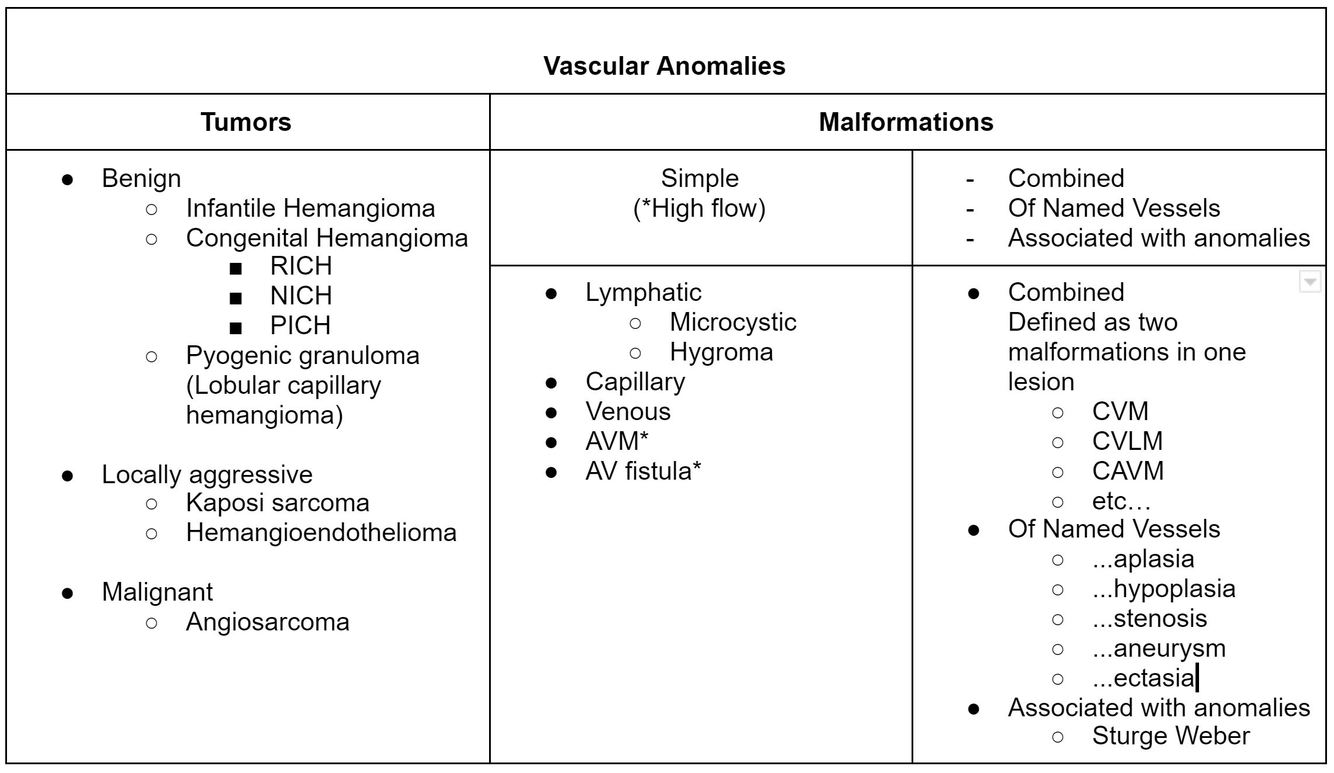
Vascular Tumors
Benign
ISSVA Classification
- Tumors and Malformations
- Tumors
- Benign
- Infantile Hemangioma
- Congenital Hemangioma
- RICH
- NICH
- Pyogenic Granuloma
Lobular capillary hemangioma
- Locally aggressive
- Kaposi sarcoma
- Hemangioendothelioma
- Malignant
- Angiosarcoma
- Benign
Infantile Hemangioma
- Epideiology
- 4-10% (Fonseca)
More common in Caucasians - 60% found in the H&N region
- 4-10% (Fonseca)
- Clinical course
- IH appears during first month
- Growth peaks at 5 - 6 month but continues until 12 months
- Regresses at 10% per year
- Histopathology
- Proliferation
- Rapidly dividing endothelial cells that form tightly packed sinusoidal channels
- Involuting
- Decreased proliferation
- Increased apoptosis
- Increase in stromal cells
- Involuted
- Few tiny capillary feeding vessels
- Islands of fibrofatty tissue admixed with dense collagen and reticular fibres
- Proliferation
- Associated anomalies
- PHACE
- Posterior fossa anomalies
- Hemangiomas
- Arterial abnomalities
- Cardiac defects and Coarctation
- Eye abnormalities
- Sternal non-union
- PHACE
Congenital Hemangioma
- Two subtypes - RICH and NICH
- RICH
- Presentation
- Red violaceous colour
- Central telangiectasia
- Peripheral pale halo
- Transient thrombocytopenia
Consumptive coagulopathy
- Natural history
- Proliferates and involutes rapidly during the first few weeks and months post partum
- Presentation
- NICH
- Presentation
- Ovoid, macular and raised
- Light gray with prominent coarse telangiectasia
- Well circumscribed lesion
- Natural history
- Expands during adolescence
- Presentation
Pyogenic granuloma
Lobular capillary hemangioma
- fsdfs
Vascular Tumor
Locally aggressive & Malignant
ISSVA Classification
- Tumors and Malformations
- Tumors
- Benign
- Infantile Hemangioma
- Congenital Hemangioma
- RICH
- NICH
- Pyogenic Granuloma
Lobular capillary hemangioma
- Locally aggressive
- Kaposi sarcoma
- Hemangioendothelioma
- Malignant
- Angiosarcoma
- Benign
Locally aggressive
- Kaposi Sarcoma
Malignant
- Angiosarcoma
Vascular Malformation
Lymphatic and Capillary
Vascular Malformation
Venous and Arterial
Fibro-osseous lesions
Fibro-osseous lesions
- A group of lesions in which normal bone is replaced by fibrous connective tissue initially and eventually infiltrated by osteoid and or cemmentoid tissue
- This is a descriptive histological term and is non-specific in diagnosis
- Classification - Eversole 2008
- I - Bone dysplasia
- Paget’s disease
- Fibrous dysplasia
- Monostotic
- Polyostotic
- Craniofacial
- Segmental odontomaxillary dysplasia
- II - Cemento-osseous dysplasia
- Periapical
- Focal
- Florid
- III - Inflammatory/Reactive
- Primary Osteomyelitis
- Focal sclerosing osteomyelitis
- Diffuse sclerosing osteomyelitis
- Periostitis ossificans - Garres Osteomyelitis
- Primary Osteomyelitis
- IV - Metabolic
- Hyperparathyroidism
- V - Neoplasia
- Ossifying fibroma
- Cemento-ossifying fibroma
- Juvenile ossifying fibroma
- Trabeculae
- Psammomatoid
- Cementoblastoma
- Familial gigantiform cementoma - Subtype of COD
- I - Bone dysplasia
* WHO 2017
WHO re-classifies many of the lesions into differenct categories
* Fibro-osseous lesions
* Fibrous dysplasia
* Cemento-osseous dysplasia
* Familial gigantiform cementoma
* Ossifying fibroma
* Benign Mesenchymal Odontogenic Tumour
* Cemento-ossifying fibroma
* Cementoblastoma
* Odontogenic fibroma
* Odontogenic myxoma
* Giant Cell Lesions
* Central giant cell granuloma
* Peripheral giant cell granuloma
* Cherubism
* Aneurysmal bone cyst
* Simple bone cyst
Fibrous Dysplasia
- Epidemiology
- <20 yrs of age
- Pathophysiology
- GNAS mutation
- Affects
- Osteoblasts - fibrous dysplasia
- Melanocyte - Cafe au lait spots
- Endocrine cells - Endocrinopathies (40%)
- Age at which the mutation occurs determines the severity of disease
- < 6 weeks - Severe
- >6 weeks - Less severe
- Near birth - Monostotic
- Presentation / Progression
- Painless asymptomatic deformity
- Neuropathies can occur due to entrapment of nerves
- Lesions tend to burn out after puberty
- Presentation
- Monostotic 85%
- Polyostotic 15%
- Associated syndromes
- Jaffe-Leichtenstein - Cafe au lait
- McCune Albright - Cafe au lait + Endocrinopathies
- Mazabraud - Soft tissue myxomas (Typically cardiac)
- Histology
- Irregular trabeculae of woven immature bone with fibrous stroma
- Chinese characters
- Treatment
- Small lesions - Excised fully
- Can re-occur in younger patients
- Symptomatic treatment
- Function
- Neuropathies
- Restriction of mouth opening
- Esthetic
- Deformity
- Orbital dystopia
- Medical
- Bisphosphonates for pain
- Bisphosphonates for pain
- Function
- Small lesions - Excised fully
- Malignant transformation and associated pathology
- XRT contraindicated due to risk of post XRT sarcomas
- Kaban - 1/70 underwent transformation into Osteosarcoma
- Aneurysmal bone cysts can occur within this lesion due to hypervascularity during the proliferative phase
Cemento-osseous dysplasia
- Epidemiology
- F>M : 10>1
- African americans
- 30 - 50 yrs of age
- Most common fibro-osseous lesion
- Pathophysiology
- ?Local trauma
- Arises from bone adjacent to PDL
- Classification
- Periapical
- <1cm
- Can be multiple
- Typically involving anterior mandibular teeth
- Focal
- Single, edentulous areas
- Florid
- >2 quadrants, symmetrical
- Familial gigantiform cementoma
- Periapical
- Presentation / Progression
- Asymptomatic
- Vital teeth
- Can become secondarily infected
- Typically occurs above the IAN
- Initially radiolucent and become radiopaque over time
- Histopathology
- Lesion poorly defined compared to COF
- More cementum and less woven bone compared to COF
- Cementicles
- Ginger roots calcifications with rounded projections (sharp projections in Fibrous Dysplasia) in a fibrous connective tissue stroma
- Treatment
- No treatment generally required
- Avoid surgical procedures as it can less to osteomyelitis
- Antibiotics + Saucerization and debridement if infected
- Associated pathology
- 10% of Florid cases progresses to osteomyelitis
- Associated with simple bone cysts
Familial Gigantiform Cementoma
- Epidemiology
- Rare hereditary form of COD
- M=F
- No ethnic predilection
- Occurs in first decade of life
- Pathophysiology
- Presentation / Progression
- Multiple quadrants affected
- Rapid regrowth of recontoured lesion
- Sclerotic lesion has high rate of infection - Osteomyelitis
- Expansile lesion
- Associated Pathology
- Uterine adenomas
Cemento ossifying fibroma
- Epidemiology
- F>M : 5:1
- 30 - 40 yrs of age
- Mand > Max
- Pathophysiology
- Associated with HRT2 mutation (Tumor suppressor gene)
- Associated with HRT2 mutation (Tumor suppressor gene)
- Presentation / Progression
- Asymptomatic lesion
- Well defined lesion
- Histology
- Capsulated
- Mainly avascular fibrous connective tissue with bits of woven bone and cementum like material
- Small trabeculae with peripheral osteoid and osteoblastic rimming
- Treatment
- Enucleate if small and has not lost its capsule
- Resect large/recurrent lesions affecting function - nose
- 5mm margin
- 5mm margin
- Associated pathology
- Aneurysmal bone cyst occur within lesion
Cemento ossifying fibroma - Juvenile ossifying fibroma
Subtype of COF but occurs within the first two decades of life
More aggressive form of COF
- Epidemiology
- Occurs within the first two decades of life
- Occurs within the first two decades of life
- Classification
- Psammatoid (4x more common)
- 20 yr olds
- More common in orbital/sinonasal
- Trabeculae
- Young children
- More common in jaws
- Psammatoid (4x more common)
- Histology
- Both subtypes do not have a capsule - High recurrence rate with enucleation
- Psammatoid
- Concentric lamellar round/ovoid ossicles
- Within myxoid fibrous connective tissue
- Trabecular
- Strands of osteoid
- Osteoblasts and giant cells
- Treatment
- Chrcanovic 2019
- Enucleation: 40% recurrence rate
- Enucleation + adjuncts: 15 - 30% recurrence rate
- Marginal: Up to 10%
- Segmental: 0%
- Consideration
- Proximity to vital structures
- Patients wishes
- Patients age
- Chrcanovic 2019
Paget’s Disease
Osseous dysplasia characterised by rapid turnover and remodelling of bone throughout the skeleton
- Epidemiology
- 1:100 in over 45 yrs of age
- 10% in over 90 yrs of age
- M>F : 3:2
- Pathophysiology
- Defective function of the OPG/RANK/RANKL
- Dysregulation of Osteoclastgenesis
- Presentation / Progression
- Lion Facies - leontiasis ossea
- 3 Phases
- Resorption - Bone softened
- Vascular - Bone distortion and increase in size
- Sclerotic - Bone mineralised in deformed state
- Monostotic and Polyostotic
- Presentation
- Bone pain common - may be asymptomatic
- Enlarging calvarial or jaw bones
- Cranial nerve palsies
- Bowing of long bones - weakened bones
- Splaying of teeth
- Imaging
- Bone scan
Abraham Lincoln sign - Blackbeard sign
- Bone scan
- Histology
- Irregular bone with basophilic reversal lines + trabeculae line by osteoid
- Fibrous dysplasia vs Paget’s disease
Histo in Paget’s:- Osteoclast and osteoblast on the same piece of bone
- Bone more mature
- Reversal lines
- Treatment
- Medical
- Reduce bone resorption
- Bisphosphonates
- Reduces bone pain
- Fracture risk
- Bisphosphonates
- Hypocalcemia
- Calcitonin
- Pain management
- Paracetamol
- NSAIDs
- Reduce bone resorption
- Surgical
- Recontouring of bone
- Hypervascular bone in early phases
- OMS Issues
- Hypervascular bone
- Dental extraction difficult due to hypercementosis
- Abnormal bone healing
- Monitoring due to malignant transformation
- Recontouring of bone
- Physiotherapy
- Aims to strengthen muscles and control bone pain
- Medical
- Malignant transformation
- 1% lifetime risk
Osteoblastoma / Osteoid osteoma
Benign neoplasm of the bone - arising from osteoblasts
Very similar to Osteoid osteoma
Osteoblastoma > 2cm
Osteoid osteoma < 2cm
- Epidemiology
- <30 yr olds
- M:F - 2:1
- Mand > Max
- Pathophysiology
- FOS gene rearrangement
- Function in regulating the development of cells destined to form and maintain the skeleton
- Function in regulating the development of cells destined to form and maintain the skeleton
- FOS gene rearrangement
- Presentation / Progression
- Dull aching pain
- Worse at night
- Osteoid osteoma - Nocturnal pain relieved by NSAIDs
- Gait disturbances
- Neuropathy if lesions affect vertebrae and foramina
- Dental displacement and root resorption
- Dull aching pain
- Histology
- Osteoid osteoma
- Discrete central nidus <1cm with diffuse peripheral sclerosis
- Nidus is usually distinct well circumscribed cavity surrounded by dense reactive bone of varying thickness
- Typically cherry red in colour and can be shelled out from surrounding reactive bone
- Osteoblastoma
- Immature bony trabeculae are lined by plump large osteoblasts. Some of these trabeculae may have extensive ossification
- Highly vascularized connective tissue
- The stroma contains widely dilated capillaries and areas of large dilated sinusoids
- Low mitotic activity - slow growth
- Osteoid osteoma
- Treatment
- Medical
- Chemotherapy and Radiotherapy have been controversial
- Post XRT sarcoma has been documented
- Surgery
- Currettage - 24% recurrence
- Resection with 5mm margins - curative
- New technology
- Radiofrequency ablation for spinal lesions
- Medical


-
1 - Anatomy & Embryology11
-
2 - Imaging2
-
3 - Dentoalveolar24
-
4 - Preprosthetics and Implantology2
-
5 - Paediatrics9
-
6 - Pathology45
-
7 - Pathology - Mucosal Diseases8
-
8 - Maxillary Sinus0
-
9 - Cancer and Reconstruction21
-
10 - Reconstruction5
-
11 - Trauma16
-
12 - Orthognathics and OSA0
-
13 - Facial Pain5
-
14 - TMJ7
-
15 - Prosthetics & Technology0
-
Infection and Microbiology2
-
Nerve Injury9
-
Cosmetic6



