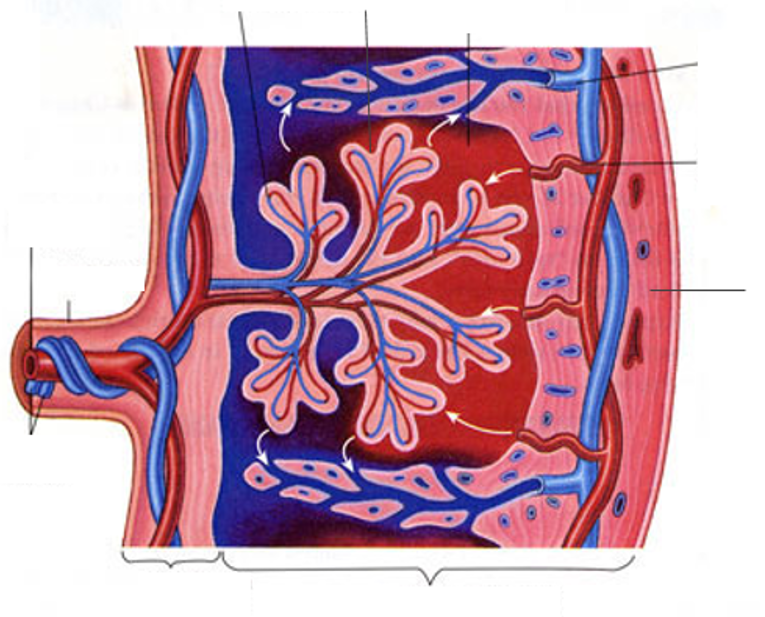
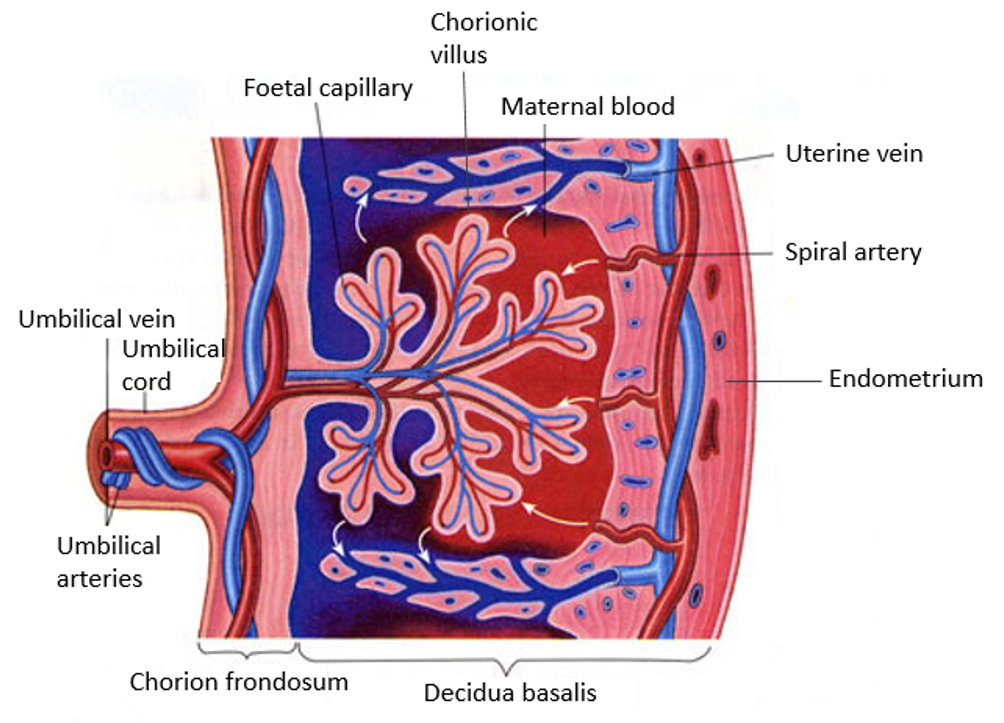
name the 2 major components of the placenta
- maternal placenta = decidua basalis (develops from maternal uterine tissue)
- foetal placenta = chorion frondosum (specialisation of chorionic membrane)
how is the foetus connected to the placenta and what does this structure contain
- connected via umbilical cord
- contains 2 umbilical arteries (deoxygenated blood from placenta) and 1 umbilical vein (oxygenated blood from placenta to foetus)
what are the chorionic vili
network of foetal capillaries branching out of umbilical vessels, enveloped in a trophoblast layer and with a core of CT mesoderm (from which the capillaries develop)
what are cotelydons
the grouping of chorionic villi into lobules on maternal side - increase surface area for optimised transport
how does the structure of chorionic villi change during pregnancy
Thinning of placental barrier (from 40um on wk14 to 5um on wk38):
- 1st T villi: thicker barrier - complete layer of cytothrophoblast cells acting as stem cell layer for syncytiotrophoblast growth
- 3rd T villi: barrier at optimal “thinness” to meet increased foetal metabolic demands and due to reaching end of placental lifespan
- cytotrophoblast layer reduced to few isolated cells, and foetal capillaries are pushed against syncytiotrophoblast membrane for optimised transport
- trophoblast layer only 1 cell thick
from which blastocyst structure does the placenta develop from
CYTOTROPHOBLAST - gives rise to the foetal membranes, i.e. amniotic sac and chorionic sac (inc. placenta which is a specialised region of this
on which day of dev. does the blastocyst implant into the uterus and where does this normally occur
- on day 6 (interstitial implantation is complete by end of wk 2)
- posterior superior wall of uterus
from which early structure does the umbilical cord develop from
connecting stalk (incorporates yolk sac)
describe how the trophoblast develops into the placenta
- syncytiotrophoblast sends out projections into endometrium and forms lacunae… erodes endometrial BVs and glands so that lacunae are filled with maternal blood and glandular secretions… lacunae fuse allowing maternal blood to flow and establishing early utero-placental circulation
- end of wk2: projections of cytotrophoblast expand into syncytiotrophoblast - primary chorionic villi
- early wk3: extraembryonic mesoderm grows into villi forming core of loose CT - secondary chorionic villi
- end wk3: BVs form in extraembryonic mesoderm of villi - tertiary chorionic villi. These connect to decidua basalis to form anchoring villi that anchor placenta to uterus. Also form branch villi surrounded by intervillar space that serve as main sites of exchange.
- wk4: foetal blood flow is established and umbilical vessels branch into the chorionic villi of the placenta, forming capillary networks that exchange material across placental membrane with maternal blood in intervillar space.
what happens to the endometrium where implantation occurs
endometrium is changed into compact decidua basalis by decidual reaction stimulated by progesterone - resulting decidua plays important role in regulating invasion of trophoblast
what is the effect on pregnancy if the decidual reaction doesn’t occur
- if decidual reaction is sub-optimal, can lead to range of adverse pregnancy outcomes, e.g. pre-eclampsia, miscarriage, preterm birth…
- in ectopic pregnancues - no decidua so lack of control over invasion by trophoblast
which hormone is measured in maternal urine for pregnancy testing
human chorionic gonadotrophin (hCG) - pregnancy specific and excreted in maternal urine
describe the endocrine functions of the placenta
placenta releases hormones to modulate maternal metabolism in support of pregnancy:
- steroid hormones: oestrogen and progesterone (placental production takes over from corpus luteum by week 11)
- protein hormones, e.g. human chorionic gonadotrophin (hCG): produced during 1st 2 mths of pregnancy by syncytiotrophoblast
which type of antibody is able to cross the placental barrier and which type of transport does this involve
- IgG - receptor-mediated endo-/exo-cytosis
label this diagram

-
3. Puberty16
-
6. Pregnancy related conditions13
-
3. Puberty-related conditions5
-
6. Placenta15
-
6. Physiological adaptations to pregnancy17
-
7. Foetal growth and dev.14
-
7. Foetal dev. of key body systems13
-
7. Foetal physiology13
-
9. PID9
-
2. Development of the repro. system10
-
8. Parturition17
-
8. The post-partum period11
-
9. The pelvic floor18
-
10. Menopause12
-
5. Contraception11
-
5. Sexual function and fertilisation15
-
1. Male repro.23
-
1. Male repro. clinical conditions10
-
11. Testicular tumours6
-
11. Female repro. tract cancers17
-
2. Female repro20
-
9. STIs11



