Name 10 PM changes in latin + english

What is post mortem ?
Post mortem means “after death” and refers to changes in the body after death.
influenced by endogenous and environmental factors
Algor mortis
English: Cooling off
Metabolic processes ends →no heat
production→thermoequalisation
Factors affecting speed of cooling:
- Hair
- subcutaneous fat tissue
- environmental temperature
Pallor mortis
English: Pale colour
- Blood settles to lower parts of the body (gravity)
- Skin + mucous membranes = paler
- Contraction of small blood vessels
Why is pallor mortis difficult to observe in animals?
Not as visible, due to hair and pigmentation
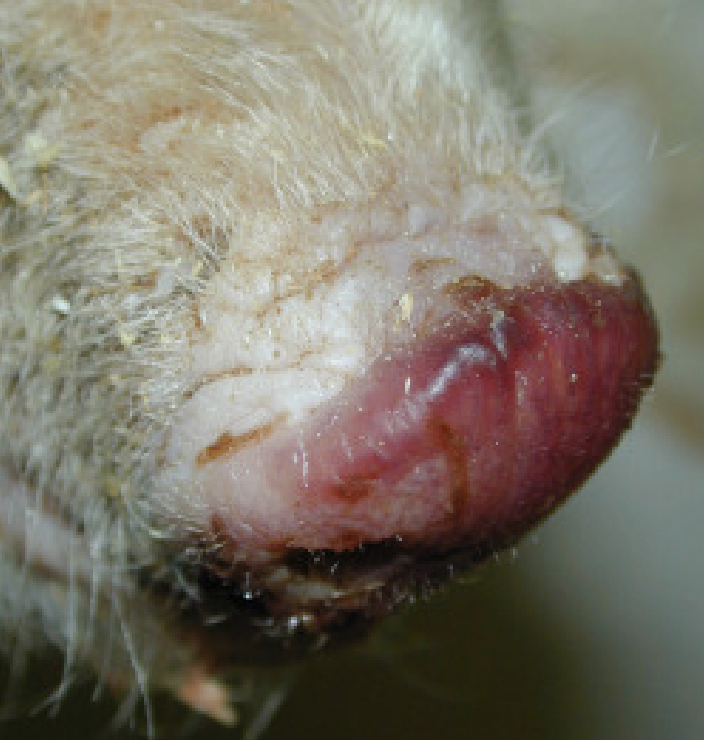
Exsiccatio postmortalis
English: Desiccation
Drying due to evaporation
drying out, often seen in piglets nose
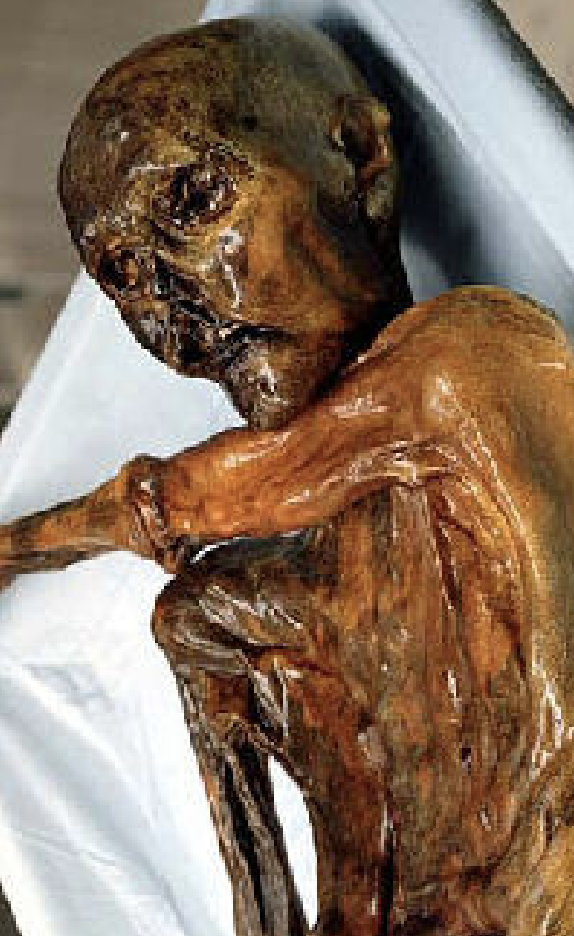
mummification–> complete dehydration of tissue
maceratio postmortalis
English: Soaking
- Skin and organs filled with fluid
Can occur if: - Carcass is in water
- Intrauterine death of fetus
Rigor mortis
English : stiffness
- Occurs in all 3 muscle types
- starts 2-4 hours
- stops 48-60 hours
cruor postmortalis
English: Postmortem clot
- Dark red, smooth, fleshy surface
- Blood clots 15-30 minutes after death
- Not attached to the intima
Hypostasis
English: PM Blood sedimentation
- Effect of gravity on the blood fluid
- Occurs within 1h
- Livores mortis - dark purple
postmortem spots where blood has
pooled
Imbibition
English: Discolouration
Discoloration by absorption of
pigments after death
Blood: hemoglobin, permeates
within 24 hours
Gall bladder: bile pigment
imbibition
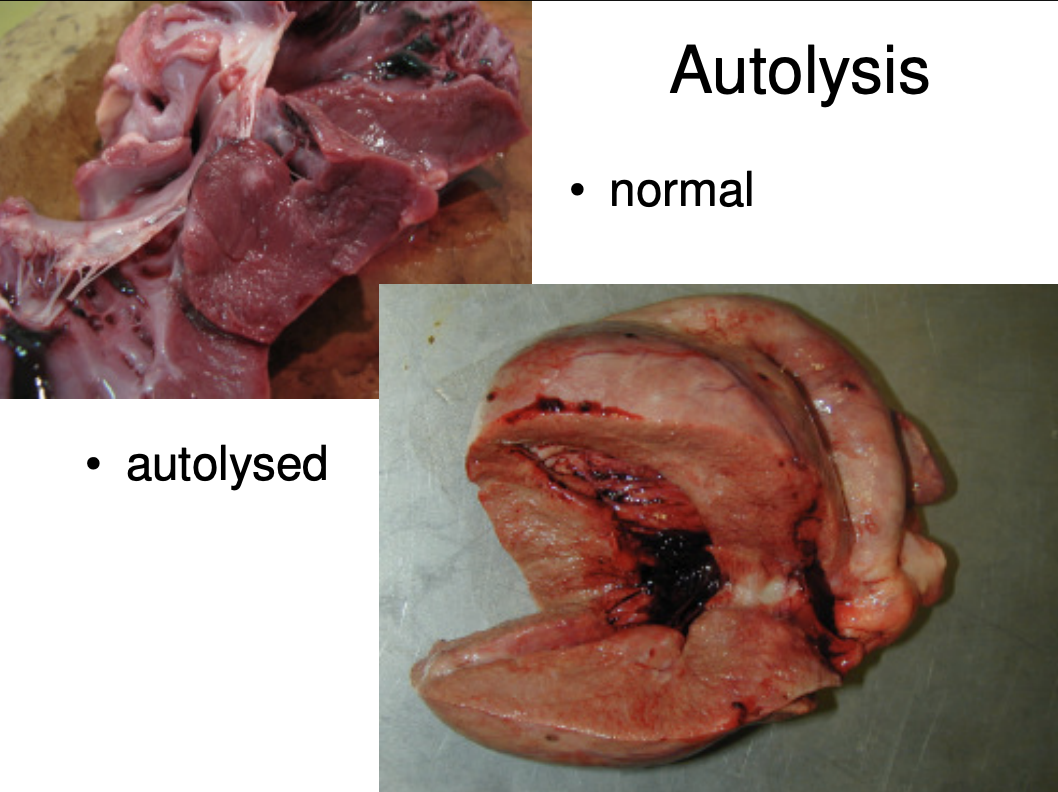
autolysis
English: Self-softening
- Autolysis by the cells own
endogenous enzymes - Autodigestion by digestive juices
- Leads to softening of the tissues
putrefaction
English: Postmortem destruction
Decomposition by saprogenic bacteria → gases, liquids, salts
Effects: Gas production → stomach distension, rapid putrefaction (esp. in warm environments, obese animals, hyperemic organs, infections, injuries)
Slower in:Lean, dehydrated animals; stops below 5°C
Consequences:
Emphysema: Gas bubbles in tissues
Tympany:GIT bloat/distension
Discoloration:
Sulph-hemoglobin: Hb + H₂S → Grey-green
Pseudomelanosis: H₂S + Hemosiderin →Black
Adipocere
English : Postmortem wax
Conditions:Forms in wet, clayey soil or in moist, low-oxygen environments
when body fat breaks down, fatty acids and soaps (salts of fatty acids) are produced through saponification.

-
57. Objective, task and investigation methods of pathology + internal condition of disease21
-
58. Disease10
-
59. Death8
-
60. Postmortem changes14
-
61. Traumas and their consequences10
-
62. Irradiations and electricity as cause of disease14
-
63. Degeneration changes of cells and tissue2
-
64. Pathological mucus production and pathological changes in the mucosubstance5
-
65. Hyalinosis, fibrinoid necrosis7
-
66. Pathologic pigmentation caused by hemoglobin and haemosiderin5
-
67. Pathologic pigmentation caused by hematoidin, and bilirubin9
-
68. Pathologic pigmentation caused by porphyrins7
-
69. Pathologic pigmentation caused by melanin, lipofuscin, and ceroid11
-
70. Exogenous pigments4
-
71. Concretions (lithiasis) and pseudoconcretions7
-
72. Gangrene6
-
73. Metaplasia, pseudomateplasia6
-
74. Accomodation (hypertrophy, hyperplasia, transformatio)4
-
[C] 1.42 Proliferative changes during regeneration. Fibrosis, elastosis, fibroelastosis, reticulosis, cirrhosis27
-
[C] 1.56 Inflammation in organs without blood vessels. The inflammation-organism relationship27
-
77. Necrotizing and proliferative inflammation8
-
78. General characteristics of the granuloma formation9
-
79. Granulomas caused by fungi28
-
80. Granulomas caused by chemicals and other granulomas8
-
81. Development animals used by non-infectious diseases6
-
82. Development animals used by infectious diseases4
-
83. Professional and formal aspects of writing a post mortem report5



