Hospital performance indicators
- Number of hospitals and beds
- Occupancy rate (%)
- Average length of stay (ALOS)
- Admissions per 1000 population
- stratified by age, insurance status, others
- Quality indicators
- “Report cards” and rankings with other hospitals on quality of care and other performance indicators
- Financial ratios
Balance sheet and income statement
Balance Sheet (at a given point in time)
- Lists different components of
- Assets
- Liabilities
- Shows net assets (assets minus liabilities)
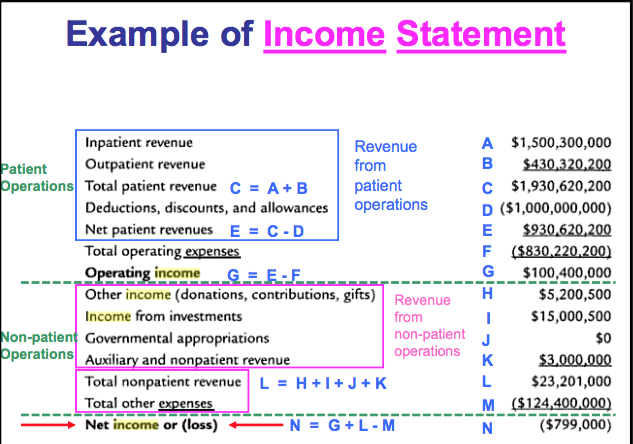
Income Statement (during given time period)
- Shows different sources of revenue and costs
- (e.g. operating revenue and expenses and other, non-patient revenue and expenses)
- Shows net income or loss (revenue collected minus costs/expenses)
_**Look at examples on pg. 14 and 15 of Week 10 handout_
Examples of financial ratios:
- Operating margin
- Total margin
- Trend in hospital margins
Operating Margin (from pt cases) = net operating income (profit) / total operating revenue
(net operating income = revenue - expenses)
- Measures ability to cover expenses with revenue from patient operations
Total Margin = net income / total revenue
((net operating income + net nonoperating income) - expenses) / total revenue
- Measures ability to cover expenses with revenues from all sources (including investment income, donations, etc.)
Trend in hospital margins: Both total margin and operating margin had ups and downs between 1993 to 2013. Overall range of 4% to 8% for total margin. Overall range of a little above 2% to about 6% for operating margin
- Total margin is usually greater than operating margin b/c operating margin is included in the total magin (so you would expect it to be greater, unless you are making a loss from things you did other than provide care to patients, but this is not usually the case)
Hospital regulatory compliance
- Growing # government rules, regulations, policies governing hospital operations
- much more complex than 1960s-1980s
- Health Reform (ACA) will increase even more
- Most hospitals have compliance system & dept
- tools that ensure organization’s operations conform to govmt. & other rules
- satisfy (among others):
- State licensing requirements
- Medicare certification requirements
- Hospital objective: minimize cost of compliance
Ethical Issues in Delivery of Health Services
- HIPAA and patient privacy
- Rationing (especially with financial incentives to reduce costs)
- MD autonomy in decision making vs. practice guidelines vs. benchmarking
- Services based on ability to pay
- Insured vs. uninsured
- Mental health patients
- Tradeoff: protecting patient confidentiality & rights vs. protecting society against possible threats
Inpatient Utilization Measure - Occupancy Rate
- Equation
- Trends between 1980-2012
Occupancy rate = # beds occupied / # beds available
e.g. Avg 90 beds occupied during August 2015; 120 bed available. Occupancy rate = 90/120 =75%
Trends:
- Both nonprofit and for profit occupancy rates decreased (especially from 1980 to 1990) until about 2000, then increased a tiny bit (fairly constant after 2000)
- Nonprofit: 78.2% in 1980, 64.9% in 2012
- For-profit: 65.2% in 1980, 56.8% in 2012
- For-profit occupancy rates are consistently less than nonprofits (gap narrowed slightly between the two over over the years, but still an 8-10% difference between since 2000 between nonprofit and for-profit - with nonprofit having the lower occupancy rates)
- The larger the hospital, the higher the mean occupancy rate (e.g. bed size 500+, 72.6%); the smaller the hospital, the lower the occupancy (e.g. bed size 1-49; 41% occupancy).
- This is a problem for small hospitals because there are a lot of fixed costs for hospitals and small hospitals would have fewer pts anyway, so with lower occupancy, it is even more difficult for them financially.
*Occupancy rate gives more info about a hospital’s financial status as compared to ALOS (which relates more to pt health status) b/c if they have multiple empty beds (decreased occupancy) they still have to pay expenses for the facility, etc. and are not receiving receiving revenue to offset those costs
Inpatient utilization measure - average length of stay (ALOS)
- Equation
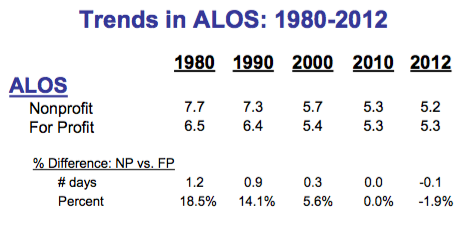
- Trends 1980-2012 (by ownership: nonprofit vs. for-profit)
Average length of stay (ALOS) = total # patient days / total # inpatients.
e.g. 600 pts stayed 3960 total days during August 2015. ALOS = 3960/600 = 6.6 days
Trends:
- Both nonprofit and for-profit ALOS decreased markedly from 1980 to 2012 (an especially marked decrease in non-profits: 1.5 days)
- For-profit ALOS was less than nonprofit ALOS in all years before 2010. Gap then narrowed; by 2010 ALOS in for-profit and nonprofit hospitals was identical. Nonprofit hospitals had a slightly lower ALOS in 2012.
Outpatient utilization measures - examples
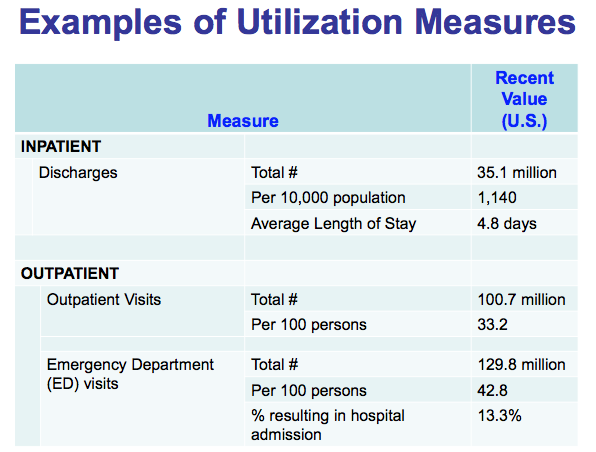
- # MD visits
- Total number
- Rate: # visits to MD per given population in area
- e.g. 212.4 office visits per 100 persons in 2013
- % of adults who had contact with primary care provider in past year
- % of children < 2 y.o. who were fully immunized in 2013
What is long-term care (LTC)?
- Variety of services
- health, mental health, residential, social support
- Provided to persons with functional disabilities; also over extended period of time
- chronic, not acute
- Continuum of services
- Not just nursing home care provided to elderly
- includes community-based services, care at home, other
- Not just nursing home care provided to elderly
- Formal vs. informal LTC services
- formal: continuum of care (includes nursing homes)
- informal: family, etc.
- Goal: coordinated and integrated services to meet person’s needs
- maximize independence
- provides continuity of care over time and across settings
- formal and informal care
- all diagnoses (services change as needs change)
Who needs long-term care?
- Have 1+ functional disabilities
- limitation in ability to perform
- Activities of daily living (ADLs) - core self care tasks
- Instrumental activities of daily living (IADLs) - not necessary for functioning, but permit independence
- Possibly early inpt discharge but still require care
- Possible physical or mental health issues
- (family situation can also play a role)
- limitation in ability to perform
- Population segments at great risk of needing LTC include:
- elderly
- those with chronic conditions, comorbidities, and/or disability (these are often interrelated)
- children with special health care needs
- Needs, formal care available, and funding vary depending on specific population
Settings for long term care (LTC) services
- Skilled nursing facilities (nursing homes) (SNFs)
- Pt doesn’t require hospitalization, but requires ongoing RN and other services provided in formal setting
- Large % of expenditure (>30%) paid by Medicaid
- Intermediate care facility (ICF)
- 24 hour care
- Lower skill level required than SNF (don’t require as many nurses)
- Often focus on providing care to those with mental health issues
- Hospital care (distinct part LTC units)
- Outpatient (adult day care; senior centers)
- Home health
- Hospice
Number of nursing homes
- 2000-2014; US vs. CA (and % of all nursing homes that are in CA)
- Occupancy rate in 2014: US vs. CA
Number of nursing homes:
US:
2000: 16, 886
2010: 15,622
2014: 15,401
CA: (number is decreasing more quickly in CA than in rest of US)
2000: 1,369 (8.1%)
2010: 1,229 (7.9%)
2014: 1,178 (7.6%)
Occupancy rate in 2014:
US: 82.3%
CA: 86.1%
Provider payment methods: Retrospective (fee-for-service) vs. Prospective
Retrospective (fee-for-service): $ amount determined after services provided
- based on specific services provided and $ charges (costs for those services)
- often called “cost-based”
Prospective: $ amount determined before services provided
- exact $ amount depends on how pt is classified (usually based on illness or medical condition)
- NOT dependent on each pt’s actual $ charges
- $ amount based on prior utilization for group of patients with same diagnosis or using similar resources
- Historically initiated by Medicare (subsequently followed by most private insurances doing the same sort of thing)
- Different methods for different services and settings (e.g. hospital inpt, outpt, etc.)
- Examples in hospital setting - 1 payment:
- per case (e.g. DRGs - pay one price for entire hospital visit based on the dx)
- per diem (this would result in pt’s being kept in longer, b/c hospital is paid for every day they are there)
- bundled services
**Prospective payments are not paid before service is given, it is just that payments are set before the services are provided (common question people miss on exam)
Medicare Prospective Payment changes over last 30+ years according to service/type of provider
- Services: hospital inpt, MD, nursing homes, hospital outpt, home health
- Year the prospective payment service began for each
- How payment system works for each (including terminology for each)
*Before 1983, pretty much all of these providers were paid on a fee-for-service basis
*Over a 20 year period of time, huge changes in payment methods were made (seen below)
Hospital inpatient:
- 1983
- Payment method: Diagnosis-Related Group (DRG)
MD services:
- 1992
- Physician Fee Schedule (Medicare Fee Schedule, MFS) - based on Current Procedural Terminology (CPT) codes
- Fee schedule: $ payment (per unit) for each service; not bundled payment
- Covers services provided by physicians to Medicare pts
Nursing home (SNF):
- 1998
- Resource Utilization Group (RUG)
- SNF pts classified into a RUG based on service needs (then calculate 1 “case mix” level per SNF - represents overall illness severity level)
- Reimbursement per day depends on SNF case mix (several other adjustments)
- (This is a different reimbursement form from hospitals/MDs - not paid per patient, but instead per group)
Hospital outpatient:
- 2000
- Hospital Outpatient Prospective Payment System (OPPS) - payment for services provided in hospital outpt departments
- Uses Ambulatory Payment Classification (APC) scheme
- All oupt services divided into 300+ gruops based on procedures (similar resources)
- Geographic adjustment ratio
- APCs recently extended to surgi-centers
- Uses Ambulatory Payment Classification (APC) scheme
Home health:
- 2000
- Home Health Resource Group (HHRG) - payment based on HHRG (n >150)
- Pt’s specific HHRG dpends on: functional status, clinical severity level, need for rehab
- $ payment using HHRGs covers all HH services provided in a 60-day episode
- If <5 visits during 60 days, pay per visit instead of per episode
Medicare Hospital Reimbursement
Before 1983: hospitals reimbursed based on “reasonable” (actual) cost
- result was larger reimbursement with longer LOS, additional services, etc.
Tax Equity and Fiscal Responsibility Act (TEFRA):
- 1983: implementation of Medicare Prospective Payment System (PPS)
- a major part of this was DRGs
- Hospitals reimbursed a fixed amount for each discharge based on patient’s specific diagnosis-related group (DRG)
- 4-year phase in: blend actual costs with DRGs
- 467 different DRGs in 1983
- increased total # DRGs slightly every year
- in 2007: more adjustments for complications and comorbidities
- approximately 538 DRGs replaced by 750 MS-DRGs (Medicare Severity DRGs)
DRG Payment Rate:
- Based on national average cost of treating patient with similar diagnosis
- based mainly on primary diagnosis
- adjusted for differences in regional practice costs, teaching hospital, outliers, and other factors
- Independent of LOS, services provided, cost, etc.
- DRG rate “all inclusive” - includes all hospital costs
- institutional costs only; excludes individual MD services
Incentives (ways to reduce costs and related issues) in Prospective Payment System
- Reduce ALOS
- Since hospital payment fixed, incentive to decrease costs by reducting ALOS
- lower quality of care and worse health outcomes might result (external peer review organizations to protect against this)
- Expansion of home health to address medical needs previously done as inpatient
- Since hospital payment fixed, incentive to decrease costs by reducting ALOS
- Unbundling
- multiple admissions; provide services previously done in one admission to gain multiple DRG payments
- transfer services formerly provided as inpt (and thus included inpt cost of treating pt) to outpt setting (where separate fee billed)
- reduces inpt cost but still paid as if providing services
- “DRG Creep”:
- Use DRG assignment algorithm to assign a higher-paying DRG
- Often “grey area” regarding appropriate primary clinical diagnosis and which comorbiidty to assign
- Use DRG assignment algorithm to assign a higher-paying DRG
*Many of these have been remedied (e.g. CMS controls for these factors of “gaming the system”)
Evidence on performance (after Prospective Payment/DRGs implemented in hospitals)
- No consistent evidence of poor quality
- Peer Review Organizations (PROs) find no consistent decline in quality of care indicators, including 30-day readmission rates
- Length of stay (LOS) did decrease
- But it was decreasing prior to PPS
- Less seriously ill transferred to outpt; remaining inpts sicker
- but ALOS still fell
- Slower increase in total Medicare expenditures
- But increased HH and other outpt expenditures




