The main sensory organ of the visual system is the ______, which takes in the physical stimuli of _____ and ______ them into electrical and chemical signals that can be interpreted by the brain to construct physical images.
The main sensory organ of the visual system is the eye, which takes in the physical stimuli of light rays and transduces them into electrical and chemical signals that can be interpreted by the brain to construct physical images.
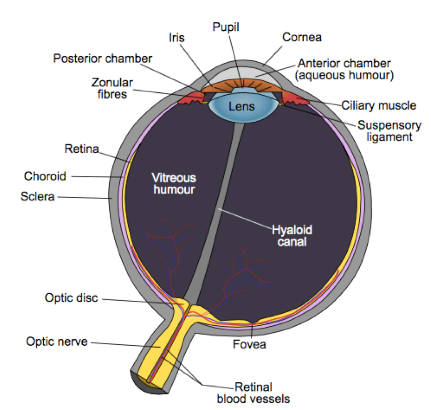
The eye is divided into anterior and posterior segments (cavities). Describe the location and strucutres included in each segment.
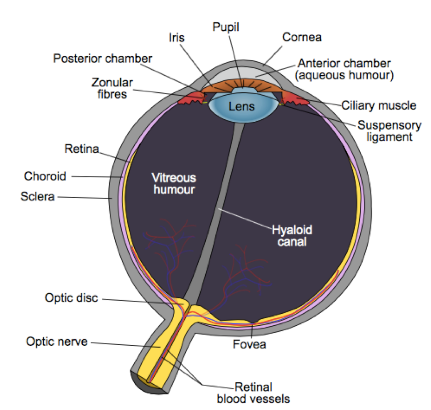
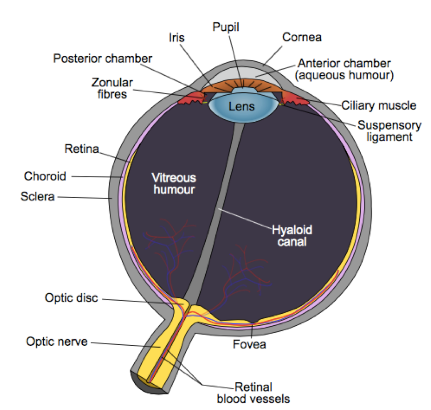
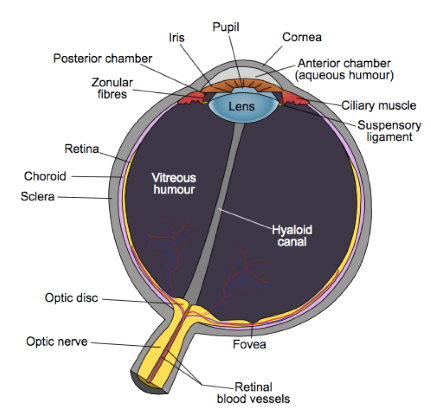
Anterior segment/cavity - front 1/3 of eye; incl structures in front of vitreous humour: cornea, iris, ciliary body, lens, and aqueous humour.
- Composed of two spaces: anterior and posterior chambers.
Posterior segment/cavity - back 2/3 of eye; incl vitreous humour, retina, choroid, and optic nerve.
The anterior chamber is filled w __________, wh provides pressure to maintain shape of eyeball and nourishes the ____ and ____.
The anterior chamber is filled w aqueous humour, wh provides pressure to maintain shape of eyeball and nourishes the cornea and iris.
Which structure lines the inside of eyelids and covers/nourishes/protects the sclera and cornea?
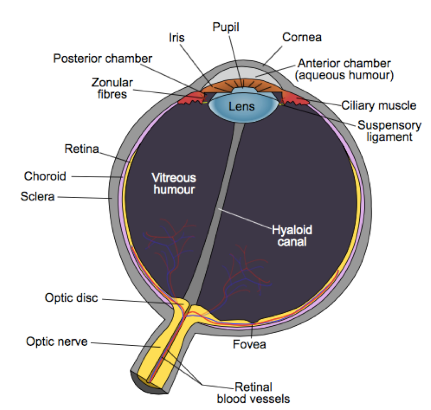
Conjunctiva – thin layer of cells that lines inside of eyelids and covers/moisturizes/protects sclera (whites) and cornea.
The ______ is the transparent covering over iris/pupil/ant. chamber; starts to refract light, first part of eye light hits.
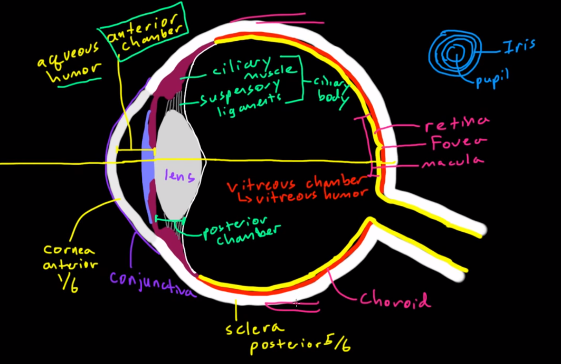
The cornea is the transparent covering over iris/pupil/ant. chamber; starts to refract light, first part of eye light hits.
- Thick sheet of fibrous tissue
- Works t/g w ant. chamber and lens to refract light.
- Cornea accounts for ~2/3 of eye’s total optical power.
- Humans: refractive power of cornea is ~43 dioptres.
- Can be surgically reshaped, e.g. LASIK
Which structure accounts for the majority of the eye’s refractive power?
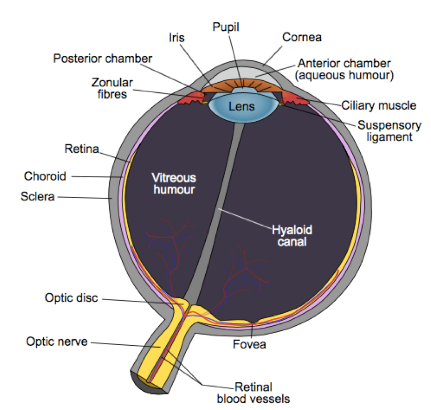
The cornea, ant. chamber, and lens work t/g to refract light, but the cornea accounts for ~2/3 of eye’s total optical power.
- Humans: refractive power of cornea is ~43 dioptres.
- Can be surgically reshaped, e.g. LASIK
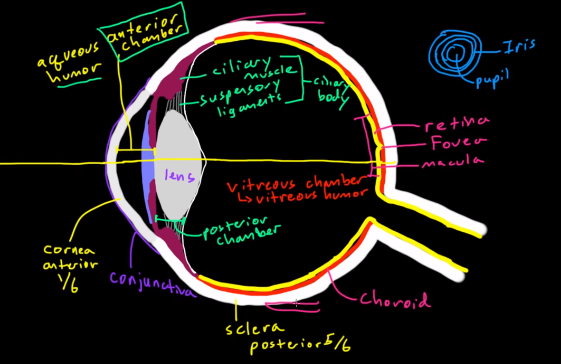
The pupil is the opening in the middle of the iris. How does the size of the pupil change, and how does this affect the amount of light entering eye?
Pupil - opening in middle of iris; size of pupil changes based on iris relaxing/contracting; modulates amount of light that enters.
- As iris contracts → pupil size ↓ → amount of light ↓
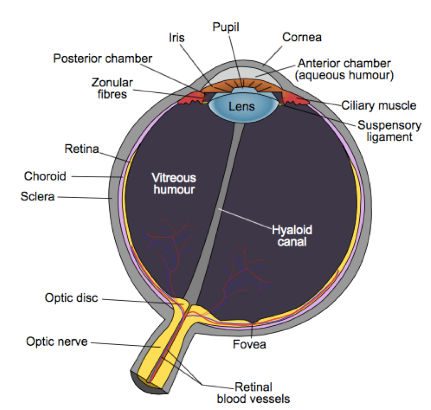
Describe the structure and function of the iris.
Iris - Gives the eye color; muscle that constricts/relaxes to change size of pupil → modulates amount of light entering eye (“accommodation”).
- Iris contracts → pupil size ↓ → less light enters eye.
- Location: anterior chamber of anterior segment.
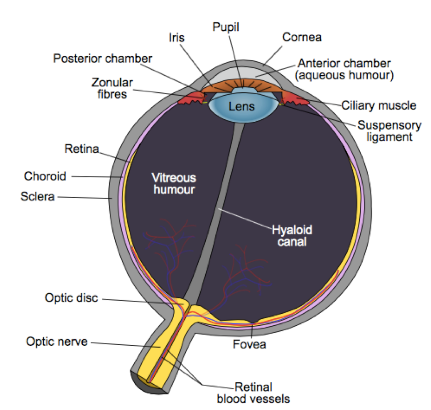
The _______ is the narrow region behind iris and in front of lens; also filled w aq humour.
The posterior chamber is the narrow region behind iris and in front of lens; also filled w aq humour.
- Part of anterior segment (front 1/3 of eye).
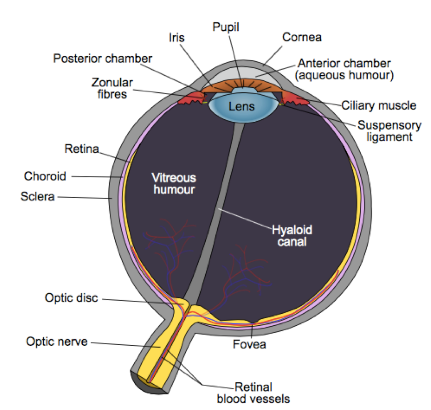
Describe the structure and function of the lens.
Lens - transparent, biconvex; refracts light → focuses onto retina.
- Adjusts focal distance of eye via accomodation, i.e. changes shape (curvature/thickness) using suspensory ligaments to focus objects at various distances onto retina.
- Accounts for ~1/3 of refractive power of eye; ~18 diopters.
- Recall: cornea accounts for ~2/3; ant chamber makes up minor balance.
The eye can adjust focal distance via a process called accommodation. Describe how this process works.
Short focal distance:
- Ciliary muscle contracts → zonule fibers loosen → lens thickens (more round) → higher refractive power.
Long focal distance:
- Ciliary muscle relaxes → zonule fibers tighten→ lens thins (more flat) → less refractive power.
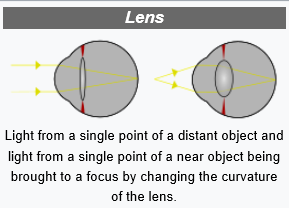
To focus on a distant object, ciliary muscles must (contract/relax) → zonular fibers (tighten/loosen) → lens becomes (thick & round/thin & flat) → refractive power (↑/↓) → focal distance (↑/↓).
To focus on a distant object, ciliary muscles must relax → zonular fibers tighten → lens becomes thin & flat → refractive power ↓ → focal distance ↑.
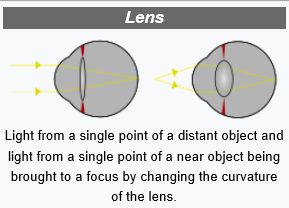
The ___________ is a ring of smooth muscle that controls accommodation (adjusts focal distance) and regulates secretion of aqueous humour.
The ciliary muscle is a ring of smooth muscle that controls accommodation (adjusts focal distance by changing shape of lens) and regulates secretion of aqueous humour.
- Suspensory ligaments - attached to a ciliary muscle → combine to form ciliary body.
- Note: pupil size changes via sphincter pupillae muscle and dilator pupillae; ciliary muscle not involved.
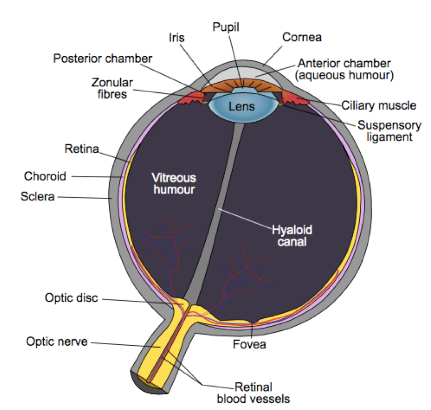
The __________ is the space b/w the lens and retina; filled w __________, wh provides pressure/nourishes posterior segment of eye.
The vitreous chamber is the space b/w the lens and retina; filled w vitreous humour, wh provides pressure/nourishes posterior segment of eye.
- Vitreous humor - transparent, colorless, gelatinous mass; comprises 4/5 volume of eye.
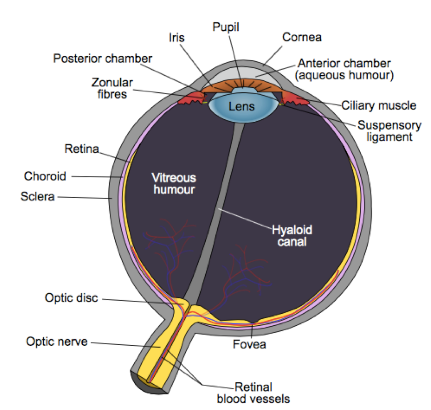
What is the term for the region along back of eye where phototransduction occurs, i.e. light → neural impulse → perception.
Retina - region along back of eye where phototransduction occurs, i.e. light → neural impulse → perception.
- Contains three layers of neural cells: photoreceptors (rods/cones), bipolar cells, and ganglion cells.
- Rods - dim; black/white.
- Cones - light; color.
- Retinal blood vessels create “red-eye” effect in photos.
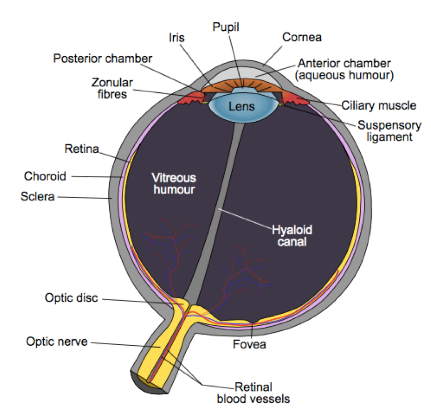
What are the macula and fovea?
Macula – region of retina directly behind lens, center of wh is the fovea; rich in cones, some rods.
Fovea – small indentation in center of macula; completely covered in cones, no rods.
- FOvea, COnes.
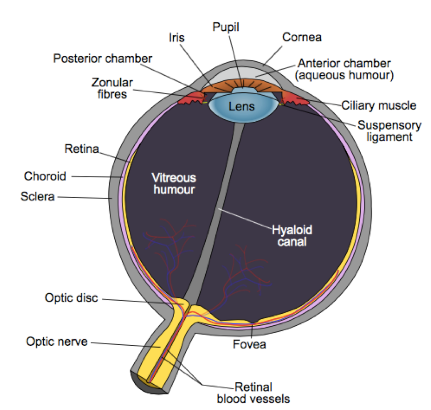
Describe the structure, function, and location of the choroid.
Choroid - vascular layer b/w retina/sclera; provides O2/nutrients.
- Thickest at rear of eye; narrow elsewhere.
- Forms uveal tract, along w ciliary body and iris.
- Humans: pigmented black → all light is absorbed.
- Other animals (e.g. cats) have reflective/unpigmented choroid → enhances night vision
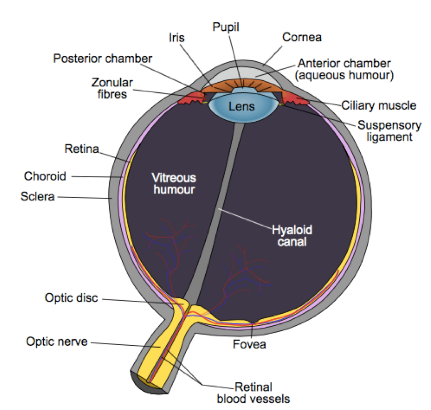
Describe the structure and function of the optic nerve.
Optic nerve (cranial nerve II) - carries visual info fr retina to brain.
- Composed of retinal ganglion cell axons and glial cells.
- Extends fr optic disc to optic chiasm.
- Optic disc/nerve head - point of exit for ganglion cell axons; no photoreceptors → blind spot.
- Optic chiasm - part of brain (below hypothalamus) where optic nerves partially cross.
What is the term for the “white of the eye”?
Sclera - white of eye; thick, fibrous tissue; covers posterior 5/6th of eye (cornea covers anterior 1/6); attachment point for muscles; extra layer of protection; lined w conjunctiva.
- Humans: rare for having plainly discerible iris against sclera → easier to infer where another individual is looking → cooperative eye hypothesis suggests this has evolved as a method of nonverbal comm.
What condition involves the ability to see things up close, but not from far away?
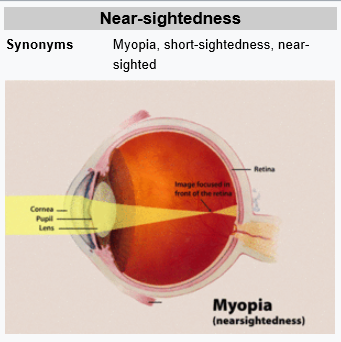
Myopia = nearsightedness, i.e. ability to see things up close, but not fr far away.
- Lens has too much refractive power, i.e. light reflects off of a far away object → refracts via cornea/lens → creates image that falls in front of retina rather than directly ON retina.
- Correct w diverging lens (negative power), e.g. glasses wh ↓ total refractive power of eye.
- Most common eye problem; ~1.5 bil (22% of population)
What condition involves the ability to see things from far away, but not up close?
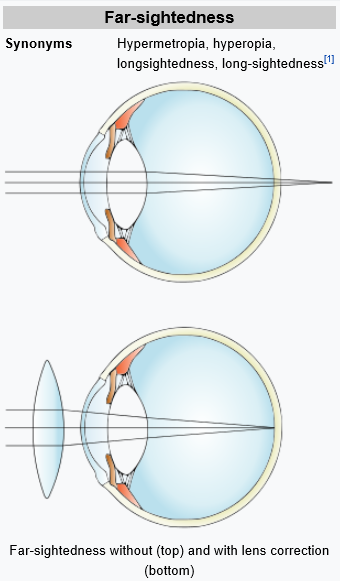
Hyperopia = farsightedness, i.e. ability to see things far away, but not close.
- Lens has too little refractive power, i.e. light reflects off close up object → refracts via cornea/lens → creates image that falls behind retina rather than directly ON retina.
- Correct w convex lens (positive power), e.g. glasses wh ↑ total refractive power of eye.
What are emmetropia and presbyopia?
- Emmetropia - normal vision
- Presbyopia - inability to accommodate (focus); results fr loss of flexibility of lens, wh occurs w aging.
What is a diopter?
Diopter - unit of measurement of optical power of a lens/curved mirror.
- Reciprocal of the focal length in metres; 1 diopter = 1 m-1.
- I.e. a unit of reciprocal length.
- E.g. a 3-diopter lens brings parallel rays of light to focus at 1/3 meter.
- E.g. a flat window has an optical power of zero diopters.
__________ is the electrical activation of one neuron by another neuron.
Transmission is the electrical activation of one neuron by another neuron.






