What is the action of the piriformis muscle?
ER of Hip (when extended) and abduction (when hip is flexed).
What is piriformis syndrome?
- May be associated with what?
- What special test is non-specific, but may be (+/-)?
- Deep ache/ LBP => butt (greater sciatic foramen) => that radiates down the posterior aspect of the thigh. Numbness and tingling in SAME pattern bc sciatic nerve is close
- Worsens when sitting > 20 minutes; better when walking
- Trauma or overuse/ wallet test
- Straight leg raise test
In Piriformis Syndrome, what may increase susceptibility of sciatic nerve entrapment?
How close the [piriformis m] is to the [sciatic nerve].
What SD may be associated with Piriformis Syndrome
- Ipsilateral hip ER SD
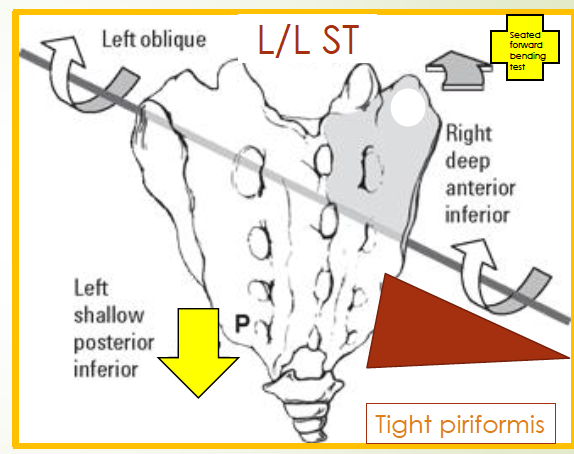
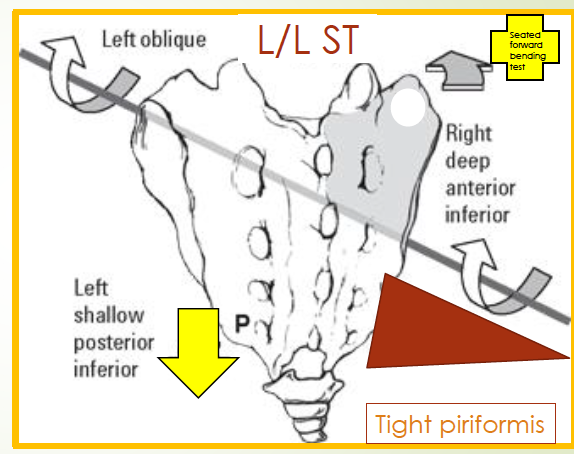
- Sacrum is rotated anteriorly towards ipsilateral side on a contralateral oblique axis.
- R-sided pirformis syndrome => L/L sacral torsion with compensatory rotation of lower lumbar vertebra to the R.
- => leads to ipsilateral physiologic short leg
How is Piriformis Syndrome diagnosed?
- Diagnosis of exclusion: rule out other causes with PE, XR, and/or MRI
- MRI is LAST resort
How is Piriformis Syndrome treated?
- OMT
- PT = effective for most
- Analgesics, glucocorticoid injection or botox injections
What physiological change do we see with piriformis syndrome?
Short ipsilatal leg
Piriformis syndrome will cause a TP where?
2/3 of the distance between the ILA and greater trochanter.
L/L Sacral Torsion
What will we find?
- R sacral sulcus = deep/ anterior
- L ILA = shallow/ posterior / inferior
What is psoas syndrome?
- Chronic psoas spasm can cause what?
RLQ sharp, cramping pain that radiates to the lower back with hypertonic psoas muscle.
- Chronic => persistent strain across lumbosacral junction.
Psoas Syndrome
- What SD may be associated?
- If crhonic
- Type 2 SD of L1 and L2: flexed and rotated towards side of affected psoas; SB towards
- L5 E (extended)
- Chronic psoas syndrome: may have two type 1 SD (1 above and below) around the type 2 SD of L1/L2
Psoas Syndrome TP is commonly found where?
Ipsilateral iliacus and contralateral pirformis
OMT for Psoas Syndrome?
- OMT directed at SD in [thoracolumbar junction and lumbosacral area].
- Stretch hypertonic psoas m.
Short Leg Syndrome
- Describe the pain
- Findings?
- Often have pain/SD where?
- Often associated with what disease?
- Dull, midline lumbosacral pain that gets worse as the day progesses due to sacral base unleveling
- Findings: sacral base unleveling; medial mallelos short after SD resolves
- SI and lumbosacral joint pain/SD
- Scoliosis
When there is pain in the [lumbosacral area], what is the first structure to react?
Iliolumbar ligmant; tender where it attaches [iliac crest] or [L4/5 TP]
Where is the Chapmans point for iliolumbar ligament?
Colon
SD associated with Short Leg Syndrome
- Lumbar spine is [SB away] and [rotated towards] the side with the LOWER sacral base
- Anterior inominate rotation on side of the short leg;
- On longer leg
- Posterior innominate rotation on side of l_ong leg._
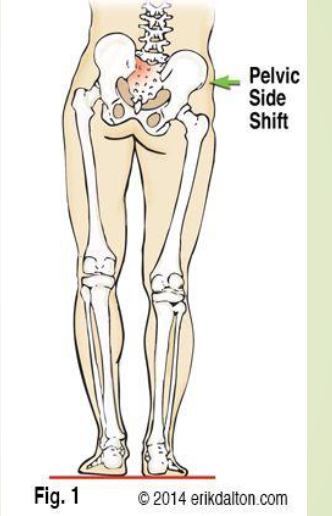
- Pelvic side shift to the side of the longer leg
- Foot = pronated and IR
How do you dx short leg syndrome
Standing postural XR and measure: iliac crests, femoral head and sacral base
How to treat Short Leg Syndrome?
- Treat SD 1st.
- Stretch assymetric muscles
- Heel lift therapy
- If there is an acute change in leg length, replace full discrepancy IMMEDIATELY.
heel lift therapy?
- Only treat if discrepency is ______.
- How much heel lift can we add?
- Final lift height
- Only treat if leg length discrepancy is > 5 mm
- Add a max of 1/4 heel lift in shoe; 1/4 can may be added to outside (1/2 total). You can add total 1/2 outside the shoe.
- Final lift height should be 1/2 - 3/4 of measured discrepancy, unless recent sudden cause apparent
When performing Heel Lift Therapy, if patients condition is fragile, how much heel lift do we add? Flexible?
- Fragile: Start with 1/16 and add 1/16 every 2 weeks.
- Flexible: Start with 1/8 and add 1/8 every 2 weeks.
A 21 year old male comes into clinic with low back pain and left buttock pain for the past 2 weeks. He is an offensive lineman on the local college football team. He does not recall a specific injury, but states that he sustains several hits during practice and games. History reveals that for the past month he has had a change in gait. He denies any radiation of pain down the legs. Straight leg raise test is negative. During the TART exam there is a palpable “step off” in the lower lumbar spine when the patient flexes forward. Which of the following mechanisms most likely contributed to this patient’s presentation?
- A. hyperflexion injury of the spine
- B. repetitive hyperextension of the spine
- C. axial load injury to the spine
- D. rapid twisting motion of the spine
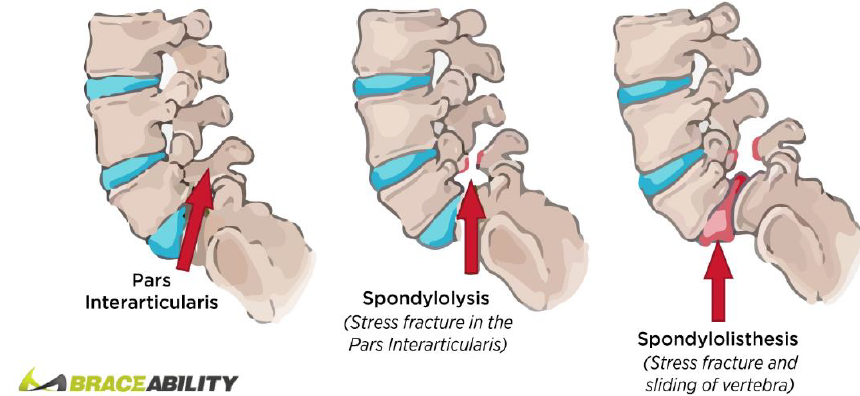
- B. repetitive hyperextension of the spine => Spondylolysis** and **Spondylolisthesis
What does Spondylolysis/Spondylolisthesis cause?
Hyperlordosis due to repetitive hyperextension, stress, overuse or macrotrauma.



-
1. Billing and Coding27
-
2. Ottawa Rules16
-
3. Rib Counterstrain37
-
4. Naming SD13
-
5. Osteopathic Considerations for Geriatrics61
-
6. Visceral Manipulation Technique Integration30
-
7. LBP52
-
8. Know Tx Recommendations in Carpal Tunnel7
-
9. Spinal Curve Compensations and Zink6
-
10. CI to OMT1
-
11. Other docs12
-
UE/LE COunterstrain33
-
1. ANS44
-
OB Patients56
-
Qs15
-
Lymphatics16



