Phases of diastole
- Isovolumic relaxation 2. Early, rapid LV inflow 3. Diastasis 4. Atrial contraction
LV relaxation vs compliance
LV Relaxation: involves the resequestration of calcium from the cytosol back into the SR * active process using Ca pumps * allows myofibrils to relax LV compliance: depends on the passive properties of the ventricle
Mitral Inflow, IVRT and deceleration time
IVRT: time from end systole to beginning of E wave DT: time from peak E wave velocity to zero Impaired relaxation: IVRT >110ms (delayed MV opening) DT > 250ms Decreased compliance: IVRT < 60ms (early MV opening due to high LA pressures) DT < 140ms
Transmitral Inflow, impaired relaxation
The initial abnormality in most cardiac disorders - ischemia/MI - hypertrophy - hypertrophic cardiomyopathy - infiltrative disorders Characteristics - E/A reversal (E/A < 1) - Prolonged DT - Prolonged IVRT
Transmitral Inflow, restrictive pattern
Markedly decreased LV compliance causing increased left atrial pressures - Restriction coexists with impaired relaxation, but overwhelms changes caused by impaired relaxation Characteristics: - Elevated E wave (due to elevated LAP) - Decreased A wave (poor atrial contractility) - E/A > 2 - shortened IVRT - shortened DT
Transmitral inflow pattern changes with preload reduction
Decreasing preload by NTG, reverse T-berg, vasalva - healthy individual has proportional decrease in E and A wave - pseudonormal will slide back to impaired relax pattern - restrictive will slide back to pseudonormal, unless end-stage and irreversible
Pulmonary Venous Flow Tracing
- Anterograde systolic velocity (S) - Often biphasic * S1 = left atrial relaxation * S2 = RV stroke volume, LA compliance, early ventricular systole (many things together) 2. Diastole (D) - LA serves as open conduit from PV to LV 3. Atrial flow reversal (A) - LA contraction
Pulmonary Vein Tracing, Normal Values
- S wave - Equal to or greater than diastolic - VTIsys/(VTIsys+VTIdias) < 40% denotes in left atrial pressures 2. A wave - Duration same or less than transmitral A wave (>30ms longer is abnormal) * Denotes more blood going forward (normal) than backwards - Peak velocity 35cm/s or more greater than mitral A wave is abnormal
Pulmonary Vein Tracing, Impaired Relaxation
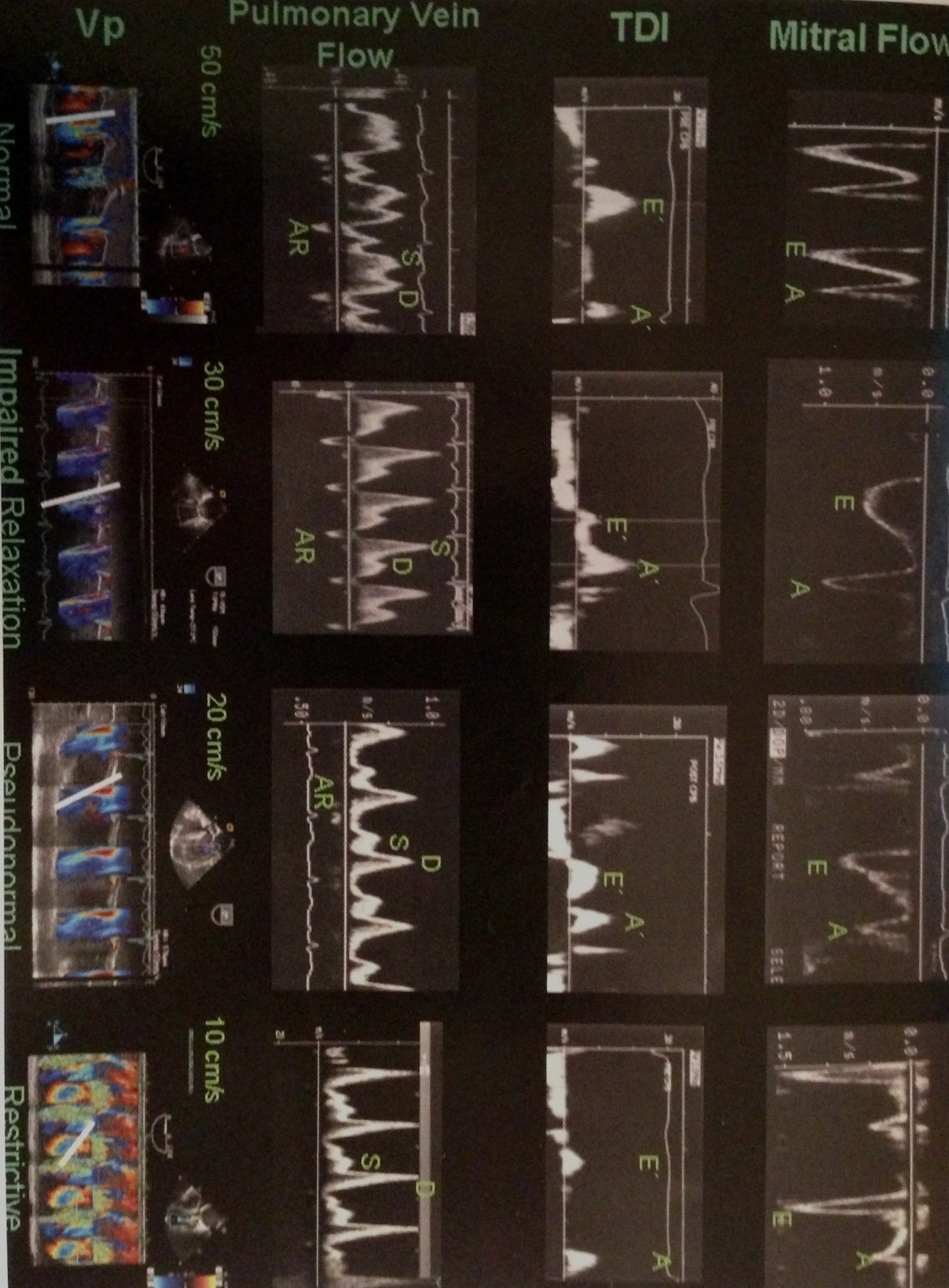
- Reduce D wave velocity (parallels decrease in mitral E wave velocity) - Compensatory increase in S wave - ** Systolic predominance
Pulmonary Vein Tracing, Pseudonormal
- Systolic blunting (due to reduced ventricular compliance) - A wave with prolonged duration and increased velocity
Pulmonary Vein Tracing, Restrictive
- Systolic blunting (due to reduced ventricular compliance) - A wave with decreased velocity, often due to failure of atria - Diastolic wave DT shortened (similar to transmitral E wave DT shortening with restrictive defect)
Transmitral and Pulmonary Vein Limitations
- Preload, afterload, HR, rhythm all have effects
Tissue doppler to assess mitral annular motion, general considerations
- Use ME 4 chamber view - Best alignment to assess lateral wall * Septal wall possible, although velocities are lower and blood flow in LVOT can obscure measurements
TDI of mitral annular motion, normal
- Mirror image of transmitral flow velocities, with lower velocities (E’, A’, S’) - E’ normal 8-15 cm/s *** PRELOAD INSENSITIVE ***
TDI of mitral annular motion, pathology
Impaired relaxation: E’ wave decreased while A’ wave remains normal (similar to transmitral flow) Pseudonormal and Restrictive: A’ begins to fall, BUT E’/A’ remains decreased such that E’/A’ <8 (differs from transmitral flow here)
Propagation Velocity
- velocity at which flow propagates into the ventricle - slope of the color wavefront of transmitral flow (first aliasing velocity) starting at mitral annulus extending 3cm into LV - ME 4 chamber *** PRELOAD INSENSITIVE *** Normal: >45-50
Methods of Assessing RV Diastolic Dysfunction
- Transtricuspid Flow Velocities 2. Hepatic Vein Flow 3. IVC
Transtricupid Flow Velocity
Similar to transmitral flow with E and A waves with similar changes in impaired relaxation
Hepatic Vein Flow
Morphology 1. Small reversal following atrial contraction (A wave) 2. Antegrade systolic phase (S wave) 3. Small flow reversal end systole (V wave) 4. Antegrade diastole (D wave)
IVC and RV diastolic dysfunction
IVC Normal (Right atrial pressure 0-5mmhg) - IVC diameter 50% of original diameter with spontaneous inspiration Elevated RAP (>20mmhg) - Large diameter - Little respiratory variation
Pericardial Tamponade
- Early diastole RV collapse - Late diastole - early systole RA collapse - Abnormal ventricular septal motion - > 25% respiratory variation in mitral and tricuspid flows
Comparison of Doppler measures of diastolic function

-
1. Principals and Technology of 2D Echo37
-
3. LV Systolic Performance and Pathology50
-
4. Diagnosis Of Myocardial Ischemia12
-
5. Doppler Technology25
-
6. Quantitative Doppler And Hemodynamics15
-
7. Ventricular Diastolic Function22
-
8. MR9
-
Photos30
-
congential11
-
Diastolic6
-
9. MS7
-
10. MItral Valve Repair17
-
11. AR11
-
12. AS9
-
13. Prosthetic Valves7
-
14. RV, RA, Tricuspid and Pulmonic Valve16
-
16. TEE of the Thoracic Aorta7
-
18. TEE for Congenital Heart Disease in the Adult20
-
19. Cardiac Masses and Embolic Sources8
-
Questions114



