define metabolism
sum of all chemical changes occurring in a cell, tissue or body
define metabolic pathway
a series of enzymatic reactions producing specific products - branches and interconnected
degradative pathway
catabolic metabolised in central oxidative pathway - convergent variety of molecules common end products energy releasing
exergonic (delta G<0)
energy contained in ADP
biosynthetic pathway
anabolic
few metabolites at starting point (divergent- many end products)
endogenic (delta G> 0) requires energy ATP
define metabolic flux
what is it determined by
net rate of movement
steady state of flux maintained delta G=0
determined by rate determining step (slowest, largest negative delta G)
- relatively insensitivity to [substrate] permits establishment of steady state
How do cells control lux through these rate-determining steps?
1. allosteric control
2. covalent modifiation: shorter control than genetic but longer time to respond
3. substrate cycles- vary rates of two opposing non equilibrium reactions
4. genetic control: changes within hours and days, long term control
how much energy do carb, proteins and fat yield and what is the recommended intake
4 kcal, 4 and 9
c: 55% p: 15% f: 30%
Digestion of carbohydrates
- (starts with polysaccharides) mouth: amylase to oligossacharides
- further digestion into small intestine by pancreatic enzymes (amylase)
- final digestion of disaccharides to monosaccharides by enzymes on mucosal cells
glucose taken into cells along with Na+ by active transport
Glucose,
why is it important?
what forms does it exist in?
how is it stored?
most abundant carb in human body
D or L enantiomers
found in plasma and stored as glycogen
what does glucose form in solution
6 membered ring structure- pyranose
anomeric carbon- exists in alpha and beta
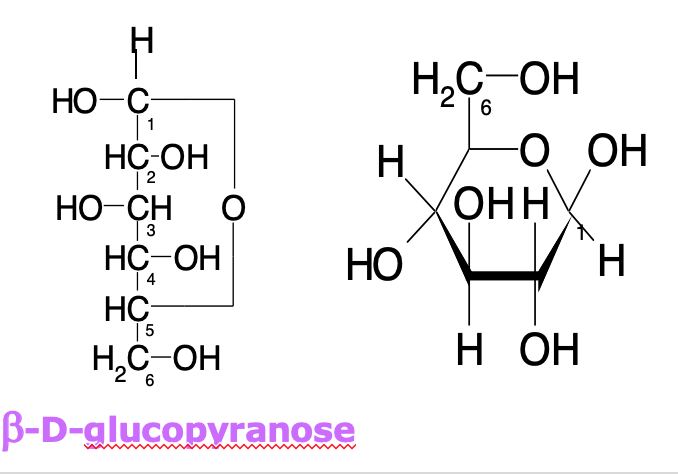
concentration of glucose in fasting and following high carb meal
fasting: 4
after meal: 8 mmol
how is blood glucose concentration controlled
hormones
what requires glucose
brain and erythryocytes (no mitochondria)
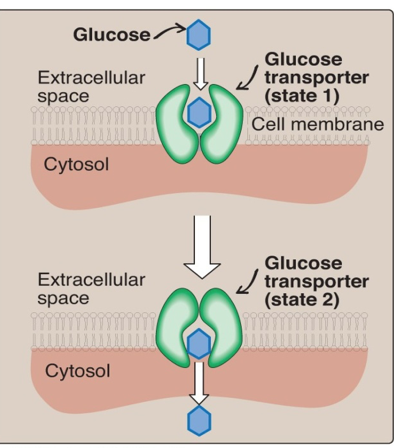
How does glucose enter cells
- Na+ independent faciliated diffusion transport
- ATP- dependent Na+ monosaccharide transport
Na+ - independent facilitated diffusion transport
- glucose moves via concentration gradient
- GLUT 1 to 14 diff isoforms (tissue-specific expression)
- GLUT 4 is common in muscle & adipose (insulin increased)
ATP-dependent Na+-monosaccharide transport system
- a “co-transport” system
- transports glucose against a gradient (coupled to Na+ gradient)
- found in intestinal epithelial cells
What happens when you irreversibly phosphorylate glucose?
traps it into cytosol and commits it as phosphorylated sugars cant cross cell membrane easily
Glycolytic reactions: 1
what catalyses this reaction?
how does this differ in other cells?
Glucose phosphorylation -> glucose-6-phosphate
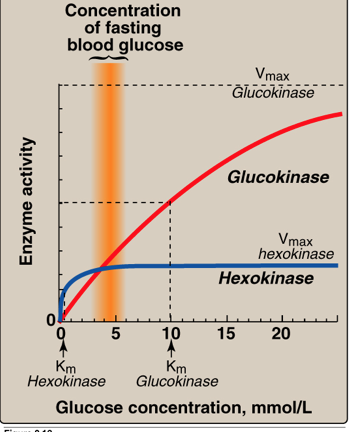
catatlysed by hexokinase I-III in most tissues (uses ATP)
irreversible
inhibited by glucose-6-phosphate
- low Km (high affinity for glucose)
- permits efficient phosphorylation in low [glucose]
- low Vmax means no overabundance of glucose 6-phosphate
glucokinase (hexokinase IV) in liver parenchymal cells
- Higher Km so only active following consumption of carb-rich meal
- High Vmax allowing glucose delivered to liver to be maximally absorbed
Glycolysis: 2
Isomerisation
glucose 6-phosphate to fructose 6-phosphate
- catalysed by phosphoglucose isomerise
- reversible & not rate limiting
Glycolysis: 3
Fructose 6-phosphate Phosphorylation
to fructose-1,6- biphosphate
-An irreversible reaction, rate-limiting
catalysed by phosphofructokinase-1
-The most important control point
ATP-> ADP
what is PFK-1 controlled by
[ATP] (high- inhibition) / [AMP]
[fructose 6-phosphate]
fructose-2,6- bis phosphate
- PFK-2 produces F-2,6BP and phosphatase activity that dephosphorylates F 2,6 BP to F-6-BP
inhibited by high citrate levels-> favours glycogen synth
Glycolysis 4,5
F-1,6-BP cleavage
to DHAP (dihydroxyacetone-P) used in triacylglycerol synthesis
and 2x Glyceraldehyde 3-P (3C)
catalysed by adolase
reversible and unregulated
Triose Phosphate Isomerise allows interconversion
Glycolysis 6 and 7
- redox
Glyceraldegyde 3-P oxidised (NAD+-> NADH) and gains phosphate to become 1,3- Biphosphoglycerate
catalysed by glyceraldehyde-3-phosphate dehydrogenase
- 3- phosphoglycerate
catalysed by phosphoglycerate kinase
2ADP-> 2ATP
both reversible
Glycolysis 8-10
- 3-phosphoglycerate to 2-phosphoglycerate
phosphate group shift
catalysed by phosphoglycerate mutase
reversible
- Phosphoeynolypyruvate
dehydration reaction
catalysed by enolase
reversible
- pyruvate
substrate level phosphorylation
catalysed by pyruvate kinase
2ADP-> 2ATP
irreversible



-
2. Intro to cells, tissues and organs29
-
5. Smooth muscle15
-
5. Muscle structure20
-
5. Skeletal muscle22
-
5. cardiac muscle18
-
5. The genetic code18
-
5. protein synthesis37
-
6. Nerve structure34
-
6. neuromuscular junction9
-
6. NM blockade and paralysis17
-
6. synaptic transmission10
-
7. Congenital anomalies and syndromes15
-
7. gametogenesis, fertilisation21
-
7. Implantation and formation of germ layers35
-
7. DNA, RNA and genes20
-
7. Somites and embryonic folding21
-
7.early embryonic development and cell differentiation20
-
7. embryonic membranes and cavities and the placenta25
-
7. Gene expression40
-
7. molecular testing21
-
7. obsterics genetics25
-
7. cytogenetic tests21
-
7. mutations20
-
7. regulation of gene expression22
-
8. Basic metabolism28
-
8. carbohydrate metabolism 116
-
8. carbohydrate metabolism 214
-
8. oxidative phosphorylation and ETC19
-
8. gluconeogenesis22
-
8. intergrated metabolism17
-
8. fatty acid metabolism and ketone bodies20
-
8. lipoprotein metabolism24
-
8. the fed state17
-
8. the starved state20
-
9. how the body responds to infection12
-
9. recognition of extra-cellular pathogens10
-
9. introduction to haematology22
-
9. Blood histology16
-
9. Lymphoid system16
-
9. defence against extra cellular pathogens20
-
9. T cell mediated immunity15
-
9. Helper T cells and cytokines25
-
9. bacteria structure growth and taxonomy25
-
10. physiological response to inflammation18
-
10. inflammation and anti-inflammatory drugs17
-
10. skin45
-
10. virology19
-
10. immunity to viruses11
-
10. bacteria pathogenicity22
-
10. tissue repair22
-
11. structure of ANS23
-
11. Para/ Sympathetic drugs6
-
11. theories of drug action12



