Adrenal medulla (AM)
- Sympathetic nervous system.
- Epinephrine synthesis can only happen here,
- The 2 other hormones are synthesized in other parts of the body (nervous system).
- Hormones, reaching the bloodstream, exert their effects everywhere in the body.
- Hormones act on alpha and beta receptors, making possible the mobilization and utilization of energy stores, especially glucose reserves.
- AM has an important role in the formation of the “alarm-reaction” (Cannon’s reaction).
Morphology of AM
It is consisted of large, ovoid cells, which appear brown after staining, because of epinephrine and norepinephrine.This explain the name: “chromaffin” cells.
-Axons of sympathetic neurones terminate on chromaffin cells. Chromaffin cells are primitive ectodermal sympathoblasts, and correspond to postganglionic neurons, which do not have axons.
Removal of the adrenal medulla
.The removal of the adrenal medulla is called demedullation
-After demedullation, normal activity and reproductivity of the animal remains intact, health of the animal is basically not affected, since the lack of medulla is compensated by the sympathetic nervous system.
In spite of the lack of adrenal medulla animals react in fairly adequate ways even in emergency.
- Insulin caused hypoglycemia, however, is normalized only with difficulties, because hepatic glycogen mobilizing (blood glucose elevating) effect of epinephrine is lost.
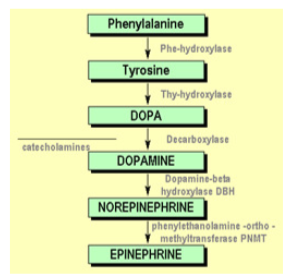
Synthesis of Cathecholamines
Synthesis of Cathecholamines
precursors enter the granules. It can only be transported into granules by an antiport protein, which utilizes a hydrogen concentration gradient. The hydrogen gradient itself is maintained by an ATP-ase pump.
The first key enzyme is DBH (dopamine-beta-hydroxylase) present in the granules. The result of this synthetic step is granular Norepinephrine
Then it is passively released into the cytoplasm, where it is converted to epinephrine by phenylethanolamine -ortho-methyltransferase PNMT.
The two main products are stored in granules until liberation.
chromogranin contains stored final products: E, NE, and also special peptides, such as somatostatin, enkephalin, NPY
these modulators are released from adrenal gland and other sympathetic terminals, and effectively influence sympathetic effects. The phenomenon is called peptidergic co-transmission.
Synthesis of AM hormones (picture)
Inactivation of hormones
- degradation of hormones
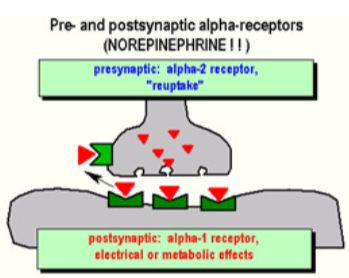
- reuptake of hormones liberated by neurons.
Two enzymes can cleave catecholamines in neurons or in muscle cells:
- MAO (monoamine oxidase) – mitochondria
- COMT (catecholamine-O-methyltranspherase) – cytoplasm
Plasma metabolites:
– DOPAC (dihydroxy phenylacetic acid) – DHPG (dihydroxy phenylglycol)
– NVN (normetanephrine)
– VMA (vanillylmandelic acid)
– HVA (homovanillic acid)
Inactivation 1: reuptake
Hormonal effect
Catecholamines exert their effects through alpha and beta receptors. Hormonal actions can be divided into two major groups: effects on circulation, (intermediate) metabolism, and particular organs.
Catecholamine receptors
Receptors:
- two alpha and three beta receptor subtypes. Alpha subtypes have further subtypes.
- norepinephrine stimulates mainly alpha1 and beta1 receptors.
- epinephrine stimulates mainly beta2 receptors, but it also acts on alpha1 receptors.
- Dopamine acts on D1, D2 receptors
Intracellular signaling
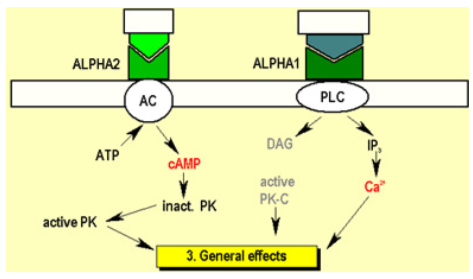
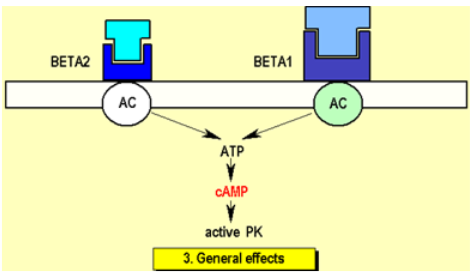
Catecholamine receptors exert their effects mostly by the G protein dependent cAMP system.
However, some of the receptor actions are manifested through the activation of phospholipase C system.
As a summation of these results, metabolic effects, smooth muscle contraction, cardiac effects, or effects on other organs can be both detected. Catecholamine receptors are also involved in sympathetic neurotransmission.
Alpha receptor signaling
Beta receptor signaling
Receptor effects:
Alpha receptor effects:
– alpha-1:
• smooth muscle contraction
• glycogenolysis
• sympathetic synaptic transduction
– alpha-2:
- regulation of transmitter release in the central nervous system
- Beta receptor effects:
– beta-1:
• stimulation of the heart
• stimulation of adipose cells (beta-1 like beta-3)
– beta-2:
- smooth muscle relaxation (bronchus, skeletal muscle- vessels)
- increase of metabolism
Effects of catecholamine
- Effects on circulation
- Effects on smooth muscles
- Effects on intermediary metabolism
- Effects on different organs
Effects on circulation
- Similar to effects of sympathetic nervous system
- Sympathetic activation
- Low epinephrine – beta effect dominates → dilation of BV’s, CO incr.
- High epinephrine – alpha effect dominates. Vasoconstriction & incr. bp
- High norepinephrine – similar to high epinephrine. Stronger contractions of SM (few beta 2 receptors)
- Effect depends on plasma conc. of hormone, receptor types & ratio of receptor types
β1: increase in cardiac output
Positive effects:
- chronotrop
- inotrop
- dromotrop
• bathmotrop
Effects of high epinephrine dose:
-When a high level of epinephrine is liberated, alpha effect becomes dominant. Vessels contract all over the body (alpha1 effect), while cardiac output rises.
As a result of these, blood pressure increases. The size of intestinal lumen does not considerably change, because beta2 and alpha1 effects reach the equilibrium.
Effects of high norepinephrine dose:
-Effects of a high norepinephrine levels are similar to effects of high epinephrine levels. The difference rises from the fact that norepinephrine has hardly any beta2 effects, thus, contraction of smooth muscles internal to the intestines becomes stronger.
Effects on intermediary metabolism
General metabolic effects:
– oxygen consumption (BMR) increases
– cardiac output increases
– respiration increases
– calorigenic effect is significant and rapid – epinephrine is a primary factor
Effects on intermediary metabolism
General effects (details):
- Catecholamines mobilize rapidly utilizable energy sources according to the increased needs of the organism.
- Catecholamines increase basal metabolic rate and oxygen consumption.The cause of this is the facilitation of glycogenolysis in the liver, elevation of respiratory frequency, and higher performance of the heart.
Carbohydrate metabolism:
– liver glycogen utilization increases
– plasma glucose level increases
– glucose uptake in the muscles increases
– glycolysis -> lactic acid synthesis increases
– Cori-cycle -> carbohydrate stores are shifted from the periphery towards the center
• Lipid metabolism:
– utilization of fat increases
– free fatty acid levels increase
– beta receptor effects dominate in adipose tissue
Alarm reaction
“fight or flight”
- The body is enabled for a rapid utilization of a high amount of energy, or the enhancement of the efficiency of physical abilities by this reaction.
- Functioning of the adrenal gland is under control of the sympathetic nervous system. Sympathetic nervous system activates hormone production of adrenal medulla by both direct and indirect effects.
- Switching the resting state to intense physical activity.
Regulation of AC
Sympathetic nervous system activates hormone production of adrenal medulla by both direct and indirect effects.
Hypoglycemia:
– directly stimulates, direct stimulus
• Alarm reaction:
– the organism is able to focus on releasing a vast amount of energy by the secretion of catecholamines
• Receptor-regulation:
– regulates in s complex way: up and down regulation (receptor Bmax and Kd values change)
Epinephrine:
-hormone of fighting
Norepinephrine:
-Regulation of AC
-produced by the effects of:
• muscle activity
• cold
• drop of blood pressure
-hormone of aggressive behavior

-
72. Classification of hormones, dynamics of the ligand - receptor interaction, the feed-back mechanism8
-
73. Communication among cells, Intracellular receptor signaling13
-
74. Membrane receptor signaling11
-
75. Hypothalamic releasing and inhibiting factors10
-
76. Adenohypophysis, the synthesis and release of the ACTH7
-
77. Growth hormone17
-
78. Hormones from the neurohypophysis3
-
79. MSH and the pineal gland8
-
80. The thyroid hormones19
-
81. Synthesis, regulation and physiological effects of glucocorticoids8
-
82. Pharmacological effect of glucocorticoids, and the physiology of the stress8
-
83. Mineralocorticoids4
-
84.Catecholamines22
-
85. Insulin and glucagon55
-
86. Eicosanoids11



