What is memory?
The process involved in retaining, retrieving and using information about stimuli, experiences, skills and ideas after the original information is no longer present.
Temporal Lobe
The Temporal Lobe is important for creating new memories.
The Modal Model of Memory
Explain Atkinson’s and Shiffrin’s Memory Model
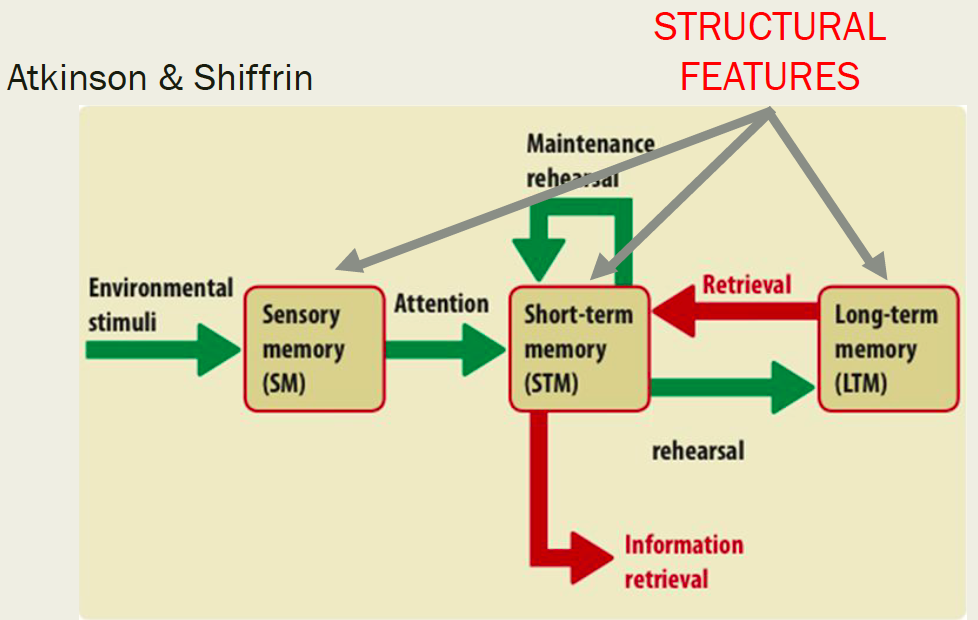
- Sensory Memory (SM): Initial storing place which holds information for fraction of a second.
- Short-term Memory (STM): Holds 5 to 7 items for 15 - 30 seconds
- Long-term Memory (LTM): Holds large amounts of memories for years or decades
- Maintenance Rehearsal: This is an active control process that can differ from task to task.
Sensory Memory
The retention for very brief periods of time of the effects of sensory stimulation
Explain how we estimated the duration and capacity of the sensory memory.
Sperling leads an experiment where he flashed for 0.05s a grid of letters and numbers to the participant and then asked them to recall as many symbols as possible. This resulted in an average of 4.5/12 symbols recorded.
He then modified the experiment such that the participants had to recall only a row or a column. They would know which one to report depending on an auditory cue (a pitch). The performance of the participants improved to 3.3/4.
It was concluded that the visual sensory memory captured everything but faded in less than a second.
This is called iconic memory.
Short-term Memory
System responsible for storing small amounts of information for short periods of time.
Most of it gets lost and just some of it gets stored in LTM.
Transfers the information to LTM and is used during processes.
Decay
Gradual reduction of performance.
Proactive Interference
This occurs when information that was previously learned interferes with new information that needs to be remembered.
Actually, when rehearsal is prevented our memory lasts 15s - 20s
Capacity of STM
- Miller wrote “The Magic Number 7, plus or minus 2”
How did we conclude that STM has small capacity?
Experiments were patients were shown an image with 8 coloured squares. They were then shown a similar image and they were asked to identify the square in a different colour.
True or False
We can only store 5 to 9 elements in our STM.
True
How can we store more elements in our STM (9 <) ?
Chunking:
Small units of information are combined into larger meaningful units.
A chunk is a collection of items that are related to each other but not with other elements.
Explain this chart, were professional and non-professional chess players were shown multiple layouts of a chessboard.
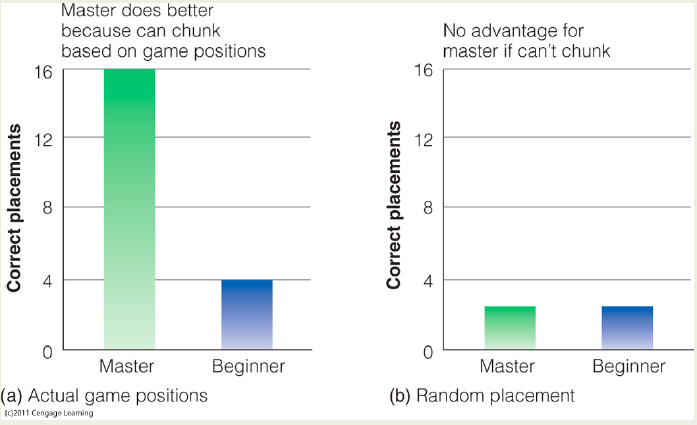
- Chess experts: They had no problem memorizing boards as long as there were no illegal moves
- non-professional chess players: In both situations had a hard time to memorize the chess boards
Explain the experiment and the results.
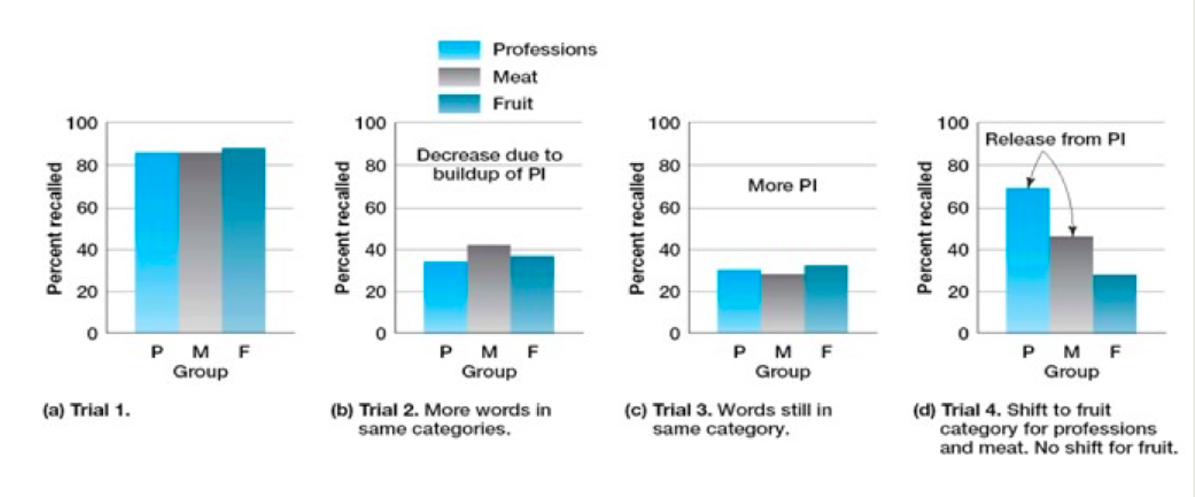
In this experiment, there were 3 groups of participants. In the first few trials, each group memorized lists of words that fell in the same category. In the last trials, all 3 groups were given a list of fruits.
We noticed that the fruit group performance did not change but the performances the other two groups increased. This is because the fruit words were not related to the previous lists they had to memorize. We call this release from proactive interference.
Notice that the Meat group did worse than the professions group since the meaning of fruit and meat are closely related.
Name a few problems that the Modal Model of Memory had
- Does not consider dynamic processes that unfold over time
- The Modal Model of memory cannot explain how you can carry out two tasks at the same time
For these reasons, Baddeley concluded that STM had to be dynamic.
Working Memory
A limited-capacity system for temporary storage and manipulation of complex tasks such as comprehension, learning and reasoning.
How does STM and working memory are different?
- STM is concerned with storing information for a short period of time whereas WM is concerned with manipulating information
- STM is one component whereas WM consists of multiple components
Baddeley and Hitch’s Working Memory Model
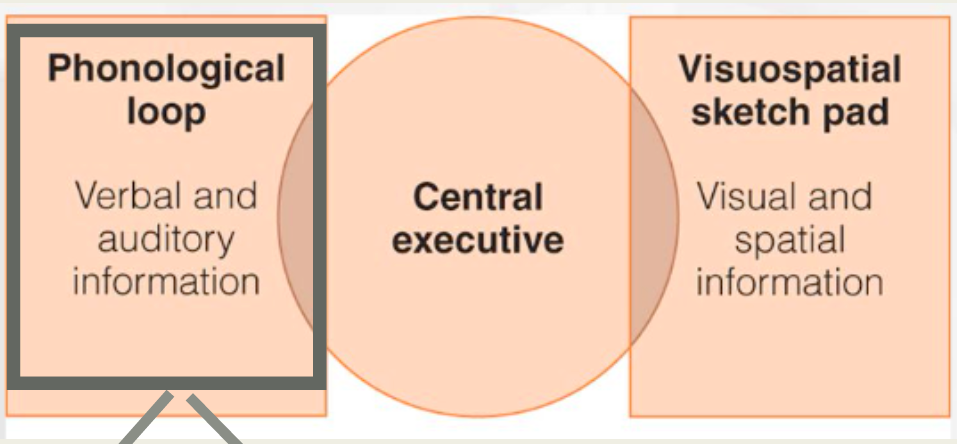
- Phonological loop:
- Phonological store: Limited capacity that holds information for a few seconds.
- Articulatory process: Responsible or rehearsal which keeps the elements in the phonological store from decaying.
- Central Executive: Controls the phonological loop and the visuospatial sketch pad. The central executive pulls information from the LTM and coordinates the activity of the phonological loop and visuospatial sketch pad by focusing on specific aspects of the task at hand.
- Visuospatial sketch pad: holds visual and spatial information.
Phonological Similarity Effect
Similar sounding elements compete for a space in the phonological loop.
Ex: F, S, X
Word Length Effect
Longer words are harder to remember.
Articulatory Suppression
Memory is reduced by the repetition of an irrelevant sound.
Ex: Try to remember a list of objects but put the word “the” in front of each word.
Visual Suppression
Visual suppression happens when you have to do another visual representation
Central Executive
It is an attention controller and decides where to put the attention or how to divide it.
On way of studying this kind of systems is by looking at patients that have some brain damage in areas related to attention control.
Another role of the central executive is to filter out information and focus only on the relevant information.
Is there anything that the Working Memory Model can’t explain?
How do we remember long sentences with meaningful units?

-
Intro and History36
-
Cognitive Neuroscience and Visual Perception30
-
Object Recognition28
-
Attention37
-
The Wandering Mind28
-
Acquisition and Working Memory29
-
Memory: Acquisition and Retrieval36
-
Remembering Complex Events25
-
Investigation Into Autobiographical Memory11
-
Communication and Conversation20
-
Visual Knowledge19
-
Judgment and Reasoning33
-
Problem Solving15
-
Consciousness4



