Excitable Cells
Cells that can be electrically excited
Properties:
- electrical current is the flow of ions
- have proteins that form chanels to control ion/current flow
- all cells have the gene for these channels but only excitable cells express them
Examples:
- Muscle cells (e.g cardiac myocytes or skeletal muscle cells) - use flow of ions to generate contraction
- Neurons - use flow of ions to generate action potentials
Potential Differences Across Membranes
- Excitable cells must be able to generate & maintain a PD across the membrane by using protein pumps/channels
- Membrane potentials can be between -60v to -80v
- Can be measured by a voltmeter with a microelectrode outside the cell & one inside the cll (through plasma membrane)
How PDs Arise:
- Passive movement of ions - membrane permeability, driving force (electrochemical gradient)
- Active transport of ions - against conc./electrical gradient
- Requires expenditure of metabolic energy by cell
Permeability
- Impermeable to an ion - no channels let ion through
- Slightly impermeable to an ion - large driving force required
- Readily permeable - small driving force required
At rest:
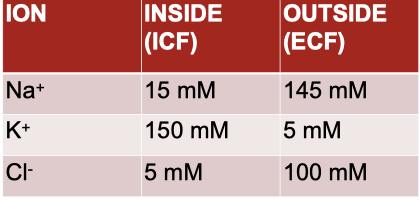
- fairly readily permeable to K+ & Cl-
- poorly permeable to Na+
- impermeable to various large organic anions
Origin of Resting Potentials
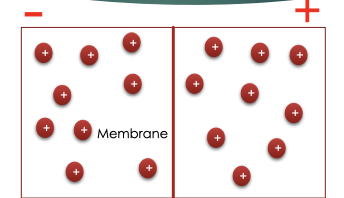
There is always a voltage difference & uneven distribution of charge on a membrane, even at rest
Due to:
- selective permeability of the cell membrane to different ions
- unequal distribution of ions across the membrane - maintained by Na+/K+ pump (3 in, 2 out)
Electrochemical gradient = combined chemical (concentration) & elecrtical (charge) gradient - usually cancel each other out, no net movement
Ionic Basis of an Action Potential
- Stimulus (-70mv to - 55mv) - EPSPs via neurotransmitters cause some Na+ gated-channels to open
- Threshold Potential (-55mv) - all or nothing
- Depolarisation - all Na+ ion channels open, less negative membrane potential
- Action Potential (+30mv) - action potential generated & Na+ channels close. K+ channels are fully open at -25mv
- Repolarisation - K+ channels are fully open & Na+/K+ pumps open to restablish resting potential
- Hyperpolarisation (-90mv) - over correction to stop action potentials happening too quickly, K+ channels close
- Resting potential (-70mv)
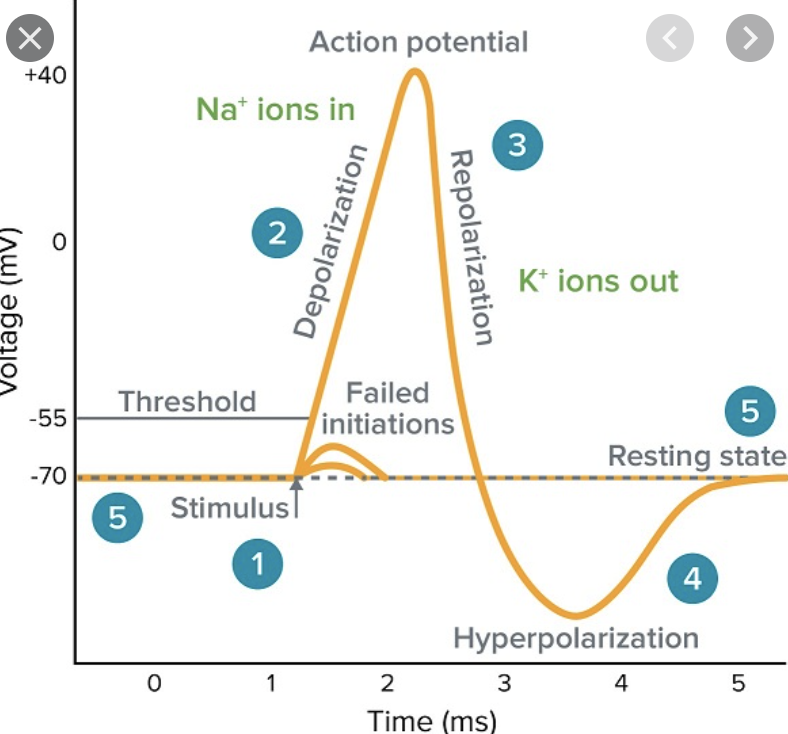
Stimulus to Threshold Potential
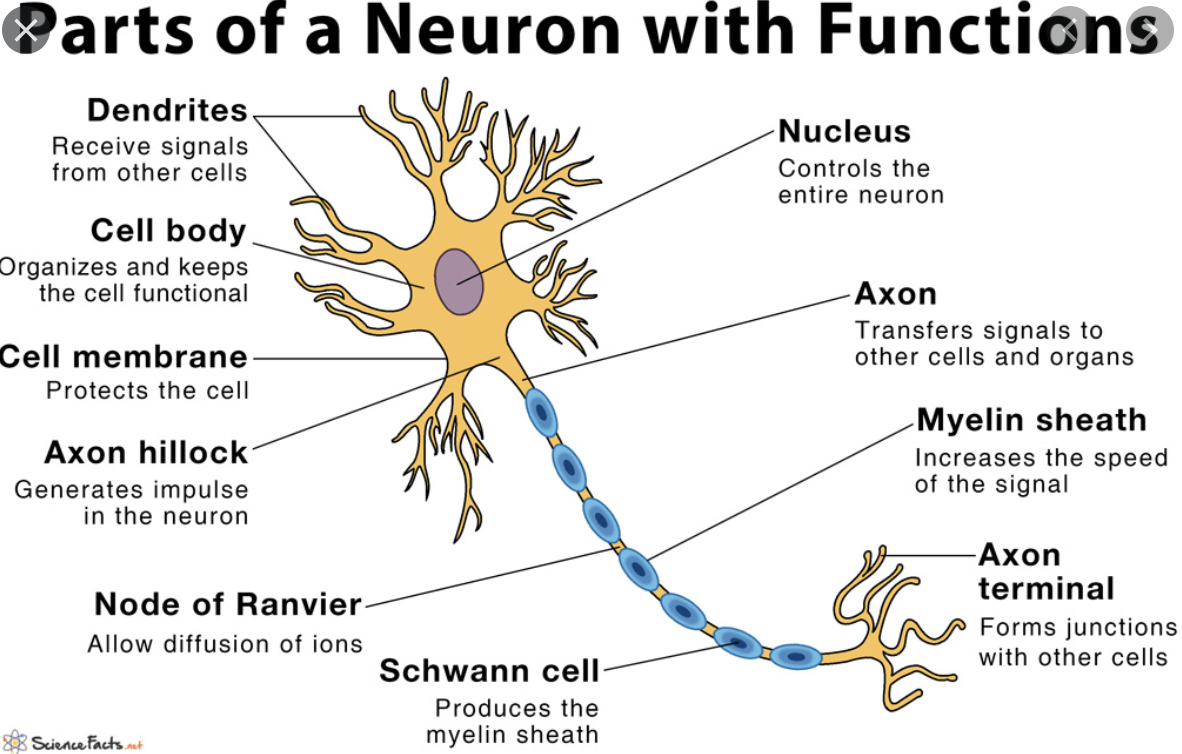
- Dendrites receive signals from other neurons via neurotransmitters - binds to ligands & act as chemical signal
- Causes ligand-gated ion channels to open
- Allows charged ions to flow in & out
- Now an electrical signal: EPSP or IPSP
EPSP - net influx of positive charge
IPSP - net influx of negative charge or efflux of positive charge
- If enough EPSP happen at once, there will be a bigger effect on the cell’s charge
- Threshold potential - all or nothing
- If charge reaches -55mv, an action potential can happen
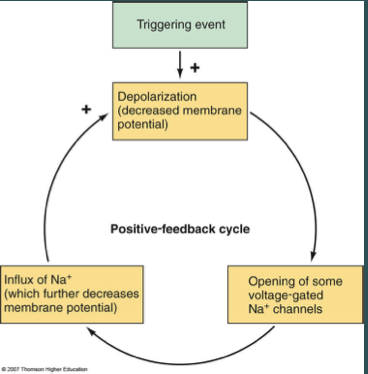
Depolarisation to Action Potential
Once threshold potential is reached:
- triggers voltage-gated Na+ channels to open at the axon hillock (respond to change in v)
- sodium rushes in (depolarisation), chain reaction down entire length of axon
- neuron has fired the action potential - membrane is now +30mv relative to external environment due to depolarisation
Absolute Refractory Period & Repolarisation
Absolute refactory period (+30 to -55mv)
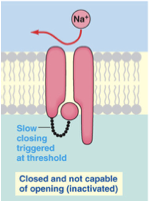
- Innactivation gate blocks the sodium-gated channel - impossible to generate another action potential (won’t respond to any stimuli)
- Keeps the action potentials moving in one direction
- Stops the action potentials happening to close in time
Repolarisation
- Potassium voltage-gated channels (slow to respond) are fully open - K+ moves out of the cell
- No inactivation gate - stays open for longer
- Sodium-potassium pumps move 2 K+ in, 3 Na+ out (more postive ions out than in)
- Cell becomes more negative (closer to resting potential) to blunt the effects of sodium depolarisation
Relative Refractory Period & Hyperpolarisation
Relative Refractory Period
- sodium channels closed but no longer innactivated (around -55mv)
- Would take a stong stimulus for them to re-activate (depolarise) when the cell is hyperpolarised - need more ions to meet the threshold
Hyperpolarisation
- due to slow closing of potassium voltage-gated channels & efforts of S/P pumps, small period of overcorrection
- stops the action potentials happening too close together
- as potassium channels close, the cell returns to resting potential
Changes to Ionic Permeability
During action potential, ionic permeabilities are the opposite to that of the resting potential:
- membrane is very permeable to Na+ - more Na+ inside than outside (depolarisation)
- membrane is relatively permeable to K+ - less K+ inside (repolarisation - channels vs pumps) than at resting potential
Convergence/Divergence
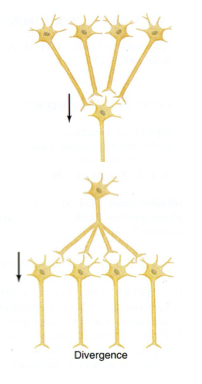
Convergence = multiple impulses that converge into one on a single neuron (rod cell - eye)
Divergence = one impulse in, multiple neuron branches out (motor neuron to a group of muscles)
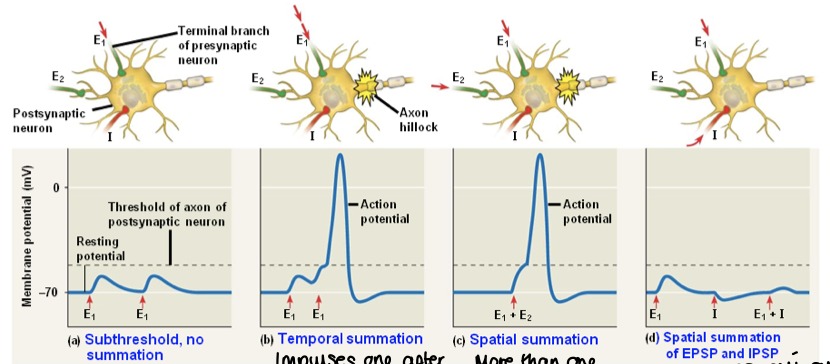
Summation of Post-Synaptic Potentials
A) Subthreshold, no summation = single EPSPs do not increase membrane potential enough to fire an action potiental
B) Temporal summation = timely impulses, one after the other reaches threshold - action potential fires
C) Spatial summation = more than one EPSP impuluse simultaneously on the same neuron - strong enough to meet threshold
D) Spatial summation of EPSP & IPSP - cancel each other out, no effect on membrane potential so no action potential fired
Propagation of Action Potentials
- Fatty myelin sheath - from glial cells like schwann/oligodendryctes
- Myelin insulates axons to increase conduction velocity - there are no channels within the myelin sheath
- Nodes of Ranvier - non-myelinated cells form gaps between myelin sheath
- Propagation of action potentials take place at the Nodes of Ranvier (as there are channels)
- Saltatory conduction - charges essential jump/bump between node to node, speeds up conduction
Conduction Velocity
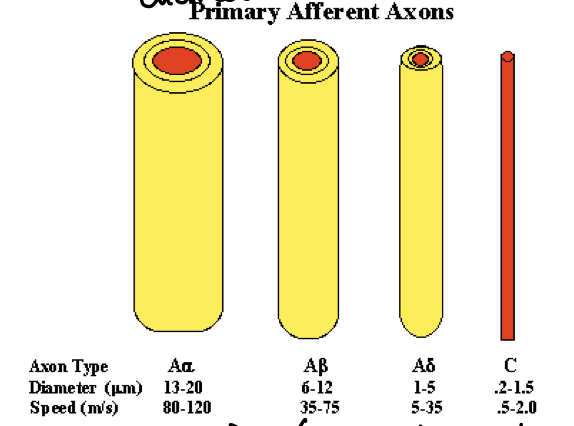
Nerve fibres are classified according to:
- diameter - less resistance, faster flow
- degree of myelination - insulation increases velocity of conduction
Axon types:
- A-alpha (propriception) - most myelination, largest diameter
- A-beta (propriception)
- A-gamma (sharp pain)
- C - (dull pain, throb, ache) - less myelinated, smallest diameter
Accomodation
- Maintained depolarisation leads to a higher threshold
- Most likely due to inactivation of Na+ channels - few channels to potentially open, threshold changes
- Overstimulation of axon - switch off
- Phenomenon - means our body stops responding to certain stimuli after a certain period of time e.g clothes or itch
- Alters propriception - awareness of external environment
Clinical Relevance of Action Potentials
Local Anaesthetics e.g Lignocaine
- increases threshold of firing
- prevents the initiation of an action potential by blocking Na+ channels
- Fine nerve fibres are most sensitive - those involved with pain (A-gamma & C)
Epilepsy
- dysfunctional sodium channels (open too quickly/at different thresholds) or potassium channels (slows efflux)
- can lead to overstimulation - too many action potentials fired
- results in seizures
Toxins e.g Tetrodotoxin (TTX)
- neurotoxin found in puffa fish
- increases threshold of firing
- specifically blocks Na+ channels
- no action potential fired as there is no initial influx of Na+
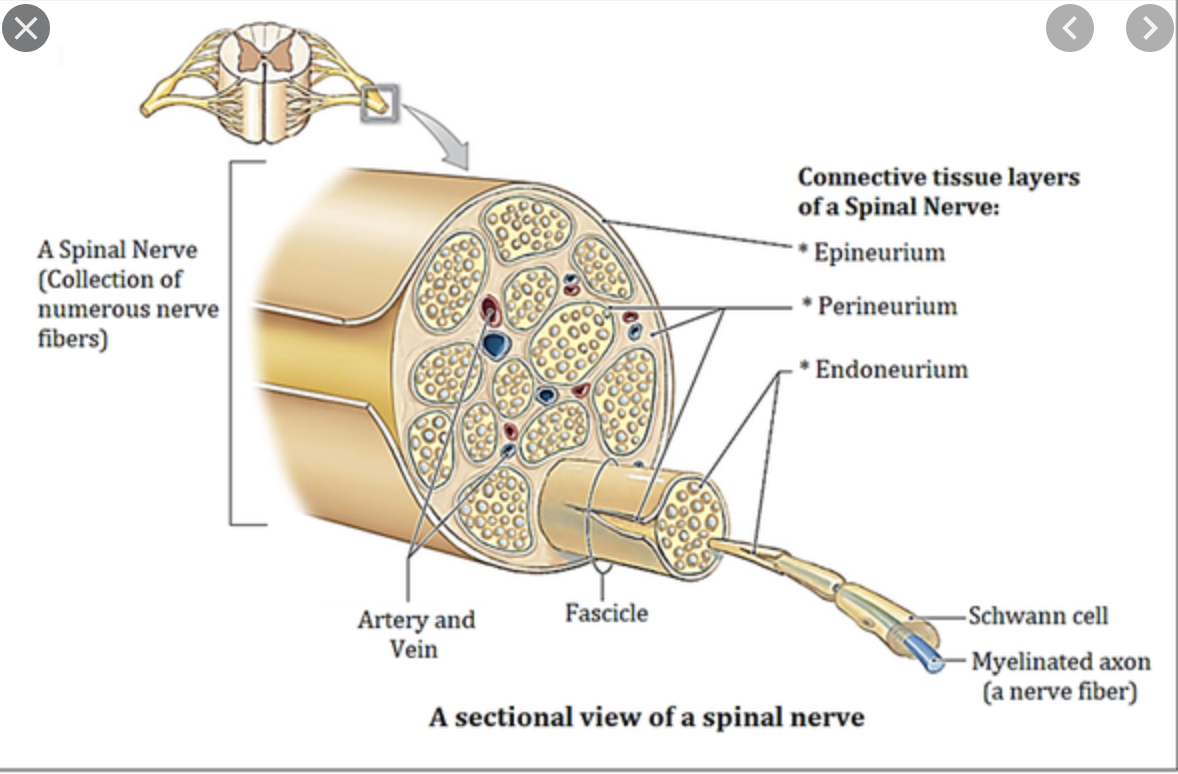
Cross Section of a Nerve
Endoneurium: connective tissue surrounding a nerve fibre
Perineurium: surrounding a fasicle or group of fibres
Epineurium: surrounds the entire nerve
- endoneurium acts to selectively allow molecules to pass into the endoneurial fluid around each fibre
- volume of this liquid increases with nerve irritation
Compound Action Potentials
- Measuring action potentials from a single axon is too complicated & requires highly specialised equipment
- Activity of whole nerves is recorded externally using surface electrodes instead - gives the summed activity of all action potentials in the nerve
- Summed action potentials = Compound Action Potentials (CAPs)
- Arise from extracellular stimulation of the nerve, recorded by extracellular electrodes
- Potential difference between two electrodes is recorded with extracellular surface electrodes
- Basline recording - no potential difference between the two electrodes in the absence of a stimulus
- When a stimulus is applied, a wave of depolarisation passes down the nerve - first electrode. becomes negative to the more distal electrode
- Difference is shown by a positive deflection in the recording
- When the wave reaches the second electrode, it becomes more negative compared with the more proximal electrode - shows as a negative deflection in the recording
Threshold Voltage
- Amount of stimulation required to produce an action potential in a nerve
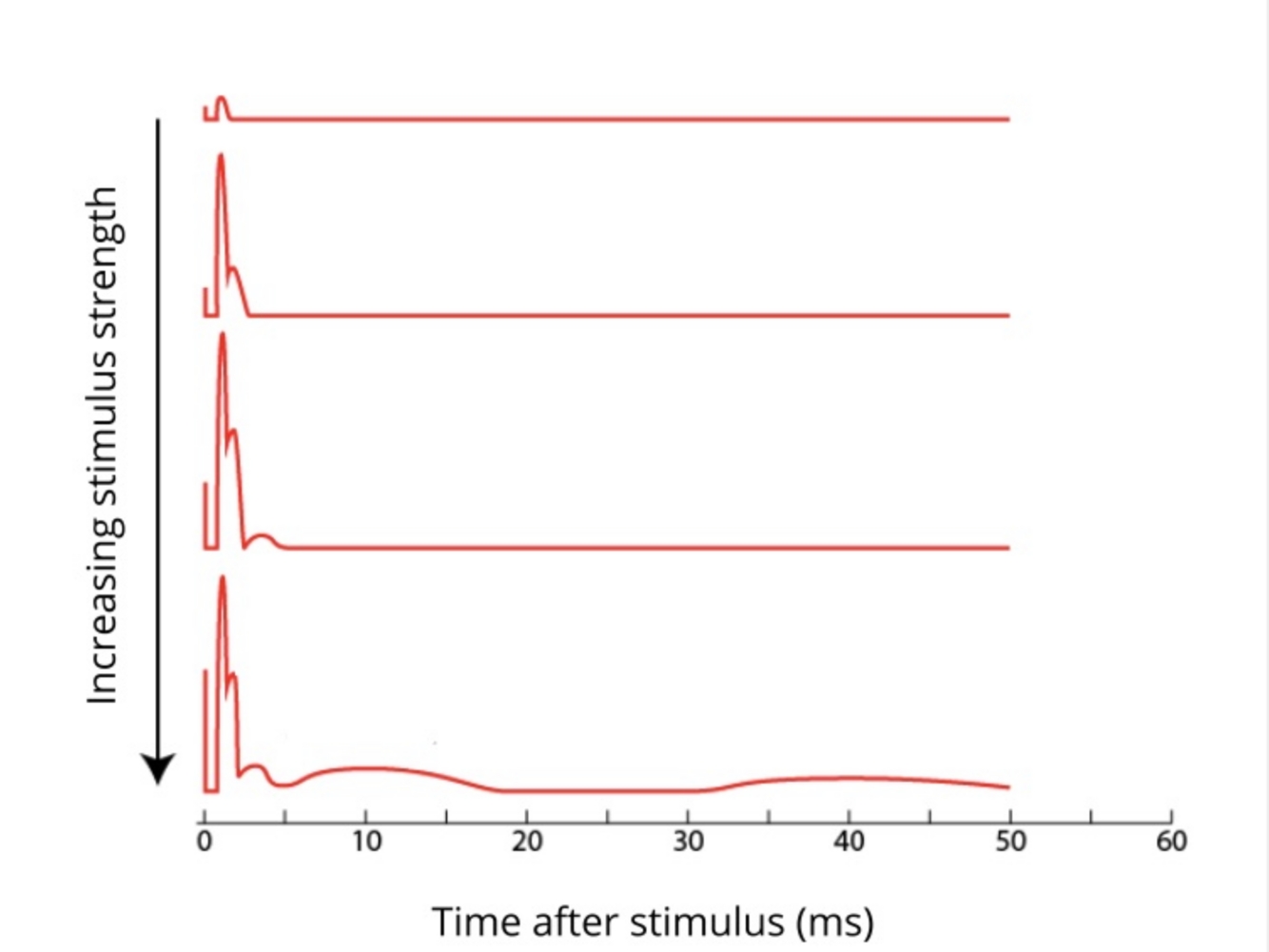
- Depends on the axon diameter - large diameter stimulated at lower voltages than smaller diameter axons
- CAPs represent the ‘all or nothing’ action potentials only from those actions that are stimulated at that particular voltage
- As the simulus voltage increases, more & more axons will be excited until all are
- Therefore, the magnitude of the CAP will increase with increased stimulus strength
- After the maximum response is obtained, further increases in stimulus (supramaximal stimuli) will have no further effect on CAP magnitude
- As Axons have different diameters so different conduction velocities, as more & more axons are excited, the shape of the CAP will alter
Recording Peripheral Nerve Activity
Sensory Nerve Activity
- usually recorded by stimulating the fingers or toes, recording over the nerves proximal to stimulation
- example: stimulate ring finger & record the nerve response over the median nerve above the wrist
- Disadvantage - electrical signal is tiny (just a few uV) & a large amount of stimuli must be delivered and averaged to produce a reliable estimate
Motor Nerve Activity
- can be recored much more readily - stimulating a peripheral nerve & recording the resultant actvity in a muscle supplied by that nerve
- Common approach is to stimulate the median nerve at the wrist & record consequent electrical activity over the abductor pollicis brevis in the thumb
Measuring Nerve Conduction Activity
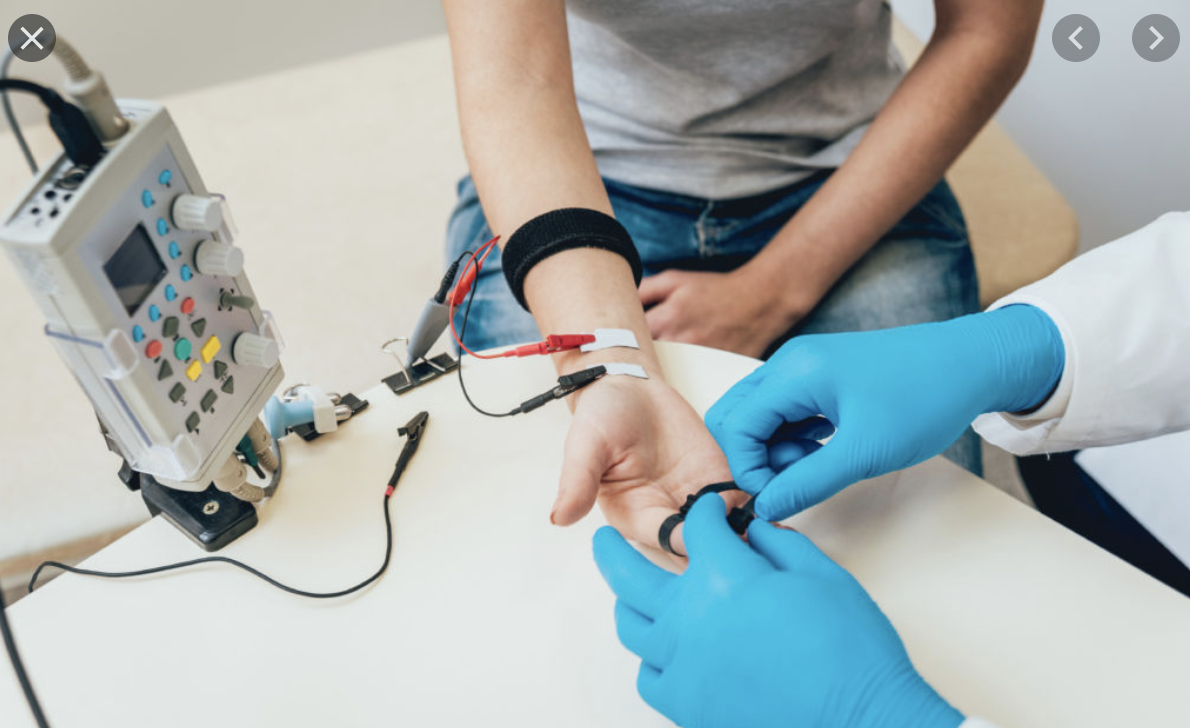
- Electromyography
- Small electrical current is applied over a motor nerve & contraction of a muscle is measured (by flat electrodes on the skin)
- Small electrical current can be applied more proximally over the same motor nerve
- Distance between stimulation sites is measured & divided by the difference in latency (or delay) between muscle contractions, giving nerve conduction velocity (m/s)
- Time it takes for the muscle to contract = evoked potential
- Maximum voltage when all the axons are stimulated = supramaximal response
- Conduction velocity (speed of the response) in motor nerves is approx 50-60m/s average
Factors that Affect Conduction Velocity
Increases Nerve Conduction Velocity
- Increase in nerve diameter
- Increase in temperature
Decreases Nerve Conduction Velocity
- Blocking sodium channels with tetrodotoxin
- Loss of myelination
- Immersion in ice-cold water
Physiological Events that Occur During Latency
- Electrical stimulus generates an action potential in median nerve
- Action potential is conducted along the nerve axon to the neuromuscular junction
- Acetylcholine (ACh) is released into the synaptic cleft
- ACh diffuses across synaptic cleft
- ACh binds to ‘nicotinic’ acetylcholine receptors on the motor endplate, leading to depolarisation
- Initiation of an action potential that spreads across the motor unit
- Action potential stimulates a release of calcium ions from the sacroplasmic reticulum
- Increased cellular calcium levels start the biochemical events that underlie contraction
Peripheral Neuropathies
- Various combinations of motor, sensory & autonomic dysfunction
- Motor problems include weakness, cramps, spasms, muscle wasting & fasciculations (twitching)
- Sensory symptoms include both loss of sensations & disordered sensations with tingling, numbness & heightened sense of pain
- Autonomic involvement may mean balance is impaired, abnormal blood pressure/heart rate, decreased ability to sweat, constipation/diarrhea, incontinence or sexual dysfunction
- Motor neuron disease is distinguished from peripheral neuropathies as there are no sensory or autonomic symptoms/signs