Define agonist
Favours the active receptor confirmation, binds to a receptor and causes an effect
Define antagonist
A drug that prevents the agonist-induced activation of the receptor
Law of mass action - AGONISTS
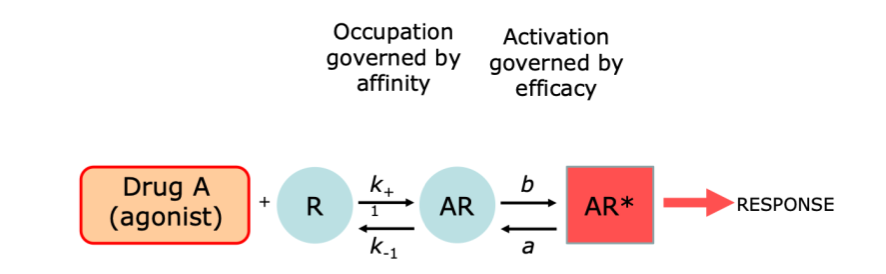
Law of mass action - ANTAGONISTS

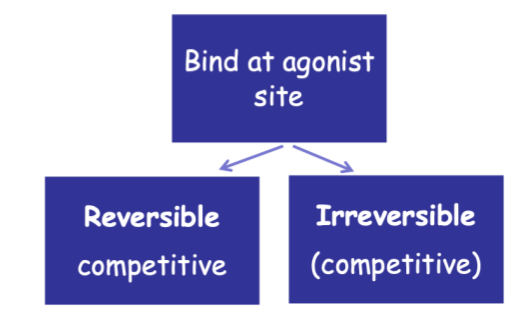
In terms of classifying antagonists, what are the 2 subgroups of those that bind at the agonist site
- REVERSIBLE - competitive
- IRREVERSIBLE - competitive
Where else can an antagonist bind, other than the agonist site
Binds elsewhere - allosteric site (non-competitive)
Define competitive antagonists
What are the 2 types
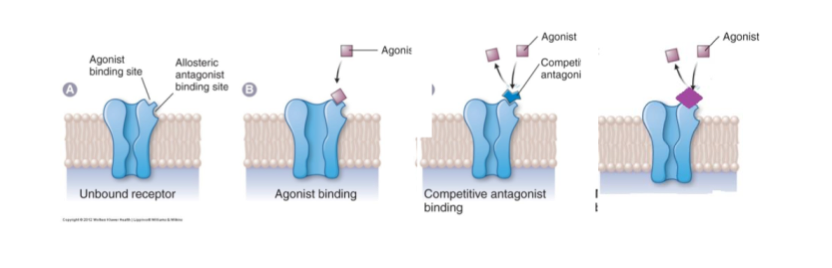
This type of antagonism is at the binding site of the endogenous ligand
REVERSIBLE - most common and most important type of antagonism
IRREVERSIBLE - covalent bond formation
Explain this graph
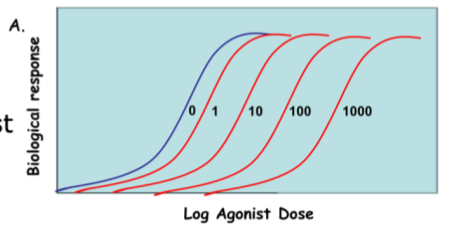
Antagonist competes with agonist for receptor binding sites
Increasing concentrations of antagonist progressively inhibit the agonist response
High concentrations of agonist can surmount the effect of the antagonist
Explain this graph
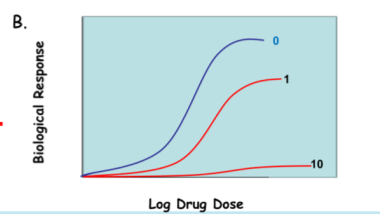
Antagonist binds with covalent bonds to receptor
Agonist cannot displace antagonist
What will the competitive antagonist do
Is it possible to move a non-competitive antagonist
- Compete with the agonist for the binding site => more and more of the agonist needs to be administered (concentration response curve)
- A non-competitive antagonist (purple) cannot be moved by other agonists
What happens to an irreversible antagonist at the agonist binding site
Stays bound - cannot be displaced because it dissociates only very slowly (due to nature of bonds)
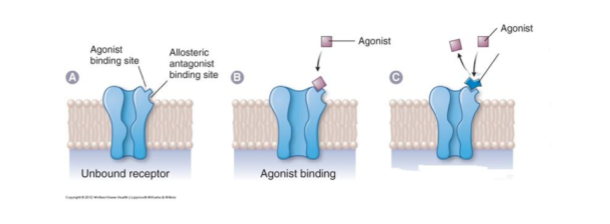
Where would a non-competitive antagonist block
What might this do
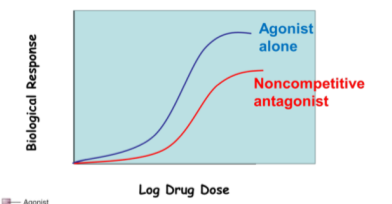
At some point other than the receptor binding site
May bind to another site on the receptor (allosteric inhibition)
May block the signal transduction process
Why are allosteric antagonists non-competitive
Because they do not bind at the agonist binding site
Define chemical antagonism (a type of non-receptor antagonism)
Inactivates agonist by forming a complex with it e.g. protamine is a basic protein that binds to heparin forming an inactive complex
Define physiological antagonism (a type of non-receptor antagonism)
Activates/blocks a receptor that mediates a response physiologically opposite to that of the receptor
e.g. histamine acts on parietal cells to stimulate gastric acid secretion, whilst the proton pump inhibitor omeprazole blocks this action
What sort of response do partial agonists produce
What is this response due to
What can they act as
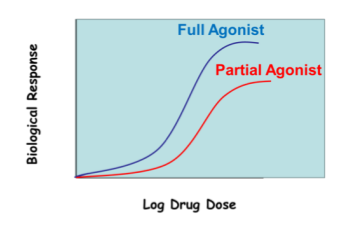
- Produce a lower response than full agonists
- Reduced response not due to decreased binding affinity but decreased efficacy
- As partial agonists bind to same site, they can reduce the response produced by a full agonist, thus can acts as competitive antagonist
What is buprenorphine a partial agonist of
What does it produce
How does it compare to morphine
- u opioid receptors
- Produces a submaximal relief of analgesia when compared to morphine
- As a result, ought to have less addiction liability than morphine
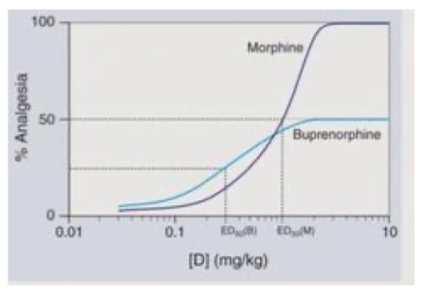
Explain the 2 theories for the molecular basis of partial agonism
- The partial agonist is a good fit for the receptor binding site, but less able to promote the receptor conformational change leading to transduction
- The receptor may be in an active and inactive state, and that partial agonists form complexes with both states, whereas full agonists preferentially bind the active form
What does the 2-state receptor model account for
What are the 2 states & what are they favoured by
- Accounts for the fact that
- Agonists bind receptors and activate them
- Antagonists bind but do not activate
- Can be in 1 of 2 states:
- Resting (R)
- Activated (R*)
- Binding an agonist favours the active (R*) state
- Binding an antagonist favours the resting (R) state
What state would an unbound receptor be in
Normally in R state
In the unbound state, what do some receptors have
Name 3 examples
What can cause this phenomenon
- A degree of acitivity - in the R* state
- => constitutively active
- e.g. cannabinoid receptors, benzodiazepine receptors, serotonin receptors
- Disease causing mutations can cause a receptor to become constitutively active
What does an inverse agonist do
Binds to receptors, reduces the fraction of them in an active conformation and has biological effects OPPOSITE to those produced by an agonist
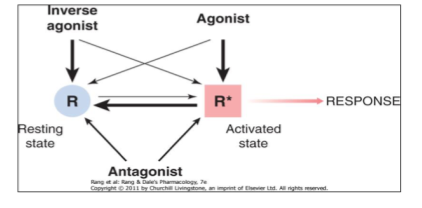
What does an inverse agonist do when it binds to a constitutively active receptor
REDUCES its activation => NEGATIVE EFFICACY
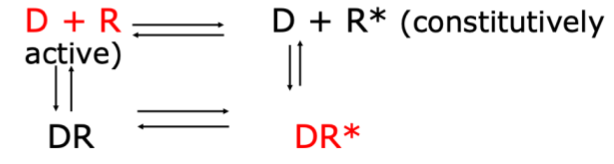
Graphic depiction of inverse agonists
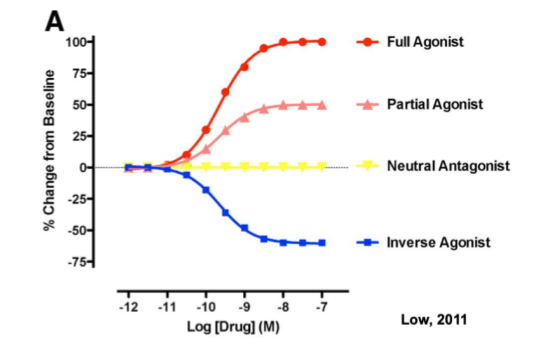



-
Drug Sources & Classifications18
-
Drug Targets27
-
Receptor Families41
-
Agonists & Antagonists30
-
Dose Response Relationships16
-
Mechanisms & Dose Responses39
-
Clinical Trials25
-
Systematic Reviews and Meta Analysis12
-
Adverse Drug Reactions (ADRs)29
-
Poisoning20
-
PK: Movement Across Cell Barriers & Ion Trapping52
-
PK: Drug Distribution45
-
PK: Drug Metabolism48
-
PK: Drug Excretion108
-
ANS & NMJ68
-
Cholinergic Neurotransmission, Cholinergic Drugs, Adrenergic Drugs175
-
Dopaminergic Neurotransmission & Dopaminergic Drugs57
-
Cholinergic Neurotransmission and Cholinergic Drugs17
-
Serotonergic Neurotransmission and Serotonergic Drugs57
-
GABAergic and Glutamatergic Neurotransmission, GABAergic and Glutamatergic Drugs79
-
Unit 4 Introduction2
-
Unit 4 Workbook68
-
Unit 4 Drugs24



