Match the most appropriate investigation that will help identify the cause of renal disease: A. A patient presented with ARF, chest symptoms, urine dipstick showed blood +++& protein+++ 1. Plasma osmolality 2. Urine microscopy looking for white cell casts, urine culture 3. Renal angiogram 4. Physical examination & bladder scan 5. Urine Bence-Jones protein 6. Renal Biopsy 7. Immunoglobulin electrophoresis 8. Anion Gap 9. Urinary Na
- Renal Biopsy
Match the most appropriate investigation that will help identify the cause of renal disease: B. Patient presented with ARF, fever, night sweats, dysuria, & loin pain 1. Plasma osmolality 2. Urine microscopy looking for white cell casts, urine culture 3. Renal angiogram 4. Physical examination & bladder scan 5. Urine Bence-Jones protein 6. Renal Biopsy 7. Immunoglobulin electrophoresis 8. Anion Gap 9. Urinary Na
2) Urine microscopy looking for white cell casts, urine culture
Match the most appropriate investigation that will help identify the cause of renal disease: C. An elderly patient developing ARF 4 days after elective knee replacement 1. Plasma osmolality 2. Urine microscopy looking for white cell casts, urine culture 3. Renal angiogram 4. Physical examination & bladder scan 5. Urine Bence-Jones protein 6. Renal Biopsy 7. Immunoglobulin electrophoresis 8. Anion Gap 9. Urinary Na
9) Urinary Na
Match the most appropriate investigation that will help identify the cause of renal disease: D. Patient with symptoms of poor stream, dribbling hesitancy and nocturia developing a gradual rise of serum urea & creatinine 1. Plasma osmolality 2. Urine microscopy looking for white cell casts, urine culture 3. Renal angiogram 4. Physical examination & bladder scan 5. Urine Bence-Jones protein 6. Renal Biopsy 7. Immunoglobulin electrophoresis 8. Anion Gap 9. Urinary Na
4) Physical examination & bladder scan
• Chose the electrolyte abnormality likely to be associated with the following clinical conditions A. ARF after a marathon run 1. Hypernatremia 2. Metabolic acidosis 3. Hypomagneseamia 4. Hyponatremia 5. Hypocalcamia 6. Hyperkalaemia 7. Hypercalcaemia 8. Hypokalaemia 9. Metabolic alkalosis
5) Hypocalcaemia
• Chose the electrolyte abnormality likely to be associated with the following clinical conditions B. Recovery phase of ARF due to rhabdomyolysis 1. Hypernatremia 2. Metabolic acidosis 3. Hypomagneseamia 4. Hyponatremia 5. Hypocalcamia 6. Hyperkalaemia 7. Hypercalcaemia 8. Hypokalaemia 9. Metabolic alkalosis
7) Hypercalcaemia
• Chose the electrolyte abnormality likely to be associated with the following clinical conditions C. ARF after introduction of ACEI in a patient with chronic heart failure 1. Hypernatremia 2. Metabolic acidosis 3. Hypomagneseamia 4. Hyponatremia 5. Hypocalcamia 6. Hyperkalaemia 7. Hypercalcaemia 8. Hypokalaemia 9. Metabolic alkalosis
6) Hyperkalaemia
• Chose the electrolyte abnormality likely to be associated with the following clinical conditions D. Chronic laxative abuse 1. Hypernatremia 2. Metabolic acidosis 3. Hypomagneseamia 4. Hyponatremia 5. Hypocalcamia 6. Hyperkalaemia 7. Hypercalcaemia 8. Hypokalaemia 9. Metabolic alkalosis
8) Hypokalaemia
• Chose the electrolyte abnormality likely to be associated with the following clinical conditions E. Ingestion of MDMA (Ecstasy) 1. Hypernatremia 2. Metabolic acidosis 3. Hypomagneseamia 4. Hyponatremia 5. Hypocalcamia 6. Hyperkalaemia 7. Hypercalcaemia 8. Hypokalaemia 9. Metabolic alkalosis
4) Hyponatraemia
Match the following urinary casts to the pathological conditions: A. RBC casts 1. Renal tumour 2. AKI after simvastatin introduction 3. Acute tubular necrosis 4. Renovascular disease 5. Post streptococcal glomerulonephritis 6. Obstructive uropathy 7. Acute pyelonephritis 8. Nephrotic syndrome 9. Obstructive uropathy
5) Glomerulonephritis
Match the following urinary casts to the pathological conditions: B. WBC casts 1. Renal tumour 2. AKI after simvastatin introduction 3. Acute tubular necrosis 4. Renovascular disease 5. Post streptococcal glomerulonephritis 6. Obstructive uropathy 7. Acute pyelonephritis 8. Nephrotic syndrome 9. Obstructive uropathy
7) Acute Pyelonephritis
Match the following urinary casts to the pathological conditions: C. Fatty casts 1. Renal tumour 2. AKI after simvastatin introduction 3. Acute tubular necrosis 4. Renovascular disease 5. Post streptococcal glomerulonephritis 6. Obstructive uropathy 7. Acute pyelonephritis 8. Nephrotic syndrome 9. Obstructive uropathy
8) Nephrotic Syndrome
Match the following urinary casts to the pathological conditions: D. Pigmented casts 1. Renal tumour 2. AKI after simvastatin introduction 3. Acute tubular necrosis 4. Renovascular disease 5. Post streptococcal glomerulonephritis 6. Obstructive uropathy 7. Acute pyelonephritis 8. Nephrotic syndrome 9. Obstructive uropathy
3) Acute Tubular Necrosis (Rhabdomyolysis)
Select the likely cause of the above abnormal urine sediments
- Red cell casts 2. Calcium oxalate 3. Tamm Horsfall protein 4. Triple phosphate (struvite) 5. Uric acid 6. Glycine 7. Cystine 8. Broad Cast

2) Calcium Oxalate
Select the likely cause of the above abnormal urine sediments
- Red cell casts 2. Calcium oxalate 3. Tamm Horsfall protein 4. Triple phosphate (struvite) 5. Uric acid 6. Glycine 7. Cystine 8. Broad Cast
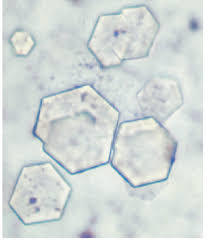
7) Cystine
Select the likely cause of the above abnormal urine sediments
- Red cell casts 2. Calcium oxalate 3. Tamm Horsfall protein 4. Triple phosphate (struvite) 5. Uric acid 6. Glycine 7. Cystine 8. Broad Cast
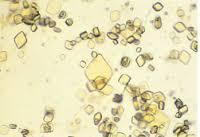
5) uric acid
Select the likely cause of the above abnormal urine sediments
- Red cell casts 2. Calcium oxalate 3. Tamm Horsfall protein 4. Triple phosphate (struvite) 5. Uric acid 6. Glycine 7. Cystine 8. Broad Cast
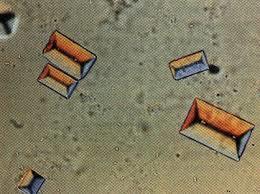
4) Triple Phosphate
• Select the biochemical abnormality most closely linked to the following clinical scenarios.
A. An athlete participating in a marathon tournament for the first time.
- High creatine kinase 2. Hyponatremia 3. Hyperkalemia 4. Metabolic acidosis 5. Hyperuricaemia 6. Hyperglycemia 7. metabolic alkalosis 8. Hypernatraemia
1) High Creatanine Kinase
• Select the biochemical abnormality most closely linked to the following clinical scenarios.
B. The use of Angiotensin receptor blocker (ARB) for treatment of hypertension
- High creatine kinase 2. Hyponatremia 3. Hyperkalemia 4. Metabolic acidosis 5. Hyperuricaemia 6. Hyperglycemia 7. metabolic alkalosis 8. Hypernatraemia
3) Hyperkalaemia
• Select the biochemical abnormality most closely linked to the following clinical scenarios.
C. Ecstasy use
- High creatine kinase 2. Hyponatremia 3. Hyperkalemia 4. Metabolic acidosis 5. Hyperuricaemia 6. Hyperglycemia 7. metabolic alkalosis 8. Hypernatraemia
2) Hyponatraemia
• Select the biochemical abnormality most closely linked to the following clinical scenarios.
D. Prostatic carcinoma
- High creatine kinase 2. Hyponatremia 3. Hyperkalemia 4. Metabolic acidosis 5. Hyperuricaemia 6. Hyperglycemia 7. metabolic alkalosis 8. Hypernatraemia
4) Metabolic Acidosis
• Select the biochemical abnormality most closely linked to the following clinical scenarios.
E. Chemotherapy for a bulky sarcoma of right thigh
- High creatine kinase 2. Hyponatremia 3. Hyperkalemia 4. Metabolic acidosis 5. Hyperuricaemia 6. Hyperglycemia 7. metabolic alkalosis 8. Hypernatraemia
5) Hyperuricaemia
• Match the drug combination causing each of the following biochemical abnormalities
A. AKI with hyperkalemia
- Vitamin D & oral calcium 2. Loop diuretic & calcium channel blockers 3. Loop diuretic & thiazide 4. Digoxin & nitrates 5. Spironolactone & ACEI 6. Digoxin & calcium channel blockers 7. Betablockers and Calcium channel blockers 8. Statins and cyclosporin
5) Spironolactone & ACE-I
• Match the drug combination causing each of the following biochemical abnormalities
B. AKI with Hypercalcaemia
- Vitamin D & oral calcium 2. Loop diuretic & calcium channel blockers 3. Loop diuretic & thiazide 4. Digoxin & nitrates 5. Spironolactone & ACEI 6. Digoxin & calcium channel blockers 7. Betablockers and Calcium channel blockers 8. Statins and cyclosporin
1) Vitamin D & Oral Calcium




