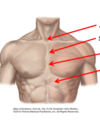
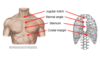
Coronal Plain
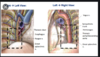
vertical plane that divides body ventral and dorsal parts
cranial
superior ( nearer to head)
caudal
inferior ( nearer to feet)
proximal vs distal
proximal is closer to point of origin distal is farther from point origin. example shouder is more proximal than hand
Ipsilateral
occuring on same side of body.
the right arm and the right lung are ipsilateral but not bilateral
not equilent to unilateral
unilateral= unpaired structure on one side
the liver is unilateral
bilateral= paired structure on L and R side of body
the lungs are bilateral
contralateral
occuring on the opposite side of body
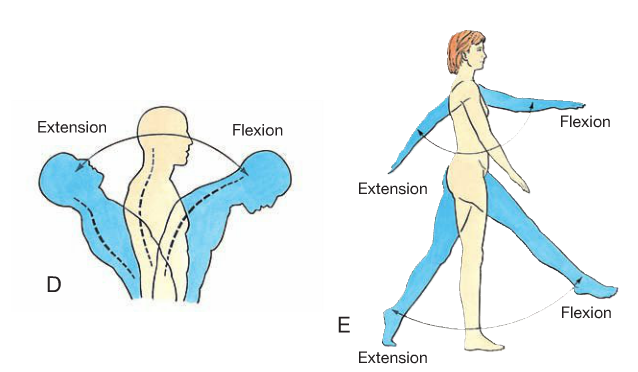
Flexion vs extension
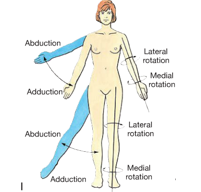
Adduction vs abduction
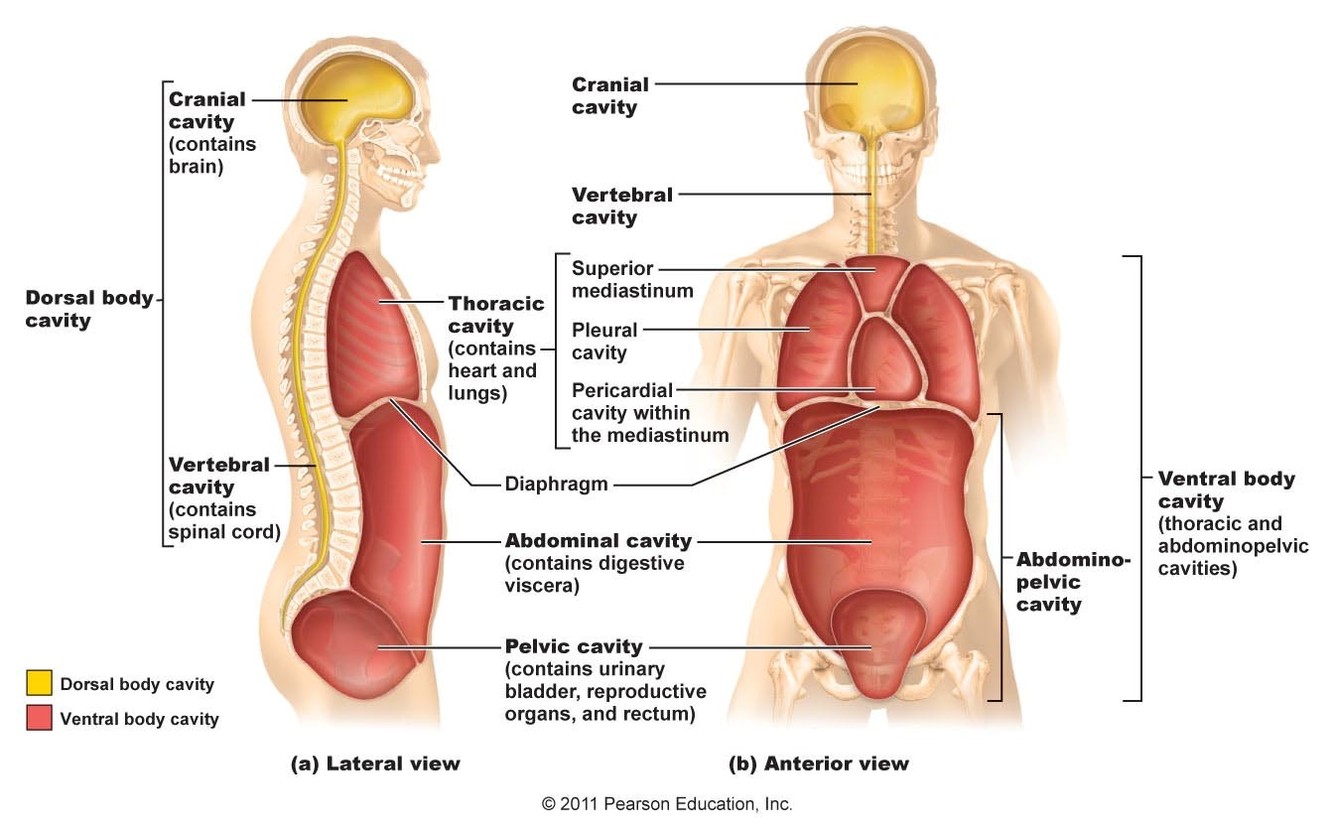
Dorsal Body Cavities
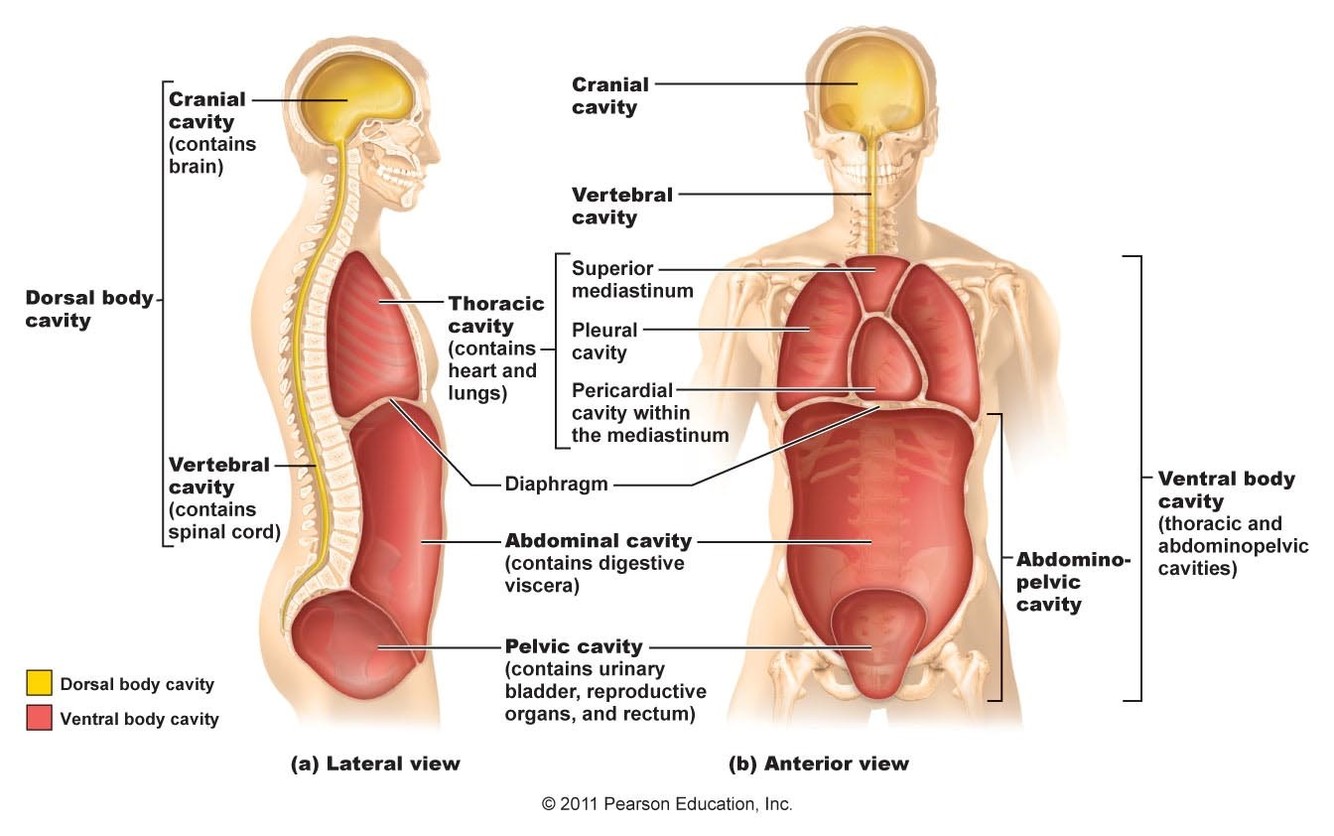
Ventral Body Cavities
What are the tissue types
- Epethilias
- connective Tissue
- Muscle Tissue
- Nervous Tissue
Epithelial tissue
function?
What are 3 examples of epithelial tissue in the body?
describe what it looks like
1)Epithelial tissue
- Tightly packed cells that form a sheet
- Functions: cover and line, seperate different environments
ex)
- Cover body surface (epidermis)
- Line internal body cavities (thoracic & abdominopelvic – serous membrane made of epiethlium( the pleura of the lungs are a serous membrane) )
- Line tubes (GI tract & respiratory tract – mucosa- epiethelial tissue)
- Internal lining of blood vessels (endothelium) and heart (endocardium)
- Helps to form glands and ducts
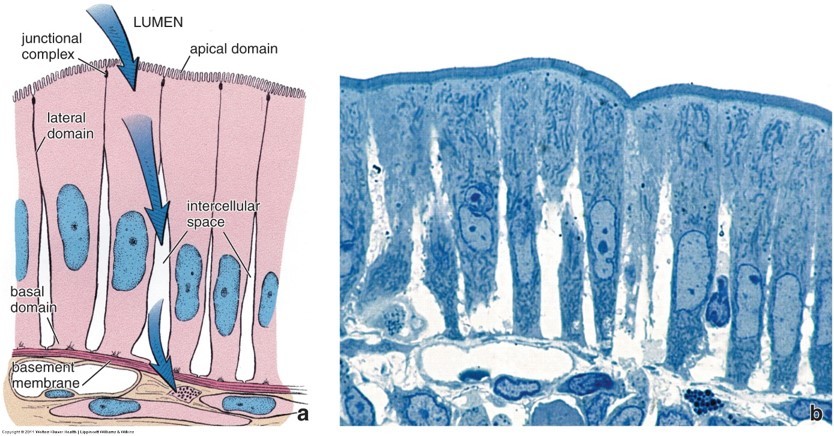
- Apical surface (interacts with lumen or the inside of whatever it is lining, has microvili) and basal surface (located on basement, or connective tissue side)
- Avascular. Capillaries in underlying CT.
Integumentary System
describe its structure
Integumentary system:
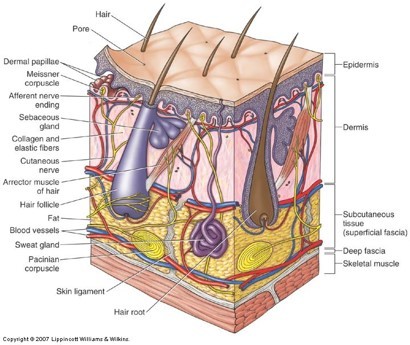
Skin protects the body and underlying tissues, prevents dehydration, participates in thermoregulation, is involved in sensation, and synthesizes/stores vitamin D
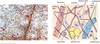
- Epidermis: epithelium (avascular)
- Dermis: dense connective tissue, tougher structure
- Collagen and elastic fibers in ECM provide strength and skin tone
- Hair follicles, arrector pili muscles (smooth), sebaceous (sweat) glands
- Subcutaneous tissue (superficial fascia; hypodermis)
- Loose connective tissue
- Most of body’s fat storage
- Blood vessels, lymphatics, deep parts of sweat glands, cutaneous nerves
- Deep fascia (white layer)
- Dense connective tissue
- Surrounds body deep to skin and superficial fascia
skin = epidermis+dermis
Deep fascia: function?
deep fascia vs investing fascia
- Extensions of deep fascia invests neurovascular bundles and muscles, divides groups of muscles, surrounds bone and lies between the body wall and membranes that line body cavities
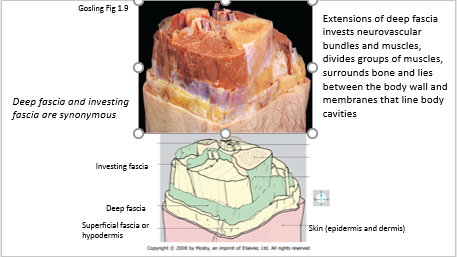
- Deep fascia and investing fascia are synonymous
Deep fascia is like seran wrap holding everything together. It will surround a neurovascular bundle, artery nerve and vein that run together
Deep fascia surrounds bone, will lie between bone and body wall
Muscle Tissue
What are the different types?
What are thier fuctions ?
tendon vs aponeurosis
Muscle tissue
- Allows for movement and control
- 3 types:
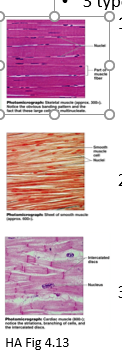
1) Skeletal muscle (Somatic; Voluntary)
- Made up of striated muscle on one end and tendon (round) or aponeurosis (flat) on the other end
- Attached to bone, cartilage, ligaments or deep fascia (sometimes skin)
- Contracts to move or stabilize body, manipulate environment, produce facial expressions
- Striated or banded appearance
2) Smooth muscle (Visceral; Involuntary)
- Found in walls of hollow organs; arrector pili muscle in dermis
- Contracts to propel substances through hollow tube to reduce diameter of organ
- Not striated
3) Cardiac muscle (Visceral; Involuntary)
- Found in wall of heart
- Contracts and propels blood through circulatory system
- Striated, branching
What is nervous tisssue?
What are the cells components?
Neuron = functional unit of nervous system
Neuron consists of:
- Cell body
- Processes extending from cell body
- Dendrites: carry impulses towards cell body
- Axon: carry impulses away from cell body
- Point of communication between 2 neurons = synapse (via neurotransmitters)
Other type of nervous tissue - neuroglia (glial cells or glia)
- Support, nourish and insulate neurons
- Schwann cells provide myelin sheath in PNS and enhance conductivity
- Nerves may be myelinated (white) or unmyelinated (gray)
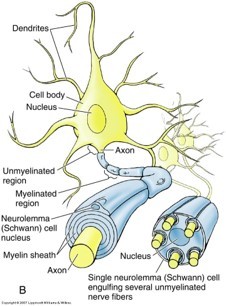
Multipolar neuron
•motor neuron
Most abundant
- Many dendrites and single axon
- Dendrites receive stimulus
- Axon terminals release neurotransmitter to effector
( 2 types of neurons)
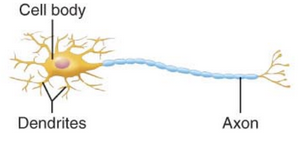
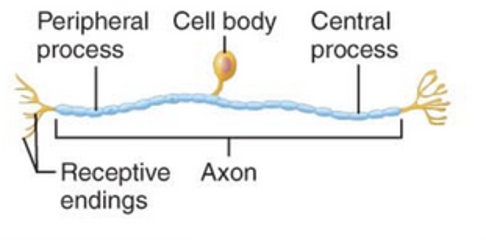
Unipolar neuron
- Mainly in peripheral nervous system (cell bodies located in dorsal root ganglia)
- No dendrites and one axon (peripheral and central process)
- Peripheral process has receptive endings
- Central process releases neurotransmitter
- sensory neuron
2 types of neurons that we discuss in this anatomy class
What is the function of the skeletal system?
What does the skeletal system consist of?
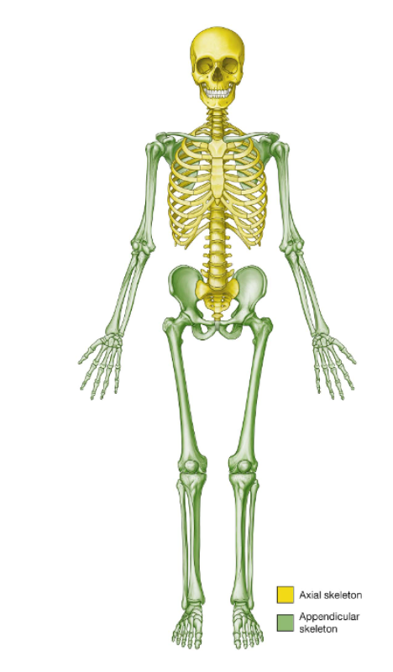
axial vs appendicular skeleton
•Divided into:
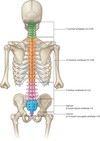
1) Axial skeleton – cranium, vertebrae, ribs and sternum
2) Appendicular skeleton – bones of upper and lower limbs
•
•Made up of bone and cartilage
•
•Bone is vascular (has a blood supply) and innervated
What are the three types of cartilage and thier different functions?
- Cartilage is avascular and is not innervated
- Hyaline cartilage – most common (articular surfaces, synovial joints )
- Elastic cartilage – recoil property (external ear)
- Fibrocartilage – tensile strength (IV discs or areas that bear a lot of weight from upper body )
What are the two types of joints?
Describe thier differences
Joints
•Where two skeletal elements come together (articulate)
•
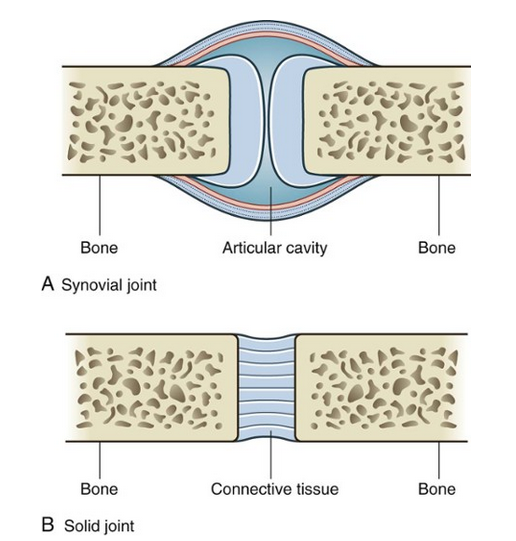
•Are either classified as: Synovial or Solid joints
•
- Synovial joints: highly moveable
- Hyaline cartilage covering articular surfaces
- Joint capsule with inner synovial membrane(pink) (produces synovial fluid) and outer fibrous membrane (dense CT)
- Articular cavity with synovial fluid that reduces friction and noursishes cartiledge
•
- Solid joints: some or little movement
- Skeletal elements united by fibrocartilage
- Moments at solid joints are more limited than those at synovial joints
What is the muscular system?
origin vs insertion
prime mover vs synergist
agonist vs antagonist
fixator
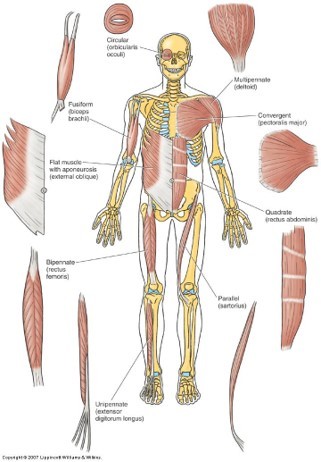
- Skeletal muscle that attaches directly or indirectly to bone
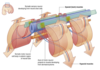
- Origin: proximal/fixed end
- Insertion: distal/movable end
•
•Prime mover (agonist): main muscle responsible for a specific movement
•
•Synergist: complements action of prime mover
•
•Antagonist: opposes action of prime mover
•
•Fixator: steady skeletal elements during certain movements
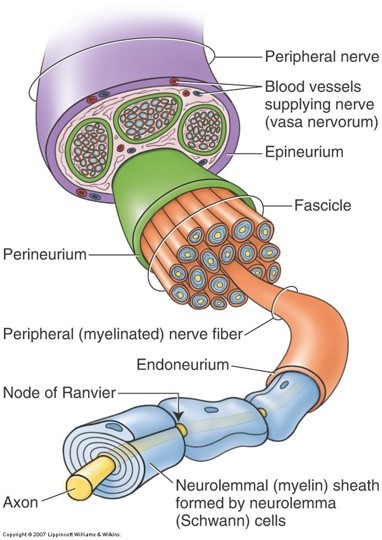
How are neurons organized?
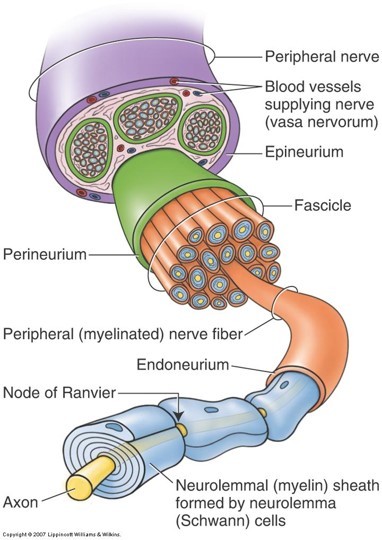
Nerves are bundles of fascicles (and fascicles are bundles of long axons that are called nerve fibers).
•Each nerve has a connective tissue framework and blood vessels (vasa nervorum)
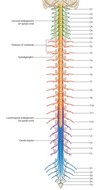
Nerves in the PNS are either spinal nerves (31 pairs) or cranial nerves (12 pairs)
A collection of cell bodies in the PNS is called a ganglion
What is the lymphatic system? What does it do?
Recycles excess tissue fluid back to cardiovascular system
- Interstitial fluid
- Pathogens
- Cell products (e.g. hormones)
- Cell debris
Substance known as lymph
- Carried from lymphatic capillaries to lymph nodes by way of lymph vessels
- Lymph nodes act as body’s defense against foreign antigens
- Filter, detect and phagocytose