Culture Meets Scripture 6 Steps
Step #1 – Describe Traditional Practices. List ALL practices that must be done for this ritual event – especially those that may cause tension for believers. For THREE of the practices you list, describe the reasons (or benefits) why the practice must be done, the consequences if it is not done, and the beliefs that make the practice necessary.
Step #2 – Compare Traditional Practices with Scripture:
- List Scripture verses/passages that comment on the topic of each of the three practices.
- Ask: What guidelines do these Scriptures give for making choices that honor God?
Step #3 – Transform the Ritual Event:Having compared the three practices with Scripture, does each oneagree with Scripture,or does it need to bemodifiedorrejected completely?If it is to be rejected, is there a need tocreate a new practice?
- If you decide you need to make some modifications or create new practices for this ritual event, describe what those might look like and how they might honor God.
Step #4 – Unite Believers:
- Believers need to plan in principle how to support each other before the given event happens. What are some specific ways believers can put into practice the “one another’s” of Scripture?
- 1 Thessalonians 5:11 – Encourage one another
- Galatians 6:2 – Bear one another’s burdens
- 1 Corinthians 12:25 – Care for one another
- 1 Peter 4:10 – Serve one another
- 1 Thessalonians 4:18 – Comfort one another
- James 5:16 – Pray for one another
- Also, during the event verbalize to others why the ritual was required traditionally, and the fears associated with not doing it. Then give God’s answer to the reasons, consequences, and beliefs with verses. Practice during this workshop!
Step #5 – Create an Action Plan:Describe some ways you willsharethis CMS process with yourextended Christian community. Include how you will encourage believers to help each other stand firm in doing things that honor God.
Step #6: Describe a few ways you hope the new choices will help believers honor God.
Five STEPS (C’s) to Learning that Lasts
- Connection: Getting started, connecting with what participants already know or feel about the topic.
- Content: Teach them new and needed content about the topic.
- Challenge: A learning TASK(s) related to the new topic, with all needed resources to complete it successfully. E.g.,
- SLRG questions: What question(s) can we add to incorporate local arts?
- Let’s try to write an approximation of a Pantun poem in pairs in English, and then share with the class.
- What ideas do you have for your own LtL lessons?
- Change: An activity or discussion that leads to a plan or idea for doing something different in the future in response to what has been learned. E.g.,
- In what ways could it be helpful to create new artworks together with local artists rather than creating exclusively on your own?
- In what ways is it harder to work together than to work alone?
- How much extra effort is collaborating worth?
- How can Learning that Lasts help strengthen your future teaching?
- How will it help people learn in another cultural context you know—or how may it need to be adapted?
- Closure: Help them focus on their most important takeaway, reflect and release, get ready for the Next Thing.
Five Learning that Lasts PRINCIPLES
- How will you make your teaching Learner-centered (NOT subject-centered)? Respect, Relevance, Relationship.
- What opportunities are there for Action and Reflection? People learn well by doing activities and reflecting on experiences; actions should create a response.
- How will learners Solve Problems? Help them discover solutions; there are often multiple answers to a problem; don’t fish for only one answer to an open question.
- How will learners engage in Teamwork? Encourage dialogue and small group learning.
- In what ways will Self-discovery and Self-direction be created and supported? Learners have choices about their learning; teachers consult and help learners find resources.
Three stages of checking a Scripture publication before it is presented to the intended audience
- Team Check
- Consultant Check (scripture/translation consultants, who can adapt a scripture verse in context with surrounding scripture)
- Community Check (3+ members of the intended audience + gatekeepers)
How to Community Check an Illustration Using UNICEF’s Four Interview Questions (Haaland 1984):
- What do you see? What else do you see?
- What do you think the artist wants us to learn?
- What do you like about it?
- What don’t you* like? Is there anything about it that may offend someone? How could it be improved? (Revise before release).
General version for checking any publication:
- Content: What is it about?
- Meaning: What do you learn?
- Appreciate: What do you like about it?
- Suggestions: What don’t you* like about it? What may offend someone? How could we improve it? (Revise before release).
* May be culturally more appropriate to ask what “someone” might not like about it.
Four Steps for Successful Marketing and Distribution of SE Materials Into a Community
- Assess current Scripture use (through current sales & who is using Scriptures and how).
- Assess current marketing strategy (Scripture appropriateness, appearance, and current advertising).
- Assess current distribution channels (and potential ones) for Scriptures.
- Assess management of finances (accountability, storage of Scripture materials)
Dye’s (2009) Eight Conditions for SE
- Appropriate Language, Dialect, and Orthography
- Acceptable Translation and Translators
- Accessible Forms of Scripture (printed, audio/visual)
- Background Knowledge of the Hearers
- Availability of Scripture (distribution)
- Spiritual Hunger of Community Members
- Freedom to Commit to Christian Faith
- Partnership Between Translators and Other Stakeholders
Grasping God’s Word (Duvall & Hayes 2005): The Interpretive Journey (4 questions + application steps)
“The Interpretive Journey”:
1) Understand the biblical text as the original audience did. What was the authorial intent, not receptor intent?
2) What are the differences of culture, language, time, and situation between the biblical audience and us?
3) What is the timeless theological principle(s) in this text? (Step 3.5 for OT: Does NT teaching modify or qualify this principle, and if so, how?)
4) How should we apply the timeless theological principle(s) to our lives and contexts now?
- What are the key similarities in this text between the biblical audience and us?
- Identify a real or fictional parallel situation in our contemporary context that contains all of the similarities.
- Discuss how to apply the timeless biblical principle(s) to our chosen contemporary situation in specific ways.
Grasping God’s Word (Duvall & Hayes 2005): Meaning and Application
Meaning is set by the author and thus doesn’t change from reader to reader. Application, however, varies for different readers.
Grasping God’s Word (Duvall & Hayes 2005): Five Steps to applying meaning from Scripture
Five Steps to applying meaning from Scripture (“what the author intended to communicate through the text”):
1) Summarize the original situation and meaning for the original hearers; 2) List the timeless theological principle(s) communicated by the passage; 3) List all elements in the text that are addressed by the timeless principle(s); 4) Identify a real or fictional parallel situation in a contemporary context that contains all of the elements; 5) Discuss how to apply the timeless biblical principle(s) to the contemporary situation in specific ways.
Grasping God’s Word (Duvall & Hayes 2005): Which CLAT steps could benefit from the Interpretive Journey? How?
- Meet a Community (GGW Step 3: Who is the contemporary audience/context?)
- Specify Kingdom Goals (IJ + GGW Steps 3-5)
- Spark Creativity (IJ + GGW Step 5: commissions, workshops, contests, creative groups)
- Improve New Works (GGW Steps 5: 3-4 checks)
3 Orality Authors, 5 points
Tex Sample (1994)
- Sample estimates that one-half of the U.S.A. and two-thirds of the world are predominantly oral (p. 6). The popularity of rap and country music is an illustration of how dominant orality is in this culture (p. 11).
- Sample describes 11 marks of a traditionally oral person, which include: Use of tacit meaning and hyperbole, remembering (memorization), preservation of community relationships, importance of tradition, and resistance to experts from outside their community.
Walter Ong (2002)
- Primary orality = a culture totally untouched by any knowledge of writing or print
- Secondary orality = present-day high-technology culture where orality is sustained by telephone, radio, television, and other electronic devices that depend for their existence and functioning on writing and print.
Rick Brown (2004)
- Provides a list of common characteristics shared by oral communicators such as preference for dialogue, repetition, melodrama, sensitivity to the sounds of voices, and valuing of oral information over written text.
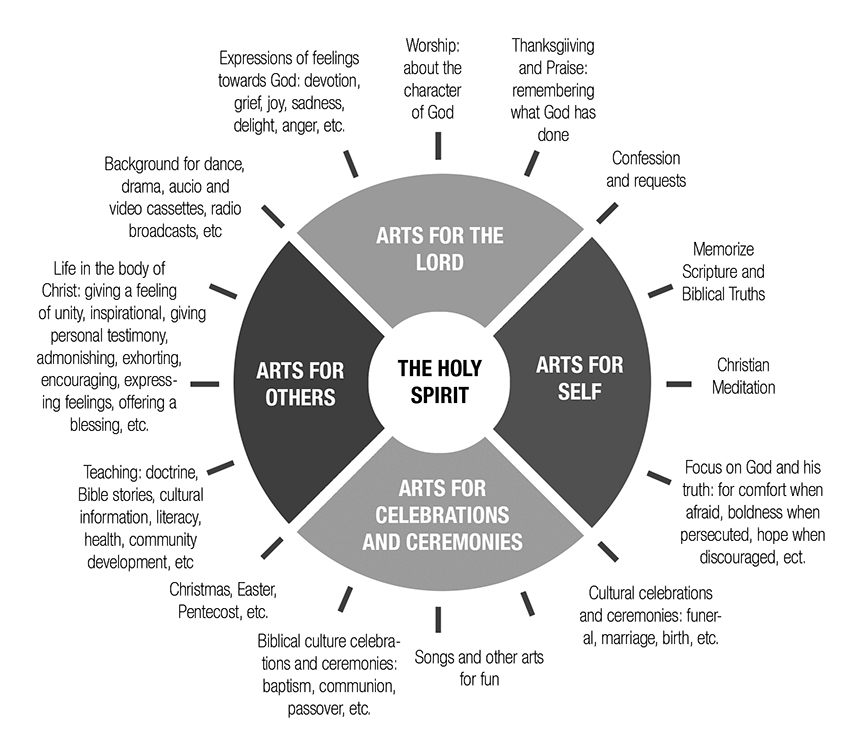
Worship Wheel (filled) – purpose & 4 parts
Purpose: helps a church identify which aspects of Christian life are not being affected/enriched by the arts
There are four kinds of Christian songs:
- We “speak to one another”—songs for others.
- Music we “make in our hearts”—songs for when we are by ourselves.
- Music to the Lord, including giving thanks to God for everything—songs to the Lord.
- Verses 15 and 16 talk about wisely making the most of every opportunity—which could easily include songs for special occasions, such as ceremonies, celebrations, and festivals.
PMEC: Appreciative Inquiry
This helps a group discuss the things they like about their current situation, brainstorm ideas for improving their situation, and plan which of those ideas to begin working on.
PMEC: Cause and Effect Tree
The Cause and Effect Tree helps a group of people depict the causes of positive and negative effects in a situation.
PMEC: Force Field Analysis
Helps a group with a desired change to identify the forces working for and against the desired change. Participants plan how to strengthen favorable forces, weaken negative forces or change negative forces into positive ones.
PMEC: Stakeholder Analysis
The Stakeholder Analysis helps a small group of stakeholders to identify other people who have an interest in or are important to a project or program that the group plans to undertake.
PMEC: SWOT Analysis
This tool helps a group think about a goal and the internal Strengths and Weaknesses and external Opportunities and Threats that affect it. They can categorize the items they have brainstormed, and indicate the strongest in each category. It also helps them to develop an action plan.
PMEC: Overlapping Circles
The purpose of this tool is to assist church leaders in assessing which languages/artistic genres/etc. are used to what degree in which activities related to worship, nurture, and spiritual growth.
Finding Artists to Commission: 5 Questions to consider
- Who is the intended audience?
- Who is good at an art form the intended audience likes?
- What kinds of people like the artist’s style?
- What Scripture is similar in theme to the content of the artist’s style/genre?
- How willing is the artist to revise their work?
What is Stephen Krashen’s i+1 in language learning?
According to Krashen, we acquire language only when we receive Comprehensible Input, termed i+1. i represents knowledge of the language and context. i+1 is a little more than what we knew before.
Study Scripture before Creating Together from Scripture:
Four Things to Remember
- Teach artists to find the author’s intent and apply the timeless principle to the local context—what does this look like lived out here?
- Respect the author’s intent in context. There is one meaning, with many applications.
- Learn what the audience doesn’t know and relate to their existing worldview, i+1 and i-1
- Scripture gives a standard for consultant checking and community checking new works.
What is the artist’s FRAME?
+
4 Frames in Biblical Illustrations
What is the artist’s FRAME (Bauman 1992)? The purpose or intention of the artist. The audience needs to understand the intention of the artist to interpret a work rightly.
Four possible frames in Bible illustrations:
- Storytelling Frame: illustrations portray characters, actions, and emotions. These illustrations are likely to engage a reader with a text when they show a key story event.
- Historical Storytelling Frame: shows a story in its original culture, time, and place
- Contextual Storytelling Frame: shows a story in the audience’s culture, time, and place; concepts behind images more critical than historical accuracy
- Background Knowledge Frame: teach audiences how to picture unfamiliar objects and places; e.g., bit in horse’s mouth;
- Symbolic Frame: illustrations evoke concepts; for example, for some cultural audiences, filigree borders around sacred text evoke respect for holiness.
What 4 characteristics make for a good storytelling illustration?
- Interesting characters: all the characters needed to understand the story are in the picture
- Action: something interesting and understandable is happening
- Appropriate Emotion: no blank faces!
- Identification: Women identify with women, men with men, children with children, so show a variety of people in the totality of Scripture illustrations to increase audience identification.



-
RMWA42
-
Applied Arts48
-
Applied Arts in CLAT Steps ONLY10
-
CLAT – Prepare Yourself22
-
CLAT Step 1 – Meet a Community and Its Arts33
-
CLAT Step 2 - Specify Kingdom Goals16
-
CLAT Step 3 - Select Effects, Content, Genre, and Events13
-
CLAT Step 4 - Analyze an event containing the chosen genre8
-
CLAT Step 4A - Describe the event & its genre(s) as a whole17
-
CLAT Steps 4A-4B Event Lenses Questions3
-
CLAT Step 4B EFA vocabulary24
-
CLAT Step 4B - [UNEDITED] Explore the event's genre(s) through artistic domain categories64
-
CLAT Step 4C - Relate the event's genre(s) to its broader cultural context46
-
CLAT Step 4D - Explore how a Christian community relates artistically to its broader church and cultural context21
-
CLAT Step 5 - Spark Creativity26
-
CLAT Step 6 - Improve New Works7
-
CLAT Step 7 - Integrate and Celebrate for Continuity21



