What is APRV
Inverse ratio, pressure controlled, and time cycled ventilation mode
Applies a continuous airway pressure (Phigh) that is similar to CPAP but has a breif time cycled released phase at a low pressure (Plow) to allow for the removal of CO2
Purpose of APRV
Maintain lung volumes as well as promote alveolor recruitment
What Diseases is APRV used for
This mode is most commonly used for ARDS where it is difficult to oxygenate and recruit the lung
New reserach has soon that to be the most effective APRV should be started at the initiation of ventilation rather than after ARDS has been diagnosed
Has been used for patient with COPD as they will be able to maintain spontaneous breathing
Advantages of APRV
- Lung protective strategy
- Easy to manipulate MAP as well as I:E
- Can help both oxygenation and ventilation
- Is argued to be a more comfortable more mode as the patient is able to breath spontaneously on this mode
- However, in the ICU there are few patients who are breathing spontaneously and any of the positive effect that are derived from APRV are due to the patient spontaneously breathing
- Patient will not need to be paralysed on this mode but made need to be sedated for oxygenation/WOB issues
Disadvantages of APRV
May result in respiratory muscle atrophy if the patient is on this mode for prolonged periods
Theory Behind APRV
Can be thought of as an elevated CPAP pressure (which aids in oxygenation) with a brief intermittent release in airway pressure (which aids in ventilation)
What Kind of Ventilatory Support will APRV give
Can provide full ventilatory support in an apneic patient, but spontaneous breath is desired
Why is Spontaneous Breathing Preferred When Pt is in APRV
*This is the same for spontanesou breathing in all modes
- Contributes to the overall minute ventilation
- Improved V/Q mismatching and results in better gas exchange for a given volume
- Better recruitment and surface area for gas exchange
- Allows for a high MAP at a safe plateu pressure
- Will help with the retention of the thoracic pump mechanism
- Can reduce sedation levels
- Instead of a RASS of -4 to -5 which is done to reduce metabolic rate (VO2 and VCO2) patient can be more alert at a RASS of -2
- Some sources say titrate sedation to a goal MVspontto at least 10% of total MV
Elevated CPAP Pressure Does What
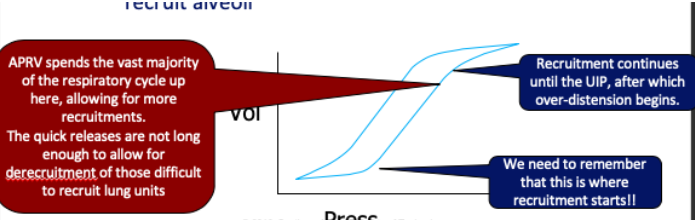
Results in a higher mean airway pressure and improve oxygenation at the same (safe) plateau pressure
This is what is responsible for recruiting the difficult to recruit alveoli
Link Between Thigh and Expiratory Flow Rate
Tlowwill commences once Phighis released, and at this point the expiratory flow rate is the highest (100%) which is equal to PEFR
Tlow should terminate at the time taken for PEFR to reduce to between 25-50% of its peak
Expiratory flow is not finished before inhalation occur, we are doing this in order to maintain PEEP so that even though our PEEP is set at zero we still have some auto PEEP.
What are the Settings that you set
- There will be two set pressures
- Plow which corresponds to PEEP (release phase)
- Phigh which corresponds to the high “CPAP” level
- There is also two times that you will be setting
- Thigh which is the time spent at Phigh
- Tlow which is the time spent at Plow (time at the release phase)
- There will be no RR set as that will be determined through TCT
- On some machines you will have the ability to set a pressure support breath
What Will be Total PEEP in APRV
Total PEEP will be determined by adding Plow plus auto PEEP
What Will be Frequency in APRV
Frequency is 60 seconds divided by the sum of Tlow plus Thigh
APRV is most successful with a limited number of releases. Thus, ventilator frequency should remain around the 10- 12 range. Increases outwith this range promotes derecruitment, and risks a return to refractory hypoxaemia.
Settings When Transferring from Conventional Ventilation
Phigh: Match Pplat on current mode (max 30 cmH2O)
Plow: Set to 0 cmH2O
Thigh: 4.0 sec
Tlow: 0.5-1.0 sec (often 0.8 sec)
Phigh
Transition from conventional ventilation – set Phigh as the plateau pressure in volume-cycled mode or peak airway pressure in pressure-cycled mode
Phigh >30 cmH2O may be necessary in patients with decreased thoracic/abdominal compliance (e.g. tense ascites) or morbid obesity.
Plow
We can leave this at zero because the time at this setting is so short that due to air trapping, we will not be derecruiting the lung
Tlow
Want to adjust to ensure that end expiratory flow is 25-50% of PEFR
I:E in APRV
4:1 or greater
We want to spend 90-95% of the time in Phigh
Settings When Initiating Ventilation on APRV
Phigh: Set at 30 cmH2O
Plow: Set to 0 cmH2O
Thigh: 4.0sec
Tlow: 0.5-1.0 sec (often 0.8 sec)
Setting APRV on G5
Called-APRV
Attempts to synchronize transitions
PS set as a delta pressure, from Plow
Setting APRV on PB 840
Called-BiLevel
Attempts to synchronize transitions
PS set as a delta pressure, from Plow
Setting APRV on Servo-i
Called-Bi-Vent
Attempts to synchronize transitions
PS set separately for each pressure level
Setting APRV on Evita XL
Called-APRV
Time-triggered, time-cycled only
No pressure support options
Increasing Ventilation in APRV
Decreasing PaCO2
- Weaning sedation/increasing spontaneous ventilation
- Increase Phigh
- This is increasing your tidal volume which will increase you minute ventilation and decrease your CO2
- Decrease Thigh
- Optimize Tlow to between the 25-50%
- Increase Tlow

-
Manual Ventilation30
-
EXTUBATION AND DECANULATION40
-
Rapid Sequence Induction14
-
Notes From Quizes10
-
10 Maxims Fro Modes of Mechanical Ventilation37
-
Mechanical Ventilation Variables12
-
Lung Recruitment Maneuver15
-
Arrow Diagrams85
-
Initiation of Mechanical Ventilation34
-
Review Questions45
-
Review Points47
-
Indépendant Lung Ventilation5
-
Prone Positioning13
-
Esophageal Pressure Monitoring18
-
Lung Recruitment Maneuver9
-
APRV33
-
High Frequency Ventilation57
-
ACLS93
-
Volumetric Capnography14
-
Tube Compensation9
-
Mandatory Minute Ventilation9
-
Adaptive Support Ventilation22
-
PAV9
-
NAVA7
-
Volume Support6
-
PALS32
-
Drug Calculations18
-
Practice Questions23
-
Ng/OG23
-
Thoracic Drainage Unit60
-
Review88
-
Practice Tests44
-
Pre Labs1
-
Practice Questions3



