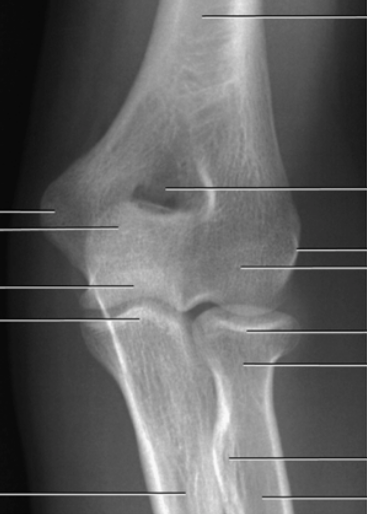
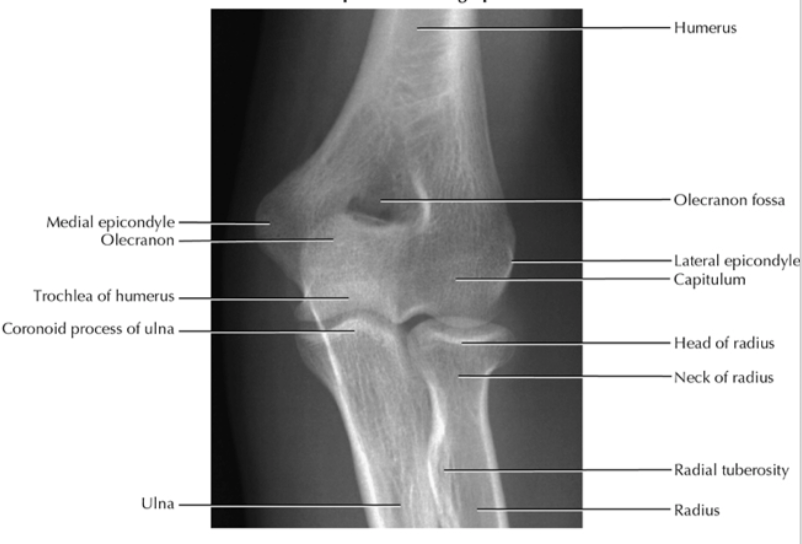
What is the arm?
What is the leg?
- Arm then forearm
- The arm refers only to the portion of the upper limb between the shoulder and the elbow, not the entire upper limb.
- Thigh then leg
- The leg refers only to the portion of the lower limb between the knee and the ankle, not the entire lower limb.
What are the three muscles in the anterior arm?
What are nerve are they all innervated by?
What do the muscles do?
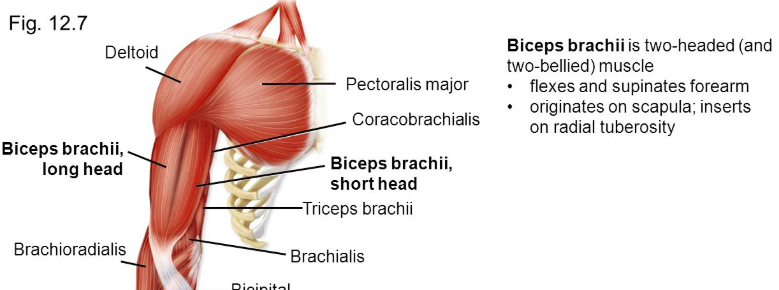
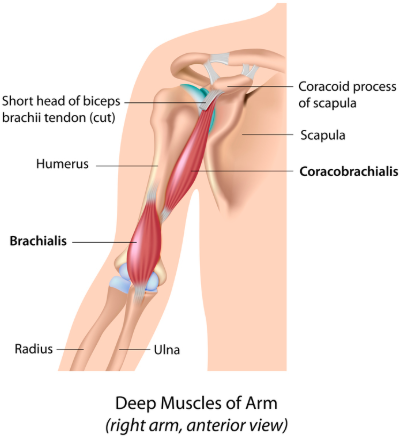
- The musculocutaneous nerve (C5 and C6) innervates the 3 muscles in the anterior arm: the biceps brachii, the brachialis, and the coracobrachialis.
- coracobrachialis flexes the arm at the shoulder
- brachialis flexes the forearm at the elbow
- biceps brachii flexes at both of these joints, as well as supinating the forearm.
What are the muscles in the anterior forearm?
What nerves innervate them?
What do the muscles do?
- The median nerve innervates all muscles of the anterior forearm except one and a half (the flexor carpi ulnaris and the medial half of the flexor digitorum profundum).
- Median nerve also innervates five muscles in the hand.
- The ulnar nerve innervates a few aneterior forearm muscles, in addition to flexors in the hand.
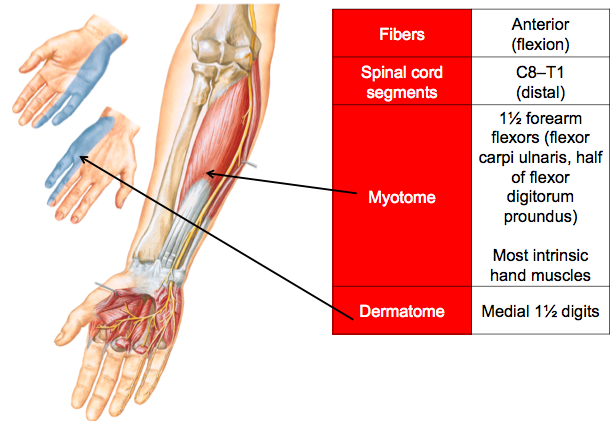
- Innervates the flexor carpi ulnaris and the medial half of the flexor digitorum profundus in the anterior forearm, and all of the intrinsic hand muscles not innervated by the median nerve. Its dermatome is the medial one and a half digits, including both the anterior (palmar) and posterior (dorsal) sides. Hitting the “funny bone” refers to transient trauma of this nerve as it passes under the medial epicondyle of the humerus; next time this happens to you, notice that it’s only the medial half of the ring finger that gets the “pins and needles” sensation, not the lateral half.
posterior arm
What is the one muscle, and what nerve innervates it?
Blood supply?
What nerve innervates the dermatome?
- The radial nerve (posterior division fibers from C5 through C8) innervates all of the muscles of the posterior arm (and forearm)
- Innervates triceps brachii (the only posterior arm muscle)
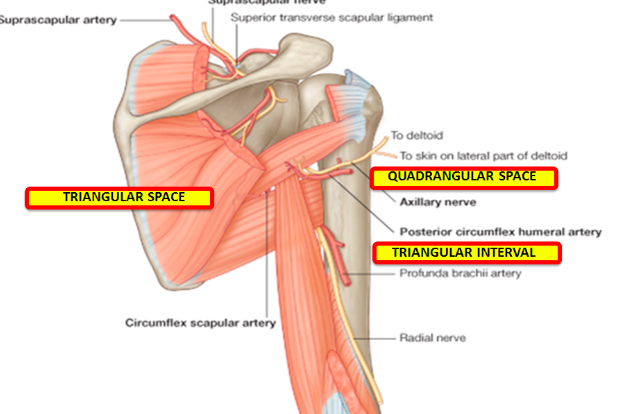
- Radial nerve courses with deep (profunda) brachial artery, through the triangular interval
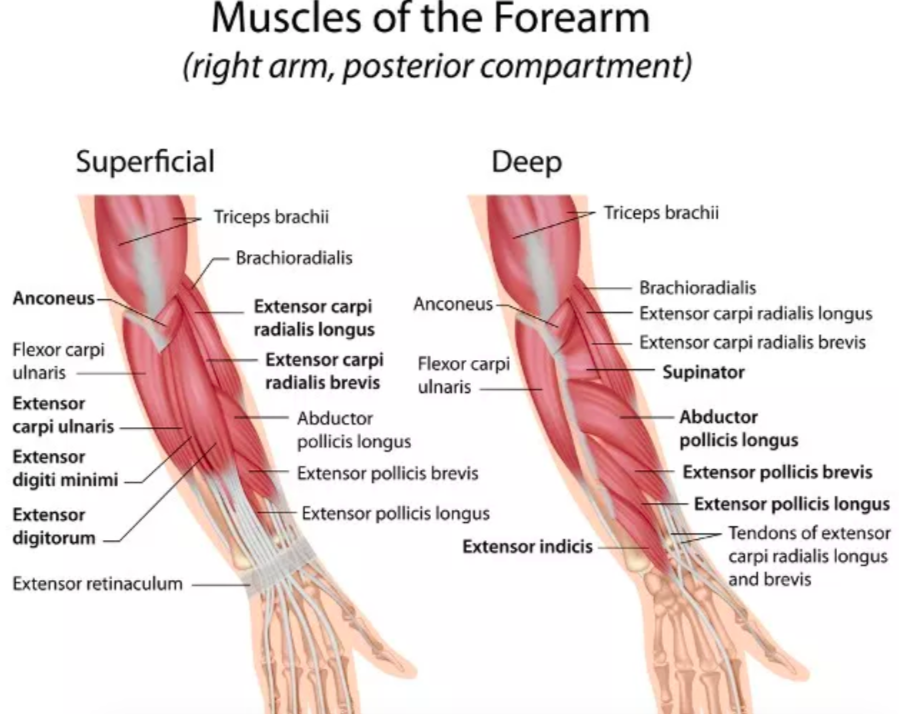
posterior forearm:
What are the muscles, and what nerve innervates all of them?
What nerves innervate the dermatome?
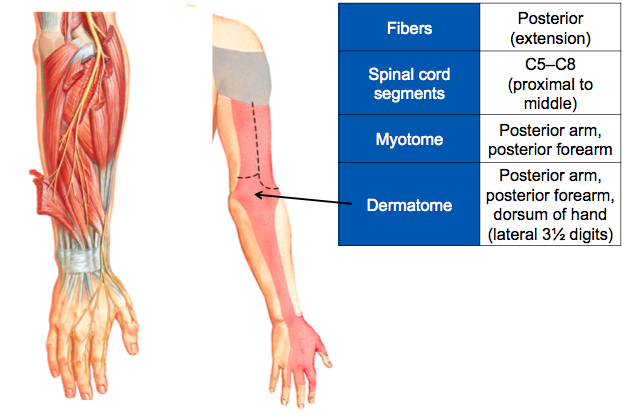
- After innervating the posterior arm muscle (triceps brachii), the radial nerve continues into the posterior forearm to innervate all muscles there, as well
- The posterior forearm contains twelve muscles which are responsible for extension of the wrist and digits, and supination of the forearm.
- Radial nerve also continues down as a cutaneous branch into the dorsum of the hand; the full dermatome of the radial nerve consists of the posterior arm, posterior forearm, and the dorsum of the lateral 3½ digits; excluding the nail beds.
What is in the anterior and posterior compartments of the arm?
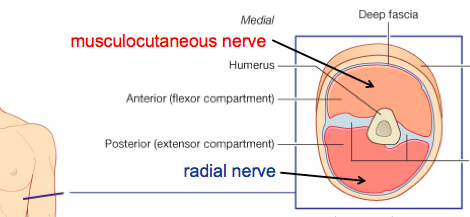
In the arm, there are two compartments:
- anterior compartment
- 3 muscles: biceps brachii, brachialis, coracobrachialis
- All innervated by musculocutaneous nerve (C5-C7)
- Blood supply = brachial artery
- posterior compartment
- 1 muscle: triceps brachii
- Innervated by the radial nerve
- Blood supply = deep profunda brachial artery
What is in the anterior and posterior compartments of the forearm?
- Anterior forearm:
- Innervated mostly by the median nerve (except one and a half muscles innervated by the ulnar nerve)
- Blood supply from ulnar artery
- Posterior forearm:
- Innervated by the radial nerve
- Blood supply from radial artery
- The radial artery and the ulnar artery anastomose in the hand, by forming two arches, the superficial palmar arch, and the deep palmar arch
What are the muscles of the rotator cuff?
What are they innervated by?
- Commonality = they are all innervated by nerve fibers from the C5 and C6 spinal cord segments
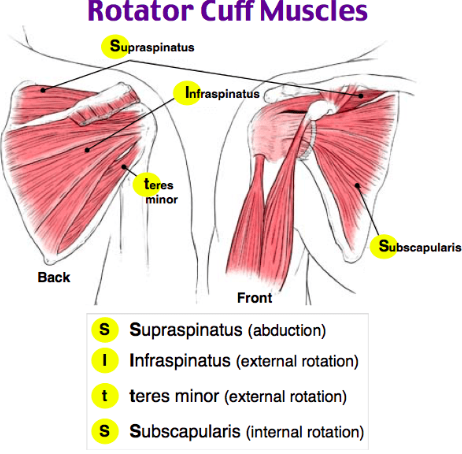
- Rotator cuff is a common name for the group of 4 distinct muscles and their tendons that provide strength and stability during motion of the shoulder. They are also referred to as the SITS muscle with reference to the first letter of their names: Supraspinatus, Infraspinatus, Teres minor, Subscapularis
- supraspinatus = an abductor of the arm at the shoulder
- infraspinatus = a external/lateral rotator of the arm at the shoulder
- teres minor = a external/lateral rotator
- subscapularis = internal/medial rotator
- Suprascapular nerve innervates 2 of the 4 muscles: the supraspinatus and infraspinatus
- Axillary nerve innervates teres minor (main nerve, the only one that isn’t collateral!)
- upper and lower subscapular nerves innervate subscapularis (collateral off posteiror cord)
Which nerves contribute to innervation of the forearm?
A: The axillary nerve innervates two muscles in the shoulder: the deltoid and the teres minor. Its dermatome is the lateral shoulder. It does not contribute to innervation of the forearm.
(A)(correct answer)
(B)The median nerve innervates almost all of the muscles of the anterior forearm.
(C)The musculocutaneous nerve innervates skin of the lateral forearm through its lateral antebrachial cutaneous branch.
(D)The radial nerve innervates all muscles of the posterior forearm.
(E)The ulnar nerve innervates 1½ muscles of the anterior forearm.
median nerve
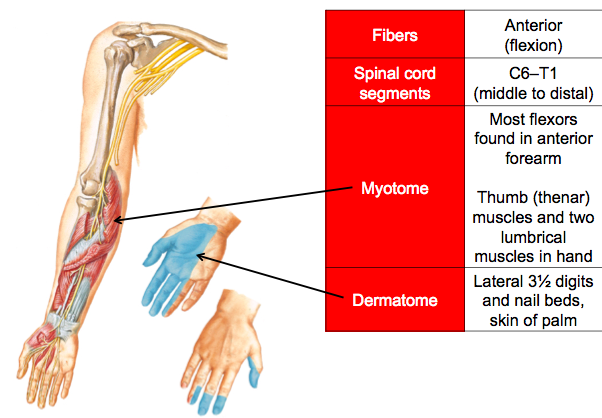
- The median nerve innervates almost all muscles in the forearm and a few muscles in the lateral hand. It also innervates some skin of the lateral hand.
- The median nerve contains anterior division fibers from C6 through T1, and thereby innervates mostly flexors within the forearm and hand.
- Innervates all of the muscles of the anterior forearm except for:
- the flexor carpi ulnaris and the medial half of the flexor digitorum profundum
musculocutaneous nerve
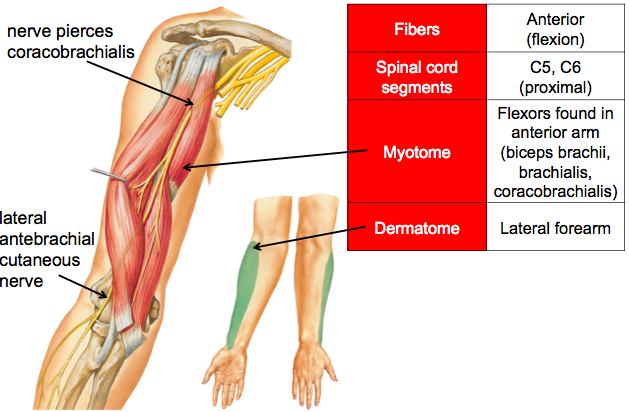
- The musculocutaneous nerve innervates skin of the lateral forearm through its lateral antebrachial cutaneous branch.
More:
The musculocutaneous nerve contains anterior division fibers of C5 and C6. We would predict that it should innervate flexors that act mostly at the shoulder and/or elbow, and that would be an accurate prediction. The three muscles this nerve innervates are the three muscles found in the anterior arm: the biceps brachii, the brachialis, and the coracobrachialis. The nerve can be found piercing the substance of the coracobrachialis, which can help with its identification in the cadaver. The coracobrachialis flexes the arm at the shoulder; the brachialis flexes the forearm at the elbow; and the biceps brachii flexes at both of these joints, as well as supinating the forearm. After giving off small muscular branches to the other two anterior arm muscles, the remainder of the nerve continues as a cutaneous nerve, the lateral antebrachial cutaneous nerve, which innervates the skin of the lateral forearm.
radial nerve
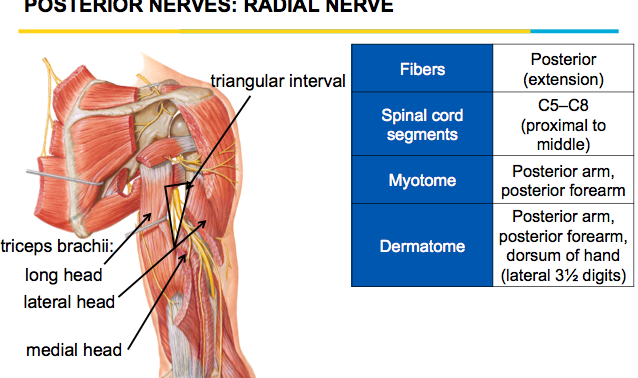
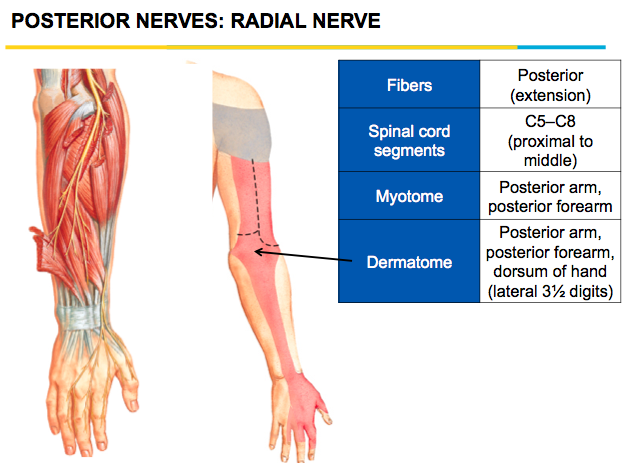
- The radial nerve innervates all muscles of the posterior forearm and arm
- Its dermatome includes these same areas, as well as much of the dorsum of the hand
- It’s a posterior collateral nerve
More:
The radial nerve is composed of posterior division fibers from C5 through C8. It innervates all of the muscles of the posterior arm and forearm, which are predominantly extensors. To get into the posterior compartment of the arm, the radial nerve passes through the triangular interval, bounded by the long head of the triceps brachii laterally, the lateral head of the triceps brachii laterally, and the teres major superiorly. The deep (profunda) brachial artery travels alongside the radial nerve.
After innervating the triceps brachii and the other posterior arm muscles, the radial nerve continues into the posterior forearm to innervate all muscles there, as well. It also continues down as a cutaneous branch into the dorsum of the hand; the full dermatome of the radial nerve consists of the posterior arm, posterior forearm, and the dorsum of the lateral 3½ digits; excluding the nail beds.
ulnar nerve
- The ulnar nerve innervates 1½ muscles of the anterior forearm, and many of the flexors of the hand
- Specifically, it innervates the flexor carpi ulnaris and the medial half of the flexor digitorum profundus in the anterior forearm, and all of the intrinsic hand muscles not innervated by the median nerve
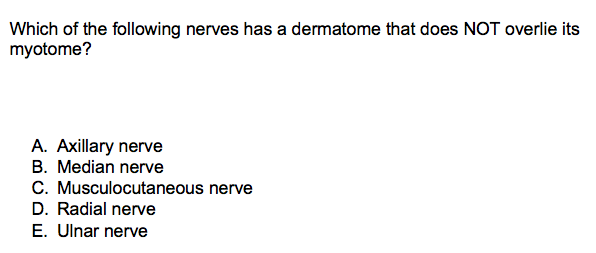
Which nerve has a dermatome that does NOT overlie its myotome?
- The muculocutaneous nerve
- The myotome of the musculocutaneous nerve is the anterior arm (coracobrachialis, biceps brachii, brachialis). Its dermatome is the lateral forearm (through the lateral antebrachial cutaneous nerve).
- In this case, the dermatome (forearm) does not overlie the myotome (arm).
axillary nerve
What myotome and dermatome does it innervate?
The axillary nerve innervates the deltoid and teres minor, and the skin covering these muscles (lateral shoulder).
D:
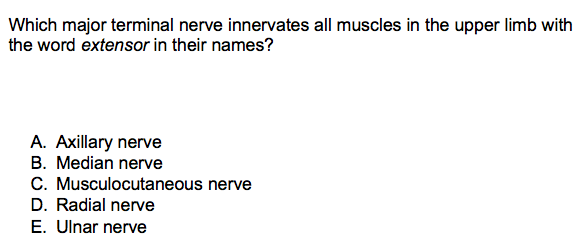
- The radial and axillary nerves contain posterior division fibers (extensors), whereas the median, musculocutaneous, and ulnar nerves contain anterior division fibers (flexors).
- The axillary nerve only innervates the deltoid and teres minor muscles. Thus, any other extensor must be innervated by the radial nerve.
- (Ex: extensor digitorum, extensor indicis, extensor digiti minimi, extensor pollicis longus, extensor pollicis brevis, extensor carpi radialis longus, extensor carpi radialis brevis, and extensor carpi ulnaris).
Which two terminal nerves innervate extensor muscles?
Which one does more?
- The radial and axillary nerves contain posterior division fibers (extensors)
- (Think RA-P.)
- Whereas the median, musculocutaneous, and ulnar nerves contain anterior division fibers (flexors).
- The axillary nerve only innervates the deltoid and teres minor muscles. Thus, any other extensor in the upper limb must be innervated by the radial nerve.
- Ex: extensor digitorum, extensor indicis, extensor digiti minimi, extensor pollicis longus, extensor pollicis brevis, extensor carpi radialis longus, extensor carpi radialis brevis, and extensor carpi ulnaris
B: The supraspinatus and infraspinatus are innervated by the suprascapular nerve. The subscapularis is innervated by the upper and lower subscapular nerves. The only rotator cuff muscle not innervated by a collateral nerve is the teres minor, which is innervated by the axillary nerve (a terminal nerve).
(A)The medial brachial cutaneous nerve arises from the medial cord; there is no medial trunk (the trunks are upper, middle, and lower; also can be called superior, middle, and inferior).
(B)(correct answer)
(C)The lateral antebrachial cutaneous nerve arises from the musculocutaneous nerve (a terminal nerve).
(D)The dorsal scapular nerve comes off of the brachial plexus before the divisions, and therefore does not contain designated “anterior” or “posterior” division fibers.
(E)The upper and lower subscapular nerves share a muscle in common: the subscapularis (the lower also innervates the teres major). The middle subscapular nerve (also called the thoracodorsal nerve) innervates the latissimus dorsi, and does not contribute to innervation of the subscapularis.
movements of arm at glenohumeral joint
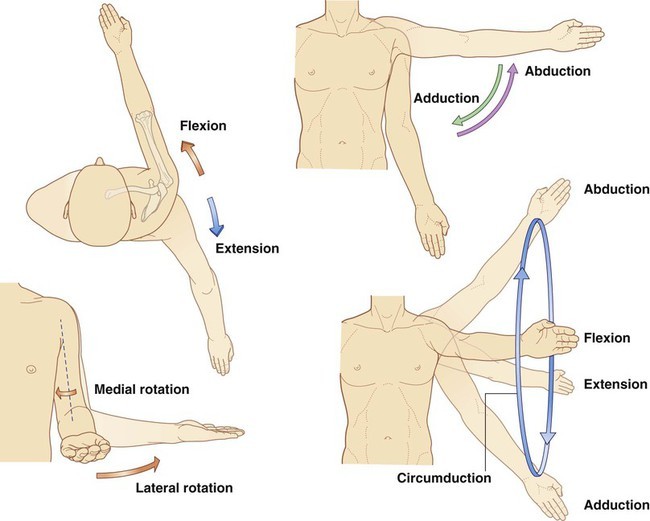
movements at elbow joint
- “pure hinge joint”
- Limited to just flexion and extension, actions that occur in sagittal plane.
- ankle joint is also “pure hinge joint”
- knee is “modified hinge joint” - can rotate
biceps brachii
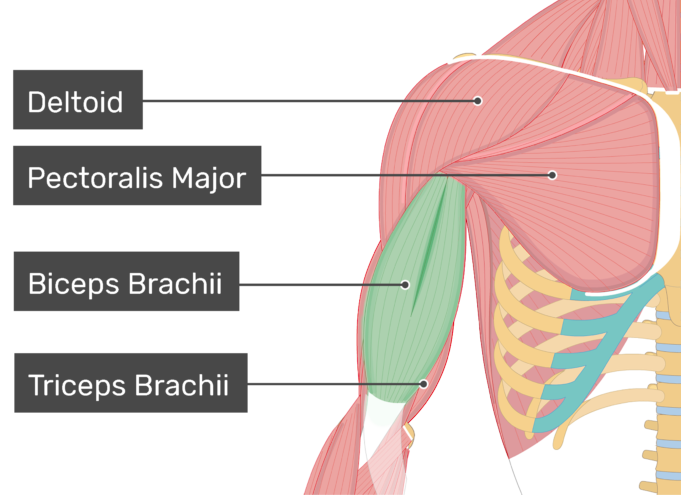
- Crosses elbow joint and shoulder joint
- Has 3 actions:
- Biceps brachii acts to flex the forearm at the elbow
- Biceps brachii acts to flex the arm (weakly) at the shoulder
- Biceps brachii acts to supinate the forearm at the elbow
review superficial, intermediate, and deep
muscles of the anterior forearm
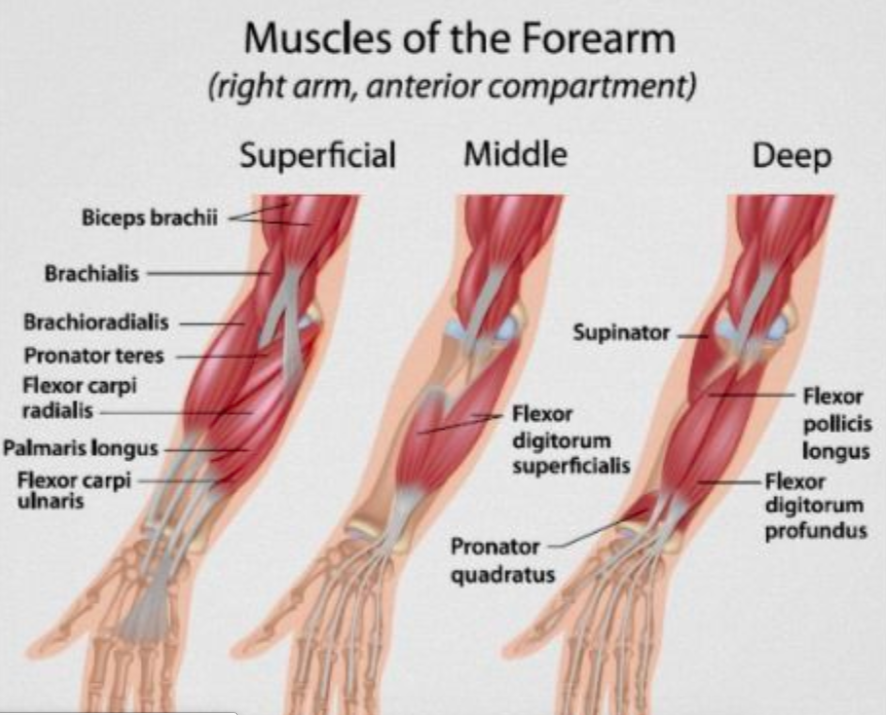
review superficial and deep muscles
of posterior forearm
- Radial - ABduction, extension,
- Median - ABduction, flexion, opposition
- Ulnar - ADduction
what do you see?