“Cut and Sew” MAZE Lesions
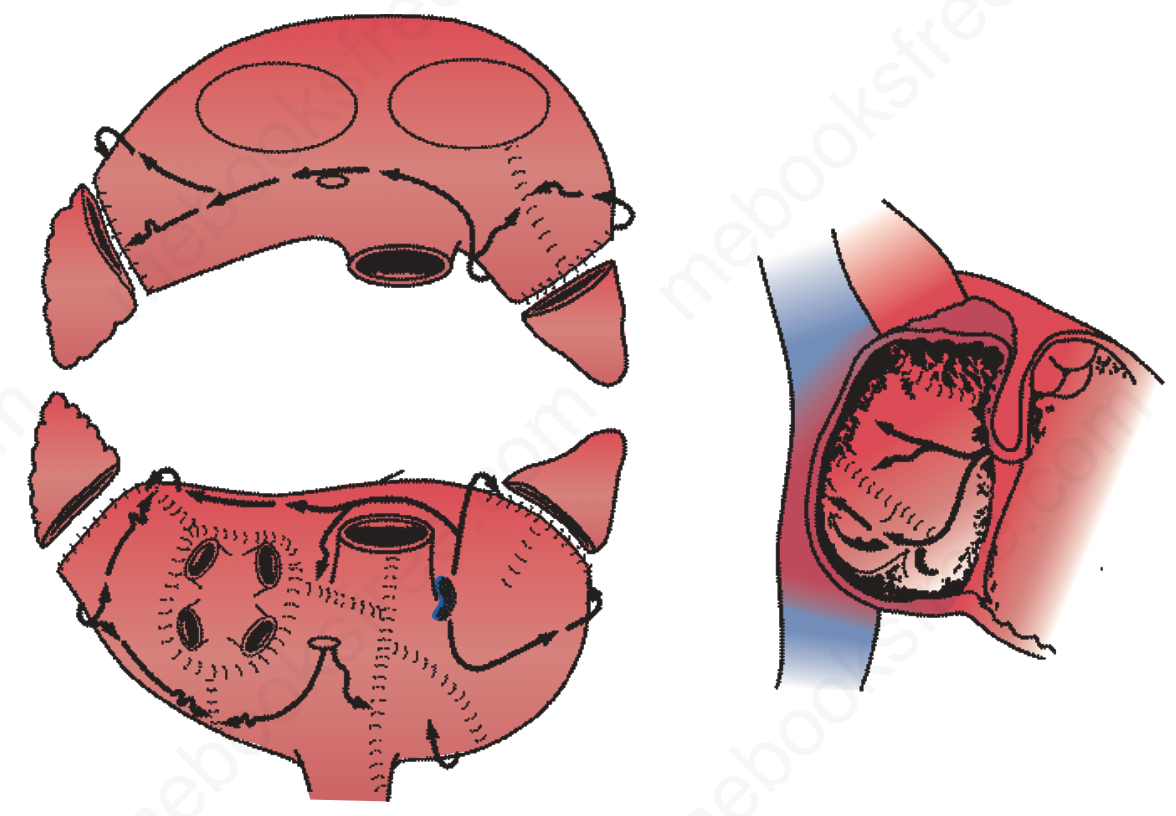
Determinants of Cryoablation Lesion Size
- Probe Temperature
- Thermal Conductivity
- Tissue Temperature
Cryoablation Advantages and Disadvantages
Advantages
- Freezing is a safer energy source - preserves ECM structure
Disadvantages
- Risk of coronary stenosis
- Time consuming (1-3min per lesion)
- Less safe/effective on beating heart (thromboembolism/heat sink)
Determinants of Radiofrequency Ablation Lesion Size
- Electrode-Tissue Contact Area
- Interface Temperature
- Current and Voltage (Power)
- Duration
Biopolar Radiofrequency Advantages and Disadvantages
Advantages
- Create trasnmural lesions on the beating heart
- Limits collateral injury
Disadvantages
- Access needed for tissue to be sandwiched between the two poles
Cox-Maze IV Lesion Sets
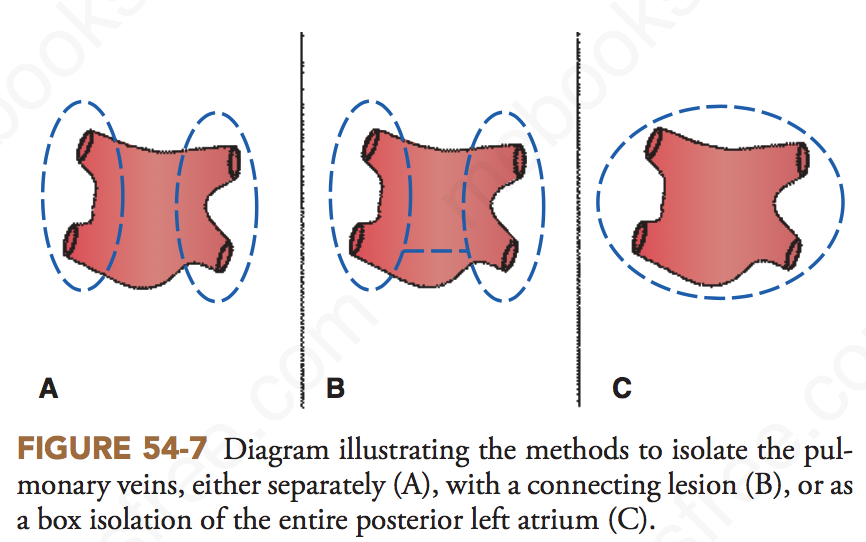
- Pulmonary Vein Isolation (bipolar RF)
- Right Atrial Lesion Set (beating heart; bipolar RF + unipolar or cryoablation endocardially down to the TV annulus)
- Left Atrial Lesion Set (arrested; amputation of the LAA; bipolar RF to connect the PVV lesions + unipolar or cryoablation endocardially down to the MV annulus)
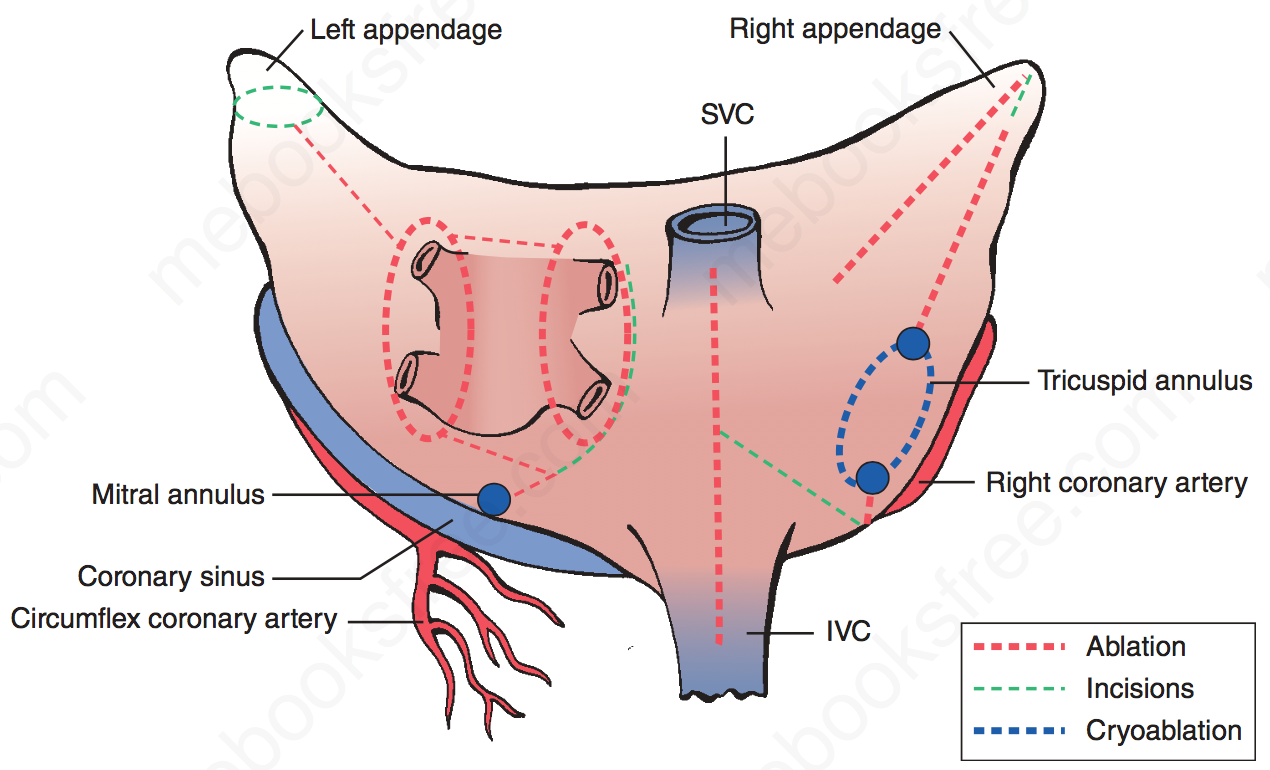
Pulmonary Vein Isolation Lesion Sets
Rx-free Freedom from Symptomatic AF
Paroxysmal AF
- 6-months - 90%
- 1-year - 90%
- 2-years - 90%
- 10-years - 85%
Persistent AF
- 6-months - 90%
- 1-year - 90%
- 5-years - 80%
Pulmonary Vein Isolation and LA Lesion Sets Without the Mitral Annular Lesion Increase the Risk of…
Atrial Flutter
Freedom from AF with Complete MAZE vs. LA Lesion Sets Only
Freedom from AF
- Complete Cox-MAZE IV - 85%
- LA Lesions Only - 75%
Drug-free Freedom from AF
- Complete Cox-MAZE IV - 80%
- LA Lesions Only - 50%
Freedom from AF for Surgical vs. Catheter Pulmonary Vein Isolation
at 1-year
Surgical - 65%
Catheter - 35%
Indications for Surgical MAZE
- Symptomatic patients with documented AF undergoing concomitant cardiac surgery
- Asymptomatic patients with documented AF undergoing concomitant cardiac surgery if low risk
- Symptomatic patients with documented AF and failed (or not candidates for) catheter ablation
- Symptomatic patients with documented AF with CHADS > 2 but contraindications to anticoagulation, especially if they have already suffered a neurologic event
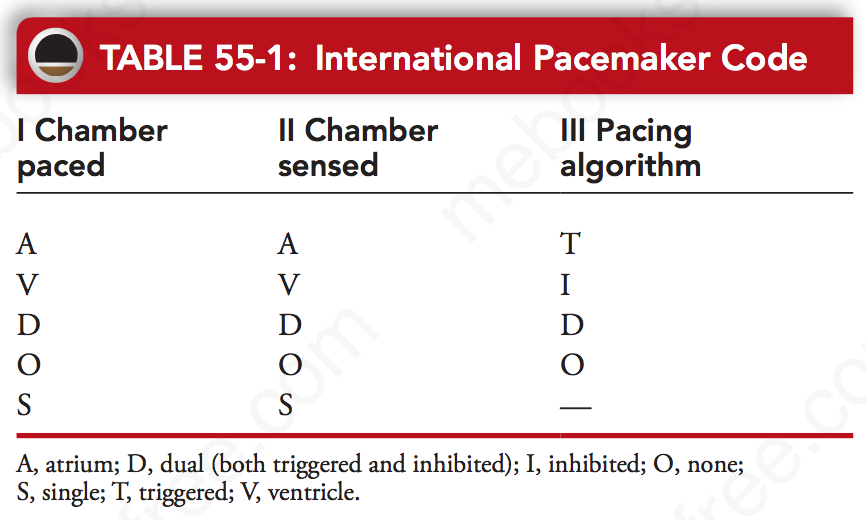
3 Letter International Pacemaker Code
“Paced” / “Sensed” / “Algorithm” / “Rate Response”
CRT-P ⇒ biventricular pacer
CRT-D ⇒ biventricular pacer-defibrillator
ACC/AHA Guideline Indications for PPM Insertion
Class I (symptomatic…)
- AVB (second or third degree)
- Sinus bradycardia/block/arrest (positive tilt table test SA asystole > 3sec
- Tachy-Brady syndrome
Class II
Symptomatic patients with…
- Bifascicular/Trifascicular block
- Hypertensive carotid sinus syndrome
Asymptomatic patients with…
- Complete AVB
- Mobitz II
- Congenital AVB
- Sinus bradycardia < 40 requiring Rx
- VT requiring overdrive pacing
Class III
- Syncope NYD
Asymptomatic patients with…
- Sinus bradycardia/block/arrest
- BBB
- Mobitz I
AVB
1º AVB
- P-R interval > 200ms
2º AVB
- Mobitz I (Wenckebach)
Progressive P-R interval increase followed by dropped QR
- Mobitz II
Dropped QRS without P-R progression
3º AVB
- Complete AV dissociation
Etiologies of Sinus Node Dysfunction
- CAD
- Cardiomyopathy
- Reflex Abnormalities
- Carotid Sinus Hypersensitivity
- Vasovagal Syncope
- Micturition-Induced and Deglutition Syncope
“R” - Rate Responsiveness
Increases the lower rate setting in response to increase metabolic demand
Measured by…
- Body Vibration
- Respiratory Rate (minute ventilation)
Componants of DDD Algorithm/Settings
- Lower Rate Limit
- Upper Rate Limit
- AV Delay
HR between rates → 1:1 pacing of the ventricle unless the ventrticle depolarizes prior to the delay length
Atrial HR below lower limit → atrial pacing at the lower limit rate
Atrial HR above upper limit → ventricle paced at upper limit (Wenchebach appearance)
Anticoagulation for AFib Trials
Warfarin vs. DOAC for non-valvular AFib
- RE-LY (2009 NEJM) - Dagatroban
- ROCKET-AF (2011 NEJM) - Rivaroxiban
- ARISTOTLE (2011 NEJM) - Apixaban
MAZE Energy Sources
- Radiofrequency
- Cryoablation
- High-Intensity Focused U/S
- Laser
Normal ECG Intervals
- PR Interval 120-200ms (3-5 small boxes)
- QRS Duration < 120ms (3 small boxes)
- QT < 400ms
Indications for DDD pacing in elderly patients
- Pacemaker Syndrome
- HTN
- CHF
Magnet Mode
VOO
Best PPM mode for Trasnplant Patients with SA Node Dysfunction
AAIR

-
AHA/ACC Guidelines1
-
CCS Guidelines0
-
Coronary Surgery3
-
Mitral Valve Surgery9
-
Aortic Valve Surgery0
-
Mechanical Circulatory Support35
-
Aortic Surgery0
-
Transplant70
-
Congenital9
-
Arrhythmia Surgery37
-
Pericardial Surgery and Cardiac Tumors63
-
Seminal Articles10
-
Cardiac Physiology2
-
Cardiac Pharmacology0



