Name parts of Evaluation
- Case History/Background
- Physical Examination
- Assessments
Case History/
Background
Includes:
- Personal information
- medical, social, surgical & treatment history
- chief complaint
- history of present illness
- current medications
- test results/imaging
Info used to:
- determine their cognitive function pre-injury
- confirm assessment choice
- determine their current function
Family/friends helpful in providing info:
- what is their native language?
- what was premorbid cognitive functioning like?
- besides new acquired injury, any other reasons you might see changes in cognition?
- what were their premorbid responsibilities to work and family?
- what will their post-injury responsibilities be?
- their cheif complaint: what is their awareness of what is happening?
History of present illness
Consider:
- etiology of cognitive impairment
- if early in course of treatment, may be unknown
- knowing pathophysiology will direct treatment, discharge planning, prognosis, etc.
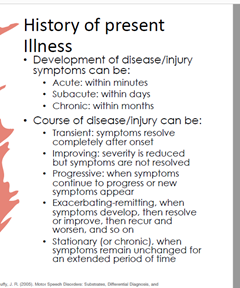
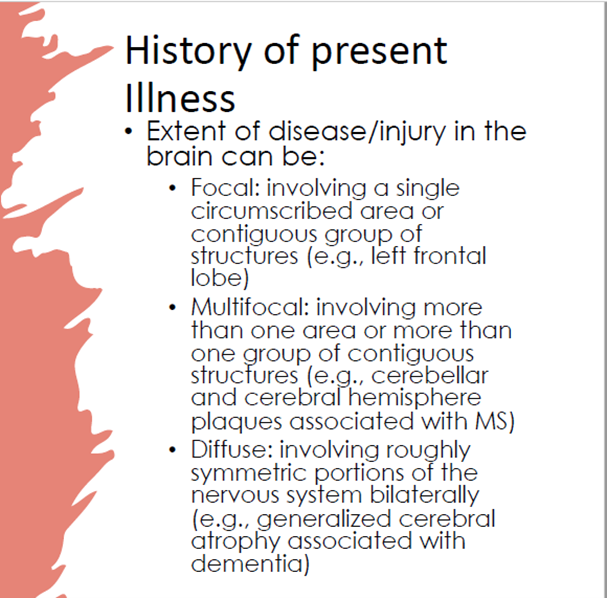
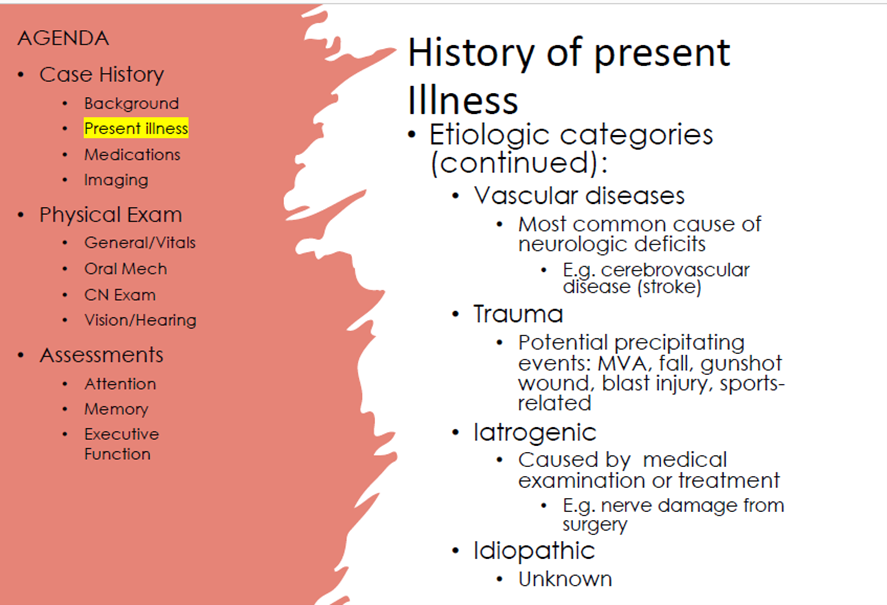
HIstory of present illness:
Development,
Course,
Extent
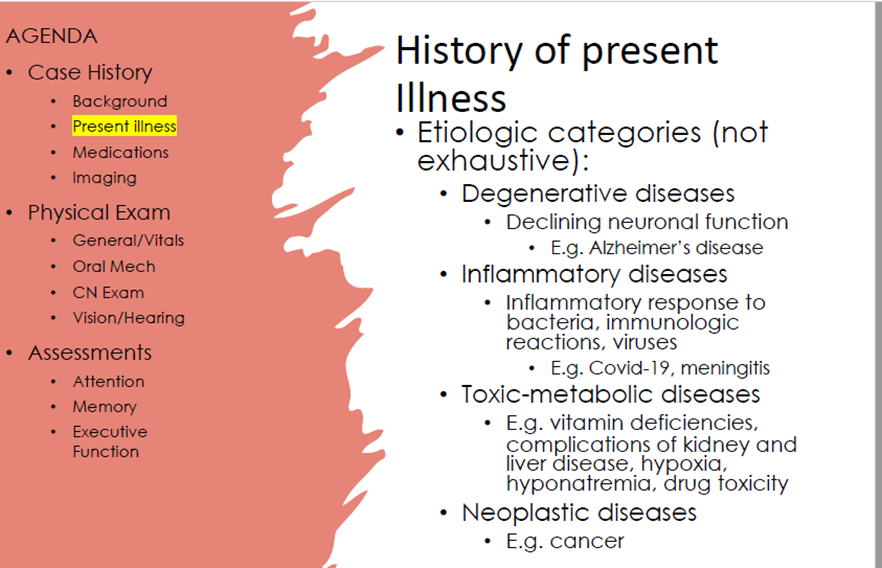
Etiologic Categories
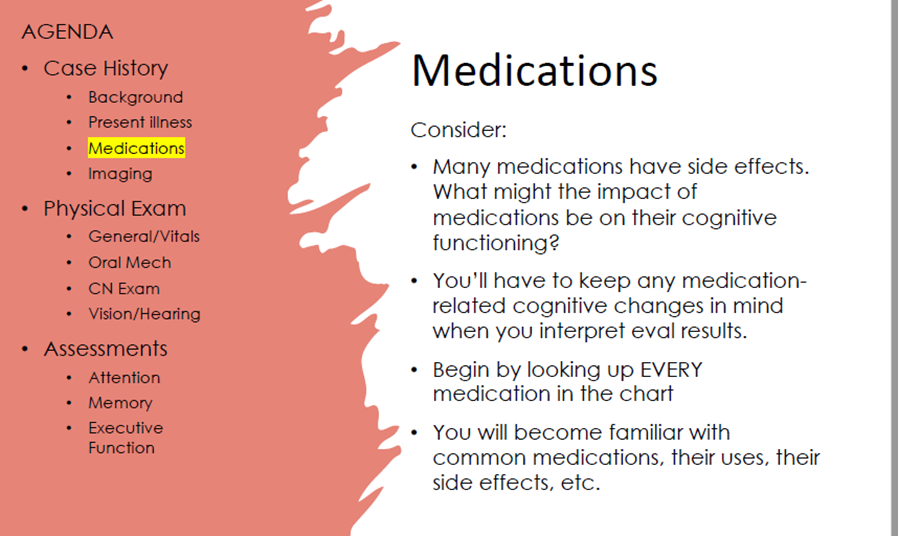
Medications
Imaging/Test Results
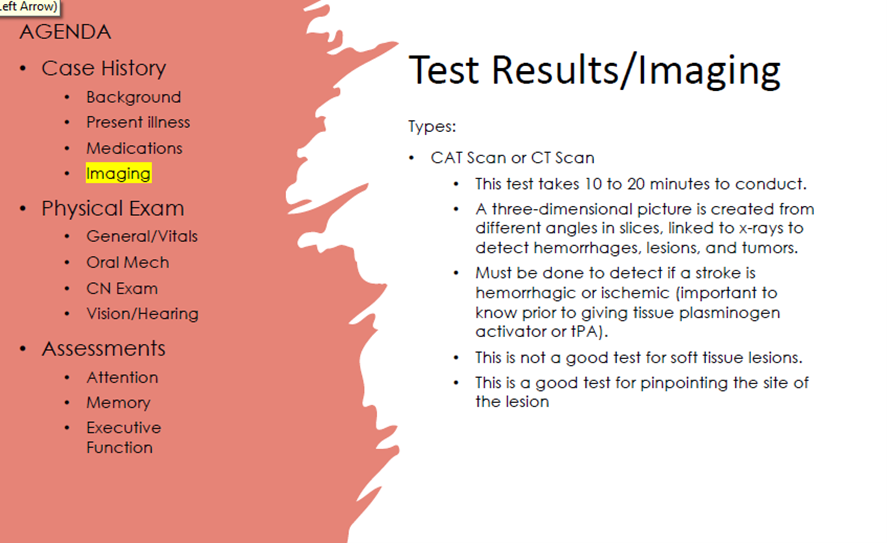
CAT SCAN
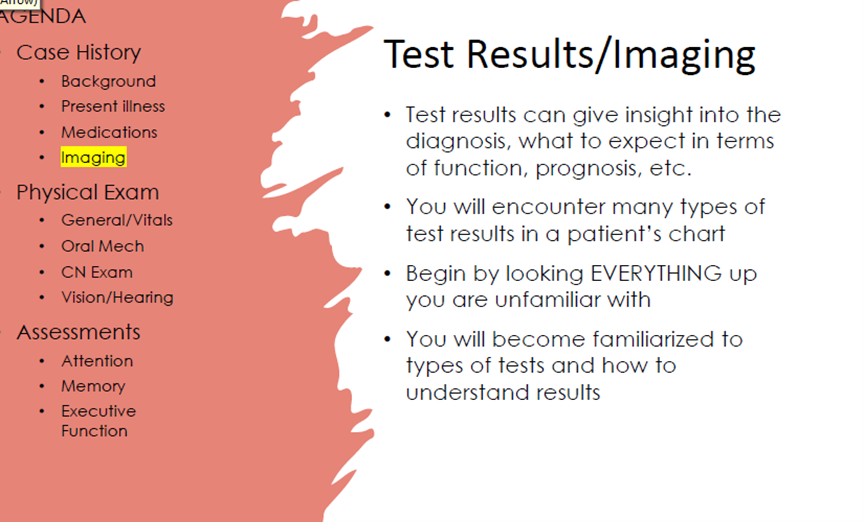
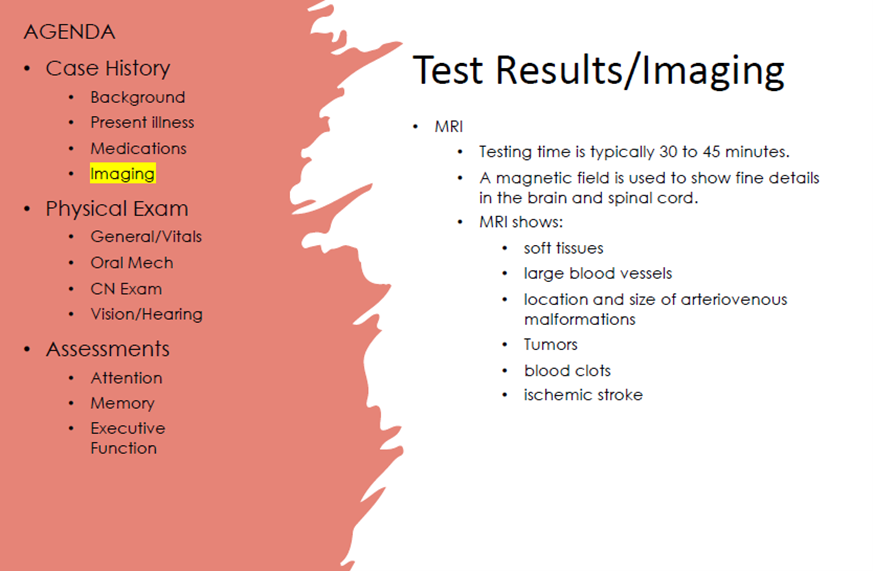
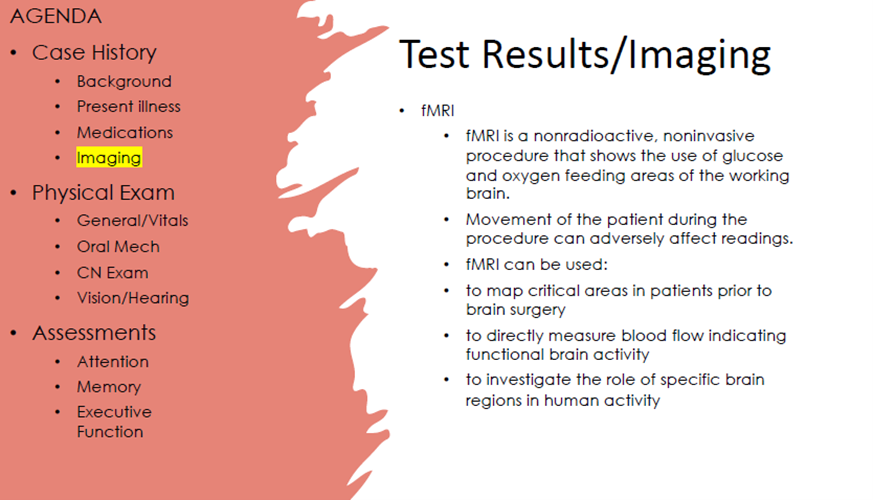
MRI/fMRI
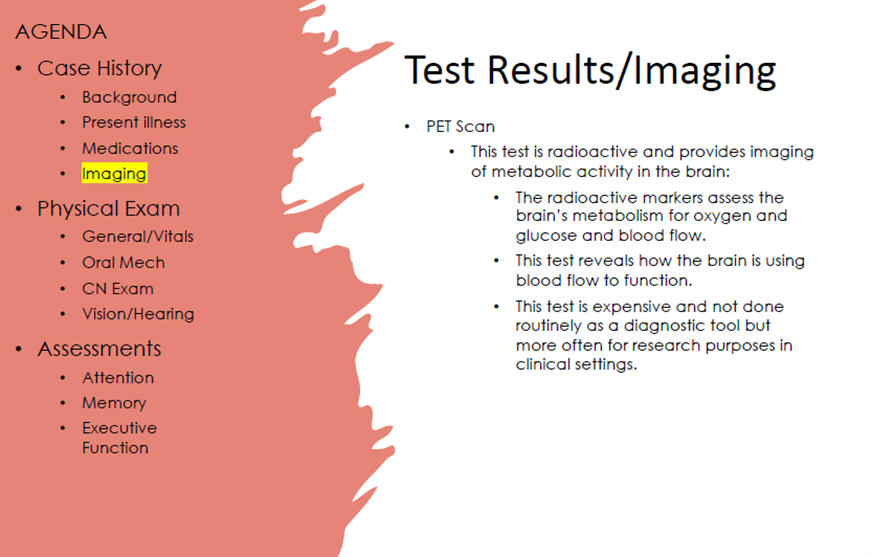
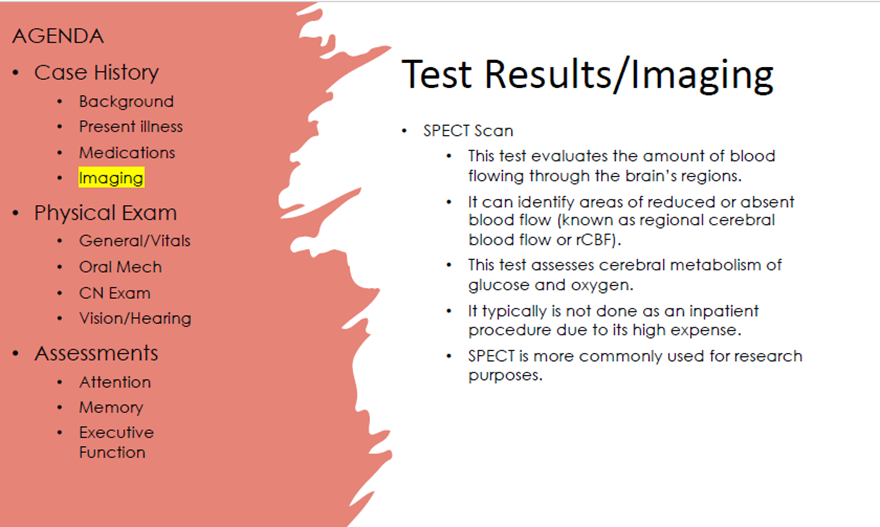
PET/SPECT
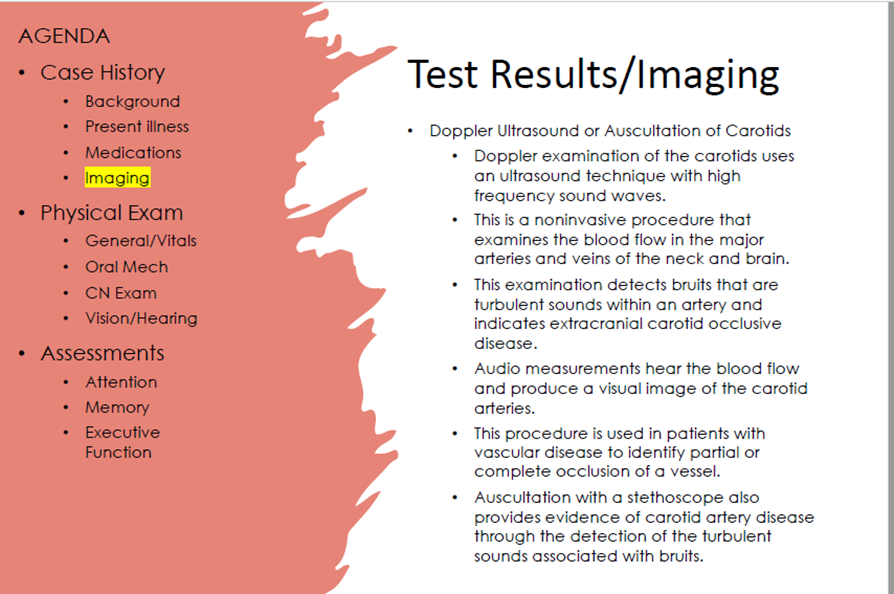
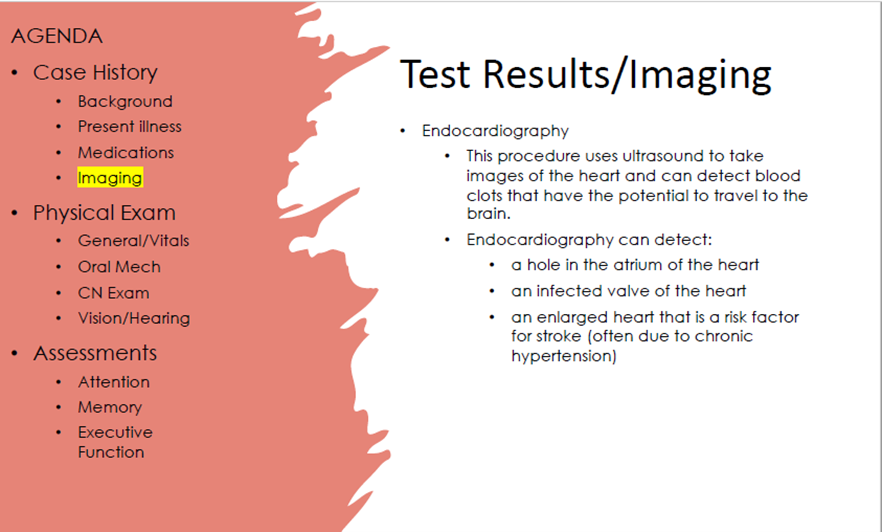
DOPPLER/ENDOCARDIOGRAPHY
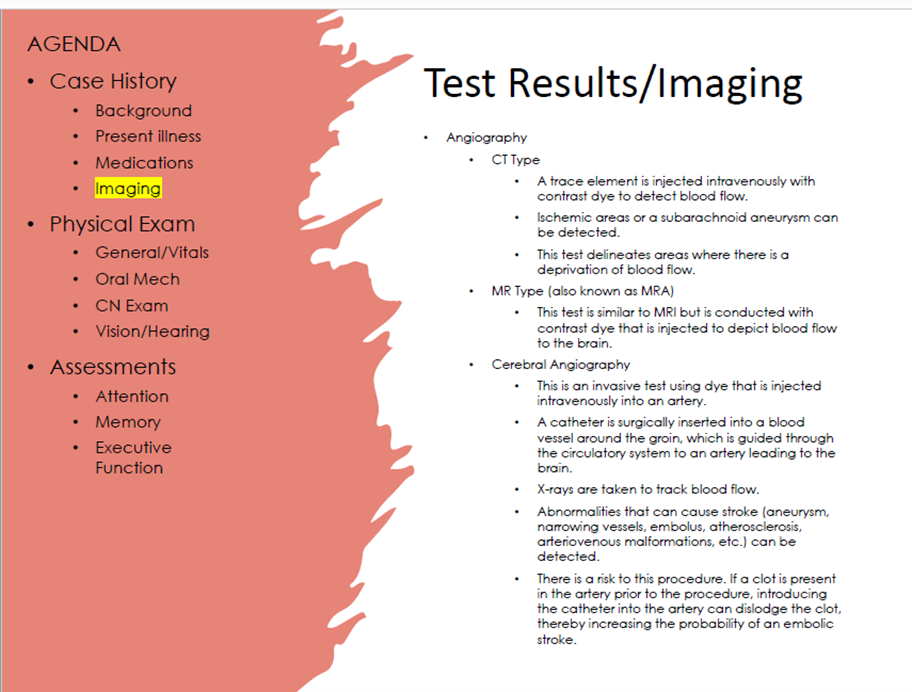
ANGIOGRAPHY
how to use case history/background
use case history to determine which assessments you will use
make a hypothesis about what you’ll see during assessment
Physical Exam
Components
- General observations
- Vitals
- Oral Mech
- Cranial Nerve Exam
- Vision/Hearing
Synthesize results of physical exam into overall clinical picture of patient
- how they may impact evaluation results/diagnosis
- how they may impact treatment
General Observations/Vitals
Must be aware of global elemetns of patient condition & integrate info into clinical picture
- Behavior
- Gait/posture
- alertness
- vitals out of normal ranges can indicate a more acute problem/need
Oral Mech/
Cranial Nerve Exam
General idea of motor function mechanism:
ex. symmetry, coordination, involuntary movements
- Cranial Nerve exam- provides information relating to site of lesion, neurologic conditions, etc.
- if very early in disease process (acute care), may not be imaging results
- cranial nerves can help you consider where the issue is in the brain
Vision/Hearing
Exam
Consider impacts on:
assessment completion & results
Treatment
Assessment for
Attention, Memory, Executive Function
- difficult to tease out one type of cognition from another (memory vs. language)
- presence/absence of impairment should never be baed on results of single measure
- assessments dedication to attention alone, and more global cognitive assessments with attention subtests available
Attention Assessments
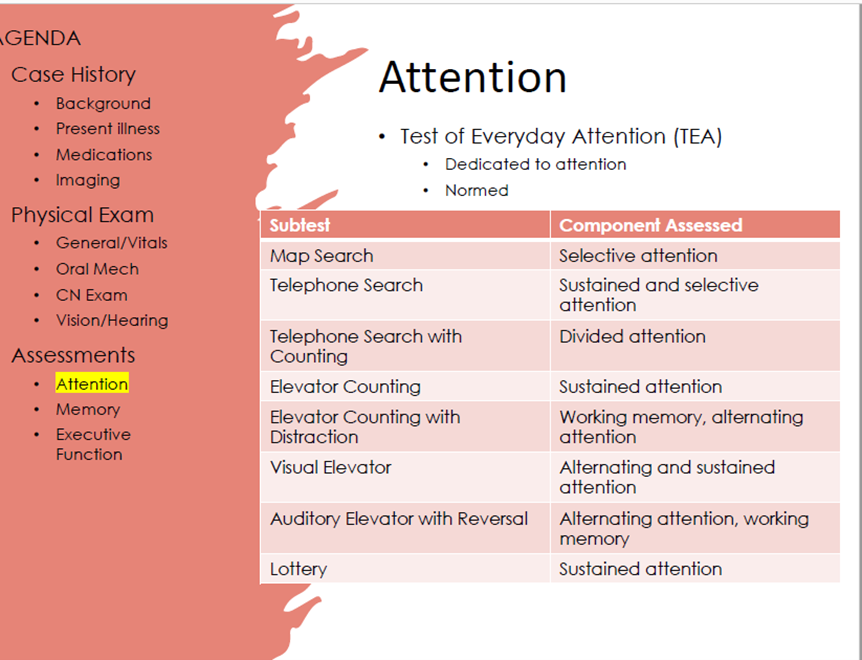
Attention Processing Training Test (APT-Test)
- dedicated
- not normed
- sustained, selective, alternating & divided attention
- can be followed by APT-I and APT-II attention treatment programs
Wechsler Adult Intelligence Scale (WAIS-IV)
- normed
- includes subtests:
- Digit Span forward (sustained attention)
- Digit Span backward (sustained attention, working memory)
- Digit sequencing (sustained attention, working memory)
Remember to pay attentino to modality (auditory, visual)
Remember to consider time (attention normally decreases over time
MOCA: Montreal Cognitive Assessment- is a screen not eval
Memory Assessments
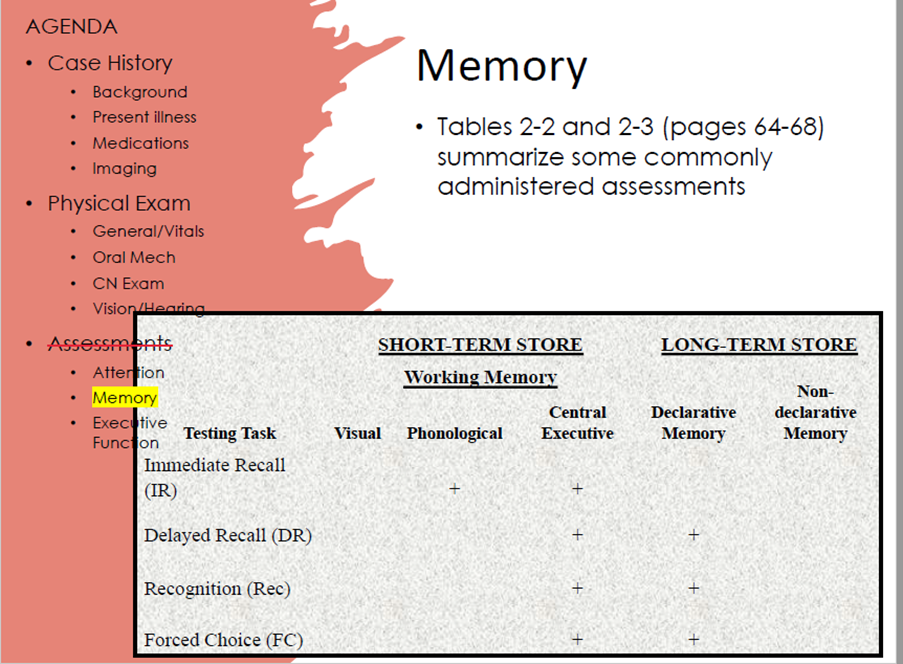
Assessments can be organized by:
- Memory Systems -working vs. long-term
- Types of memory- verbal vs. nonverbal
- declarative vs. nondeclarative
- Types of testng tasks
- immediate recall - recalling stimuli immediate following presentation
- delayed recall (retrieval)- recall of stimuli following time interval
- recoginition-recognize target stimuli from distractor materials
- forced choice- chose word from a pair that was from a previous list
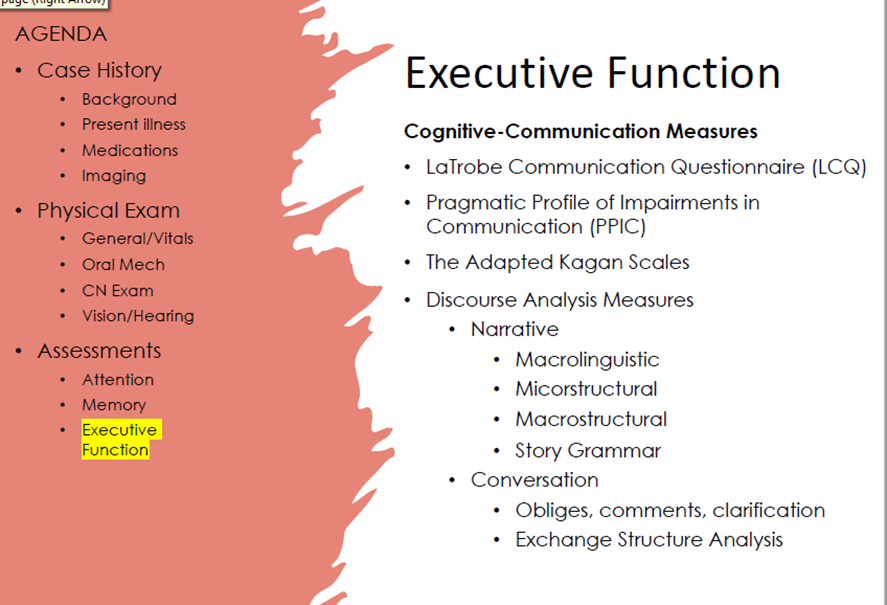
Executive Function
Assessment
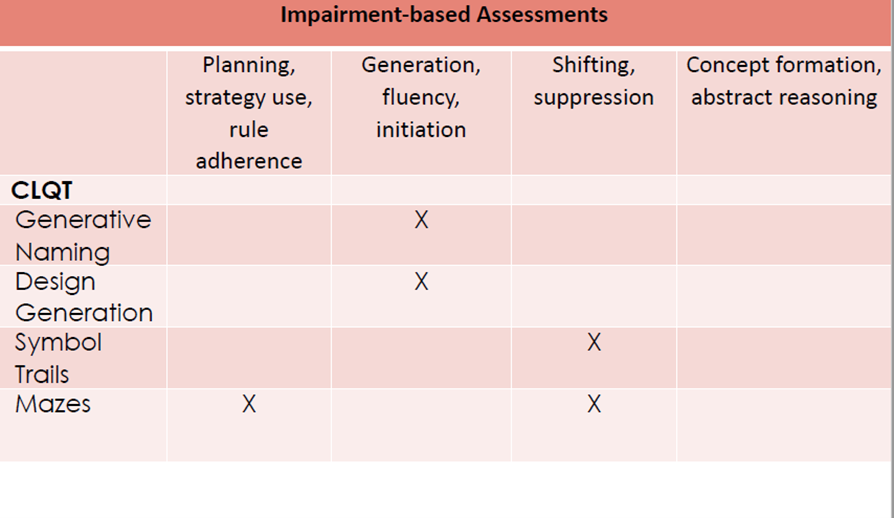
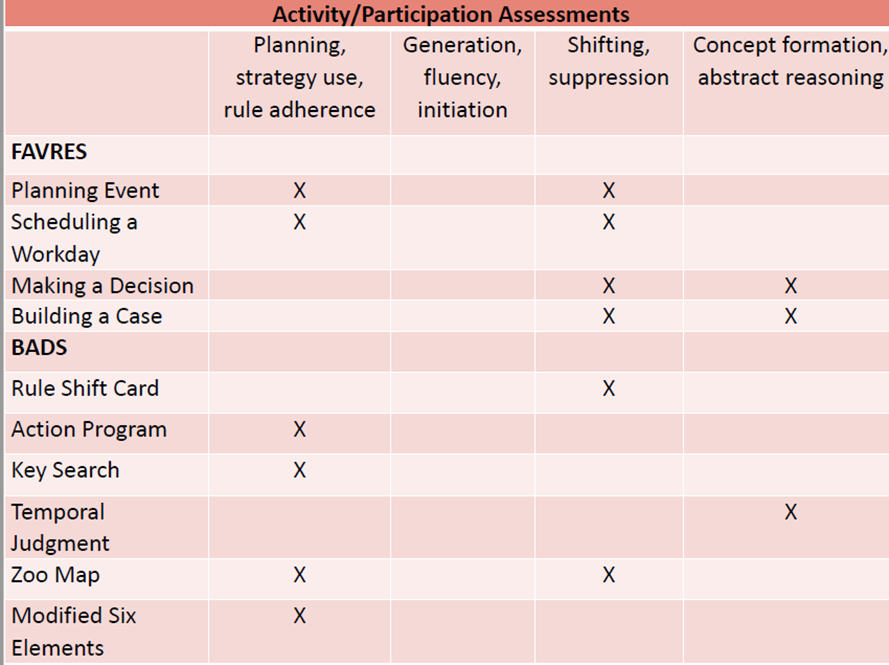
Organization framework for assessment
- tests of planning, scheduling, strategy use & rule adherence:
- includes tests that require creation of subgoals, temporal sequencing, strategy generation, and application, using environmental feedback to guid behavior & self monitoring
- tests of generation, fluency, initiation:
- includes tests that require generation of concepts & compliance with environmental constraints, measure lack of monitoring (through perseverative errors)
- tests of shifting & suppression
- includes tests that require shifting between tasks (i.e. set) & inhibition of external/internal/overlearned responses
- tests of concept formation & abstract reasoning:
- includes tests that require formation of concepts & conceptualization of abstract relationships
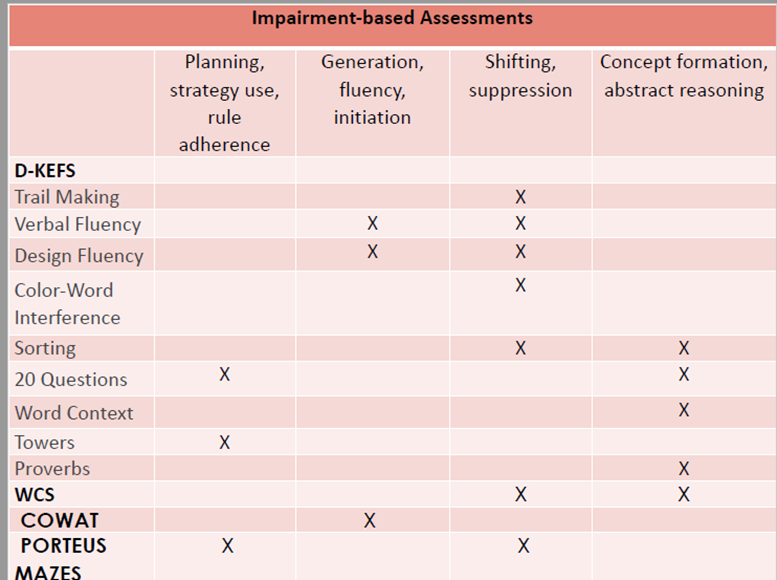
Executive Function Assessment
Activity/Participation
Observation/Performance Based Measures
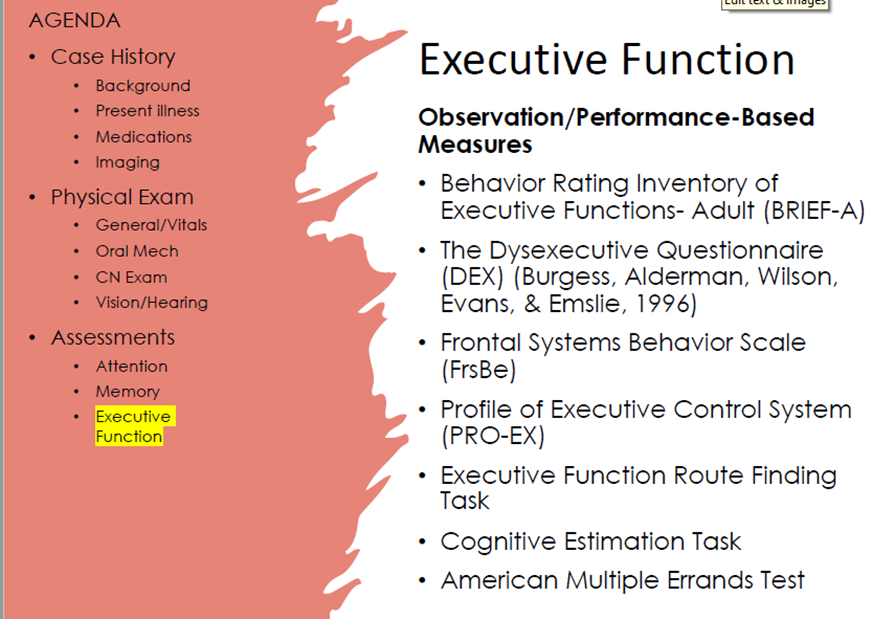
Executive Function
Cognitive Communication Measures