Catabolic Reactions
Breakdown reactions
Anabolic reactions
Synthesis reactions
Hydrolysis
Where molecules are broken down by the reaction of dilute acid/ alkali in high temps (reflux)
- enzyme reactions 37C
- Proteins –> amino acids
- Starch –> simple sugars
Condensation Polymerization
Anabolism
monomers combine together to form polymers and water is eliminated
Functions of Proteins
- Enzymes - biological catalysts
- Transport proteins - haemoglobin
- Immunoproteins - antibodies
- Hormones - chemical messengers
- structural proteins - collagen
- Energy source - when fats and carbohydrates become scarce
Amino Acids
Functional Groups and chemical properties
- COOH carboxy
- can be considered as weak acids as they are partially dissociated aqueous solution
- NH2 Amine
- behaves as base because they accept protons
Amino Acids
Zwitterions
- Amino acids exist as zwitterions in solid or aqueous solution
- Isoelectric point - pH wehre Amino acid becomes zwitterion

Dipeptide
2-Aminoacids will combine together in a condensation reaction to form a dipeptide –> anabolic reaction, energy required
compounds will have an amide/ peptide link
Thin Layer Chromatography
Alumina Al2O3 + Silica SiO2
Retardation factor x/y –> used to identitfy the components as long as external conditions remain the same
Gel Electrophoresis
Buffer solution - zwitter ion used to control the degree of ionization
- Polyacylamide gel (PAGE)
- locating agent: Ninhydrin
Gel electrophoresis - Amino Acid separation
Amino Acids will separate according to
- their Mr
- The overall charge on the molecule
- potential difference applied
Primary Structure
- Sequence of Amino Acids in the polypeptide chain
- bond responsible: peptide bond/ amide link
Secondary Structure
The folding of the polypeptide chain as a result of hydrogen bonding
Proteins
Polymers composed of amino acids (monomers)
Secondary Structure
alpha-helix
alpha-helix
H bond between the C=O of 1 peptide bond and the NH of the peptide bond 4 amino acids down
Secondary Structure
Beta-pleated Sheets
ß-pleated sheet
consists of 2 or more stretches of amino acids in which the polypeptide chain is almost fully extended
H bonds form between a C=O on one strand and an NH on an adjacent strand
Tertiary Structure
The twisting and folding of the Secondary structure to form a specific 3D shape
Bonds involved
- LDF - between nonpolar side chains
- Hydrogen - between polar side chains
- Ionic - between polar side chains
- Disulfide bridges (covalent) - between the side chains of cysteine which contain CH2-SH
Quaternary Structure
- Interactions between polypeptide chains (sub-units)
- sub-units held together by various intermolecular forces
- Dimers - 2 sub-units
- Trimers - 3 sub-units
- Tetramers - 4 sub-units
- (sub units may be identical or different)
Biological catalysts - Enzymes
- increases rate of reaction by lowering the activation energy of the forward and backward reactions equally
- remains unchanged in mass and composition
Enzymes
E + S <—> ES —> E + P
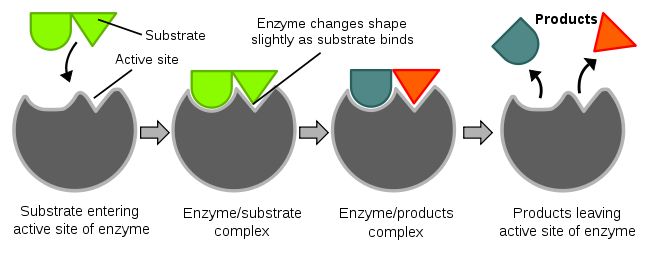
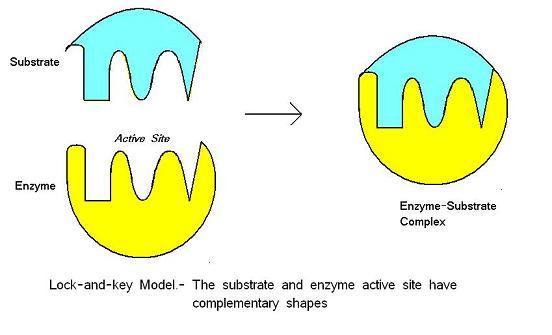
- Enzyme binds to substrate @ active side
- hydrophobic pocket, nonpolar
- Active complex
- E –> unchanged in mass and composition ; P –> products
Induced Fit theory
Lock and Key theory
Enzyme Kinetics
- Molecules must have Ea and a certain orientation to react successfully
- As conc. of substrate increases, rate of reaction increases proportionally
- because of sufficient active sites to bind to
- As the reaction progresses, the active sites are becoming occupied –> fewer are available and rate of reaction decreases
- Eventually, a maximum value is reached, after which the rate no longer increases
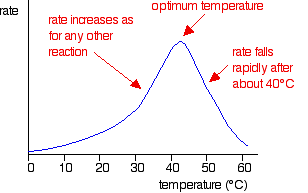
Enzymes - Effect of Temperature
- collisions with E > Ea, orientation allows for the ES activated complex to form, frequency of collisions is high
- optimum temperature at which the rate is a maximum
- due to increased vibration of the molecule, the active site’s shape changes and hence fewer substrate molecules can bind –> denature



-
1. Stoichiometry7
-
2. Atomic Structure16
-
3. Periodicity14
-
4. Bonding46
-
5. Thermo Chemistry21
-
6. Chemical Kinetics17
-
7. Equilibrium8
-
8. Acids and Bases20
-
9. Redox Processes20
-
10. Organic Chemistry61
-
11. Measurement14
-
B: Proteins41
-
B: Carbohydrates8
-
B: Nutrients8
-
B: Lipids17
-
B: Chemistry and the Environment9
-
B: Nucleic Acids HL10
-
B: Biological Pigments HL15
-
B: Stereochemistry HL10



