The back is defined as the ______ part of the trunk, that os inferior to the ____and superior to the ____ ___.
The back forms the ___ of the human body; it consists of the ____ ____, _____ ____, ____ ____ and _____ ____ (skin, connective tissue, vessels and nerves).
posterior part
neck
gluteal region
axis
vertebral column
supporting muscles
spinal cord
associated tissue
The _____ formed the longitudinal axis of the body during development, but only remnants of it are left in the form of the ____ ____.
notocord
intervetebral disks
1-6?
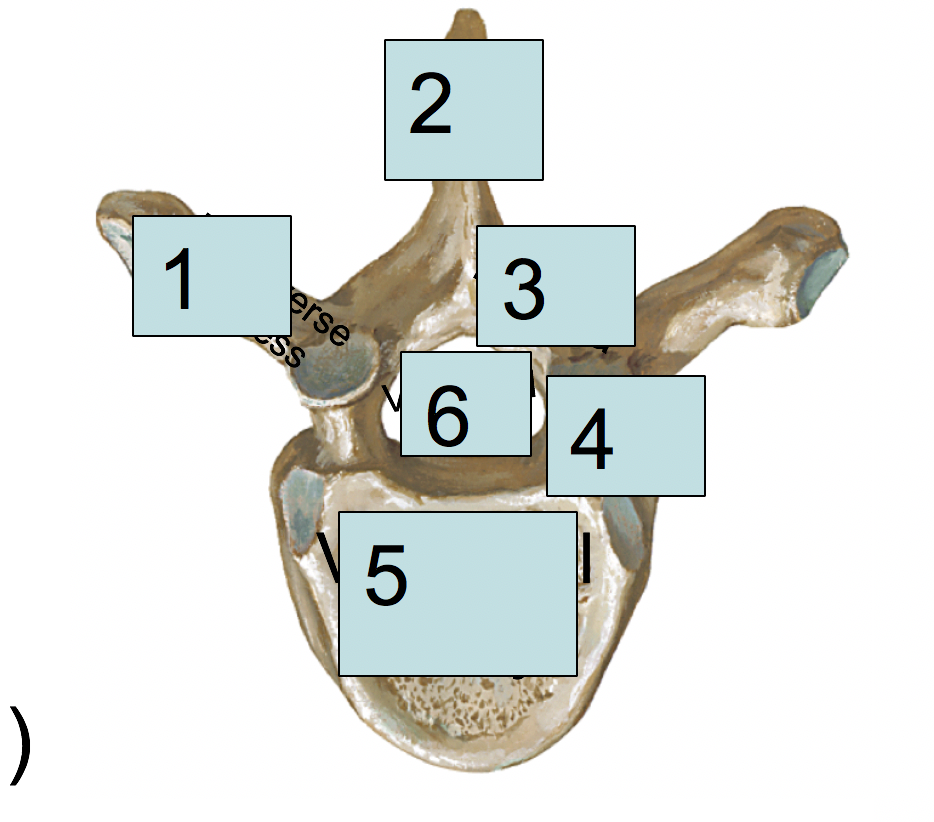
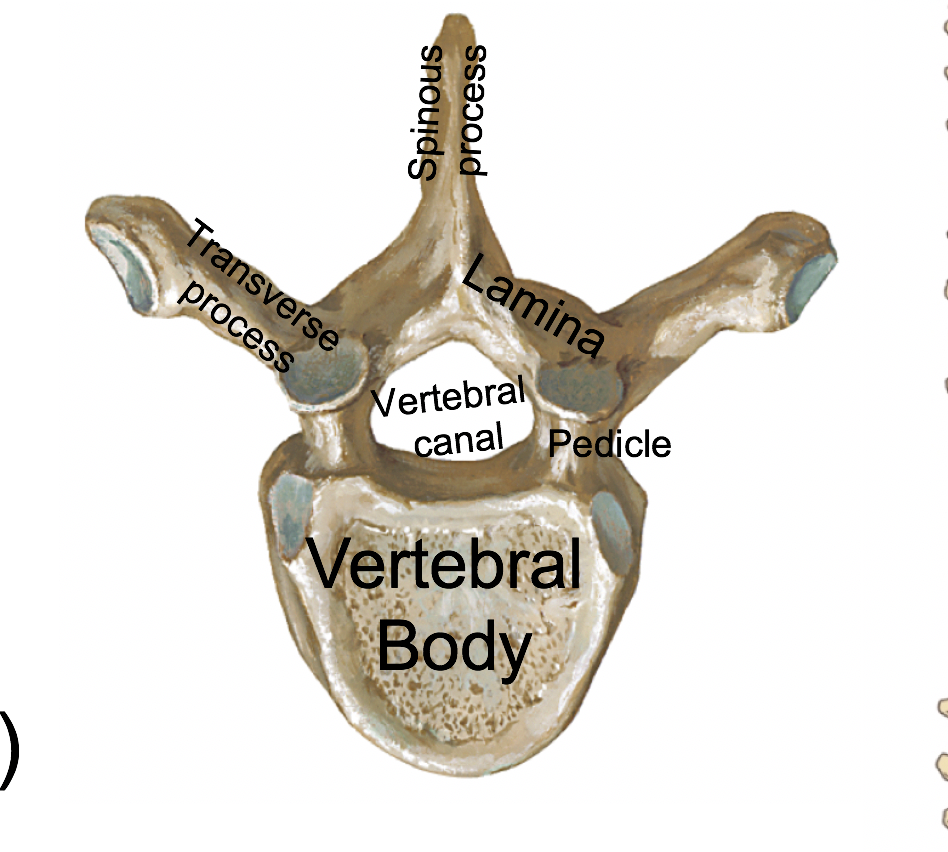
- transverse process
- spinal process
- lamina
- Pedicle
- Vetebral Body
- Vetebral Canal
The Vetebral column has two different types of ____. What are they? Describe each.
Joints
Synovial(diarthroidal)- a moveable joint
Cartilaginous- cartlidge is between bones so that the bones don’ t damage each other.
Synovial Joints in the back are located between ____ of ___ ___ and specifically where a _____ ____ ____ meets an ___ ____ ___. This joint is called a ____ joint or a _____ joint
processes of adjacent vertebrae
superior articulating process
inferior articulating process
Zygapophysial
facet joint
What are the processies in red and what forms between them?
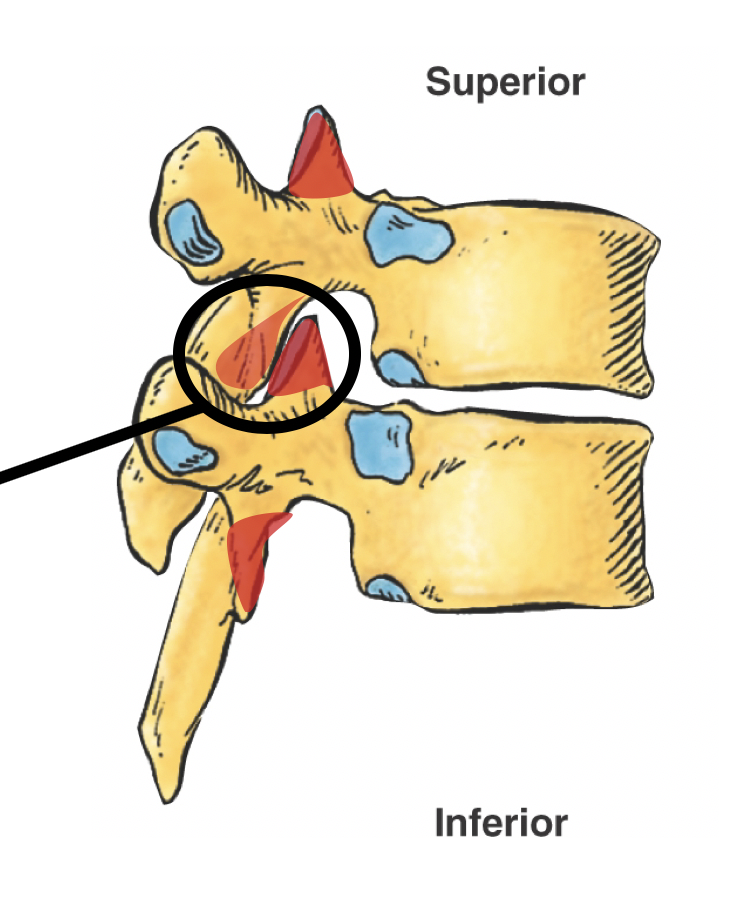
- The top is the superior articulating process
- The bottom is inferior articulating process
- The joint between them is a zygopophysial synovial joint
How are joints innervated?
Any nerve that crosses a joint sends off tiny sensory branches to the joint and innervate it
(this is Hiltons law but dont worry about the name)
Intervetebral discs are ___ ___ and aren’t very moveable. They are meant to ____ the adjacent vetebrae.
Cartilaginous joints
cushion
The intervetebral discs consist of the __ __ and the __ __.
Nucleus pulposus
annulus fibrosus
The nuclues pulposus is __% water and is the remnant of the ____.
90
notocord
The outer lamellar part of the intervetebral disc is called the ___ ___.
Annulus fibrosus
When a ____ ____ or (prolapsed disc) occurs due to trauma or hyperextenstion, the _____ ____ could come out. The nuclues pulposus almost always come out _____ or ___ and this is because there is a very strong ____ (called the ___ __ ___) that runs along the front of the vetebral bodies that prevents them from herniating forward. However, since it herniates backwards, it can push back on the ____ ___ ____ and cause ____.
herniated disc
nucleus pulposus
posteriorly
laterally
ligament
Anterior Longitudinal Ligament
true spinal nerve (clinical nerve root)
radiculopathy
You can herniate discs in the ____ region and the radiculopathy pain takes the form of ____. The ____ nerve is the largest nerve in the body, so when you press on nerves in the lower back it affects it and the_____ will have pain. The pain radiates down the lower ___to the ____ and down the back of the ____ to the ___.
lumbar
sciatica
sciatic
dermatome
back
hip
thigh
leg
More caudal spinal nerve roots descend as cauda equina to the ____ ____ where they join as a _____ ____ ___ and exit the vertebral column; a spinal nerve exits through the ____ half of the intervertebral foramen. Because of this, the spinal nerve lies above the intervertebral disc at that level, so it won’t be affected by a herniated disc at that level. Instead, the spinal nerve ____ the herniated would be affected.
SO usually if the L4/L5 disc herniated, the ___ spinal nerve would most likely be compressed.
intervertebral foramen
true spinal nerve
superior
below
L5
L5 radiculopathy causes weak _____ of ___ and ___
dorsiflexion
foot and toes
S1 radiculopathy causes depressed ___ ___ and weakness of ____ ____ in the ___
depressed ankle reflex
plantar flexion in the foot
The ___-___ joints allow you to nod and shake your head. The two we need to know are the _____ joint and the ____ joint.
Atlas is the ___ ___; Axis is the ____ ___; Occipital is a part of the ___.
Cranio-veterbral joints
atlanto-occipital joint
atlanto-axial joint
Atlas- C1 vertebrae
Axis- C2 vertebrae
Occipital- part of skull
Atlanto-occipital joints are _____ ____ that lie between the ____ ____ ____ of the C1 vertebrae (atlas) and the _____ ____of the skull. What do these joints allow?
synovial joints
superior articulating processes
occipital condyles
“Nodding” of the head to indicate “yes” occurs at this joint.
_____ loints are ____ joints that lie between C1 (atlas) and C2 (axis). What do these allow?
Atlanto-axial
synovial
“Shaking the head to indicate no” occurs here
Anterior Longitudinal Ligament checks the ____ of the _____ ____. It continues superiorly as the (aka renamed superiorly) ____ _____ ____ and then the ___ ______ ____ as you continue more.
Checks extension
vertebral column
anterior atlanto-axial ligament
•anterior atlanto-occipital ligament
The ____ ____Ligament is found on the back of the vetebral bodies. This is going to check the ____ of the _____ _____. It will continue superiorly as the___ ___ at the level of vertebra __.
Posterior Longitudinal
flexion of the vertebral column
tectorial ligament
C2
What is the red?
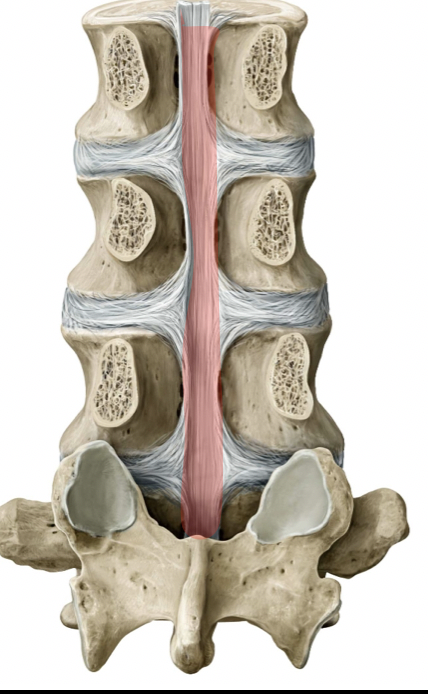
Posterior longitudinal ligament
What is in the yellow?
What is #1 representing?
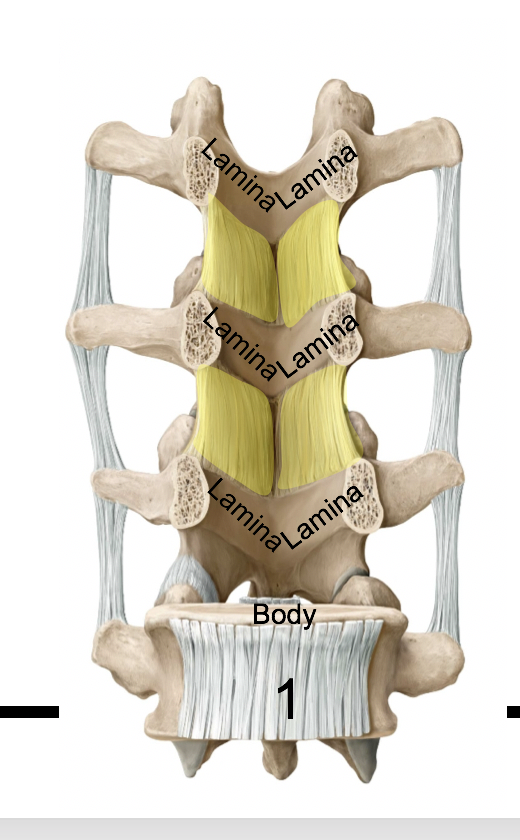
yellow -Ligamentum Flavum
anterior long. lig.
_____ ____ connects adjacent laminae and checks _____ of the ____ ___. It will be renamed as it moves superiorly and called the ____ ___ ____ and then the
____ ___ ____
Ligamentum Flavum
flexion of vertebral column
posterior atlanto-occipital ligament
posterior atlanto-axial ligament (C1 & C2)






