Describe the differences between prokaryotic and eukaryotic cells
Eukaryotes
- DNA in nucleus
- Membrane-bound organelles
- 80s ribosomes
Prokaryotes
- No nucleus
- Organelles not membrane-bound
- 70s ribosomes
- Most bacteria have a peptidoglycan cell wall
List some drug targets for antibiotics
- Cell wall
- Cell membrane
- Nucleic acid synthesis
- Protein synthesis
Why is the cell wall a good target for antibiotics?
Because it contains a component unique to bacteria (peptidoglycan)
Example and mode of action of penicillin
- Pencillin (ß-lactam) inhibits enzymes e.g. traspeptidase involved in forming cross-links between peptidoglycans
- Also promote autolysin activity
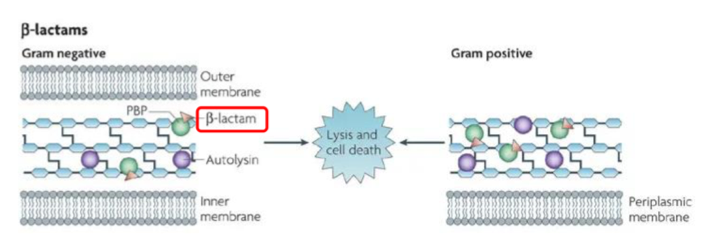
Example of an antiobiotic that acts on bacterial cell walls
Penicillin / β-lactam
Why is the cell membrane a good target for antibiotics?
Disrupting the functional integrity of the cell membrane leads to escape of macromolecules and ions from bacteria –> cell death
What are the disadvantages of using an antibiotic that targets the cell membrane?
- High similarity between animal and bacterial cell membranes means antibiotic is also toxic to body cells
- Potential for surrounding tissue damage, side effects
- Should be used as a last resort
Example of antibiotic that targets cell membrane
Colistin
Bateriostatic
prevents multiplication of bacteria without destroying them outright
Why is nucleic acid synthesis a good target for antibiotics?
Organisation and replication of bacterial DNA and RNA different to eukaryotes
Give an example and mode of action of antiobitics that act of nucleic acid synthesis
- Quinolones
- Act on DNA gyrase, which separates DNA strands during bacterial replication
Why is protein synthesis a good target for antibiotics?
There are differences between eukaryotic (80s) and prokaryotic (70s) ribosome structure
Give the example and mode of action of an antibiotic that targets protein synthesis
- Tetracyline
- Blocks tRNA molecule attachment site on 30s subunit
Virulence factor
molecule that allows bacteria to adhere, invade, evade host defence, cause tissue damage, replicate or persist in the host.
Virulence genes
Genes encoding a virulence factor
How have virulence genes evolved?
- Horizontal gene transfer has enabled rapid evolution
- Mobile elements such as plasmids, transposons, phages
PAMP
Pathogen associated molecular patterns: specific components expressed by the pathogen and recognised by the host as ‘danger signals’.
PRR
Pattern recognition receptor: specific receptor expressed by the host that recognise PAMPs.
TLR
Toll-like receptors: transmembrane receptors on a wide range of cels types, and that have a wide range of roles.
e.g. TLR4, important for the recognition of LPS
How do TLRs differentiate between pathogenic and commensal bacteria
Number of strategies - main one is location of TLRs
- TLRs expressed on the basal surface of epithelial cells, but not on apical surface, that is in contact with gut lumen
- Thus commensal bacteria are tolerated by only in the right place
- If these bacteria are found elsewere, an inflammatory response will be stimulated
Septicaemia
presence of viable bacteria in the bloostream. Does not always, but can develop into sepsis.
SIRS
Systemic inflammatory response syndrome: systemic respose to an array of severe clinical insults.
Shock
SIRS induced hypotension unmanageable by fluid resuscitation, in association with hypoperfusion, leading to ischemia.
Sepsis
SIRS due to infection


-
Cell proliferation and death, cytokines and signalling39
-
Bacteria26
-
Innate and adaptive immunity24
-
Microbiology of disease20
-
The Lymphoreticular System19
-
Nasal cavities and sinuses52
-
Nasopharynx, oropharynx and larynx18
-
The thoracic cavity25
-
Radiology of the respiratory system6
-
Lung anatomy and function29
-
Erythropoiesis23
-
Haemostasis40
-
Heart anatomy and cardiac cycle59
-
Preload, afterload and contractility21
-
Heart failure39
-
Cardiovascular disease in farm animals8
-
Cardiac embryology0



