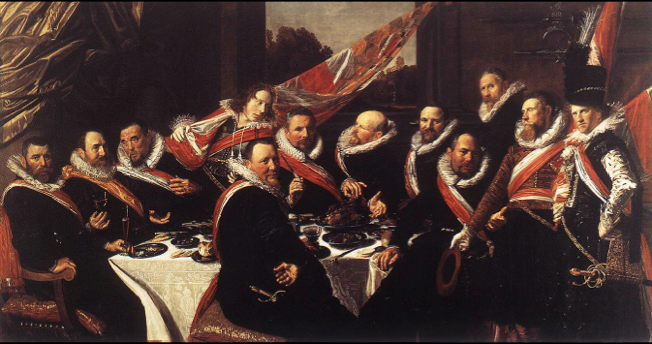
- Frans Hals, Banquet of the Officers of the St. George Civic Company, 1616, oil on canvas
- Haarlem School, Dutch painter
- Group portraits showing civic militia
- Netherlands are known for the group portraiture
- Vibrant brushstrokes
- Frans Hals was apart of this group
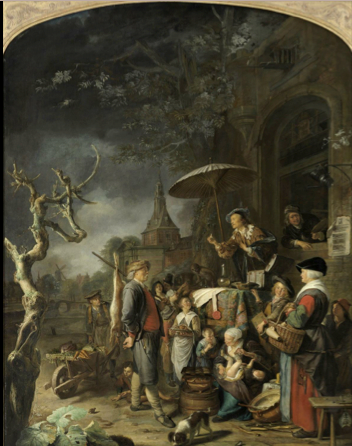
Dou, The Quack, 1652, oil on panel
- Rembrandt’s first pupil
- The founder of the so-called Leidse Fijnschilders, the Leiden “fine-painters”
- The man under the umbrella is selling something to the people of the market; he is the quack
- Quack—is something that is fake
- Artist is in the window holding his pallet
- Why did the artist make himself level with the quack? – he is also making illusions, he is deceiving the eye, he is a quack
- Woman wiping her child; we are born from dust and then become dust
- Tower in the background is in Leiden
- All levels on the working class together to give sense of all of humanity
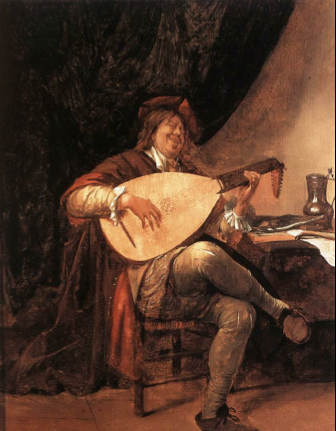
- Jan Steen, Self-Portrait as a Lutenist, ca. 1660, oil on canvas
Leiden/ Haarlem School
Dutch Painter
- Son of a brewer
- Trains in Utrecht and Hague
- Son of a brewer
- Liked to drink and hang out
- His personality was the reason he was not a popular as a painter
- Theater – maybe he is dressed in costume and entertaining the audience
- Approach this painting like theater—both amusing and fun to look at; laugh with and at him
- An artist is a performer and a teacher
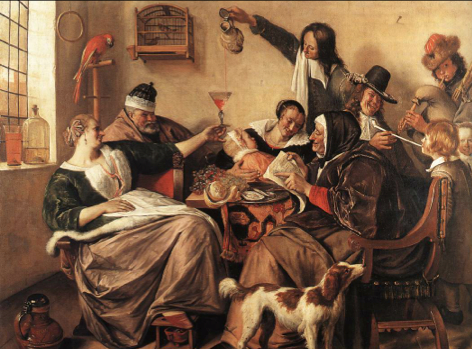
- Jan Steen, As the Old Sing, So the Young Pipe, ca. 1663, oil on panel
- Family party
- The bean king
- Wife’s foot is on a warmer; women would put them under their skirts while sitting to warm them
- The old woman is singing, “As we sing you’ll have to chirrup, It’s a law the whole world knows, I lead, all follow suit, From baby to centenarian
- Violet gown is painted wet on wet in order to give a satin look
- Sense of joy even though there is a sense of craziness
- The woman’s dress is painted roughly
- Jan Steen in the background letting a child smoke; he is a mischief maker
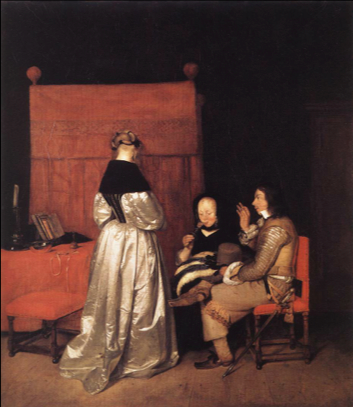
Gerard Terborch (1617–1681), Gallant Conversation (“The Parental Admonition”), 1654–1655. Oil on canvas, 70 x 60 cm, Staatliche Museen, Berlin
He remarks how the father quietly and moderately admonishes his daughter who is seen from behind. The woman in black, sipping from a glass, Goethe interprets as the young woman’s mother, who lowers her eyes so as not to be too attentive to the ‘father’s admonition’. This moralizing title, however, is without foundation and not in accordance with Ter Borch’s usual themes.
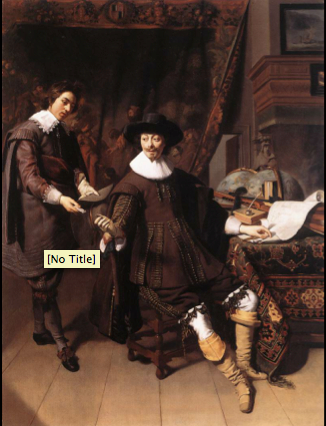
Thomas de Keyser (ca. 1596/7–1667), Constantijn Huygens and His Clerk, 1627. Oil on canvas, National Gallery, London
Constantijn Huygens the Elder (1596 - 1687), Lord of Zuylichem, served in the Dutch embassies in Venice and London and was knighted by James I in 1622. He became secretary and adviser to successive members of the ruling House of Orange, beginning with Prince Frederick Hendrick in 1625. He visited Amsterdam in 1627 and was married there in April of the same year. De Keyser’s painting emphasises both the sitter’s official role and his private interests. The tapestry on the rear wall of the room, decorated with the Huygens arms, represents the subject of Saint Francis before the Sultan. The elaborate still life of objects on the table includes a musical instrument (a chitarrone), plans apparently showing architectural projects, and a pair of terrestrial and celestial globes.
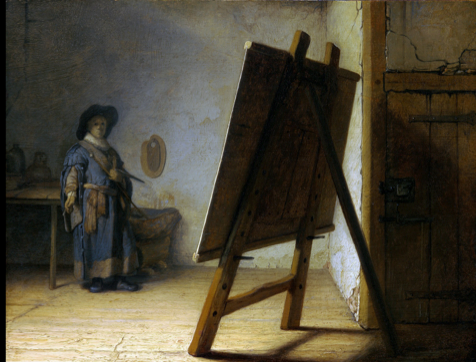
- Rembrandt, The Artist in His Studio, ca. 1626-1628, oil on panel
- Father was wealthy and mother was a catholic woman, daughter of a baker
- Came from a prosperous middle class background
- Parents were maybe hoping for a bright future for him hence why he got a good education; knew Latin and classics
- Becomes the apprentice of Jakob Isaaczoon Swanenburgh, a history painter
- Eventually works with Pieter Lastman, a history painter
- Enjoys history painting
- Is in Leiden in this period and opens his own studio
- Small painting
- Uses the rough surfaces of the panel to relate to the wood floors
- Stucco walls
- Light for a north window; would create an even, neutral light source
- Broken wall in the corner to show his talent and attention to detail
- Painted this back to front; painted the figures on top of the background
- Rembrandt’s costume—theatricality, the artist as the performer
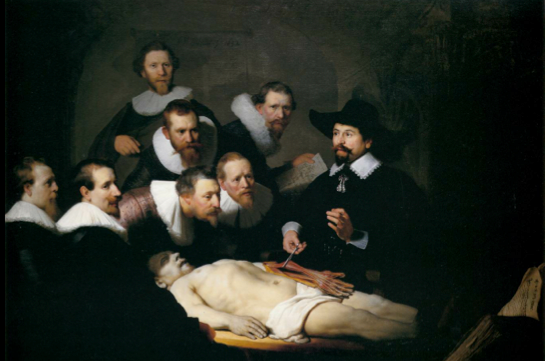
- Rembrandt, The Anatomy Lesson of Dr. Tulp, 1632, oil on canvas
- Doctor’s gild
- Civic nature of the Dutch community
- Hard work and intelligence of the Dutch
- You would never start with a hand during a dissection; you would start with the abdomen
- Nobody is really looking at the body
- Commissioned by the gild
- Dark blobs around the head suggest that everyone was originally wearing hats
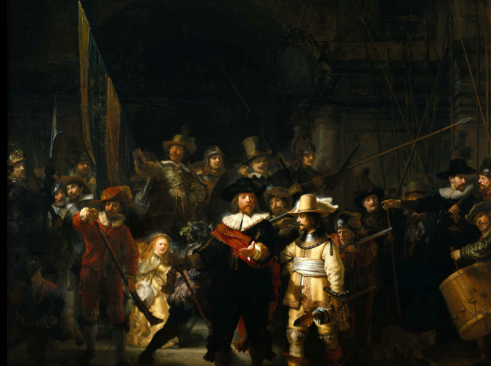
- Rembrandt, The Night Watch or the Militia Company of Captain Frans Banning Cocq, 1642, oil on canvas
- Interest in costume
- Group portrait of the militia gild
- Looks more like a history painting
- In the 1640’s many artists were asked to painting group portraits of militia gilds—this was one of the most popular
- Getting ready to parade in Amsterdam
- The young girl is holding a chicken; emblem for the militia, their emblem was gold and blue and the claws of a chicken
- The man loading his musket and the boy that fired his gun too early
- Figures based off of wood cuts
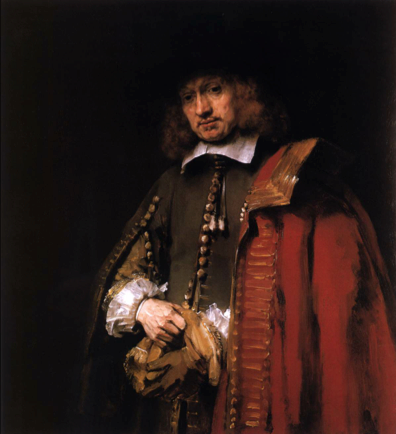
- Rembrandt, Jan Six, 1654, oil on canvas
- Rough style going out of style
- Likes the rough style because it shows that he is interested in art
- Can see the artist’s hand at play
- The brushstrokes on the coat
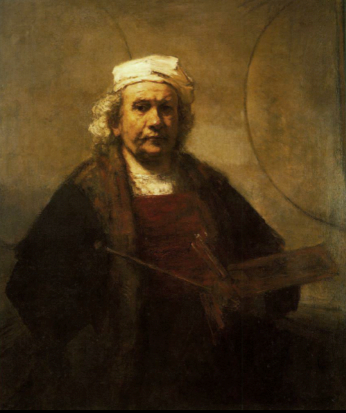
- Rembrandt, Self-Portrait, ca. 1663-1665, oil on canvas
- His most famous self-portrait
- Practices with many different mediums
- Circles in the background show his artistic ability of making a perfect circle
- Very well educated
- Circles might resemble an unfinished map of the terrestrial and celestial world
- Maybe a working hat to keep flakes off the painting
- Shows himself as a painter as opposed to Judith Leyster’s self- portrait
- Maybe it is unfinished; spent a lot of time working on it
- Studied the surfaces of the canvas for a long time
- Left his hand unfinished
- What is he saying about himself as a painter?
- “Unfinished” why?
- How does this play in his strategy of realism?
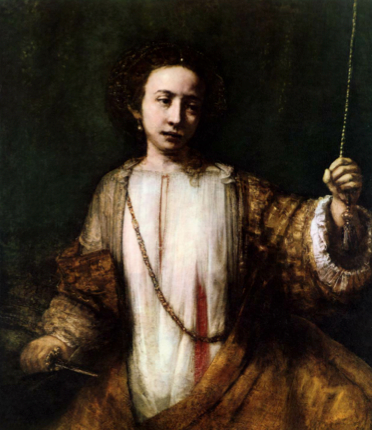
Rembrandt (1606–1669), Lucretia, 1666. Oil on canvas, 105 x 92.5 cm, Institute of Arts, Minneapolis
Lucretia’s tragedy began when she was raped by Sextus Tarquinius the son of Lucius Tarquinius Superbus, the tyrannical Etruscan king of Rome. According to the traditional tale, Lucretia was a beautiful virtuous woman, Sextus Tarquinius inflamed with desire threatened to kill her and her male slave and place their bodies in an act of adultery unless she yield to him. Fearing this form of dishonor she relented later informing her husband and father of the transgression. To restore her husband’s honor, as well as her own, she had her husband and father pledge an oath of revenge, then committed suicide. As Lucretia’s husband pulled the bloody dagger from his wife’s lifeless body he swore to avenge her and all who had been wronged by the king. Lucretia’s suicide led to a revolt that overthrew the monarchy and established the Roman Republic.
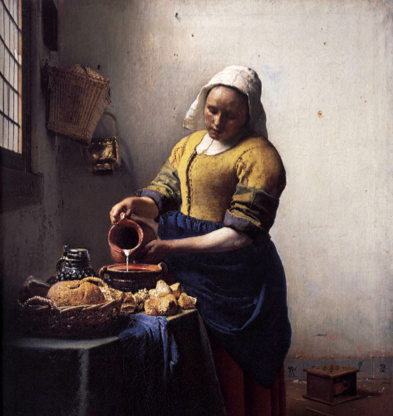
Vermeer, The Milkmaid, ca. 1658
- His father was trained as a textile merchant
Stayed in Delft basically his whole life
Grows up in a lower-middle class household
No records saying who Vermeer worked with—either he was sent out of town or he got an eclectic education (studying with different masters) at the Inn of his father
-The woman is slightly out of focus
The jug is an emblem for a woman’s body
The wall has extreme detail
Use of white led paint across the bread on the table
No sharp outlines on her face
Artistic invention of Vermeer to put a sparkle of light in a dark area i.e. the baskets on the table
Vermeer pointillism- creating sparkles of white to represent light
Delft was known for making blue and white tiles
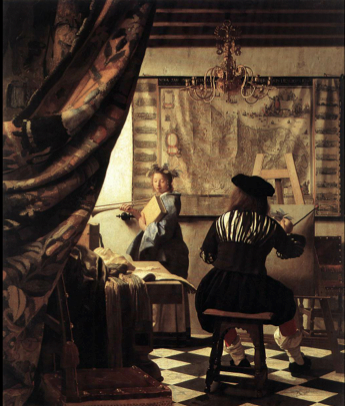
Vermeer, The Art of Painting, ca. 1666, oil on canvas
- Was left in Vermeer’s studio when he died
- His wife tried holding onto the painting but the creditors took it
- Functioned as a presentation piece to show clients etc.
- What does he think painting is?
- A man in outdated 17th century clothes
- The man is painting the woman
- Cleo muse of history also associated with Fame; holding a trumpet, History is the record that fame relies on
- The man would not started painting the woman as shown, Dutch people work from the background to the foreground
- Large plaster mask near the woman—showing you must imitate your masters in order to become a good painter
- At the top of large tapestry are dangling threads, which shows that the viewer would see the back of the tapestry if it were down
- Map of Dutch Republic in the background
- Orthogonals lead the eye to the girl
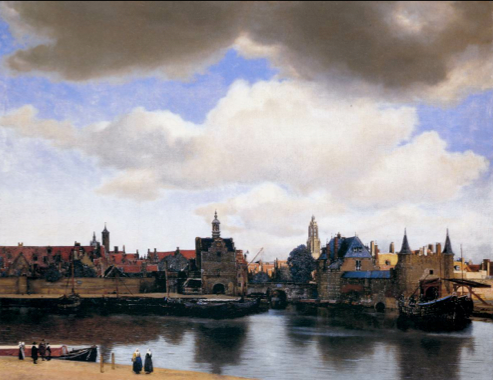
- Vermeer, View of Delft, ca. 1660, oil on canvas
- In a 1660 sale of Vermeer’s work
- Hometown of Vermeer
- Delft went through many hard times in the 16th century there was a major fire that destroyed the city and throughout the 16th and 17th century
- Reformed church met at the church in the background
- 2 major gateways from the bay to the city
- Shadows are dramatized to make vertical lines to balance the horizontals
- Dark trees in the background were originally green with blue and yellow; the yellow faded away
- Highlights of white imposto dots throughout the painting to give a glistening atmosphere; however the boat is supposed to be shaded and not have highlights
- Mixes sand with his first coat to get a rougher texture
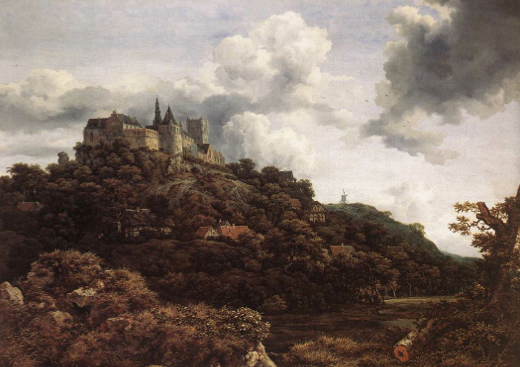
- Jacob Isaackzon van Ruisdael, Bentheim Castle, 1653, oil on canvas
- Based off a drawing of the scene
- Christ—the fortress, the savior
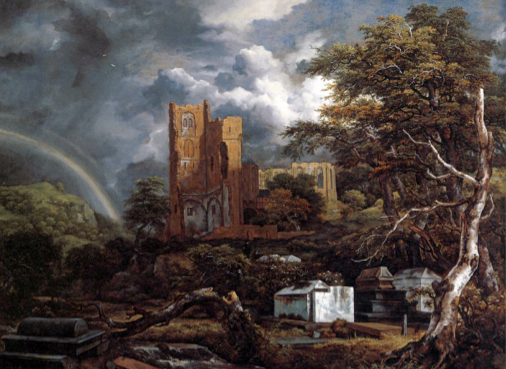
- Jacob Isaackzon van Ruisdael, The Jewish Cemetery, c. 1655, oil on canvas
- Blasted dead tree showing the passing of time and death
- Momento mori- reminder of death
- 80 years war destruction in the background
- One should watch out and think about your salvation
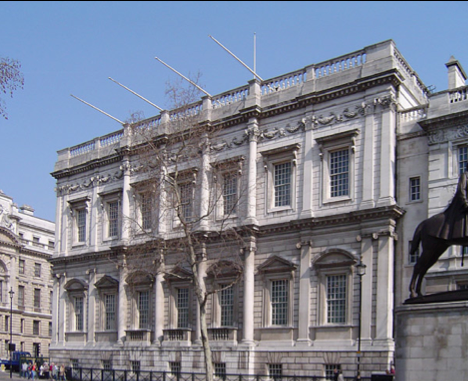
- Inigo Jones, The Banqueting House, Whitehall, London, 1619
- Jones’ second commission
- Supposed to resemble two perfect cubes
- Built on a platform with 2 stories
- Decorum- able to read the interior from the exterior
- Putting the frieze on top of the columns as opposed to above them
- 7 bays
- Plaster columns and engaged columns
- Bottom windows have a pediment and arch pattern
- Doubles the plasters at the end of the house that frame the structure
- The ceiling paintings were painted by Rubens as early as 1629
- Having ceiling paintings were very new
- Ionic capitals on the first level
- Corinthian capitals on the second level
- Temple of Solomon as described in the book of Ezekiel calls for two perfect cubes
- Style was very geometric
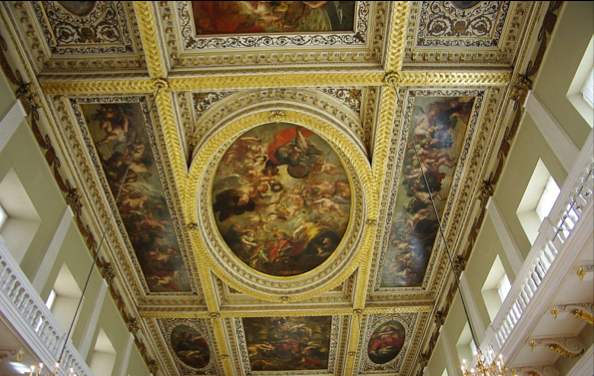
- Rubens, The Apotheosis of James I, 1630-1634, Banqueting House, Whitehall, London
- James I- son of Mary Queen of Scots
- Successor of Elizabeth I
- Scotland and England become united during his rule
- Was taken from his Catholic mother’s faith and was raised Protestant
- Commemorating his rule and his death
- He is in red
- Being crowned with 3 crowns, triumph and civic virtue (classical crowns), and the crown of the two realms
- Uniting Scotland and England
- He is being carried up to heaven
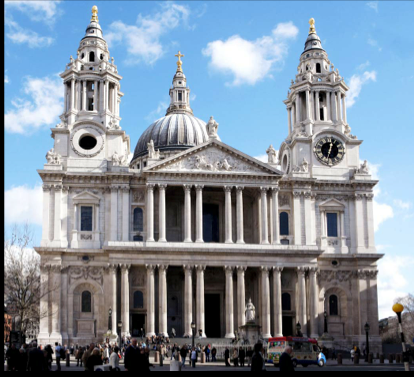
- Christoppher Wren, St. Paul’s Cathedral, London, c. 1675
- Son of a preacher
Anglican during civil war
War very well educated and became a professor in London teaching astronomy with interest in math and science
Eventually becomes interested in architecture
1666- The Great Fire—burnt down a large part of London along River Thames
- Rebuilt after the fire
- Classicized entrance way
- Large dome at the top
- The drum (base of the dome) has statues around it
- One side of the church is based off of Santa Maria della Pace, Rome
- Double Corinthian columns
- Bell towers on either side
- Frieze incorporated with the Corinthian capitals

-
Midterm86
-
Roman Art Final75
-
Baroque midterm20
-
18th century midterm31
-
18th Century Final37
-
Baroque Final20
-
Renaissance Midterm56
-
Ren Final48
-
Medieval 125
-
Medieval 220
-
Medieval 325
-
Medieval 414
-
African Midterm50
-
Latin American42
-
Contemporary36
-
African final67
-
Contemporary Art Final40
-
latin america final37



