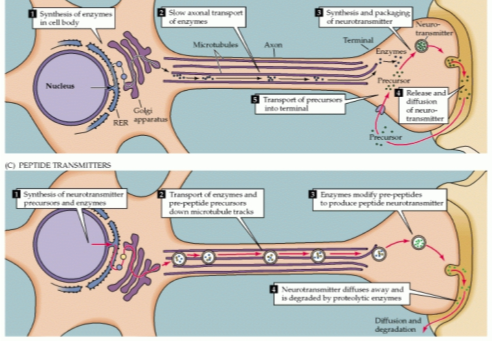
What are the differences between a small-molecule transmitter and a peptide transmitter?
- Both transport mechanisms require ATP
- Small nucleotide neurotransmitters generally mediate fast synaptic signalling.
- Neuropeptides (composed of 3-36 amino acids) mediate slower synaptic signalling, modify ongoing synaptic function.
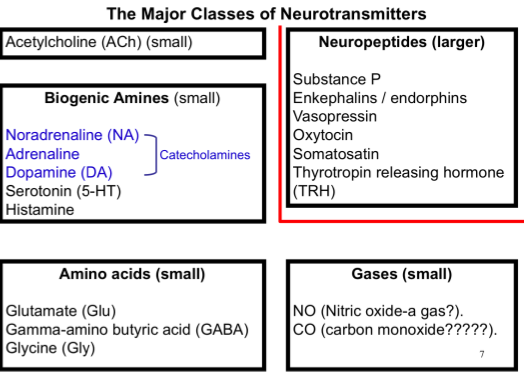
What are the major classes of neurotransmitters.
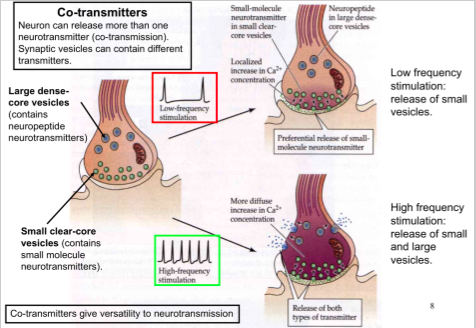
What are co-transmitters and what is the signiciance of high-frequency synaptic stimulation?
Noradrenaline/Acetylcholine - released at higher frequences.
Why are there so many different transmitters & receptors?
Allows differential release from lots of different chemical inputs.
This can qualitatively alter the post-synaptic signals.
Release of co-transmitters can modulate the post-synaptic responses.
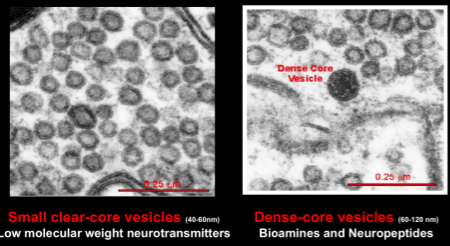
What is the difference between small clear-core vesicles and dense-core vesicles?
Small clear core vesicles - low molecular weight neurotransmitter.
Dense-core vesicles - bioamines and neuropeptides.
What are the criteria for a chemical messenger to be a neurotransmitter?
- Chemical must be synthesised or present in neuron.
- When released, chemical must produce response in target cell.
- Same response must be obtained when chemical is experimentally placed on target.
- There must be a mechanism for removal after chemica’s work is done.
- Specific receptors for the subtance must be present on the postsynaptic cell.
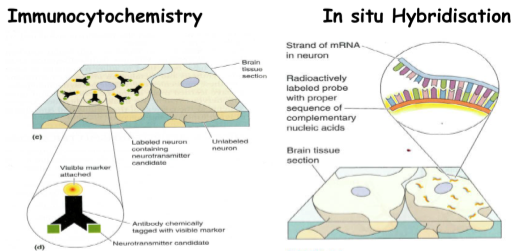
What are neurochemistry techniques for identifying neurotransmitters?
What does ‘…ergic’ neurotransmitter mean?
Although neurons can contain more than one type of neurotransmitter, neurons are still classified according to the main neurotransmitter present using the ‘ergic’ suffix e.g.
- Cholinergic neurons (contain acetylcholine).
- Glutamatergic neurons (contain glutamate).
- GABAergic neurons (contain GABA).
- Catecholaminergic neurons (contain noradrenaline/adrenaline/dopamine)
- Serotonergic neurons (contain serotonin/5-HT)
- Peptidergic neurons (contain peptides).
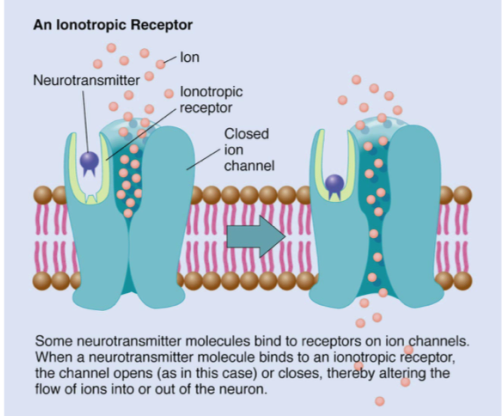
What is an Ionotropic receptor?
The receptor itself incorporates an ion channel, the gating of which is allosterically regulated by agonist binding to the receptor.
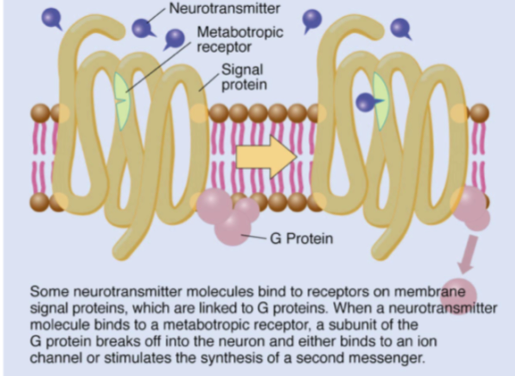
What are metabotropic receptors?
The receptor signals via intracellular intermediates to effect a change in ion channel gating, cell excitability, metabolic state or gene expression.
What is the significance of Otto Loewi’s 1921 experiment?
He had two hearts in two organ baths
In the first organ bath he had a heart with vagus nerve intact
He allowed the heart to beat in physiological solution
When he stimulated the vagus nerve, it slowed the heart-beat down
And eventually that wore off and the heart rate came back to normal.
BUT
He transferred the perfusae to the second heart solution
The second heart also slowed down
And the heart rate decreased again
So obviously vagus nerve releases some materials. This was later identified as acetylcholine. He won the nobel prize in 1936.
What role does acetylcholine play in the PNS and the CNS?
- Acetylcholine is a neurotransmitter at the neuromuscular junction.
- Part of the autonomic nervous system.
In the CNS, acetylcholine plays a role in:
- Learning and memory
- Sleep
- Arousal
- Aggression
- Biorhythms
- Thermoregulation
- Sexual behaviour.
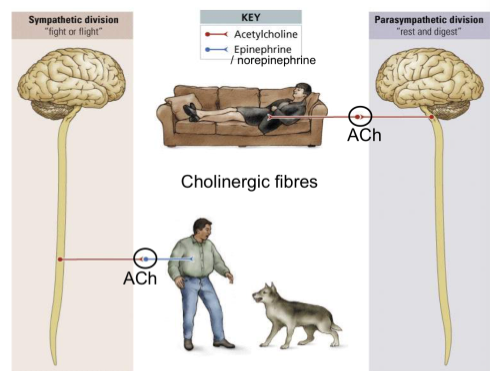
What results in loss of cholinergic (acetylcholine) neurons in the basal forebrain?
- Death of cholinergic (acetylcholine) neurons of the basal forebrain, which project to the cortex and hippocampus, leads to Alzheiemr’s disease.
- Cholinergic neurons are also involved in keeping the body alert and awake.
- Acetylcholine is a critical neurotransmitter used in forming memories and in learning.
- Acetylcholine is found in neurons of the hippocampus and cerebral cortex, regions devastated by Alzheimer’s.
- Generally, as we get older, we produce less cholinergic neurotransmitters.
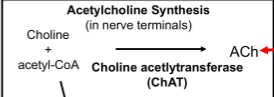
How is acetylcholine synthesised?
How is acetylcholine broken down?
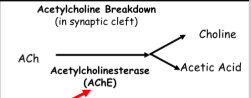
What drugs prevent the breakdown of Acetylcholine?
- Donepezil (Alzheimer’s disease).
- Nesostigmine & Pysiostigmine = used to treat myasthenia gravis, glaucoma and smooth muscle dysfunction.
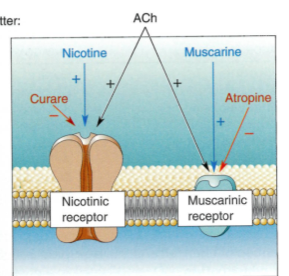
What are the cholinergic receptor subtypes?
- Named after alkaloids used in their identification: Muscarine & Nicotine.
- Nicotinic receptors found in neuromuscular junctions (NMJs), autonomic ganglia, adrenal medulla & CNS.
- Two types:
- Nicotinic Nn postganglionic neurons & some presynaptic cholinergic terminals.
- Nicotinic Nm skeletal motor endplates
- Muscarinic receptors found in peripheral tissues, ANS & CNS.
5 subtypes:
M1, M2, M3 M4 & M5
M1 & M3 , M5 couples to G-protein/PLC
M2 & M4 coupled to Gi / open K+ ion channels.
- compounds such as Curare & Atropine can block nicotinic and muscarinic receptors.
- Stops acetylcholine from binding to it.
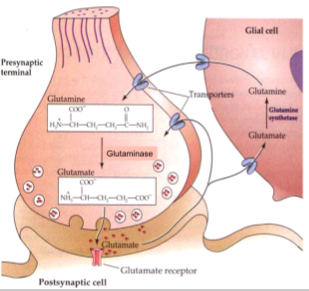
How is glutamate synthesised?
- Glutamate is one of the most important neurotransmitters for normal brain function.
- Glutamate is an amino acid.
- Nearly all excitatory neurons in the CNS are glutamatergic.
- Half of the brain synapses use glutamate.
- Many brain pathologies are due to too much glutamate which at high extracellular concentrations will kill neurons.
How glutamate is made:
Glutamate which is released into the synaptic cleft is removed by glutamate transporters (reuptake) which are located on the presynaptic terminal and on glial cells.
- Glutamine is converted back to glutamate via glutaminase.
- It is thought that a lack of glutamate transporters or dysfunction can lead to motor neuron disease, epilepsy, Alzheimer’s.
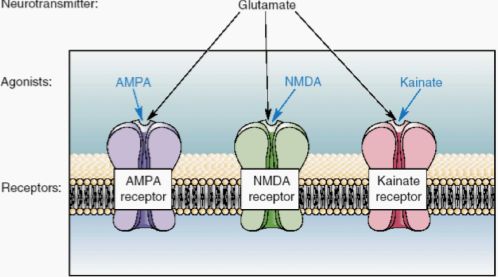
What are the three main subtypes of glutamate receptors?
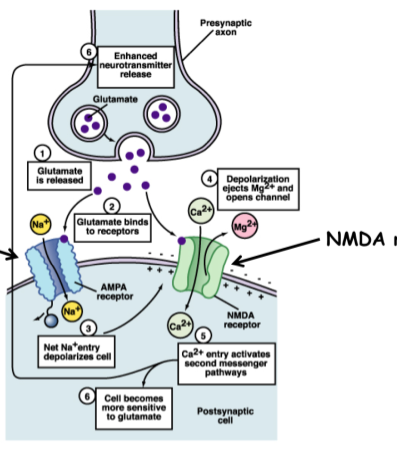
How does glutamate act upon AMPA and NMDA receptors?
Remember: Too much calcium can kill the cell.
What is GABA?
- GABA is an inhibitory neurotransmitter.
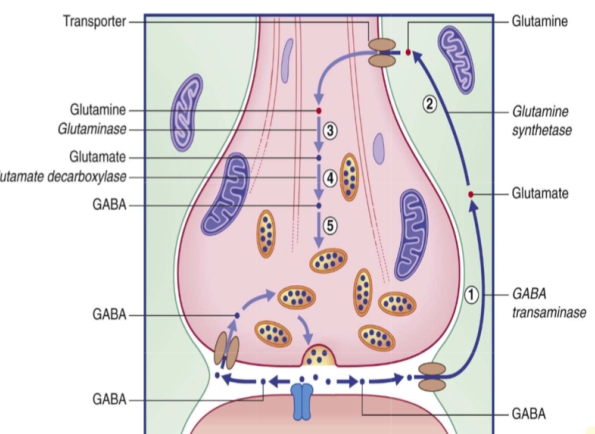
- Glutamate is converted by glutamaic-acid-decarboxylase into GABA. Therefore, a precursor of GABA is glutamate.
- Can be Glycine as well.
- GABAergic neurons are widely distributed around the brain.
- The precursor for GABA is glutamate. Glutamic acid decarboxylase (GAD) converts glutamate to GABA.
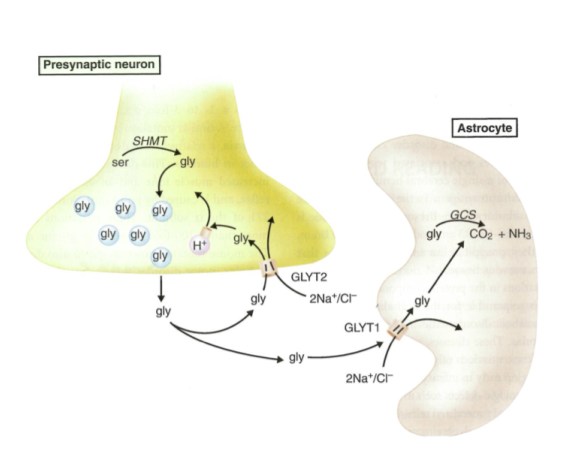
- Transporters located on the presynaptic terminal and on glial cells uptake GABA and glycine to remove it from the synaptic cleft.
How does valium work?
Valium (diazepam) interacts with the GABA receptor to increase the influx of negative charged chloride ions (CI-) into the neuron.
This hyperpolarises the neuron i.e. causes an inhibition.
Diazepam is an anxiolytic drug.
What happens in epilepsy with respect to GABA?
- In epilepsy there is uncontrolled excitation in the brain.
- Imbalance between excitatory and inhibitory neurotransmitters.
- Can use diazepam to treat epilepsy. This enhances the inhibition caused by GABA.
- Also sodium valporate which increases GABA content of the brain.
What are the glycinergic pathways?
- Serine is converted to glycine.
- Most of the glycine synthesised in CNS is derived from glucose via serine.
- Ionotropic receptor, ligand-gated ion channel. It is an inhibitory transmitter.
- Glycine receptors are linked to Cl- ion channels.
- Major spinal cord inhibitory transmitter Glycine acts mainly in the brain stem and spinal cord; associated with brain stem nuclei involved in general motor and somatosensory organs.
- Inherited defecits in glycine receptor channels implied in Hyperekplexia.
- Receptors blocked by strychnine, a potent convulsant. Pharmacology of glycine receptors still remains limited.