pharmacokinetics
the actions the body takes on a drug
can be defined in terms of volumes and clearances
pharmacodynamics (PD)
the action a drug has on the body
volume of distribution
that volume in which a substance/marker/drug appears to be homogeneously distributed (dissolved)
an apparent volume of distribution
volume of distribution = amount of substance/concentration
more accurately described as plasma equivalent apparent volume of distribution
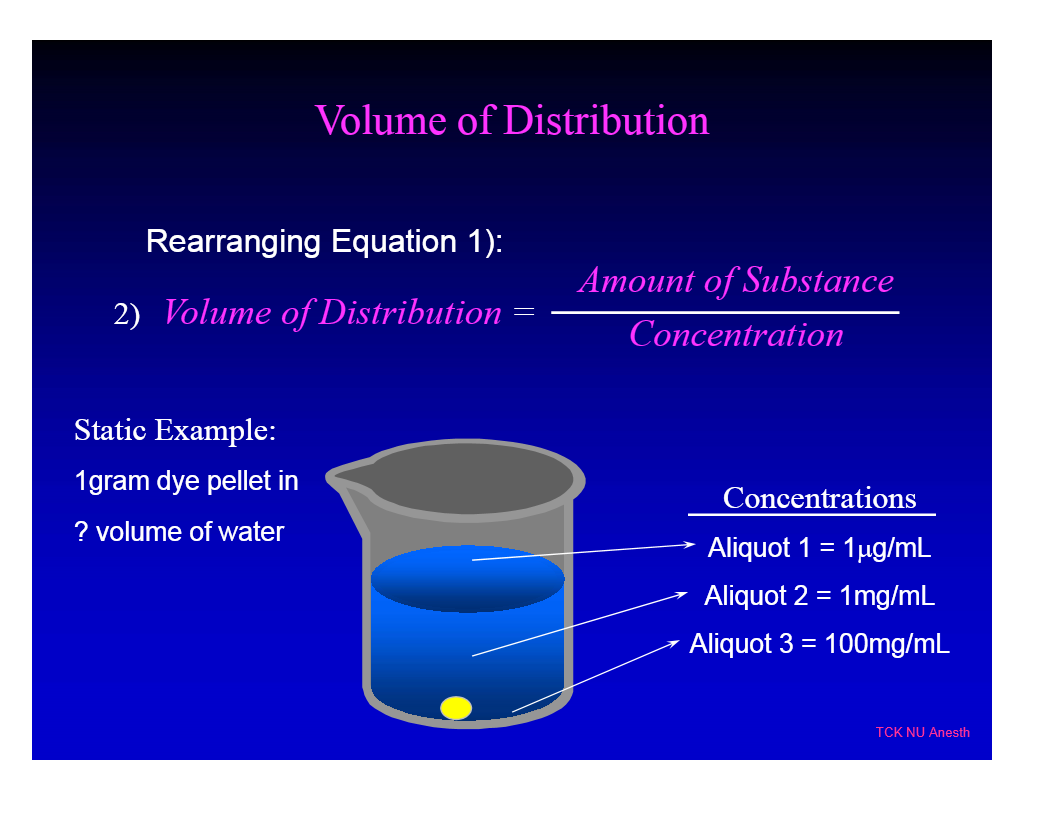
the hydraulic model
can be used to compare to drug distribution int he body
- water soluble substances travers aqueous channels between compartments
aqueous channels vary in size
Describe the body’s water distribution.
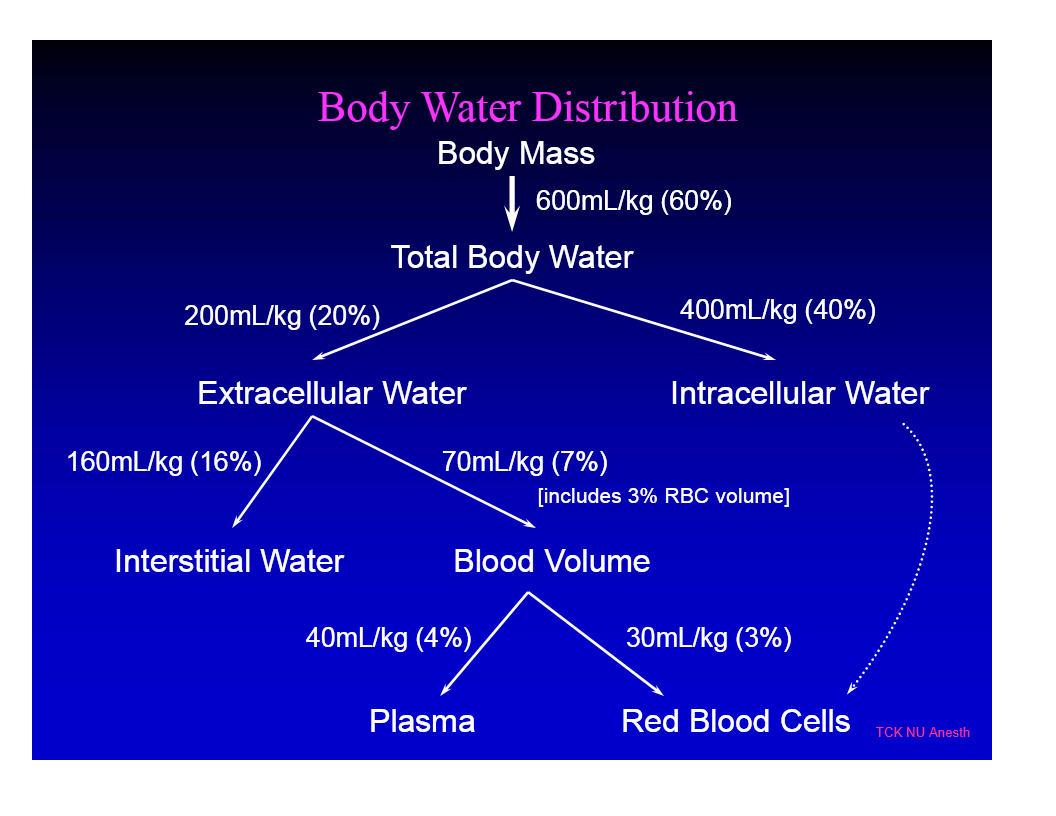
first law of pharmacokinetics
amount of drug in body = concentration * volume of distribution
clearance
a term used to describe the time-dependent movement of drug
includes intercompartmental clearance and elimination clearance
rate of elimination = clearance * concentration
intercompartmental clearance
describes the movement of drug between compartments
elimination clearance
describes the metabolic alteration or removal of drug from the blood/body
rate constant (k) = clearance (liters/min)/volume(liters)
time constant (minutes) = volume (liters)/clearance(liters/min)
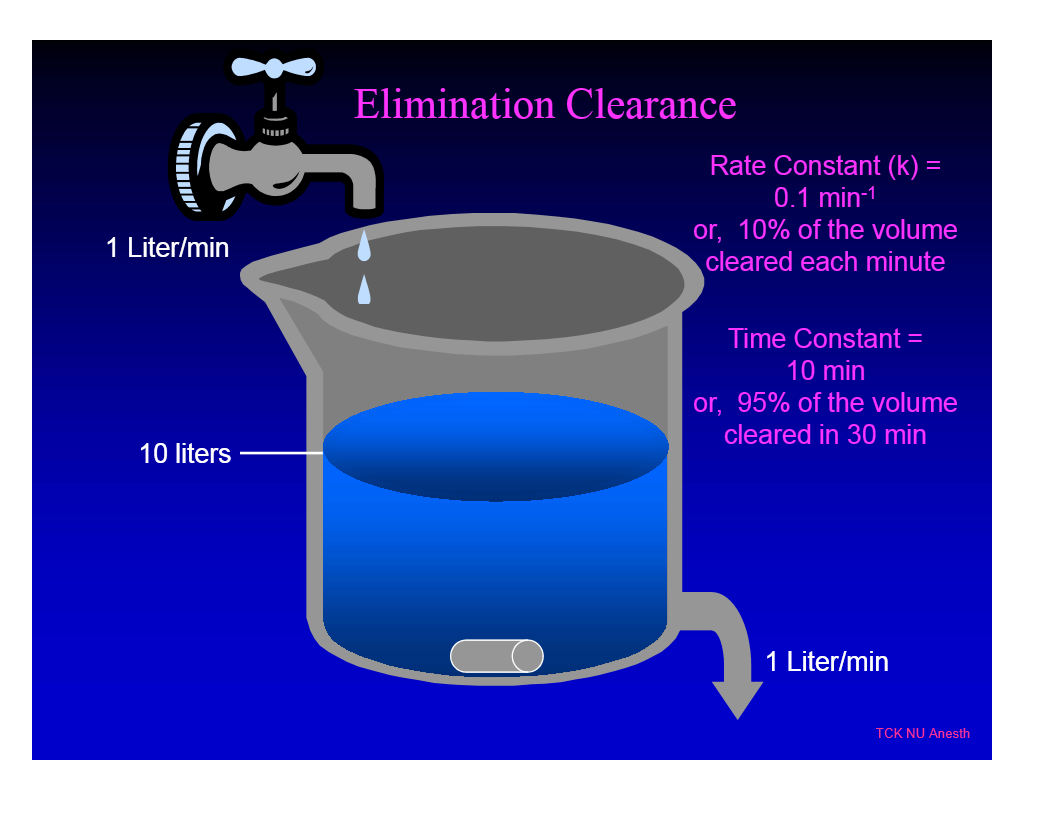
elimination clearance rate constant
the fraction or percentage of the volume that is cleared per unit time (minutes)
T(1/2) = 0.693/k
elimination clearance time constant
the time it takes for about 63% of the volume to be cleared
95% of a substance is cleared in three time constants
extraction ration
extraction ratio = clearance/flow
renal clearance
that part of the volume of distribution from which a substance is irreversibly removed
creatinine clearance = (U x V)/P
U = concentration of creatinine in the urine
V = time measured collection of urine (urine production rate)
P = concentration of creatinine in the plasma
second law of pharmacokinetics
target (steady state) concentration = infusion rate/clearance
clearance vs. elimination rate
clearance is a physiologic process assumed not to change over the course of observation
elimination rate is constantly changing due to the concentration of the parent drug constantly decreasing as a result of drug being continuously eliminiated from the system

-
Intro and Body Wall26
-
Embryology I and II67
-
Development and Pattern Formation40
-
Somites and the Typical Body Segment22
-
Organization of the Somatic Nervous System39
-
Organization of the Autonomic Nervous System27
-
Coelomic Body Cavities14
-
The Lymphatic System27
-
Lymphatic System Histology43
-
Introduction to Imaging22
-
Congenital Anomalies19
-
Developmental Toxicology15
-
Muscle Histology63
-
Histology of the Nervous System41
-
Membrane Potentials I and II31
-
Ion Channels and Transporters42
-
Receptor Theory and Dose-Response Relationships80
-
Drug Transport37
-
Drug Absorption41
-
Drug Metabolism55
-
Drug Excretion21
-
Local Anesthetics45
-
Other15
-
PNP skeletal neuromuscular transmission35
-
Postsynaptic Skeletal Neuromuscular Transmission31
-
ANS Review34
-
Cholinergic Agents70
-
Basic Pharmacokinetic Principles15
-
Adrenergic Transmission17
-
Pharmacokinetics II19
-
Pharmacokinetics III8
-
Drug List and Metabolism109
-
Adrenergic Agents58



