Basic Probability
Basic Six Sigma Probability terms like independence, mutually exclusive, compound events, and more are necessary foundations for statistical analysis.
Probability is the ratio of number of favorable outcomes to the total number of possible outcomes. Probabilities are usually shown in fractions or decimals. The probability ALWAYS lies between 0 and 1. An event is one or more outcomes in an experiment. The probability of an event E indicates how likely that event is to occur.
Probability of an event (E) = number of favorable outcomes/number of possible outcomes
- Additive law
- Multiplication law
- Compound Event

Additive Law
- Aka addition rule
- The probability of the union of two events. There are two scenarios in the additive law:
- When two events are not mutually exclusive:
- When two events A and B are not mutually exclusive, the probability of A and B will occur is the sum of the two events probabilities and subtract both probability of A and B will occur (intersection), the formula can summarize the same:
- P (A U B) = P(A) + P(B) – P(A Ո B)
- When two events A and B are not mutually exclusive, the probability of A and B will occur is the sum of the two events probabilities and subtract both probability of A and B will occur (intersection), the formula can summarize the same:
- When two events are mutually exclusive:
- When two events A and B are mutually exclusive, the probability of A and B will occur is the sum of the two events’ probabilities, the formula can summarize same:
- P (A U B) = P(A) + P(B)
- When two events A and B are mutually exclusive, the probability of A and B will occur is the sum of the two events’ probabilities, the formula can summarize same:
- When two events are not mutually exclusive:

Mutually Exclusive
Statistical term describing two or more events that cannot happen simultaneously.
If they are** mutually exclusive they **cannot happen simultaneously
If they are not mutually exclusive, they can happen simultaneously

When Would you Use the Additive Law in a Six Sigma Project?
Additive law is essential in probability. Additive law tells us with a way to calculate the probability an event “A” or the probability of “B.” The use of the additive law is dependent upon whether event A and event B are mutually exclusive or not.
Example Attached

Multiplication Law
- A method to find the probability of events occurring at the same time. There are two scenarios in the multiplication law:
- When events are independent
- When two independent events A and B are occurring from the same sample space, then the probability of two events occurring at the same is equal to the probability of A occurs times the probability of B occurs
- P (A Ո B) = P(A) * P(B)
- When two independent events A and B are occurring from the same sample space, then the probability of two events occurring at the same is equal to the probability of A occurs times the probability of B occurs
- When events are independent
- When events are dependent
- When two dependent events A and B are occurring from the same sample space, then the probability of two events occurring at the same is equal to the probability of A occurs times the probability of B occurs, given that A has already occurred. This is conditional probability
- P (A Ո B) = P(A) * P(B|A)
- When two dependent events A and B are occurring from the same sample space, then the probability of two events occurring at the same is equal to the probability of A occurs times the probability of B occurs, given that A has already occurred. This is conditional probability
Conditional Probability: If events A and B are dependent, the probability of A influences the probability of B
All Multiplication Law:
P(A&B) = P(A)*P(B)
P(A&B)= P(A)*P(B|A)
P(A& B)= P(B)*P(A)
P(A&B)= P(B)*P(A|B)

Compound Event
- It is an event that has more than one possible outcome of an experiment. In other words, compound events are formed by a composition of two or more events.
- When would you guys compound events?
- Used when the outcome may have different probabilities but they are all equally possible. Events that are chained together in a row.
Example Attached

Independent Event
- Events can be independent events when the outcome of one event does not influence another event’s outcome.
- When would you use an independent event in a six sigma project?
- Independent events are used in six sigma projects where one event does not connect with another event’s chance of occurring. Like car mileage does not depend on the color of the car.
Example Attached
P(A|B)=P(A)

Hypothesis Testing
- Key procedure in inferential statistics used to make statistical decisions using experimental data.
- It is basically an assumption that we make about the population parameter.
- When using hypothesis testing we create:
- null hypothesis (H0): the assumption that the experimental results are due to chance alone, nothing (from 6M) influenced out results.
- alternative hypotheses (Ha): we expected to find a particular outcome.
Determine the Process Capability
- Process Capability Analysis
- Tells us how well a process meets a set of specification limits based on a sample of data taken from a process.
- The process capability study helps to establish the process baseline and measure the future state performance.
- Revisit the operational definitions and specify what are defects and which are opportunities.
- Calculate the baseline process sigma
- The value in making a sigma calculation is that it abstracts your level of quality enough so that you can compare levels of quality across different fields (and different distributions.) In other words, the sigma value (or even DPMO) is a universal metric, that can help yourself with the industry benchmark/competitors.
- Baseline Sigma for Discrete Data
- Baseline Sigma for Continuous Data
- The value in making a sigma calculation is that it abstracts your level of quality enough so that you can compare levels of quality across different fields (and different distributions.) In other words, the sigma value (or even DPMO) is a universal metric, that can help yourself with the industry benchmark/competitors.
Baseline Sigma for Discrete Data aka Attribute Data
- Calculate the process capability is through the number of defects per opportunity.
- The acceptable number to achieve sex sigma is 3.4 Defects Per Million Opportunities (DPMO)
- DPO= Defects/(Units*Opportunities)
- DPMO=(Defects/Units*Opportunities*Total 1,000,000
- Yield=1-DPO(It is the ability of the process to produce defect free units)
Baseline Sigma for Continuous Data
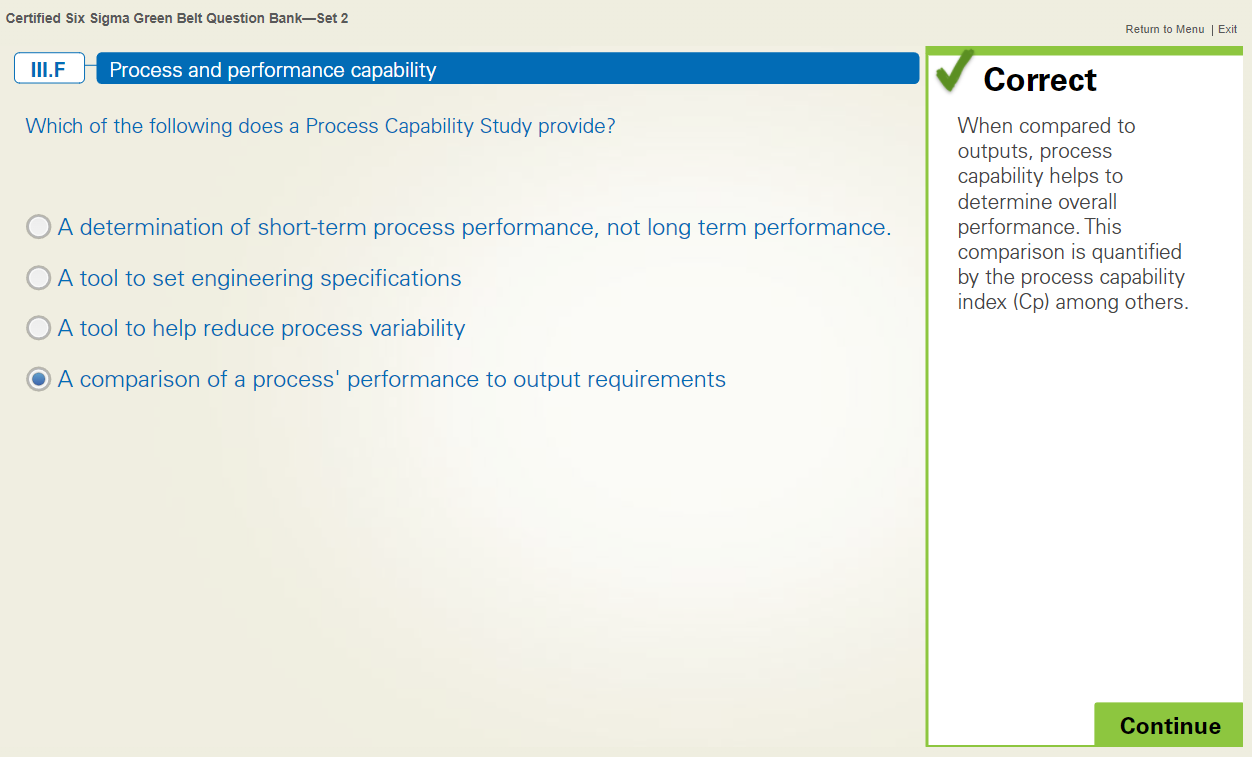
- Process Capability is the determination of the adequacy of the process with respect to the customers needs.
- Process capability compares the output of an in-control process to the specification limits.
- Cp and Cpk are considered short-term potential capability measures for a process.
Cpk
- Cpk is a measure to show how many standard deviations the specification limits are from the center of the process.
- Cplower = (Process Mean - LSL)/(3*Standard Deviation)
- Cpupper = (USL - Process Mean)/(3*Standard Deviation)
- Cpk is the smallest value of the Cpl or Cpu
- Cpk = Min (Cpl, Cpu)
Six Sigma Derives…
- Six Sigma derives from the normal or bell curve in statistics, where each interval indicates one sigma or one standard deviation
- Sigma is a statistical term that refers to the standard deviation of a process about its name
- In normally distributed process, 99.73% of measurement will fall within ±3σ and 9.99932% will fall within ±4.5σ.
Mutually Exclusive Events
- Mutually exclusive events are things that cannot both be true.
- They cannot occur at the same time.
When would we use mutually exclusivity in a six sigma project?
-Mutually exclusive events used in six sigma projects when one event occurs it prevents the second from happening
Coin Heads/Tails and dice example attached

Complementary Rule of Probability
- The comment of A is represented by A’. The complement (A’) includes all outcomes in the sample space that are not the outcomes of event A.
- In other words, it consists of all outcomes in which event A does not occur
- An event (A) and its complement (A’) are mutually exclusive, which means either event (A) or its complement (A’) will occur, not both at a time.
- The complement rule is the sum of probability of an event (A), and its complement (A’) is 1.
- P(A) +P(A’)=1
- Example: When tossing a coin, if the event (A) is tails, then the complement (A’) is heads. If you are throwing a die and the event (A) is even {2,4,6} then the complement (A’) is {1,3,5}
- The complement rule is the sum of probability of an event (A), and its complement (A’) is 1.

What are Independent Events?
- Events can be independent events when the outcome of the one event does not influence another event’s outcome.
- In other words, each event is NOT affected by others
- Whereas the dependent event is the probability of one event occurring that influences another event
Probability Question
John has a deck of cards. He has randomly drawn a card and placed on table without showing you what is it. Now he is going to draw a second card. What is the probability that is is going to be one of the hearts?

What is the probability of selecting a Queen of any suit or any Heart in a standard 52 card deck?

See Attached Example


Cpk Example

Example Including Runout Tolerance


-
Measure Phase Overview28
-
Basic Probability Concepts28
-
Central Limit Theorem13
-
Standard Distribution12
-
Collecting Data 139
-
Collecting Data & Baseline Statistics15
-
Descriptive and Analytical Statistics9
-
Graphical Methods16
-
Probability Distributions: Chi Square Distribution19
-
Probability Distributions: Binomial Distribution18
-
Probability Distributions: Poisson Distribution18
-
Measure Sample Questions74
-
Probability Distributions: Exponential Distribution6
-
Probability Distributions: Normal Distribution9
-
Measurement Systems Analysis14
-
Process Capability and Performance Overview22
-
Process Capability and Performance: Z Score & Process Capability12
-
Process Capability and Performance: Process Performance (Pp, Ppk)13
-
Process Capability and Performance: Process Capability (Cp & Cpk)1



