Parkinsons disease pathophysiology:
Name A [1]
Which protein is is A enriched with? [1]

Lewys body: enriched with protein α-synuclein
What is the structure? [1]
What has been stained brown using immunohistochemistry? [1]

A Lewy body (stained brown) in a brain cell of the substantia nigra in Parkinson’s disease. The brown colour is positive immunohistochemistry staining for alpha-synuclein.
What imaging is used in this picture? [1]

dopamine transporter (DaT) - DaT scan
Which gene is likely to code for alpha-synuclein in familial PD?
PARK2
PARK7
GBA
SNCA
LRRK2
Which gene is likely to code for alpha-synuclein in familial PD?
PARK2
PARK7
GBA
SNCA
LRRK2
Metabolism of dopamine:
Label A-C [3]

A: Dopamine
B: DOPAC
C: Homovanillic acid
Biosynthesis of dopamine
Label A-C

A: L-tyrosine
B: L-DOPA
C: Dopamine
Which part of the brain allows you to overide habitual responses? [1]
Prefrontal cortex

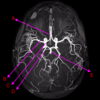
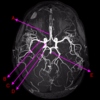
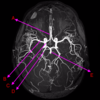
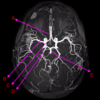
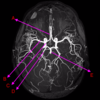
Which arteries do the arrows point to? [1]

Lenticulostiate arteries
Label 5, 6 & 7

1 - superior temporal gyrus;
2 - inferior frontal gyrus; 3 - insular cortex;
4 - temporal stem;
5 - internal capsule;
6 - thalamus;
7 - lentiform nucleus (the internal and external globus pallidus and the putamen)
8 - frontal horn;
9 - superior circular sulcus;
10 - inferior circular sulcus.
Label the arteries that supply A-C [3]

A = anterior cerebral artery (upper
and medial parts of the cortex)
(orange)
B = middle cerebral artery (lateral
areas of the frontal, parietal, and
temporal lobes) (white)
C = posterior cerebral artery (occipital
lobe and inferior parts of the
temporal lobe) (blue)
The corticobulbar tracts provide innervation to the musculature of which region of the body?
Head and neck
Upper limbs
Lower limbs
Neck
The corticobulbar tracts provide innervation to the musculature of which region of the body?
Head and neck
Upper limbs
Lower limbs
Neck
The medial reticulospinal tract is an extrapyramidal tract, responsible for involuntary and automatic control of all musculature. Which region of the brainstem does it originates from?
Cerebellum
Pons
Medulla
Midbrain
The medial reticulospinal tract is an extrapyramidal tract, responsible for involuntary and automatic control of all musculature. Which region of the brainstem does it originates from?
Cerebellum
Pons
Medulla
Midbrain
A lesion of the CST cranial to the decussation of the pyramids will result in deficits on the [] side.
A lesion of the CST caudal to the decussation of the pyramids will result in deficits on the [] side.
A lesion of the CST cranial to the decussation of the pyramids will result in deficits on the contralateral side.
A lesion of the CST caudal to the decussation of the pyramids will result in deficits on the ipsilateral side.
What type of posturing is this person displaying? [1]
Where in the body would a legion occur to form this? [1]

Decorticate rigidity
Damage to the corticospinal tract above or in midbrain
What type of posturing is this person displaying? [1]

Decorticate
COR - arms in middle of body
What type of posturing is this person displaying? [1]
Where in the body would a legion occur to form this? [1]
Decerebrate
Damage to the corticospinal tract at the level of upper brainstem, including corticospinal and rubrospinal tracts
Look at all the E’s in the word. remember the word EXTENDED.

Which pathology has the highests negative impacts of all on patients? [1]
Aphasia
Which pathology has the highests negative impacts of all on patients? [1]
Aphasia
Which of the following mechanism of TBI is depicted in the CT?
1- Skull fracture
2- Contusion (bruise)
3- hematomas (blood clots)
4- lacerations (tear)
5- Diffuse axonal injury (nerve damage)

1- Skull fracture
2- Contusion (bruise)
3- hematomas (blood clots)
4- lacerations (tear)
5- Diffuse axonal injury (nerve damage)
Which of the following types of hemorrhage is NOT common in closed head injury?
basal ganglia hemorrhage
extradural hemorrhage
intraventricular hemorrhage
subarachnoid hemorrhage
superficial parenchymal hemorrhage
subdural haemorrahge
Which of the following types of hemorrhage is NOT common in closed head injury?
basal ganglia hemorrhage
extradural hemorrhage
intraventricular hemorrhage
subarachnoid hemorrhage
superficial parenchymal hemorrhage
subdural haemorrahge
What is the name for this basal skull fracture sign? [1]

Hemotympanum
What is the name for this sign of basal skull fracture? [1]

Periorbital ecchymosis
What is the name for this sign of basal skull fracture? [1]

Post auricular ecchymosis
What type of brain herniations are A & B? [2]

A: Downward cerebellar (Tonsillar)
B: Upward cerebellar (transtentorial)







-
Rogo Qs (Year 1)16
-
Year 2 Histology Qs377
-
BB2 Qs761
-
BB2 Drugs243
-
PJE Spotter Qs (Copied to BB2Qs)128
-
Cancer Qs164
-
Rogo Qs (Y1 & 2) & (Copied to Cancer Qs)33
-
CR2 Questions630
-
CR2 Drugs154
-
ECG Qs (stopped at heart block: still to - STEMI and BBB)69
-
HD2 Drugs95
-
HD2 Qs499
-
PJE Spotter Qs & EoW Qs (also copied to qs)190
-
LOCO2 Qs395



